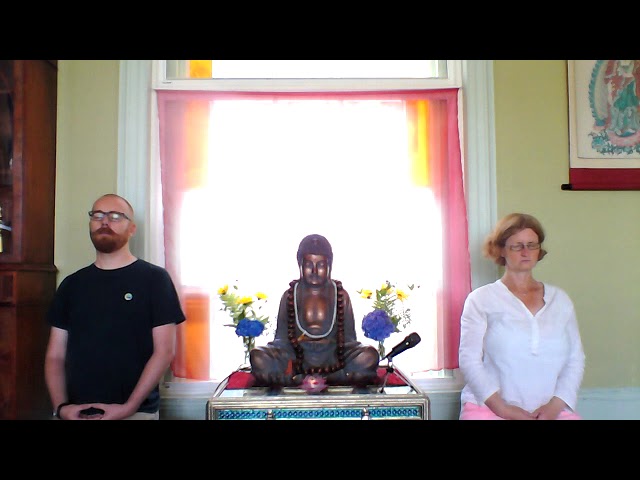
Satya Robyn leads a Buddhist practice session with the Bright Earth community. The group does guided meditation, chanting, and prostrations, then holds a formal refuge ceremony welcoming three new members into the sangha. Satya reframes everyday chores like cleaning and dog care as spiritual practice.
Chapters
Welcome to our Saturday morning practice, everybody. So we are joined on Zoom by Janice and Angesh, and in the shrine room there's 10 people this morning. And it was a smaller group of just the people in the house, and most people on Zoom— we'd let people know who was in the room so they had a sense of being here.
There's a limit.
Yeah. Anyway, welcome and Satya Robyn practice this morning.
Thank you, Caspar. Good morning, everybody, and welcome if you haven't been here before. This morning, at the end of our practice session, we will be having a refuge ceremony, which will be the first refuge ceremony of Bright Earth. So it feels very special. So I could talk about two things this morning. I could talk about refuge, or I could talk about shit. See, what word shall I use? Poo, shit. Which would you like to hear about? Shrefu, says Keima. Maybe I can find a way of intertwining them, let's see. Keima says she's got enough of that at work. So as we welcome people into our garden practice this morning. I was picking up poo from the dogs and noticed that Aiko had a dirty bottom, so I had to whisk her off to the shower as you all started walking around the garden. And it reminded me of the cleaning that I have ahead of me this weekend. There's a room that needs to be cleaned for a new resident and I'm not a very good cleaner, doesn't come naturally to me. I put it off and I don't feel like I'm very good at it. And I was thinking about the weekend ahead of me, which will be taken up with cleaning and painting, and I could really have done with a weekend of leisure. There's a couple of new vegan cafes locally that I would really have liked to have gone and sampled. But the thought that came to me this morning was that what I've got ahead of me is actually a retreat weekend, a cleaning retreat weekend and a painting retreat, and that what I will be doing is taking care of the temple and preparing that space which has been well loved by somebody else for a long time for a new person who will be moving in in a few weeks' time. And when I make that shift in my brain, suddenly it feels like, okay, I'd still rather go to a vegan cafe. Maybe we'll fit that in somewhere as well. But I can imagine just kind of pottering through the work and seeing it as an offering, an offering to the Buddha. I think that before I became Buddhist, I had a hope that becoming Buddhist might, or becoming more spiritual, or doing more spiritual practice, or improving myself in certain ways would mean that I didn't have to deal with things like clearing rooms or washing bottoms, washing dogs' bottoms. And of course, somebody's got to do those things. But what my practice does help me with is reframing those tasks as the Buddha's work. I remember that I read Suzuki Shunryu's biography Crooked Cucumber, which is a beautiful book, and it describes when he was a young man, he went to university in Japan. And he gave himself the task of cleaning the student toilet block, and he would go in every morning early and clean the toilets as his practice, as his offering to the Buddha. There's something almost extra connecting about those kinds of cleaning jobs. I know that at Buddhafield, when they need people to be— what do they call them? Toilet wizards. When they recruit volunteer toilet wizards at Butterfield, they emphasize, you know, the extra merit that you get for doing that job. And that may be one way of looking at it, but another way of looking at it is that it brings you really into contact with the mess of life, with the complexity and the the suffering and the tenderness and all of that, that there's something very— you can touch it, you can feel it. I can't think of the word.
There's a word.
And when we walk around the garden, that's also what we're doing. We're smelling the flowers as we walk past. We're Noticing the sound of the leaves above us, we're feeling the ground underneath our feet. And here we go, here's the link that this is a way of taking refuge in the Buddha, that coming into connection with the garden, with, with Pui Bottoms, with, with the beautiful golden Buddha that we now have in our shrine room, all of these connecting in experiences take us into our relationship with infinite love. And that's what it's all about. That's what refuge is all about, is coming into relationship with infinite love in all sorts of different ways. And I don't know about you, but I need to be reminded of that over and over and over again. Which is why we have so many Buddhas around, because every time you see one, there's that little reminder, oh yeah, connect in, connect in, take refuge. So the refuge ceremony that we'll be performing later is more of a formal declaration as a part of a community. It's a community ritual. And, um, and that is important. And it's also important that we take refuge in all these other little ways as well. Every time we turn up in the shrine room for practice, we're taking refuge and practicing leaning in. Namomi debu. So we will sit in silence for a little while. And in the silence, you might just want to pay attention to your breath going in and out without changing it, and just notice the thoughts and feelings as they arise. Allow them to be there and allow them to take themselves away of their own accord. Don't— try not to hold on to them. And when you notice that you're holding on to them and proliferating and planning and all those other things we do. Just loosen your grip and let them go. And you may sink into a settled place. If you do, just stay there and enjoy it. And if you don't, that's still meditation. Just notice the thoughts as they keep arising, and that is the practice. Namaste. In a minute, we'll do some chanting together and Chanting is another way of taking refuge. As we say the name of Amitābha Buddha, we are coming into connection with her and allowing her power, her acceptance, to soak into us., and this chant is the Tibetan form of Amida Buddha, Amitabha Buddha, which is Amideywa Hri. So the chant goes Om Amideywa Hri, Om Amideywa Hri, Om Amideywa Hri, and the, the ri at the end is, is actually with an h on the beginning, but don't worry about that, ri is fine. Do join in when you pick the tune up. Om Nami Deva Hari.
Om Nami Deva Hari. Om Nami Deva Hari. Om Amidevayi Om Amidevayi Om Amidevayi Omami te waari. Omami te waari. Omami te waari. Om Amidevare. Om Amidevare. Om Amidevare. Om Amidevayi. Om Amidevayi. Om Amidevayi.
So in a minute we will do prostrations. We're skipping the refuges today because we'll do them at the end. And I'll just do the announcement now as well, so when we finish we can— one of the announcements is that after practice you're welcome to join us for a cup of tea if you want to. And a reminder that the donations bowl is on the desk in in the hallway. We also have a listening circle tonight at 6 PM and every Saturday, which started up again last week. You're very welcome to join us for that, where we read a bit of dharma, and then there's a space to share about the— what you've read or whatever's going on. We've got a mindful walk later in the month. I don't know when it is, but it'll be on the website. Something like that, a couple of weeks. Yeah, I think that's everything. So we make prostrations to the Buddha as another way of taking refuge and also showing our respect. And the words that we use are Nam-myoho-renge-kyo. Do pick up the chant as you go. It's quite difficult to learn the chant and the prostrations at the same time, so don't worry too much. And in a minute I'll go and stand in front of the Buddha, and if you can just face the Buddha and find a bit of floor in front of you.
Um.
And if you'd like to bring your— it depends how well you can kneel. We don't want satellites coming in, do we? That would be really bad. Really bad. Just come forward a bit, David. Really get this in a place where you can see everybody, so I'll do that, and you can see Satya Robyn, at least see something of what's going on, and the microphone's reasonably close, so hopefully people are So we are gathered today to witness Kema, David, and Angela taking their free refuges, and it's going to be quite an emotional one because it's the first time as Bright Earth, and it's also the first time using these words. In Buddhism, when we go to refuge, we are leaning into what is reliable in an unreliable world. We entrust ourselves to the Buddha, Shakyamuni Buddha, who set the Dharma wheel turning, Amitabha Buddha, who assures us of our place in the Pure Land, and all others Buddhas and Bodhisattvas throughout space and time. We are inspired by their example, consoled by their loving presence, and nourished by their wisdom. We remember that we are accepted by them just as we are. We entrust ourselves to the Dharma, the teachings of the Buddhas and the teachings of things as they are. We find Dharma in the sutras and in the teachings of those who followed the Buddha. We find Dharma in the world and in all living things. We keep our ears, our eyes, and our hearts open, always going beyond what we think we know. We entrust ourselves to the Sangha, the community of people who follow the Buddhist path. We can include in our community those from other spiritual traditions. We lean into our community to help us to learn about ourselves, to help us keep our focus on our spiritual path, and to support us when times are difficult. We remember that all humans have both Bambu nature and Buddha nature. As Shinran says, once we entrust ourselves to Amitābha, we are grasped, never to be abandoned. Okay, David, Angela, is it your wish to take refuge in the Three Jewels?
It is.
Yeah, it's really good. So I will ask you to repeat some phrases after me, and this is between you and the Buddha. I was going to point up there, but he's changed. He's down here now. So this is also a lovely introduction to the Buddha. For this Buddha, this is the first time we've used this Buddha as a refuge. And after each section, I will ask Gyame to ring a bell, and when he rings the bell, if you bow, and then when the bell stops, then you come back up. So please repeat after me: For refuge I go to the Buddha. For refuge I go to the Dharma. For refuge— for refuge I go to this end. Please bow. A second time— for refuge I go to the Buddha. For refuge I go to the Buddha. A second time— a second time— for refuge I go to the Dhamma. Refuge should have gone to the Dharma. A second time— a second time— for refuge I go to the Sangha. Or refuges? Please back up! And the Buddha wants to make sure you're really sure about this, so always asks for a third time. For refuge, I go to the Buddha. For refuge, I go to the Buddha. A third time. A third time. For refuge, I go to the Dharma. For refuge, I go to the Dharma. A third time. A third time, for refuge I go to the Sangha. For refuge I go to the Sangha.
Please bow.
You have now taken refuge. Welcome to the community of Buddhists around the world. And, um, Kema and David, you re-bagsied your place again. Reaffirmed, that's the word. Namaste. And the tradition pre-coronavirus times was we all hugged each other now, but because I'm not sure who's in tugging and who's not, maybe if everyone would like to bow individually to each of our three refugees, and then we will go and have a cup of tea. Namaste. I'm gonna hug you though, whether you like it or not. Fantastic!
So, I've got to stop doing stuff like this.









