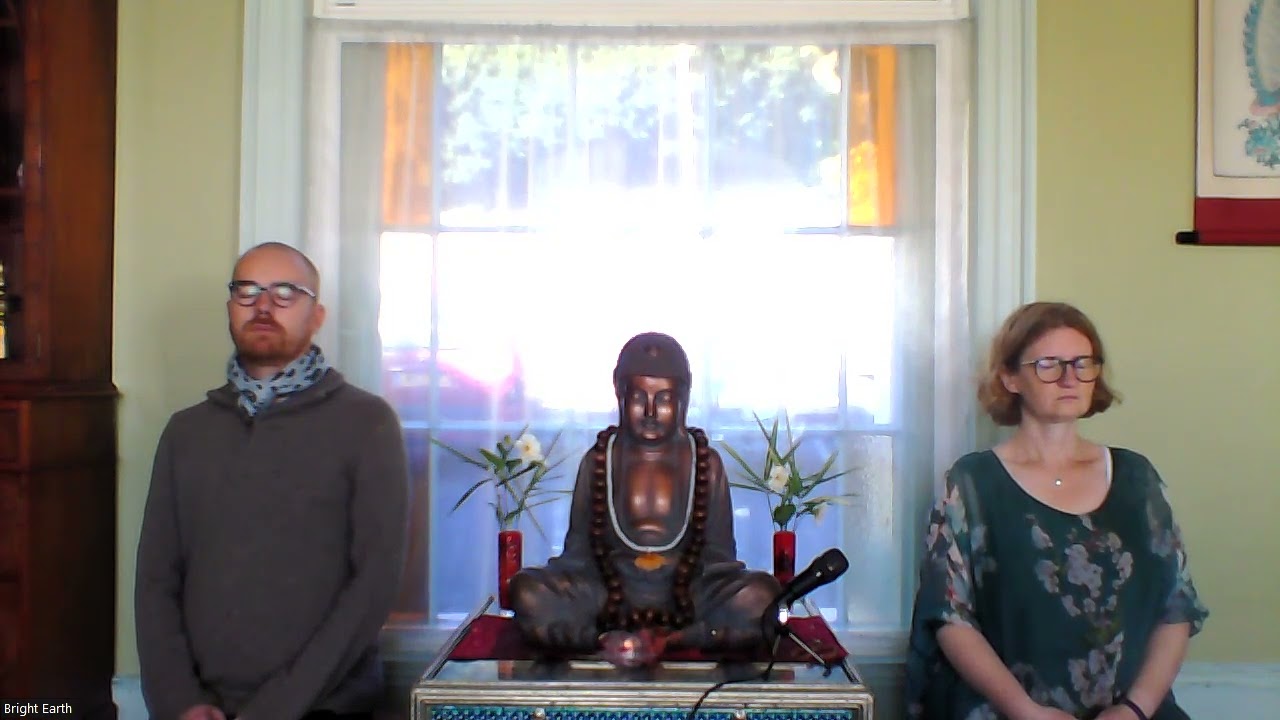
This content was created by Satya Robyn. This content was uploaded by Satya Robyn. This is a YouTube video titled "Practice - Satya's birthday & Mary Oliver's poem" (created 2022-10-09). It records an English-language Buddhist shrine-room birthday practice led by Satya Robyn with at least one named participant, Caspar, joining by Zoom. Caspar reads Mary Oliver's poem "Where Does the Temple Begin?" and Satya offers a short Dharma reflection, personal remarks about her parents' health, and leads communal practice including a Medicine Buddha chant, refuge vows, dedications, and a closing verse. The session is intimate and ritual-focused (poem reading, chanting, guided contemplation) and invites participants to include personal and collective healing.
Chapters
Good morning everybody, welcome to my special birthday practice. Thank you. Just in case anyone didn't know yet. And at the moment we're joined on Zoom by some invisible devas and dragons. That's all so far. Lovely to see everyone in the shrine room. And because it's my birthday, rather than the Dharma glimpse, I thought we would have a Dharma glimpse this morning by Mary Oliver, uh, one of my favorite poems, which Casper will kindly read for me. Over to you.
Where does the temple begin? Where does it end? By Mary Oliver. There are things you can't reach, but you can reach out to them, and all day long. The wind, the bird flying away, the idea of God. And it can keep you busy as anything else, and happier. The snake slides away. The fish jumps like a little lily out of the water and back in. The goldfinches sing from the unreachable top of the tree. I look morning to night. I am never done with looking. Looking, I mean, not just standing around, but standing around as though with your arms open and thinking maybe something will come, some shining coil of wind or a few leaves from any old tree. They are all in this too. And now I will tell you the truth. Everything in the world comes, at least closer and cordially, like the nibbling tinsel-eyed fish, the unlooping snake, like goldfinches, little dolls of gold fluttering around the corner of the sky. Of God, the blue air.
A moment, please. So we'll sit quietly with Mary Oliver's words. And as we sit, we are also reaching out to something, and we can also trust that something is coming closer to us. This morning we will chant to the Medicine Buddha, and the chant is a bit of a complicated one, so do have a look on your bit of paper if you want to get your tongue around the words. And the, the chant is Hayatha Om Begun Je Begun Je Maha begun. So as we chant to the Medicine Buddha, I'd like you to include yourself in the healing. It might be emotional healing or physical healing, and I'd also like you to allow that healing to spread out to a person or people or a country, or whoever it is you feel you'd like to offer some healing to today. Thai, Thai. Aya cha om beken je, beken je, ratsa samur kate so. Aya cha om beken je, beken je, ratsa samur kate so. Accessories! Accessory on deck indeed! Mahabeking Jem Lasa Samoyed Accessories! Hi-ho ho! On deck indeed! Mm-mm-mmm yeah! Mahabeking Jem Lasa Samoyed Accessories! Please repeat after me. For refuge, I go to the Buddha. For refuge, I go to the Buddha, the one who is awake and full of love. The one who is awake and full of love. Namo Buddha. For refuge I go to the Dharma. For refuge I go to the Dharma. All that guides us to wisdom and compassion. All that guides us to wisdom and compassion. Namo Dharmaya. Namo Dharmaya. For refuge I go to the Sangha. For refuge I go to the Sangha. Those who live in the Buddha's light. Those who live in Buddha's light— Namo Sanghaya! With faith in the Three Jewels I pray that I may not take life. I pray that I may not take life. With faith in the Three Jewels I pray that I may not steal. I pray that I may not steal. With faith in the Three Jewels I pray that I may not fall into sexual misconduct. I pray that I may not fall into sexual entanglement— With faith in The Three Jewels? —With Faith In The 3 jewels! "I Pray That I May Not Fall Into Wrong Speech." No blame... be kind; love everything ...love Everything. Innumerable are sentient beings. We vow to save them all. Inexhaustible are deluded passions. We vow to transform them all. Immeasurable are the Dharma teachings. We vow to master them all. Infinite is the Buddha's way. We vow to follow it completely. One of the things I really love about the poem that Caspar read is the title: Where Does the Temple End and Where Does It Begin?
Where does it begin and where does it end?
Close. Where does the temple begin and where does it end? And we are in a temple. And where does the temple begin and where does it end? Is it just the shrine room? Is it the hallway, the kitchen, the laundry room? Is it that kind of scrappy bit of land around the side? And where are the edges? Does it cut off just at the front there? Or if we've been to the temple and we walk into town, do we take a little bit of the temple with us? What about people that don't visit us very often but think about the temple? Are they in the temple or not? We call it the temple because as human beings it's helpful to have labels and edges, and it's helpful to think, right now I'm doing Buddhist practice, and now I finished, and now I'm going to have brunch. Um, but actually the temple is everywhere. As Mary Oliver says, the temple is the blue sky and the gold finches and the looping snake. All of Mary Oliver's poetry is about the temple. All good poetry is about the temple. And we connect to the sacred in different ways. Different people find different things helpful. Some people find it helpful to come and sit in a shrine room with other people. Some people walk on the hills. Some people go to different religious spaces or practice on their own. There are many, many ways of connecting. This morning I talked to my mom, and they've had a hard week. My dad's not well and he's forgetting how to do things, and that's frustrating for him and her., and life has really been very up and down for them for more than a year now. And I was thinking as the poem was being read, I really don't want that to be the temple. I don't want to have to think about that today. I don't want to have to think about their suffering. And of course their suffering is also the temple. We need Medicine Buddha because there is always lots of healing that needs to be done. And when we leave the shrine room, hopefully we take a little bit of something with us that we can pass on to people who need healing. And it's really important to tend to, to what's inside us that needs healing too, because that's the only way of really being able to offer it to others. So let's just imagine the walls of the temple going back and back and back. And back, including everything, and just appreciating how beautiful the world is and how brief our time is. And let's make sure we enjoy it. Namaste. Namoh Amitabha. Namoh Amitabha. Namoh Amitabha. We dedicate the merits of this incense offering to all Buddhas and bodhisattvas throughout space and time. May it be fragrant as Earth herself, reflecting our careful efforts, our wholehearted awareness, and the fruit of understanding slowly ripening. May we all beings be companions of Buddhas, may we awaken from forgetfulness, and peace our true self at home. Okay, so if you'd like to return to stand at your seats. Satya Robyn. Satya Robyn. Hide our seats and bow to our seats. You'll need your little bit of paper if you don't know the closing verse, which starts with blessed. And we'll recite that together. Blessed by Mother Earth's light, may we care for all living things. Namomi tobi. Hope you'll join us for a cup of tea.