This content was created by Satya Robyn. This content was uploaded by Satya Robyn. This is a YouTube video titled "Practice - slow and fast thinking" (created 2021-11-17) containing an English guided Buddhist practice and teaching session. Multiple speakers (labeled SPEAKER A/B/C) lead a group in a shrine room (participants mentioned include Angela-san, Kaspar, and Zoom attendees Kenneth and Chip) discussing Buddhist teachings and the psychology of priming (with a reference to the book Thinking, Fast and Slow), then guiding meditation, chanting the name Amitābha, reciting refuges and Bodhisattva precepts/vows, and instructing prostrations and bows. The excerpt is instructional/ceremonial and includes group responses, chants, and logistical announcements.
Chapters
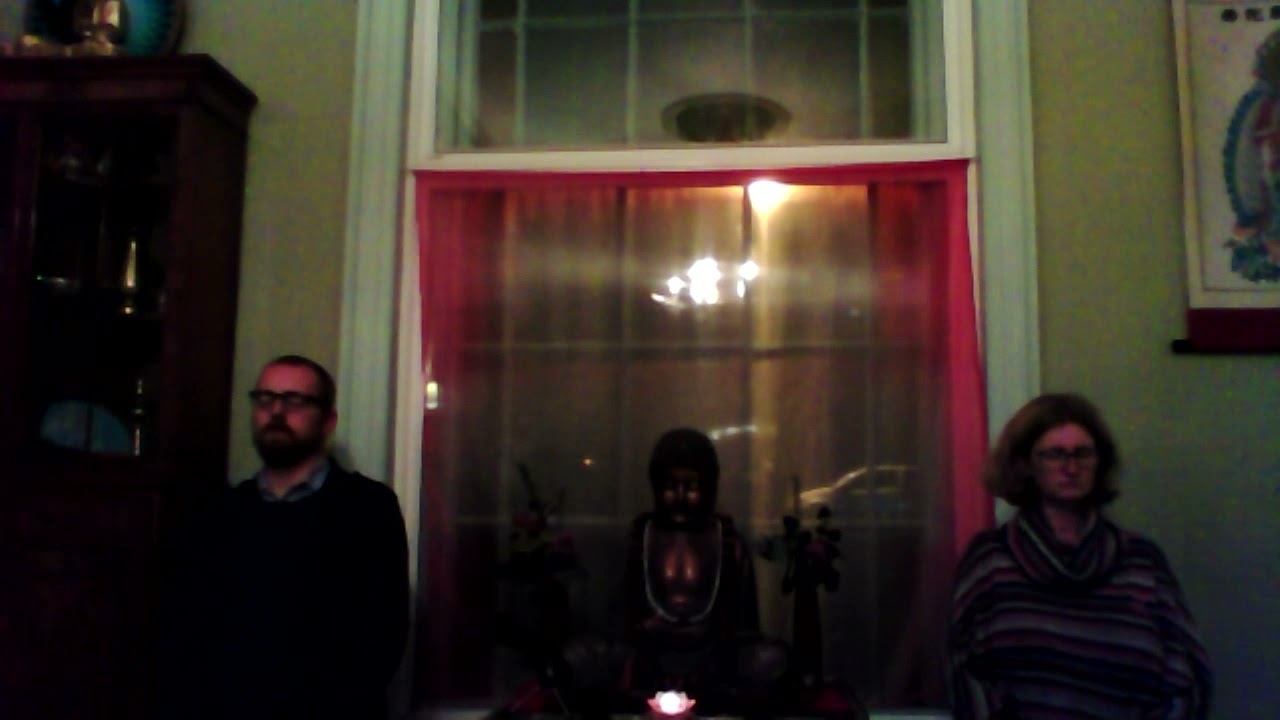
Inside the shrine room today we have Angela-san, Kaspar-me, and joining us on Zoom are Kenneth and Chip.
Recently I've been reading some Buddhist books and listening to some Buddhist talks, and One thing that a lot of Buddhist teachings have in common is that they describe the ideals, they describe the life of somebody who is already kind and compassionate and wise. They say, this is a good thing to do, this is a good way of being in the world. Even the very earliest Buddhist teachings in the Pali Canon are the same lists and lists of virtues and ways of behaving. Very rarely, if at all, is there a description of how to get from where you are to this place. And when we examine Buddhism, what we find is there's lots of different suggestions. There's lots of different practices, but I found myself getting curious about this, this bit— how you get from here to there. What is it that we do when we want to embody more of those virtues, when we want to be kinder, when we want to see things more clearly? And so on. And then separately, I'm also reading a book called Thinking Fast and Slow, which is about 8 or 9 years, or maybe even 10 years old now.
Welcome.
Yeah, so I was just saying that I've been reading this book called Thinking Fast and Slow, which is a few years old, and it's describing the difference between, between kind of intuitive, associative thinking and rational forward thinking, the kind of brain that does maths and solves puzzles and plans things, and the brain that makes guesses and estimates and solves puzzles by, oh, this is a bit like that, so I'll do it this way and see what happens. Anyway, the thing that interested me was a study that was done where they invited participants to read different sets of words, and then they told them to walk down the corridor and there would be another exercise in a different room. And the participants that read the words that were all to do with getting older and aging— and not that they necessarily included those words specifically, but they were kind of in that cloud of words— all walked down the corridor at around half the pace of the people who had just read random words that were nothing to do with aging. And that's how powerfully this associative mind works, that just picking up those few words has this effect that we don't even notice. A similar study was done around images and words of finance and money, and it showed that If you were exposed to those words and images, you were more likely to stand further away from other people. Um, when somebody knocked some things onto the floor, you would pick up, you would help, but by picking up less than you would otherwise, you would have done if you hadn't been exposed to those words. So you'd be less helpful if you'd been exposed to words and pictures about money and finance. And this is what Derren Brown plays on, of course, in those big illusions, which are ultimately magic tricks, but he frames them in that way that they're relying on this trick of psychology, which is called priming, apparently. That we can be. Our associative mind can be really powerfully influenced by the things we expose it to without us even noticing the difference. And that's partly what being a Buddhist is like. We surround ourselves with Buddha images and statues and have some sense that they're standing in for a better way of being. We listen to talks and we hear hear those words in them, or we read books, we come and share this time together. And all of those things do other things as well. You know, the talks engage our more cognitive parts of the brain, and practice helps us to settle and become more grounded, and so on and so forth. But there's also this powerful effect of priming, that just being in the space affects us. And the other— I've only read a very, uh, small amount of this book, but the other thing that I was reading about was how things that are familiar create states of mind that are more relaxed. Familiarity doesn't breed contempt, but actually breeds ease, relaxation, less skepticism, good feelings, less suspicion, I mean. And of course, the other thing that happens when we come to a place like this is that more or less we do the same thing over and over again. The same sort of people are here. The room is the same each time we come into it. And just that fact of familiarity begins to produce a feeling of safety. So we start to relax, and then it's easier for us to become primed to, to kind of be influenced by all these things that are around us. So there's lots of different things that are good to do if you want to be kinder and wiser and have a more fulfilled life and a happier life. But even if you, if you don't consistently do any of those things, As long as you keep turning up, you're probably making progress in that direction.
Namamitabha.
So we'll spend some time together in quiet meditation. Sitting upright and relaxed, the, the form of the body reflecting the form of the mind that we are aiming towards, upright and relaxed. And often in this life, when we're relaxed, we're also kind of a bit sleepy and not paying attention, or, and when we're alert, we're a bit tense and hypervigilant. So meditation is the middle point between these two things. Or at least we're aiming for that point where we can be at ease and also alert at the same time. And we encourage that by sitting in this way and by paying attention to something. The invitation now to pay attention to the breath, noticing the cooler air entering at the tip of the nose, the warmer air leaving. If the mind's particularly busy, maybe saying in as you breathe in to yourself and out as you breathe out. So now we'll chant the name of Amitābha Buddha. Amitābha's name means infinite light. Sometimes I wonder if we should chant in English for that power of association to work, but I've told you all what the name means now, so we'll trust that that's enough. So this is the Buddha of unconditional love, unconditional wisdom. We find those qualities deep in the center of ourselves when everything else falls away, and all around us in the universe being radiated by Buddhas and Bodhisattvas. So as we recite the name, we're tuning into that possibility, reminding ourselves that whether we know it, whether we can tell that it's there or not, it's still there, like the sun. Behind the clouds.
Amitabha. Amitabha. Amitabha. Amitabha. Amitabha. Amitabha. Amitabha. Amitabha.
Amitabha.
Amitabha. Amitabha. Amitabha. Amitabha. Amitabha. Amitabha. Amitabha. Amitabha. Amitabha. Amitabha. Amitabha. Amitabha. Amitabha. Amitabha. Amitabha. Amitabha. Amitabha. Amitabha. Amitabha. Amitabha. Amitabha. Amitabha. Amitabha. Amitabha. Amitabha. Amitabha. Amitabha. Amitabha. Amitabha.
In a moment, we will recite the refuges and precepts in the Bodhisattva vows. The refuges and precepts I'll ask you to repeat after me, but they are on the piece of paper if you want to read along as well. And the Bodhisattva vows are call and response. The refuge is— to take refuge in something is to experiment with putting our trust into it. We take refuge in a dry shelter in a storm, and in the same way We take refuge in awakened beings, in their teachings, in the community of people that practice those teachings. That's our refuge from the world of suffering that we inhabit. And the precepts are— these are the precepts that the Buddha gave to his lay followers 2,500 years ago, and they're a sort of They're a description that he thought was suitable for those people of enlightened behavior. Of course, they're not exhaustive, but they give us some sense of what to aim for. So please repeat after me. For refuge I go to the Buddha.
For refuge I go to the Buddha.
Namo Buddhaya.
Namo Buddhaya.
With faith in the Three Jewels, I pray that I may not fall into sexual misconduct. With faith in the Three Jewels, I pray that I may not fall into wrong speech. With faith in the Three Jewels, I pray that I may avoid intoxication.
I pray that I may avoid intoxication.
No blame.
No blame.
Be kind.
Be kind.
Love everything.
Love everything. Innumerable are sentient beings.
We vow to save them all.
Inexhaustible are deluded passions.
We vow to transform them all.
Immeasurable are the Dharma teachings.
We vow to master them all.
Infinite is the Buddha's way.
We vow to fulfill it completely.
In a moment, we'll stand and make prostrations or bows to the Buddha on the main shrine. We do 3 of these. And we say 'Nam-myoho-renge-kyo,' which is just another form of Amitābha. And we go as close to the floor as our bodies will allow in the prostration, which is the way of grounding ourselves, humbling ourselves, bringing our ego down to size, I suppose. But our hands are open and lifted up, allowing us to receive the teachings and blessings of the Buddha.
Namaste.
In gratitude, we offer this incense to Buddhas and Bodhisattvas. May it be as fragrant as earth herself, reflecting our careful efforts, our wholehearted awareness, and the fruits of understanding slowly ripening. May we and all beings be companions of Buddhas and Bodhisattvas.
May we awaken from forgetfulness and realize the truth.
So come back to our places.
And then standing.
And Fi, Rory, and I will bow to each other. So to one side and then the other side. So I will bow to Fi first. So Andrew, you'll bow to David. David, then we'll bow to nobody. Satya, you'll bow to Sam, and then we all turn and do it the other way. And don't worry about it, best not to worry about it. And now to the main shrine, tidy our seats, about our seats. And we'll finish with the closing verse, which you can find on the top of one of the sides of the piece of paper.
It begins, blessed by Amitābha.
Blessed by Amitābha's light, may we care for all living things and the holy earth.
Namamitubhu.
So a couple of announcements.









