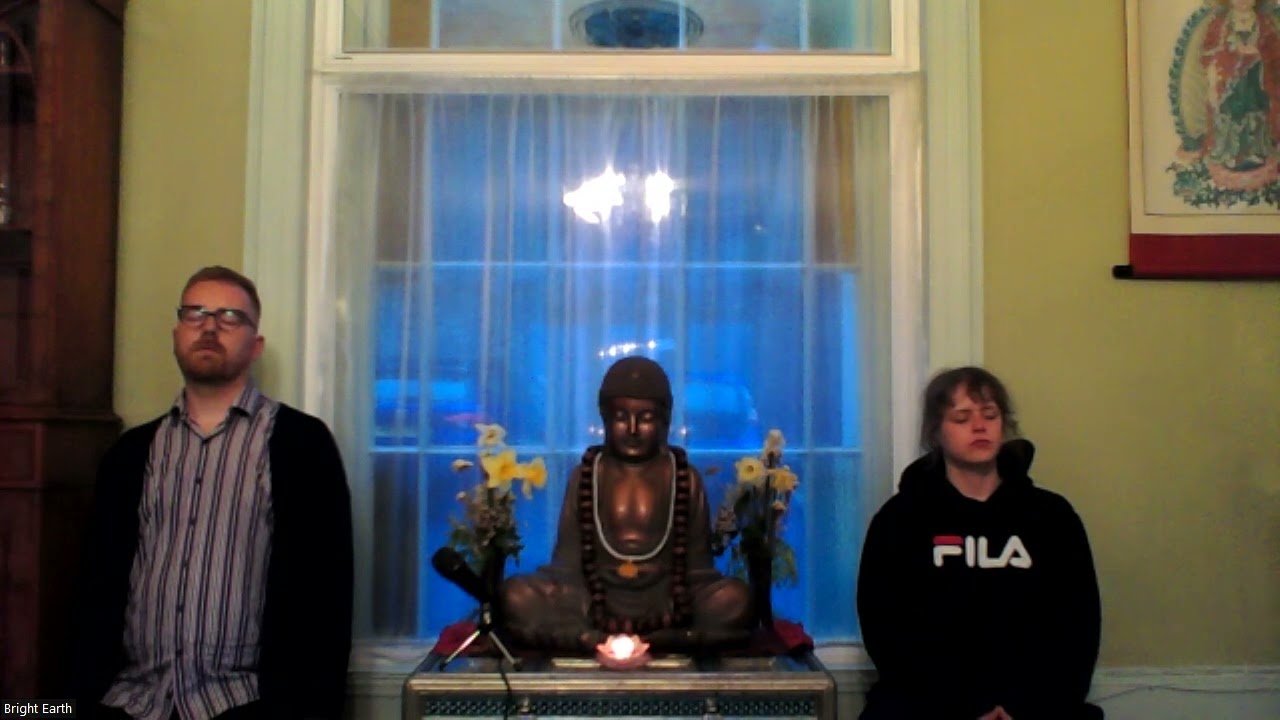
Satya Robyn leads a Buddhist practice session with readings, meditation, and chanting. Angela reads a Dharma Glimpse by Maria Trotter, the group chants Amitābha Buddha, and participants recite refuges and precepts together. A story from The Hidden Lamp is shared before merit dedications and retreat announcements.
Chapters
Welcome everybody. We'll begin this evening with a Dharma Glimpse by Maria that Angela has agreed to read for us. So I'll pass the mic over. A little bit towards—
Impermanence: Dharma Glimpse by Maria Trotter. Steve, my husband, and I went to Snowdonia for a few days last week. The weather unexpectedly dried up and we braved to go hiking up Snowdon itself. After about halfway up, Steve got worried about his poorly back and stayed behind. While I carried on a bit further on my own. Eventually I got to a ridge overlooking the inner lake and the main summit behind it— gorgeous view— and sat down to meditate. I was finding it hard to focus at first. Everything seemed to distract me: passing hikers, seagulls, even the changing brightness of the scenery depending on thickness of the clouds. Eventually this gave me an idea for my meditation: impermanence. Yes, the very same thing I've been reading a lot about in the books recently. Impermanence comes in so many varieties: sudden changes to our jobs, health, relationships, death of loved ones, political turmoil, even as unexpected as the new Prime Minister and the new King within the space of a week. I've been musing on the Great Resignation of lockdown, when so many people suddenly realized they were not happy with the way their lives were and found the stimulus to change in these bizarre circumstances. Now the Great Unretirement, the circumstances change yet again as the cost of living bites. Perhaps this country hasn't quite seen this level of impermanence in a long while. I was looking at the town of Snowdon, quietly counting my breath in the beautiful garnet beads of my mala. Garnet is meant to represent fire and self-confidence and aid us in times of crisis, also connect us with spiritual awareness of rebirth. At that time, I felt the need to focus on the Queen's passing, and as I was, I saw a glimpse of a baby girl being born in Indian family. I then saw a young Indian woman wearing a sari with a firm, brave look in her eyes, astute and sure of herself. Maybe the next Indira Gandhi, Malala, or Greta. Could this be a glimpse of the Queen's next life? It would make some karmic sense for her to be reborn in India. Whether there is any truth in this or not, this image reminded me of the endless cycle of life and death, that with each passing there are new wonderful lives being brought into this world. It gave me a sense of great peace and contentment. After coming back, I also made a little change to our house. I brought my harp down to the living room from this little study where it was hidden away from the two curious kittens of ours. The kittens, now cats, were then let into the study for the first time, so they rushed to the Buddhist shrine I made on the windowsill. As I was watching Cassie play with the dried autumn leaves on the shrine, I could think of no better way to illustrate that life always carries on and there is always joy to be found in this world.
A moment. So we'll sit together in quiet meditation for a little while before chanting the name of Amitābha Buddha. And in the quiet, an invitation to drop your awareness into your bodies, noticing physical sensations, noticing your weight on the floor or the cushion or the chair, noticing how the body changes with the breath. If other things come to mind, noticing what they are and then gently returning awareness to the body and the breath in the body. Amitabh, Amitabh, Amitabh. Amitabh. Amitabh. Amitabh. Amitabh. Amitabh. Amita. Amita. Amita. Amitabh. Amitabh. Satya Robyn! So we'll now recite the refuges and precepts and so on. The refuges and precepts I'll ask you to repeat after me, and then the Bodhisattva vows will be call and response, and the words are all on the A5 liturgy sheet. So please repeat after me. For refuge I go to the Buddha.
For refuge I go to the Buddha.
The one who is awake and full of love.
The one who is awake and full of love.
Namo Buddhaya. For refuge I go to the Dharma.
For refuge I go to the Dharma.
All that guides us to wisdom and compassion.
All that guides us to wisdom and compassion.
Namo Dhammaya.
Namo Dhammaya.
For refuge I go to the Sangha.
For refuge I go to the Sangha.
Those who live in the Buddha's light.
Those who live in the Buddha's light.
Namo Sangha—
Namo Sangha!
With faith in the Three Jewels— Faith in three jewels— I pray that I may not take life—
Take my own life—
With faith in the Three Jewels—
The same jewel—
I pray this I may not steal—
Steal me out of steel—
With faith in the Three Jewels—
We've been praying for these rituals I pray that I may not fall into wrong speech—
—with faith in the Three Jewels. With faith in the Three Jewels.
I pray that I may not fall into sexual misconduct—
—with faith in the Three Jewels. With faith in the Three Jewels. I pray that I may avoid intoxication I pray that I may avoid intoxication. No blame. No blame. Be kind. Be kind. Love everything.
Love everything. Innumerable are sentient beings.
We vow to save them all. Inexhaustible are deluded passions. We vow to transform them all. Immeasurable are the Dharma teachings. We vow to master them all.
Infinite is the Buddha's way.
We vow to fulfill it completely. Namitabu. Let me read you a story. From this book, The Hidden Lamp: Stories from 25 Centuries of Awakened Women, edited by Florence Kaplow and Susan Moon. This is a story set in India in the 6th century. As recorded by Dōgen in the 13th century and then translated into English for us in the 21st century. The nun Upalavana was a disciple of the Buddha. She visited the home of some noble young women and encouraged them to become nuns. They responded, 'We are young and beautiful and full of life. It would be hard for us to keep the precepts.' Upalavana replied, 'If you break the precepts, you break the precepts. First leave the household and become nuns.' The women said to her, 'But if we break the precepts, we'll fall into hell. Why would you have us do that?' Upalavana said, 'Go ahead, fall into hell.' The women all laughed and said, 'Why would you suggest such a thing?' She replied, 'In a former life, I was a prostitute and an entertainer. One day I dressed myself in nun's robes in front of my customers as a joke, and because of this, in my next life I became a nun and took the precepts.' But even though I was a nun, I was arrogant and I broke the precepts, and as a consequence I did fall into hell and its suffering. Later in this current life, I met Shakyamuni Buddha, ordained, developed great meditative powers, and became an arahat. In this way I learned that you can attain the fruit of the way even if you break a precept and fall into hell. The merit of receiving the precepts makes awakening possible, but if you never receive the precepts and do— if you never receive the precepts and do unwholesome things, you will never attain the way. Better to take the precepts and break them than never to take the precepts at all. I was reminded when I was reading it a little bit of Reverend Koyoko Bose's mantra, keep going, just keep going. You have to make a start to keep going, and you will definitely fail, but failure is never the end of the journey if you keep going. But if you don't set out to begin with You won't fail, but you won't succeed either. I was also reminded of Reverend Koshin Schomburg's book where he describes the spiritual path as having two wings, if you like. I don't know that that's his image, but two aspects: keeping the precepts and having faith. Keeping the precepts— the image he uses of rowing a boat, I think, across the ocean. And so rowing is keeping the precepts, and looking up at the stars to know where you're going is having faith, something like that. So we know as Pure Land Buddhists we're destined to break the precepts in obvious ways and in subtle ways. We also know there is something much bigger than ourselves that holds us with compassion when we break the precepts, that moves through us into the world when we are keeping the precepts, that is us keeping the precepts. I suppose as a pure Buddhist, you, you can easily substitute having faith for the words keeping the precepts in that story. Why should I bother to have faith? I know that I'm going to lose it. I know that I'm going to fall into hell. But if you have faith and confidence in the Buddha, however windy your path is and wherever it leads you, it will take you to the Pure Land eventually, as long as you keep going.
In gratitude, we dedicate the merits of this incense offering to all Buddhas and Bodhisattvas throughout space and time. May it be fragrant as the Earth herself. Reflecting our careful efforts, our wholehearted teaching, and the fruits of understanding slowly ripening. May we and all beings be companions of Buddha's and Bodhisattva's. May we awaken from ignorance and realize our true nature.
So we'll stand in our places and bow to each other.
Main shrine.
Taiji our seats. A reminder that our retreat day on foolish beings is this Saturday. Schedule is online. Or let us know if you've got any questions, and we'll finish this evening with the closing verse that's on the top of the A5 sheet if you want to join in. Blessed by Amitabha's light, may we care for all living things and the holy earth. Namamitabhu.
Thanks. Is there anyone here? Yep, Jim's iPhone is here. Jim's iPhone.









