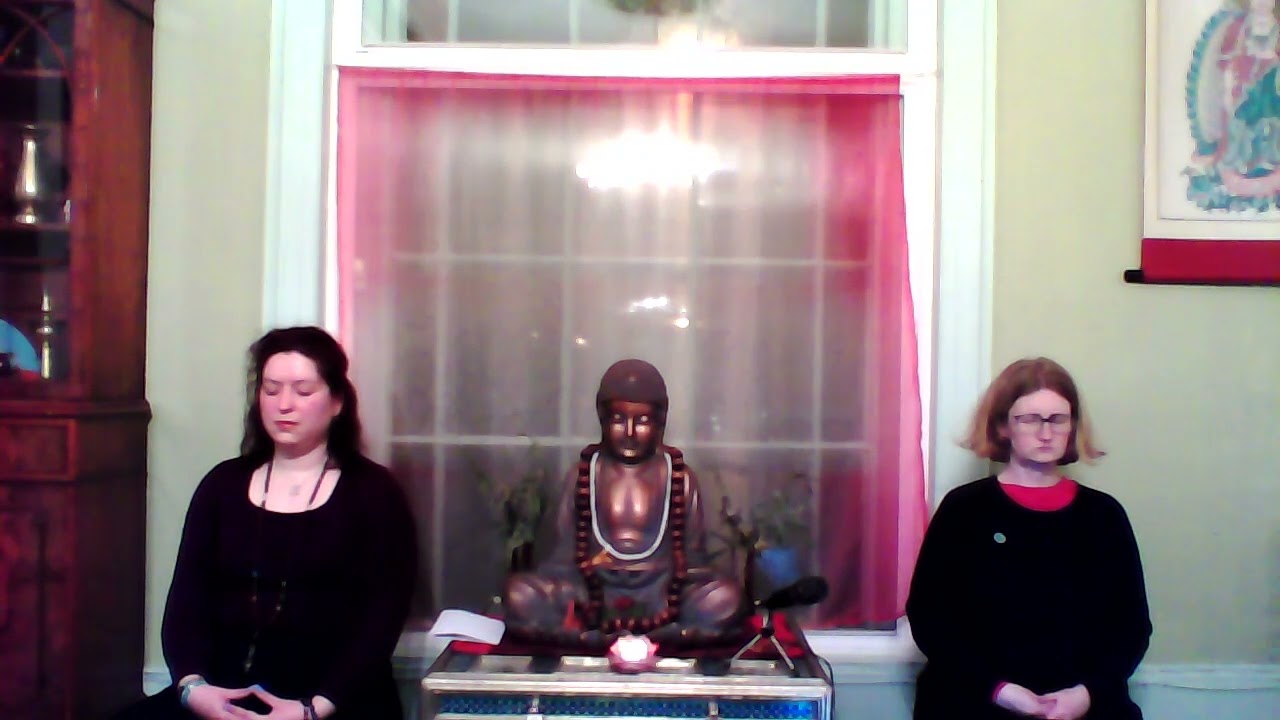
A group Buddhist practice session with teachings and reflections on the role of teachers. Participants including Caspar and Maria offer a Dharma glimpse, chant the Medicine Buddha, take refuge vows, and dedicate merits through prostration.
Chapters
That's how we start practice.
So welcome everyone to our practice this evening, to everyone in the shrine room and, uh, nobody on Zoom yet. Um, so we will begin with a Dharma glimpse by Maria.
Over to you.
This was inspired by the Medicine Buddha practice that we had in the shrine earlier and is about a teacher. The role of a Teacher with a capital T has been celebrated and explored in many Eastern cultures. There is usually an image of a struggling searcher often suffering and lost within the troubles of their life, and at the point when they are about to lose all hope, there appears a person or an image offering a new and a better way. My own search began in a much less dramatic way, although I've been known to hit a brick wall more than once since. It began, as did most positive things in my life, with music. When I was just approaching my teens, through my dad's music collection, I became interested in a British progressive rock band Yes, known for their complex and deeply spiritual lyrics. The band's lead singer Jon Anderson took inspiration in the Buddhist texts and the works of Hermann Hesse, a spiritual search that drove most of his creative career and lifestyle from the '70s. And up until the present day. John has never tried to fit within one religious confession. His quest has simply been that of seeking the light, inspiration, and the truth, deeply rooted in love for the whole of humanity and the Earth. Even though I only met John in person years later in the UK in 2017, back in my early days He became my spiritual teacher from afar. His positive approach to life and ability to touch the beauty of the universe with his music has lifted me up and given me hope numerous times, particularly when I was struggling to fit in with the material side of my life. He became the spark for my interest in Buddhism and endeavouring on a spiritual and eventually musical as well, search of my own. And I should say, John is also a harpist. Even now, I still sometimes picture talking to him during my deep meditations, the image through which would come a glimpse of universal love and joy. So, what is the role of a teacher, and who is that person? Is it someone who is most knowledgeable of religious texts, Is it someone who has been living the most ascetic life? Is it someone who is certain they know best? To me, a teacher is one who inspires me to be a better person, who shows me a better way by example and not just through reading a passage in a book, someone who sees all the beauty in our world and even in us silly humans, who knows everything that's happening in the world but still remains optimistic and hopeful for a new era to come. Someone who lives in the light. Through his music and energy, he is always with me.
Namamitabhu. So we will sit in silence together as those words reverberate through us. And we'll revisit the Medicine Buddha chant, the words for which are written on a little bit of paper because they're quite tricky. Taya ta vom vegam je, vegam je, baha vegam je, katsa samu gati su.
Taya Tao, bacon J, bacon J, maha bacon J, katsa samika tesoha. Thaiyatha Om Bekam Je, Bekam Jin Maha Bekam Je Vatsasammukkha Tissoha. Thaiyatha Om Bekam Je, Bekam Jin Maha Bekam Je Vatsasammukkha Tissoha. Thaiyatha Om Bekam Je, Bekam Jin— Maha Bekamje Ratsa Sammukati Soha— Thaya Tao Om Bekamje BeKAMJE Mahabekanjay ratsasammukahti soho ha! Thyatao om bekamjay bekenjee maha bikemjej rasa sammutkathi su ho haaa!
For refuge I go to the Buddha.
For refuge I go to the Buddha.
Namo Buddhaya. Namaste. For refuge I go to the Dharma.
For refuge I go to the Dharma.
Namo Dharmaya. For refuge I go to the Sangha.
For refuge I go to the Sangha.
Namo Sanghaya. With faith in the Three Jewels—
with faith in the Three Jewels—
I pray that I may not take life.
I pray this time they don't take mine.
With faith in the Three Jewels— With faith in the three jewels I pray that I may not steal—I praise them—they know still—with faith in the three jewels—with faith in the two tools-I pray that I may not fall into sexual misconduct—I pray this time they're not falling to sex under-with faith in the 3 Jews—with faith in the true jewel—I pray that I may not fall into wrong speech I pray that I may not fall into wrong speech. With faith in the Three Jewels, with faith in the Three Jewels, I pray that I may avoid intoxication. I pray that I may avoid intoxication. No blame, no blame. Be kind, be kind. Love everything, love everything.
Innumerable are sentient beings.
We vow to save them all.
Inexhaustible are the Vedic passions.
We vow to transform them all.
Immeasurable are the Dharma teachings.
We vow to master them all.
Infinite is the Buddha's way.
We vow to follow it completely.
No, Mommy Taboo. Literally just realized I've got to say something. It was really lovely to hear about your experience of teachers, Maria, and it very much chimes with my own experience of something that's very difficult to describe as being what gets passed on often between teacher and student. And as I, as I begin to speak about teachers, what comes to my mind is a talk that me and Caspar listened to a couple of weeks ago by Reverend Koyo Kabose, the son of Gyomei Kabose, the founder of Bright Dawn. And I've never heard him give a dharma talk before, and this was just one dharma talk that we plucked out of, so it may not be representative of him, but for most of the talk he was chuckling and talking about playing a game of poker with his Japanese kind of buddies, his old buddies. I think he's in his 80s now, and there was this kind of rambling story about— I can remember something about the road to get to the place where they played the games. I can't really remember anything of the content of it at all. But what really stays with me is something about his qualities, his being. And, um, there was a real sense of, um, feeling relaxed in his own skin. And being a bit playful, that kind of don't worry about it kind of quality, which then reminds me of a— I've told you this before, but at the start of one of the chapters of a book about, uh, what's he called, Katagiri Roshi, there's a little, just a little snippet And I think it was Katagiri Roshi who might have been him, or it might have been another Zen priest who was kind of getting anxious about something, sort of getting worked up about something to do with the Dharma. And he spoke on the phone to a Pure Land friend of his, and the Pure Land priest, the Pure Land friend, just said, "Don't worry about it." And that reminds me of the book I read quite recently by, um, G.U. Kenneth, Reverend G.U. Kenneth. And one of the messages she got from the Buddha, which kept kind of getting repeated to her, is nothing matters. And that has this— for me, that has the same kind of quality. It's like, just don't worry about it so much. The Buddha has got you. The Buddha has got our backs. And of course we do worry about it because we're human. We worry about all sorts of things, and then we put them down and pick other things up. And of course there are things that are important to do, important to be careful with. Nothing matters could also be everything matters. What I have received, what I've been very lucky to receive from many living teachers, and even more teachers through books and, and through talks I've heard, through stories that have been passed on through other teachers, is a way of being that is that is easy, that is full of faith, that is light and playful, that chuckles, that, that gets it, that it's not a spiritual bypass, it's not an avoidance or a denial of the reality of suffering. The depth of suffering is seen. But there's so much more space to just be with it and just enjoy a game of poker with your buddies. And we're all receiving this wisdom all the time from all around us, from Buddhist teachers, from musicians, from someone we bump into on the street. And we'd probably, most of us, be quite surprised about how much we're exuding, how much of that we're giving out, and that other people are picking up just from being around us, from listening to us, from watching us. So Just feeling very grateful for all of my teachers and all of their teachers, everyone in this room who is also a teacher. The Dharma glimpses are showing us that everybody gets glimpses of the Dharma, and we can see the Dharma through everybody regardless of how long they've been coming here or how much they know about Buddhism or any other practice or spiritual path. And as we make prostrations today, you might just want to offer, offer that kind of gratitude to all of our teachers, going back to Shakyamuni Buddha and back beyond.
Namamitabhu. Is he gone to sleep? Yeah. Somebody stood up once and both of their feet were gone to sleep and you just— it's just one foot. Namaste.
Namaste. Namaste. Namaste. Namaste.
We dedicate the merits of this incense offering to all Buddhas and Bodhisattvas throughout space and time. May it be fragrant as Earth herself, reflecting our careful efforts, our wholehearted awareness and the fruit of understanding slowly ripen. May we and all beings be companions of Buddhas and Bodhisattvas. May we awaken from forgetfulness and realize our true mind.
Blessed by Amitabha's light, may we care for all living things.
Namami Devi. Namami Devi.









