Practice: Thangka's covered and uncovered. Love and wisdom covered and uncovered
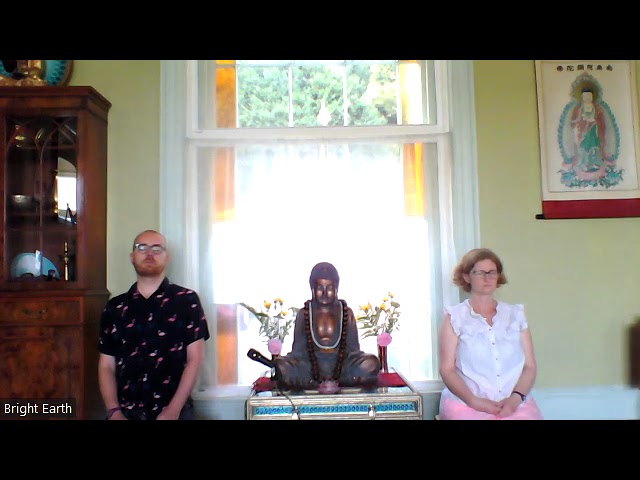
Satya Robyn leads a Buddhist practice session with guided meditation, chanting of Amitābha, and recitation of refuges and vows. Chris Earl Story shares a Dharma glimpse using a wheelie bin as a metaphor for mental cleansing.
Chapters
Good morning, everybody. Welcome, welcome if it's your first time joining us. Or your first time for a while, or if you've been here recently. That covers all the bases, I think. Welcome to Philip, who's joining us on Zoom. Uh, we'll start the practice this morning as we always do with a Dharma glimpse, which is a piece written by somebody from our community about their experience of how their practice or their understanding of Buddhism comes to life in their everyday life. Satya is going to read, and the glimpse this morning has been written by Chris, who isn't here but has sent this in for us.
A moment. A moment.
A Dharma glimpse by Chris Earl Story. I've had a difficult couple of weeks and I've been finding it hard to concentrate on things. The current hot weather does not help. Normally I would refresh myself by spending time working in the garden, but the fierce heat of the sun makes it too uncomfortable. Yesterday morning I went outside to put some rubbish in the black household waste bin. Our wheelie bins stand at the top of the driveway and are in the shade for much of the day. But even so, I was struck by the distinctly unpleasant smell coming from the black bin. This is a good time to clean it out, I thought. It's in the shade, and I don't feel like doing much, like doing anything else, so I may as well do something practical and useful. I lay the bin on its side and climbed into it. I spent half an hour scrubbing and rinsing I am sure any passing neighbors must have been amused by the sight of my rear end sticking out of the bin, but by the time I'd finished, the once minging wheelie bin was shining and considerably more sweet, sweet smelling. Alas, the same could not be said for me, and I had to put all my clothes in the wash and myself in the shower. As I washed the grime and odors from my aching body, I reflected on how simple it is to clean our physical selves but how much more difficult to wash clean our minds and spirits. The hard work had certainly distracted me from the current preoccupations of my mind, but it was only temporary. In order to do a mental cleansing, something else was needed. I spent some time that evening doing the sort of things that I know from experience are good for my mind and spirit. I meditated. I chanted, I read a Dharma text, I put some of my thoughts down on paper, and finally I saw a Dharma glimpse in the day's experience.
Thank you, Satya. Thank you, Chris. We'll move into a period of meditation now, so Taking a moment to check in with your body. We're aiming for an upright but relaxed position. I tend to check in with my hips. If they're sort of pointed roughly upwards, then I feel like that's a good place for me to begin meditating from. If they're too far forwards, then I've got this tension in my lower back, which can create sort of tension in the mind. If, if they're the other way, then it means that I'm probably slumping, and then I can't take in enough air, and then maybe I fall asleep. So just in the middle is just right, like Goldilocks and the Three Bears. And then an invitation to notice the breath, not changing it, not trying to breathe in any particular way, just noticing how it is moment to moment. And we'll do this for about 15 minutes together. If, when something else catches your attention, just gently noticing that and bringing your awareness back. To the breath. We'll move into a period of chanting together. We'll recite the name Amitabha in this— in the melody that goes with this chant.
There's—
it's a repeating tune every 4 utterances of the name Amitābha, which means limitless light, the light of pure wisdom, of pure love. So we're coming into relationship with these qualities through the Buddha called Amitābha. Amitabha. Amitabha.
Amitabha. Amitabha. Amitabh. Amitabh. Amitabh. Amitabha. Amitabha. Amitabha. Amitabha. Amitabha. Amitabha. Amitabha. Amitabha. Amitabha. Amitabha. Amitabha. Amitabha. Amitabha. Amitabha. Amitabha. Amitabha. Amitabha. Amitabha. Amitabha. Amitabha. Amitabha. Amitabha. Amitabha. Amitabha. Amitabha. Amitabha. Amitabha. Amitabha. Amitabha. Amitabha. Amitabh. Amitabh. Amitabh. Amitabha. Amitabha. Amitabha. Amitabha. Amitabha. Amitabha. Amitabha.
Amitabha. Now we'll recite the refuges and precepts and three remembrances and the Bodhisattva vows, the first of which I'll ask you to repeat after me, and the last will be call and response. The words are on the piece of paper if you'd like to read them as well. The refuges: the Buddha, the Dharma, and the Sangha. Things all Buddhists across the world for 2,500 years have taken refuge in, have put their trust in, or experimented with putting their trust in. We have to have enough confidence in these things to be willing to try out the practices but also enough mindfulness to really see what that's like and find out for ourselves if, if this is the right thing for me. So it's in that spirit of experimenting with confidence that we take refuge in these things, uh, bright faith or settled faith rather than blind faith. The precepts describe the life of a perfect— perfectly ethical community, um, based on the monastic precepts. So these ones are for lay people, and we're not expected to be able to follow them completely, but they are a guiding star or mirror that we can use to get curious about, oh, how am I doing? What's going on for me? If I'm, if I find that, um, my behavior is going outside the boundaries of these things, then usually it means there's some suffering I should be paying attention to that I haven't tended to in my own system. So please repeat after me. For refuge I go to the Buddha.
For refuge I go to the Buddha.
The one who is awake and full of love.
The one who is awake and full of love.
Namo Buddhaya.
Namo Buddhaya.
For refuge I go to the Dharma.
For refuge I go to the Dharma.
All that guides us to wisdom and compassion.
All that guides us to wisdom and compassion.
Namo Damaya. For refuge I go to the Sangha.
For refuge I go to the Sangha.
Those who live in the Buddha's light.
Those who live in the Buddha's light.
Namo Sanghaya.
Namo Sanghaya.
With faith in the Three Jewels.
With faith in the Three Jewels.
I pray that I may not take life.
I pray that I may not take wrongfully—
With faith in The Three Jewels , Faithful to Buddha Dharma Guru Samantabhaya! —with faith in The Three Jewels . Faithful to Buddha Dharma Guru Samantabhaya! I pray that time may fall into sexual misconduct. I pray that time will not be fallen into sex or misconduct. With faith in The Three Jewels, I pray that I may not fall into wrong speech. I pray that I may not fall into wrong speech. With faith in the Three Jewels, with faith in the Three Jewels, I pray that I may avoid intoxication.
I pray that I may avoid intoxication.
No blame. No blame. Be kind. Be kind. Love everything.
Innumerable are sentient beings.
We vow to save them all.
Inexhaustible are deluded passions.
We vow to transform them all.
Immeasurable are the Dharma teachings.
We vow to master them all. Infinites, the Buddha's way. We vow to fulfill completely. And then my meat spoon. The, um, thank you. The tankas on this wall either side of the mirror are of Amitābha Buddha, the red Buddha on the left, and Avalokiteshvara, the bodhisattva of compassion, the one who hears the cries of the world, on the right. You'll see that above Avalokiteshvara is a little Amitābha Buddha as well, showing that they're connected. I often think of Amitābha or Amida Buddha sitting, welcoming all beings with this kind of settled energy. Like, I'm here, I'm receive— you come towards me, I'm receiving you, I'm sending out invitations, and I'm settled. I'm ready to gather everybody up when they come into my orbit. And I think of Kuan Yin as the energy that goes out into the world more actively getting involved in people's lives. And for that reason, Kuan Yin or Avalokiteshvara is the different names for the same figure, is often more popular in South Asia, Southeast Asia, in Korea, Japan, Vietnam, seen as more accessible. And in a way, these are different qualities of enlightenment that appear in our own life as our practice matures. And as Pure Land Buddhists, we have a sense that, as most Mahayana Buddhists do, that enlightenment is sort of— it's already in the world. If we see things with the eyes of the Buddha, everything already looks enlightened, everything is shining. And as Pure Land Buddhists, we tune into that, particularly through relating to these figures. And I've been noticing that the colors in them are slowly fading. They were much brighter when we bought them. It's partly because they're prints rather than painted, hand-painted, as they probably would be in Tibet. But it's also because in Tibetan temples, gompas, the yellow— the gold fabric at the top would be down covering the figure, and you wouldn't be able to see it most of the time. You'd have to unveil it to see it, partly because that invites a particular kind of mindfulness. It doesn't just become something on the wall. You have to deliberately do something in order to encounter it. And there's an invitation there to approach with a particular kind of reverence, with an open heart, with some respect for the tradition. And some of them are even hidden in particular rooms in the gompas that only, uh, people who have been initiated can enter into. So even more steps, which brings you into this really— the idea is it brings you into this really deep state of mindfulness so that when you encounter it, you kind of, you're prepared for this sort of spiritual experience that occasionally seeing images or being in different places can evoke. It's designed to more strongly evoke those qualities that I was talking about. And we have them uncovered here partly because we're not a Tibetan center, partly to remind people that those qualities are always available whether you're in that state of mind or not. Like, we're always breathing. We're not always conscious that we're breathing, but we're always breathing. In the same way, wisdom and compassion are flowing around us. We just don't notice it a lot of the time. We don't even notice those little seeds of it in our own heart. I've put two new tankas up this week in my office, one of Shakyamuni Buddha, the, um, the person 2,500 years ago who started the Buddhist tradition, and one of Green Tara, another bodhisattva similar to Avalokiteshvara. But I've left the gold fabric down so they're covered, and actually, and I haven't uncovered them since they've gone on the walls. And there's something quite reassuring about that because it sort of reflects my spiritual experience, which is a lot of the time I'm not, you know, in enlightened states of mind. I'm not, uh, I'm not conscious of nirvana being around me, or I'm not conscious that the Pure Land is around me. My thoughts are occupied, my mind is busy, or I'm reactive, or whatever. And that's how it is to be a human on the spiritual path. We talk about these ideals and sometimes we're able to land in them, and often we're just living our life, maybe a little bit better than we used to, but still a bit greedy, still with some ill will, still with some ignorance. And yet, even when we are in that state, the Buddhas are still present, sending their loving kindness towards us, seeing us with the wisdom that means they can see into the loving center of our own hearts, even if we can't see that and we're not acting from that place. So the gold covering reminds me of that. It's like, oh yeah, even though my mind is like this today, somewhere out there, there is something that has a different quality, a kinder quality to it. And just trusting that, even if I can't feel it in my bones on that particular day, Just trusting it begins to shift and change and undermine whatever is going on in my head— the greed, the ill will— like a wave slowly smoothing a rock into a pebble. So I suppose that's the invitation of Pure Land Buddhism, to trust that even behind the fabric that hangs on those tankas, there is a Buddha. To trust that beyond the greed, ill will, and ignorance that darkens our own mind, there is loving kindness. And that the act of trusting that brings us more closely into its presence. Nam-myoho-renge-kyo. So now Kengo will ring the bell and we'll stand to make prostrations to the main shrine. Uh, as I said earlier, we'll go down to kneeling, but do as much as your body feels comfortable with So we'll chant Namo Amida Butsu, which is another form of the Amitabha chant. And all of these words that we're chanting really have that spirit that I was just describing, reminding us that that light is there whether we are able to see it or not in any given moment.
We dedicate the merits of this incense offering to Buddhas and bodhisattvas throughout space and time. May it be as fragrant as Earth herself. Reflecting on careful efforts, our wholehearted awareness, and the fruits of understanding slowly ripening, may we and all beings be companions of Buddhas and bodhisattvas. May we awaken from forgetfulness.
Okay, we will ring the bell again and we'll bow to each other, first to one side and then to the other. Into the main shrine again. We'll tidy our places, back to our seats. We'll finish with the closing verse, which is on the top of the A5 sheet if you'd like to recite it with us. Do unmute if you want to join from Zoom. Blessed by Amitābha's light, may we care for all living things and the Holy Name. No more need to boo, sorry, it's quite short. So a couple of announcements. We've got a couple of hours volunteering in the garden at, from 2 this afternoon. If you'd like to join us, you're very welcome. No skills required. No skills required. At 6, we have a listening circle in here, 6 till 7 this evening. Please do make a donation into the bowl in the hallway if you've appreciated being here this morning. Whether you have or not. Whether you have or not, we would certainly appreciate it. Yes. No worries. And Vivre Welcome stay and have a cup of tea with us. The end.









