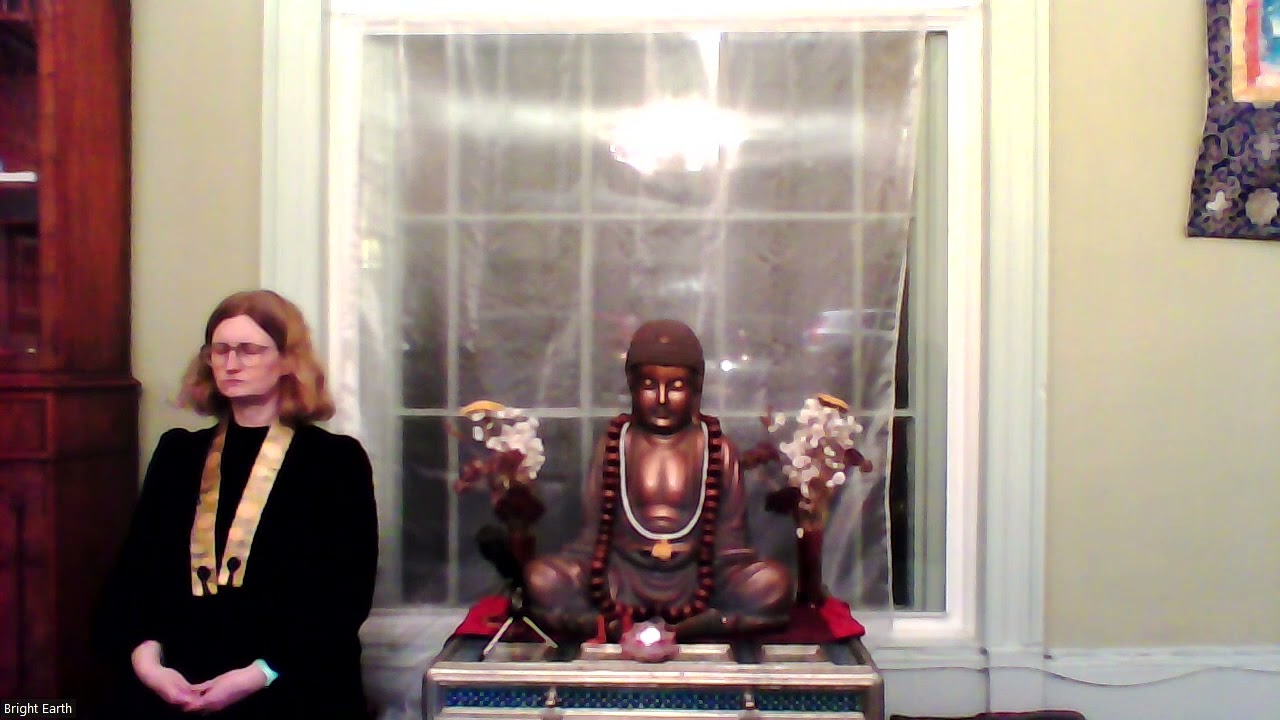
This content was created by Satya Robyn. This content was uploaded by Satya Robyn. This is a YouTube video titled "Practice - the Christmas tree" (created 2024-01-17) containing a recorded Buddhist practice/service with multiple speakers (labelled SPEAKER A, B, C). The excerpt opens with a reading from Zen Teachings in Challenging Times (a piece by Soto Zen priest Shodo Spring) about activism, offering, and the teaching of impermanence; it includes communal chanting (Om Mani Padme Hum), refuge vows, a personal reflection using a town Christmas tree as an illustration of impermanence and grief, an incense offering, and closing phrases. The recording references other figures (Master Emo, Father Tom, David) but the on-record participants remain unnamed speakers leading a group practice in English.
Chapters
Welcome everybody. There was nobody down on the list to read a Dharma Gems, and it occurred to me that we can have an empty space, uh, so here I am on my own with the Buddha, and we will begin with a reading from this book, Zen Teachings in Challenging Times, which will be a book group later on in the year. Frankie recommended it to me, and it's very good. And this section is by a Zen priest. It's, um, all female Zen priests Soto Zen priests. And this is by Shodo Spring, who, um, who runs a farm and who works as a psychotherapist and who lives in North America. And she does, um, she had a very intense year of environmental activism, and this is her speaking about that, but Hopefully it can be expanded to mean many things. For a long time, maybe this year, my life has been organized around a vow to stop climate change without knowing what that can mean. In 2015, I created an organization named Mountains and Waters Alliance. And I think of it as an alliance of sentient beings committed to protect and restore the Earth. Its members are more trees, bluffs, waterfalls, and flowers than they are human beings, because asking humans is still hard for me. I include them in morning service, in the dedication of merit after chanting. I ask them for help, and I long to visit them more often. This past June, walking on a mountain, talking with new beings, I was offered a teaching: there's nothing I need to do. The deep powers of the Earth have it in their hands. It's not up to me. It felt as if a heavy weight lifted off my shoulders. I returned home and was physically sick for a month, which may be a measure of how invested I was in my identity as activist. I'm moving slowly since then. It's as if every step I take has to be discovered, tested. What is my intention? If I think I'm saving the world, solving a problem, anything like that, it's a mistake. If I think I can sit idly at home, or even in the zendo, that might well be a mistake too. Turning the Dharma wheel does not look like disengagement. My story now is about making offerings to the Earth. Both ceremony and physical labor, and asking for help with everything, absolutely everything, small and large, personal and worldwide. Move into silence together. And maybe you can have some conversations with some of the beings nearby. The apple tree in the garden planted in David's name, maybe the tree with all the catkins at the moment. Maybe the ponds, maybe the hills behind us, maybe the sea. Just allow yourself to feel a connection with whatever you'd like to feel connected with and see if it has anything to tell you.
Om Mani Padme Hum. Om Mani Padme Hum. Om Mani Padme Hum. Om Mani Padme Hum. Om Mani Padme Hum. Om Mani Padme Hum. Om Mani Padme Hum. Om Mani Padme Hum. Om Mani Padme Hum. Om Mani Padme Hum. Om Mani Padme Hum. Om Mani Padme Hum. Om Mani Padme Hum. Om Mani Padme Hum. Om Mani Padme Hum. Om Mani Padme Hum. Om mani padme hum. Om mani padme hum. Om mani padme hum. Om mani padme hum. Om mani padme hum. Om mani padme hum. Om mani padme hum. Om mani padme hum. Om mani padme hum. Om Mani Padme Hum. Om Mani Padme Hum. Om Mani Padme Hum. Om Mani Padme Hum. Om Mani Padme Hum. Om Mani Padme Hum. Om Mani Padme Hum. Om mani padme hum. Om mani padme hum. Om mani padme hum. Om Mani Padme Hum. Om Mani Padme Hum. Om Mani Padme Hum. Om mani padme hum. Om mani padme hum. Om mani padme hum. Om Mani Padme Hum. Om Mani Padme Hum. Om Mani Padme Hum. Om Mani Padme Hum. Om Mani Padme Hum. Om Mani Padme Hum.
For refuge we go to the Buddha—
for refuge you go to the one who is awake and full of love— the one who is awake and full of love.
Namo Buddhaya! For refuge we go to the Dharma— all that guides us to wisdom and compassion—
all that guides us to wisdom and compassion.
Namo Dharmaya! For refuge we go to the Sangha.
For refuge we go to the Sangha.
Those who live in the Buddha's light—
those who live in the Buddha's light—
Namo Sanghaya! With faith in three jewels—
with faith in the three jewels—
and in light of my human tendencies—
I pray that I may become aware—
I pray that I may become aware— of when I take life—
of when I take life—
I pray that I may become aware— of when I take what is not freely given. I pray that I may become aware— of when I fall into sexual misconduct. I pray that I may become aware— of when I fall into wrong speech.
Of when I fall into wrong speech.
I pray that I may become aware.
I pray that I may become aware of when I become intoxicated.
Of when I become intoxicated. No blame. No blame. Be kind.
Be kind.
Love everything. Love everything. Innumerable are sentient beings.
We vow to save them all.
Inexhaustible are deluded passions.
We vow to transform them all.
Immeasurable are the Dharma teachings.
We bow to Master Emo.
Infinite is the Buddha's way.
We bow to Father Tom.
So I need to look something up to go with the message I had. Yeah, so, um, I waited to see which, uh, being might want to speak to me. I hoped it might be maybe a great river or mountain, but it was the Christmas tree in Malvern, the Christmas tree that had the lights on. In the center of town, and I sat with it daily while it was there on the steps, at the bottom of the steps or at the top of the steps, and enjoyed its lights. And then a few days ago, there was a big van at the bottom of the steps, so I sat at the top of the steps and The man came up with a big pair of secretary things and disassembled the Christmas tree. It was his job to take the Christmas tree away, and he basically did it by taking off all the branches and putting them in his truck. Um, so as I was sitting in meditation, this was the image that was coming to me. It was the Christmas tree showing me how it had been disassembled, how it had been reduced to quite a small pile of branches. And what the Christmas tree wanted me to remember was impermanence. That it began as a little tiny seed and grew over the years into a big tree, and then its time came to be taken away and brought into the middle of town so we could all look at it and enjoy it, and then it was time for it to return to the ground. And I'm sure that it was taken away and composted, and it'll be somewhere right now in amongst a lot of other compost, kind of slowly disintegrating, slowly returning to earth. Something that I've noticed recently, sometimes we notice that we're changing um, that we've been changing for maybe a very long time, very slowly, and then we notice for some reason. Something I've noticed is that I seem more at ease with losing things, or with things, um, not going the way I think they should go, with people stepping back from things. Um, there's less a kind of desire to put things back the way they were or to make people want different things that would suit me better. I kind of trust on a deeper and deeper level that when people or things fall away, it's okay that, that there's a kind of a rightness to it. And that sometimes that's very clear. I can see that the person that's not wanting what I have to offer anymore, or whatever it is, is better off getting that thing from somewhere else. And maybe sometimes that's not the case, but, but either way, I trust that things will unfold as they will unfold, and there is something that we can rely on that doesn't depend on permanence. And it brings a, a feeling of freedom with it. I'm not saying that We shouldn't feel sad when the tree is clipped into pieces. Um, that impermanence makes us sad. That's one of its characteristics. If we appreciate something, if we love something and it changes or it goes, it's appropriate that we feel grief. But that there is also some possibility. There is always some liveliness, some freshness that comes with that loss. And what I'm remembering really strongly right now is that as I sat and the man clipped the tree Oh, the smell was beautiful. The smell of the sap, like clouds of it really sort of billowing over me. And I could appreciate that even in the moment of the tree going through another form of death, because of course it was already dead really in some ways. What accompanied that was beautiful, and that beauty will continue. That, that when it turns into earth, it will be a home for other growing things. So Buddhism speaks a lot about impermanence because we can't escape it. We can't However hard we try, we can't make things stay the same. But what Buddhism asks us to consider is that if we can lean into the reality of impermanence, if we cannot shy away from the suffering but meet it then there is sweetness there, and there is rightness there, and there is oneness there. So thank you, Christmas tree.
Namaste.
In gratitude, we offer this incense to all Buddhas and Bodhisattvas throughout space and time. May it be fragrant as the Earth herself Reflecting our careful efforts, our wholehearted awareness, and the fruits from the standing slowly ripening. May we and all beings be companions of the Buddhas and Bodhisattvas.
Gya wu khen. Om kham. Satya Robyn.









