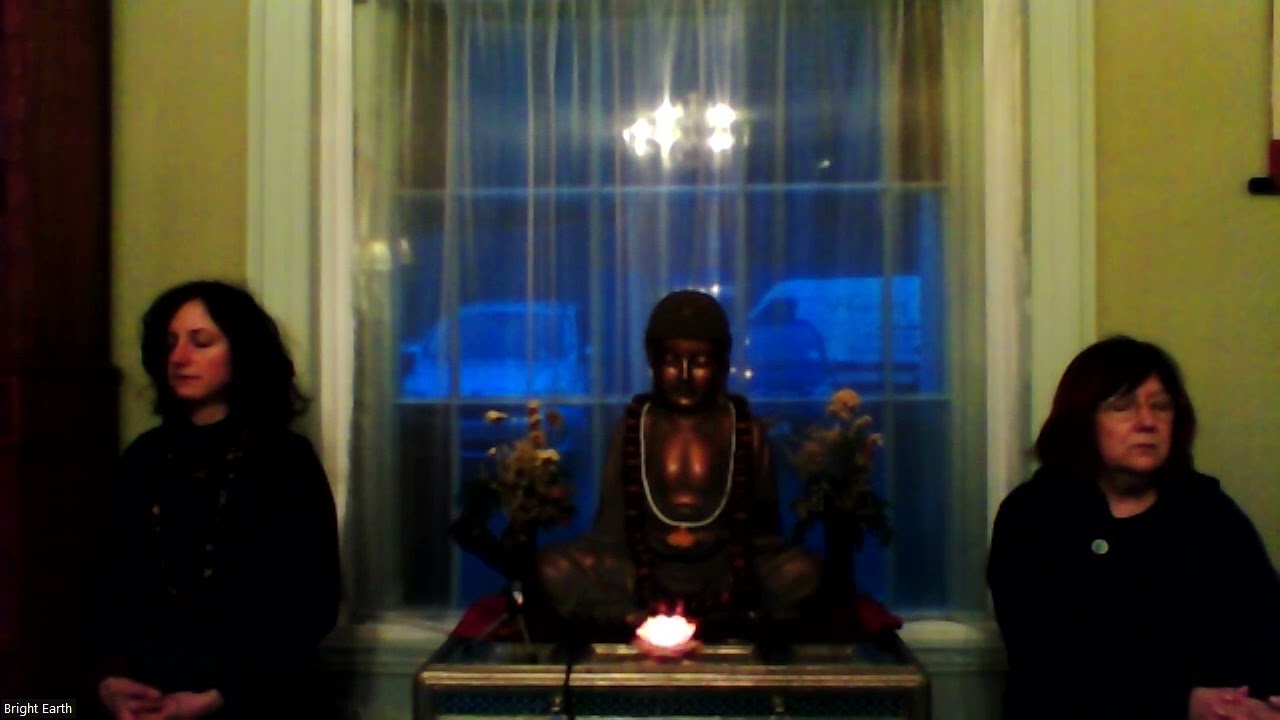
Philip Walbridge reflects on quieting the mind and opening the heart during a Buddhist practice session at the temple. The group does guided meditation and chanting, and Walbridge shares a story about finding the right chord on a shruti box for kirtan.
Chapters
Welcome everybody, well done for making it through this soggy, soggy spring evening to make it to here. And we've got Claire and Chris joining us on Zoom, and we'll go straight into a Dharma glimpse.
This one's a Dharma glimpse by Philip Walbridge. I've been listening to a track by John Hopkins. An English musician and producer of electronic and piano-driven music called Sit Around the Fire recently. I love it. The track has human connectivity. It was recommended by one Temple mate to another who then played it to me in his car on a trip over to the Sugarloaf Café in West Malvern, one of my favourite places in Malvern which now has a multitude of memories connected to it. This was one such memory. The track is based around a talk or talks by Ram Dass, an American spiritual leader according to Wikipedia. He has a calming, mesmerizing voice to me. One part which struck me and I've been reflecting on is his suggestion to quieten your mind and open your heart. How do you quieten the mind? He suggests that you meditate. How do you open your heart? He suggests you love that which you can love, such as a tree, a person, or an animal, and keep expanding it until you reach the source behind all of it. I start to be able to quieten my mind, not always, but sometimes. Really opening my heart is trickier, but I'm working on it. I wonder if there's also a need to let go. I'll tell you a short story. I was out walking on the beautifully named and pretty visually pleasing Half Moon Bay in Heysham up here in the northwest recently. There's a strangely beautiful contrast for me between the brutalist human architecture of Heysham Nuclear Power Station at the end of the bay, from the direction I come from anyway, and the natural architecture of the bay, its lush greenery, sinuous coastline, multitude of different shaped, sized, and shaded pebbles on the beach, and the flat, serene—at least on this day—slightly murky but nevertheless mesmerizing water. It hit me: I am causing myself unnecessary suffering by clinging on to things. I've been thinking of something specific recently in terms of clinging, but this truth hit me like a bolt from the blue, so that for a brief moment I could see and feel it with total clarity. It felt like a real dharma glimpse, of which I don't have many, if any. There is already so much pain there in this case, and I could see how much I'm clinging on to something that has gone, or perhaps was never really there. It's adding more pain. Attachment and impermanence suddenly came alive rather than merely words and concepts my ears hear. My brain processes, but which really haven't gone down into the murky depths of my being. Later on that day, I was reminded of a saying, "Dei me," passed on to me a year or two back: "I never let go of anything that hasn't got my claw marks all over it." Apparently attributed to David Foster Wallace, an American author, according to the internet. Almost unintended alliteration there. Maybe it's the human condition to cling on, cling on for dear life at different times, and for different parts of us, maybe all the time. Maybe it's our survival instinct as much as our ego, greed, and stupidity. Maybe they're all interrelated. Maybe for many of us, we're simply petrified to sit with our minds, open our hearts, and let go, knowing that impermanence and suffering are inevitable. Doing those things, I think, requires immense courage effort, and ultimately compassion and wisdom to know that we'll never do them perfectly, slipping back into old ways and habits time and time again. Thank goodness Amitābha Buddha accepts me just as I am, and that I can take refuge anytime to help me quiet my mind, open my heart, and let go, at least bit by painstaking but beautiful bit. Namo Amida Butsu.
Okay, so we'll move into a period of meditation.
So just making any little adjustments that you need to make. To help the body to be relatively at ease. Being aware of the body in the space we're in.
Space includes all the sounds around us.
Noticing the contact between the body and the floor and the cushion, the chair. These things which are holding us up, which are supporting us. So we're going to move into chanting the mantra Om Hamideva.
Free. Om Amideva Free.
Om Amideva Free. Om Amideva Free.
Om Amideva Free.
Oh, Mami, they worry.
Oh, Mami, they worry.
Om Ami Deva Sri.
Om Ami Deva Sri. Om Mani Deva Sri Ram.
Om Mani Deva Sri Ram.
Oh, Merry Day Warning. Oh, Merry Day Warning.
Oh, Merry Day Warning. Om Mani Deva Sri.
Om Mani Deva Sri. Om Ami Dev Wari. Om Ami Dev Wari. Oh, Mami Dei Wari. Oh, Mami Dei Wari.
Oh, Mami Dei Wari.
Breathe. Om Mary Devori. Om Mary Devori.
Om Mami Deva.
3. Oh, Mamie de Wari. Oh, Mamie de Wari. Om Nami Deva Hari. Om Nami Deva Hari. Om Nami Deva Hari.
Om Ami Deva Sri.
Om Ami Deva Hari.
For refuge I go to the Buddha.
For refuge I go to the Buddha.
Um, I do know this, but let's just come back. Um, it's not all that guides us towards compassion because that's the Dharma.
I'm full of light, love.
The one who is awake and full of love.
Namo Buddha.
For refuge I go to the Dharma.
For refuge I go to the Dharma.
All that guides us to wisdom and compassion.
All that guides us to wisdom and compassion. Namo Dharmaya. Namo Dharmaya.
For refuge I go to the Sangha.
For refuge I go to the Sangha.
Those who live in the Buddha's light.
Those who live in the Buddha's light.
Namo Sangha. Namo Sangha. With faith in the Three Jewels.
With faith in the Three Jewels.
I pray that I may not take life.
I pray that I may not take life.
With faith in the Three Jewels. With faith in the Three Jewels I pray that I may not steal. With faith in the Three Jewels I pray that I may avoid sexual misconduct. With faith in the Three Jewels I pray that I may avoid wrong speak.
I pray that I may avoid false speech.
With faith in the Three Jewels.
With faith in the Three Jewels.
I pray that I may avoid intoxication.
I pray that I may avoid intoxication.
No blame. No blame. Be kind. Be kind.
Love everything. Love everything.
Innumerable are sentient beings, we vow to save them all.
Inexhaustible are deluded passions, we vow to transform them all. Immeasurable Abhidharma teachings, we bow to master them all. Infinite Buddha's way, we vow to fulfill it completely. Mm.
So, a couple of years or so ago, I was riding around on my scooter. This was before I got my motorbike, and a Nambutsu came, came into me, began, began to be sung in my ears, and it wasn't one that I'd heard before, and I started to sing it and discovered its its full melody. And that's what I would do from that point on when I was riding around. I'd sing this new Nembutsu to myself, and it was wonderful, and it was very helpful and helped uplift me when I was riding around in pouring rain, or when my fingers were falling off with cold.. And then after a while I thought, okay, you know, I, I all, I'm already holding kind of kirtan mantra singing groups. Um, maybe I could share this, maybe I could share this with people. So I sat down with my shruti box. That's like a squeeze box that plays, uh, chords. And I thought, right, I'm just gonna, all I've gotta do is find the right chord. For this, and I played around for quite a long time, and I just couldn't find the right chord. So I found something that was good enough. It was, yeah, it was good enough. I could still sing it with a little bit of a variation of where it was pitched. It wasn't quite right. It wasn't quite the full freedom of expression that was— had happened when I was riding around. But it was, it was good enough. And so that was how I started to share it and to sing it, was with these other notes that were almost good enough but not, not quite. They were, they were a little bit like a shoe that's just not quite the right size. And from time to time I'd play around with different chords to try and find the one that was the fit, so it was the true fit. And I just couldn't do it. Find some notes and I think, oh, maybe this is a little bit better, and then it wasn't at all, and I'd revert back to the original chord that I was playing with it.. And this is how it was for, well, since it came to me really, so for a couple of years or so. And again, from time to time I'd play around and maybe you could say that I was straining, I was striving, you know, when I was playing around, I was striving to find the right, you know, the perfect fit. And I just couldn't find it. And it was, I thought it was a really quite a good metaphor for my imperfect expression and the part of me that was striving to get it right. I just couldn't get it right in the, you know, the Mpondu nature. But I kept playing around with it, kept singing it, kept chanting it. And then about a week ago, I was playing around with some other notes, maybe a week or so ago. And I actually found the perfect chord. And it was like, it was like there'd been a rock in the stream and somehow all by itself over a couple of years of practicing it, that rock had just disintegrated or it'd been moved to the side and the water was able to flow freely. And it was like the full expression of this Nembutsu. And I was like, you know, I was in bliss. I was like, this is the perfection. And, and then the next opportunity came to share this with other people, which is the kirtan that I was holding, um, last Sunday, uh, last Sunday night. And I started playing the perfect chord. And I couldn't find the right notes. I just couldn't find where to, where, where, where to start. And, and I was thrown completely back into, oh my God, I have no idea what I'm doing. It's so perfectly thrown back into my, you know, my fallabu, bombu foolish beingness. Alongside the perfection of the divine of the Nembutsu. And, you know, after a while, I was actually able to find the right notes and able to sing it. But I just thought it was so, so beautiful. It was just such a funny and perfect expression of of the, um, of the Leela. It's almost like the Leela, like the divine play, like of, of my humanness trying to, trying to, to, to find the perfect embodiment of the divine and playing around with that and getting tripped up and tripping myself up.
Um, yeah.
Namaste.
Namora me, Charlie. Namora me, Charlie. Namora me.
In gratitude, we offer this incense to all Buddhas and Bodhisattvas throughout space and time. May it be fragrant as Earth herself, reflecting our careful efforts, our wholehearted awareness, And the fruits of understanding slowly ripen. May we and all beings be companions of Buddhas and bodhisattvas. May we awaken from forgetfulness and realize our true home. Do we have any announcements? Next retreat day, uh, 8th.
Thank you, Saturday the 8th on Foolish Beings. I can't remember dates.
We've got, we've still got, um, a couple of spaces. Last plug for Angie's book group, which is running here at the temple on Sunday nights from 7:30 to 8:30. Dave's in the group, Izzy's in the group. It's going to be a really lovely, friendly group, quite short chapters for a long time. So if you want to join and speak to Angie after— Blessed by Amitabha's light, may we care for all living things on the holy earth. Nam-myoho-renge-kyo. We release.









