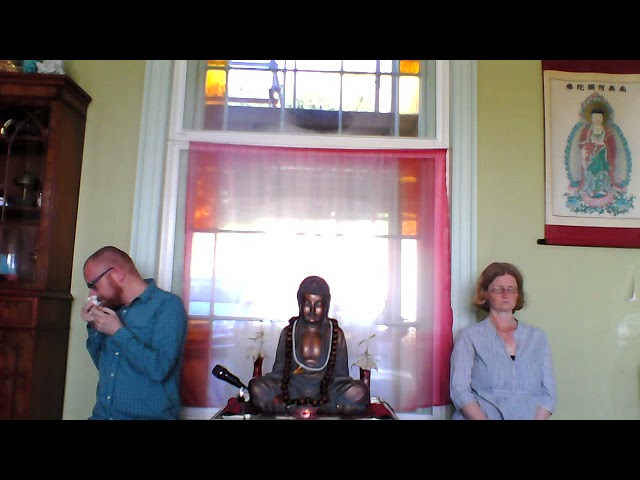
Caspar leads a Buddhist practice session with chanting, refuge vows, and a dharma talk on gratitude. The group recites together from a shrine room, then discusses upcoming temple fundraising and garden practice plans.
Chapters
Good morning everyone, this beautiful morning. Caspar will be leading practice this morning, and I'd like to welcome from inside the shrine room, Jyame, Philip, and Dave. Me, and Taylor and Andesh are joining us from elsewhere, so it's all the men this morning.
Thank you. I feel really good this morning. I felt quite joyful. It's unusual for me. Quite grateful. I've had a good week. Had some good news, and naturally there's an impulse to spread the joy, to spread the gratitude, to want other people to feel this way. Isn't this what the spiritual life is all about, getting these sorts of feelings? Just practice being joyful. If only it was so easy. If I could just say that, then we would all be joyful. My job would be very easy and everybody would be really happy. Around me. But I know from being on the other end of that, that it isn't so simple. When I'm feeling low, somebody saying, 'Just practice being joyful,' or even, 'Just practice gratitude,' can be a really hard thing to find. And sometimes when I look at Buddhist teachings through the ages, I notice this tendency for teachers to write and speak from this place of joy and of gratitude and of, uh, from enlightenment, you know, from the feeling of faith, from the place of faith. From what's called the other shore in Buddhism. This idea that they've crossed over from this side where there's greed and hate and delusion. They've gone across the river to where there is lightness of touch, where there are no fraught desires, where there is no anger and ill will, where there are no hell realms, as it says in the Pure Land Sutra. And if you're not far away from that place, if you're sort of halfway in the river or something, seeing somebody who's lit up in that way and hearing them speak about how wonderful it is over there can be really inspiring. And that's a really important position to hold. It's, it's why we, uh, it's part of the reason we used to do sutra, the Pure Land Sutra recitation, because it reminds us of that imagery, reminds us of how wonderful the thing is that we're heading towards. And in the, the Lotus Sutra The Buddha even uses this parable of the illusory castles to get people to step forward, and each time they get there, the sort of the castle disappears and there's another bit of the journey to go on, which perhaps is more disheartening than he'd intended. But there is something about being drawn forward by lovely things, by the idea of nirvana and heavenly abodes. Which is really important. But if you're further, if you're a bit further away, if you're not, if you're this side of the, the river, all of that can sound a bit far-fetched when you're mired in low moods and ill will. The low moods, the ill will they make complete sense from the point of view of being in them. You know, think of that angry teenager slamming the door and stamping around upstairs. From their point of view, that is a perfectly rational response to the world. And just saying, oh, just be a bit more joyful, or just be a bit more grateful, it doesn't quite hit the mark. So I've stopped saying to people, practice gratitude. Instead, I might encourage them to think about what they've received. I might encourage you to think about what you've received, which is a kind of act of accounting that we can do regardless of what mood we're in. And it may or may not shift anything. Maybe it just shifts things incrementally, slightly towards gratitude, but it grounds us a bit more in a reality that is beyond our own low moods and ill will, without, without dismissing them, without disrespecting them. And this is really important balance when we're stepping on the spiritual path, to have respect and understanding for these moods and feelings and thoughts that overtake us, if we can, without completely buying into them, without completely accepting that they're the whole truth. Pema Chödrön writes about this kind of practice really well, um, making friends with whatever difficult feelings are around, making space for them. It's a practice of saying yes and yes, anger, of course you're here, of course I'd be angry about this, and here's something I've received today that I hadn't paid attention to. And this is what faith in the Buddha allows us to do, to take that path a step back so that we can meet ourselves. Not so that we're dismissing ourselves or sort of kidding ourselves that we're in a pure land when maybe that isn't our experience in that moment. But so we can really go, oh, this is the place that I'm in. This is what's here at the moment. This is how I'm feeling. And it isn't the whole story because when I'm joyful, when I'm grateful, when I've had a, a good week and, and those feelings those, those more negative feelings aren't around. What I feel is these feelings are more congruent with reality. This is more— this is the more— the joyful position often is the more enlightened position. Not always, often the grateful position is the more enlightened position. But we're human beings, we're not always in the enlightened position. It's really important to respect the journey as well as the destination. Namaste. So I won't instruct you to be grateful this morning, but you might want to take stock of the things that you have received, maybe just since waking up this morning. Shelter, food, warmth from the sun, oxygen.
Clothes.
What is it that has supported you? What's, what's allowed you to get here? What have you received? And when you really start examining the detail, even that kind of piece of toast that I had for breakfast, all of the different elements of work and growing and production that go into that Starts to become a very long list. We'll do some Kwan Yin chanting together. Satya Robyn, pop the words in the chat for me.
Namah Kwan Shin Bosat. Namah Kwan Shin Bosat. Namah Kwan Shin Bosat. Namokwan Shinbosa. Namokwan Shinbosa. Namokwan Shinbosa.
Namokwanji in Bosa. Namokwanji in Bosa.
Namokwanji in Bosa. Namokwan Jin Bosat. Namokwan Jin Bosat. Namokwan Jin Bosat. Namokwanji in Bosak. Namokwanji in Bosak. Namokwanji in Bosak. Namokwanji in Bosatsa. Namokwanji in Bosatsa.
Namokwanji in Bosatsa. Namokwanji in Gosha. Namokwanji in Gosha. Namokwanji in Gosha. Namokwanji in Gosha. Namokwanji in Gosha. Namokwanji in Gosha. Namoh Quan Chi in Bosa. Namoh Quan Chi in Bos— Satya Robyn. Namoh Quan Chi in Bos—
For refuge I go to the Buddha. For refuge I go to the Buddha. Namo Buddha. Namo Buddha. For refuge I go to the Dharma . Namo Dharmaya , for refuge I go to the Sangha Namah Sangaia . With faith in the Three Jewels— —I pray that I may not take life. With faith in the three jewels With faith in the Three Jewels I pray that I may not steal. With faith in the Three Jewels I pray that I may not fall into sexual misconduct. With faith in the Three Jewels I pray that I may not fall into wrong speech. With faith in the Three Jewels, I pray that I may avoid intoxication. Innumerable sentient beings, we vow to save them all. Inexhaustible attitude of compassion, we vow to transform them all. Immeasurable are the Dharma teachings. We vow to master them all. Infinite is the Buddha's way. We vow to fulfill it completely.
Amo ami, amo ami, amo ami, amo ami.
Satya's put the closing verse in the chat, so if you're on Zoom, please do unmute and we will say the final words together. Blessed by Amitabha, may we care for all living beings and the holy earth.
Announcements. In the chat box, there is our fundraiser for the painting of the temple, which is now at £1,720. So thank you if you've already donated. And I'm giving a talk at 6 PM tonight on how to be gentle to yourself, and the Zoom link is on our website. We'd love to join us. And we're going to go outside and do some garden practice now. So Chloe, Taylor, and Aisling, and Bea and Becky came, I think, or are you in your house? I'm at home because it's hairdresser Saturday. Oh, it's hairdresser Saturday. So we're not getting going with the garden. Anyway, lovely to see you all, and see you all again soon.
Māua. Thank you.
Bye everyone, we've got to rush downstairs.









