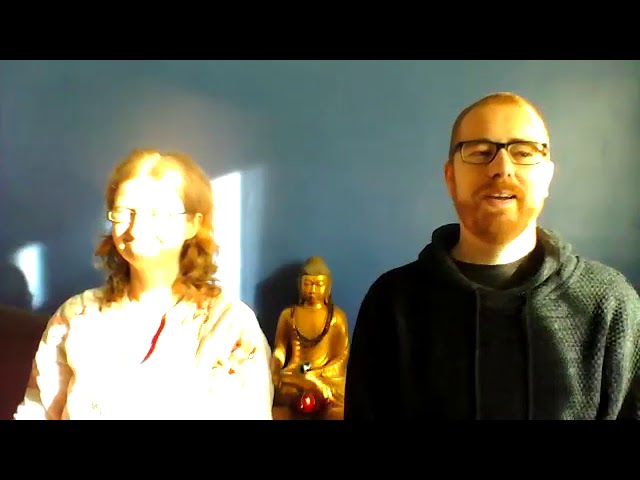
Satya Robyn leads a Buddhist practice session on receiving wisdom and handing problems to the Buddha. The group chants Amitabha, recites refuges and precepts, and performs prostrations. References include Reverend Koshin Schomburg and the I Ching.
Chapters
Welcome everybody, beautiful morning here. This is why television studios don't have any windows in so they can control the light. I think if I move over, I'm just going to be overexposed, I think, because of the sunshine. That's okay, it's nice to see the sun anyway. I was wondering what I might speak about this morning, and I went back— well, I flicked through several books that I've got on the go And the thing that jumped out at me is from— I can never remember the name of the person who wrote it, even though I've used it a few times in service— by Reverend Koshin Schomburg, the commentary on How to Grow a Lotus Blossom. And he's talking about receiving wisdom. And the way that he speaks about it is a way that you don't hear very often in Western Buddhist texts. If you sort of search around, you can find this kind of thing around the edges sometimes, but it's not really part of mainstream Western Buddhist practice. He's talking about the idea of being guided by the Buddha, of bringing a question, like a question about how should I deal with this thing in the real world, for example, into your meditation practice, into your chanting practice, and coming away with some new insight. I guess that is spoken about in Western Buddhist practice, in the sense of as your mind settles and clears, sometimes new thoughts appear. But it's very explicitly described in this book as receiving wisdom from the Buddha, a sense of something coming from the eternal is how it's described. Let me read a little paragraph. From this position of meditative effort, one can entrust every thorny problem to the Eternal, waiting patiently for the teaching that will help the need. As noted above, timing is critical, and very often the way forward will not appear until it is actually time to take the next step. It is essential to remember that the Eternal is the one in charge, not oneself. This helps us to be patient, but it also helps us to move as quickly as necessary if and when the green light goes on. Senior partner: the Eternal. Junior partner: me. Reminds me a little bit of years ago, I was reading a piece by a science fiction author, not somebody who's current now. He was describing how he dealt with coming up against writer's block when he was writing a short story or a novel, and he said, 'I would just hand it over to Bob.' And Bob wasn't a real person, it was just this, the name that he'd got for this process that happened out of the sight of his conscious awareness. He said he would kind of say, 'Bob, I don't know what needs to happen next in the story, I'm handing it over to you.' And then maybe the next morning he would wake up and Bob would have presented him with the outline of the next chapter. And I think the reason we, um, we shy away from discussing this kind of experience in the West is because we like to be in control. Like I said at the beginning, you know, in a TV studio, we close all the windows so we can be in control exactly of what's being presented. Sometimes we need to open the windows and let the sunshine in so something new can appear. And there is something about newness here. Often when we're just thinking ourselves and trying to work things out ourselves, we just, we try out solutions that have worked before for us. We go around the same circles, maybe being slightly slightly different, but it's like we've got a load of Lego blocks and there's a limited number of ways they can be put together, so there's a limited number of solutions that we know. But asking the Buddha for guidance allows for the formation of a new Lego block, a new shape, and suddenly the creative solution appears that wasn't possible before. Jacob, Jacob Moreno, and the, the guy that invented psychodrama, described new ideas as God entering the the world. When something new appears in the world, that's a sign of God appearing in the world. And there's echoes of that in this process as well. When we put ourselves in the way of thinking that the early Buddhists have. It isn't just the Buddha that might influence us from the outside, of course. There's all these other wild forces, the devas, the rakshas, some of which give good advice, some of which give bad advice. Mara, who sends his daughters to seduce the monks. So in that view of the world, it is important that we direct our question to the right person, to the Buddha, to a Buddha. And one of the ways of Checking. I guess I'm speaking to the part of me that feels very uncomfortable in this realm. One of the ways of checking that the answer that appears is from the Buddha is to check it against the precepts that we've been given. Is it Is it an action that will cause harm or not? At the beginning of this week, I received a message that I didn't quite know what to do with, and I found myself getting very tangled up in how to respond and also in what the words that I had been sent meant, to the point where I was sort of— it was all that was with me trying to work out and how to make some sense of this message. Did I need to change what I was doing somehow? Did I need to write something back? Did I need to write to other people? So I came in front of a Kuan Yin statue, lit a candle with some incense from the candle, Made some prayers, flipped some coins, and opened a page of the I Ching, which for me sometimes is a helpful way of cutting through my rational mind and opening up a space for some other kind of answer to appear. Read through the pages that it guided me to, went back into my practice, and the thing that appeared was essentially, um, don't get lost in the words. What you do is more important. And this really strong intuitive sense of just keep doing good things in the world, and this situation, one way or another, this situation will resolve itself. And you don't need to worry about the sort of the views and the words of other people. Those things will take care of themselves. And that knot which had been living with me for a couple of days dissolved. I slept well at night, I woke up in a good mood. Now you might just say that all of that ritual gave me access to something in my unconscious mind that already knew the answer. But my experience was like the experience described in the piece that I read at the beginning, that I was the junior partner and something else was the senior partner. And when they sent the advice, all I had to do was follow it. And to parts of me, it still feels a bit risky talking about this stuff because it's so out of this kind of rational scientific model that I grew up with. And yet it happens over and over again in my practice that I reach some point of not knowing what to do with myself or how to respond in the world and bring it to the meditation cushion and make an offering. And some new thought appears that directs me to the right course of action. And in those moments where I do hand things over and do then follow the answer that appears, things work out. Nam-myoho-renge-kyo. So as we go into our quiet sitting this morning, there might be something, some question, some confusion in your mind that you want to invite into the light of the Buddha. Just holding these two things together, the, the not knowing how to respond from our own side and trusting that there is something that can deliver an answer. And it may come during the practice, or it may suddenly appear in your daily life at just the right time. Namaste.
Amitabha. Amitabha. Amitabh. Amitabh. Amitabh. Amitabha. Amitabha. Amitabha. Amitabha. Amitabha. Amitabha. Amitabh. Amitabh. Amitabh. Amitabha. Amitabha. Amitabha. Amitabha. Amitabha. Amitabha. Amitabha. Amitabha. Amitabha. Amitabh. Amitabh. Amitabh. Amitabha. Amitabha. Amitabha. Amitabha. Amitabha. Amitabha. Amitabha. Amitabha. Amitabha. Ame taba. Ame taba. Ame taba. Amitabha. Amitabha. Amitabha. Amitabha. Amitabha. Amitabha. Amitabha. Amitabha. Amitabha.
Amitabha.
Amitabha. Amitabha. Amitabha. Amitabha. Amitabha. Amitabha. Amitabha. Amitabha. Amitabh. Amitabh. Amitabh. Amitabh. Amitabha. Amitabha. Amitabha. Amitabha. Amitabha. Amitabha. Amitabha. Amitabha.
All right, so please repeat the refuges and precepts. For refuge I go to the Buddha.
For refuge I go to the Buddha.
Namo Buddha.
Namo Buddha.
For refuge I go to the Dharma.
For refuge I go to the Dharma.
Namo Dharmaya. For refuge I go to the Sangha.
Nammo sanghaya.
With faith in the Three Jewels—
with faith in the Three Jewels—
I pray that I may not take life.
I pray that I may not take life.
With faith in the Three Jewels—
with faith in the Three Jewels—
I pray that I may not speak lies.
I pray that I may not steal—
With faith in The Three Jewels .
—with faith in The Three Jewels.
I pray that I may not fall into sexual misconduct. —With faith in The Three Jewels. —I pray that I may not fall into wrong speech. —With faith in The Three Jewels. —I pray that I may avoid intoxication.
I pray the time I avoid intoxication. Innumerable are sentient beings.
We vow to save them all. Inexhaustible are deluded passions. We vow to transform them all. Immeasurable are the Dharma teachings. We vow to master them all.
Infinite is the Buddha's way.
We vow to forfeit completely. So now we'll stand for prostrations together.
Namoh Amitabh. Namoh Amitabh.
Namoh Amitabh. Namoh Amitabh.
Namoh Amitabhu! Namoh Amida! Namoh Amida! Namoh Amitabhu! Namoh Amita Bu! Namoh Amitabh. Namoh Amitabh.
Namoh Amitabh. Namoh Amitabh.
So we finish by bowing to each other, to the Buddha, very important. And then if you're willing to unmute, we'll Say the closing verse together. Just waiting for Satya Robyn to unmute. There we are. Blessed by Amitābha's light, may we care for all living things and their homes.









