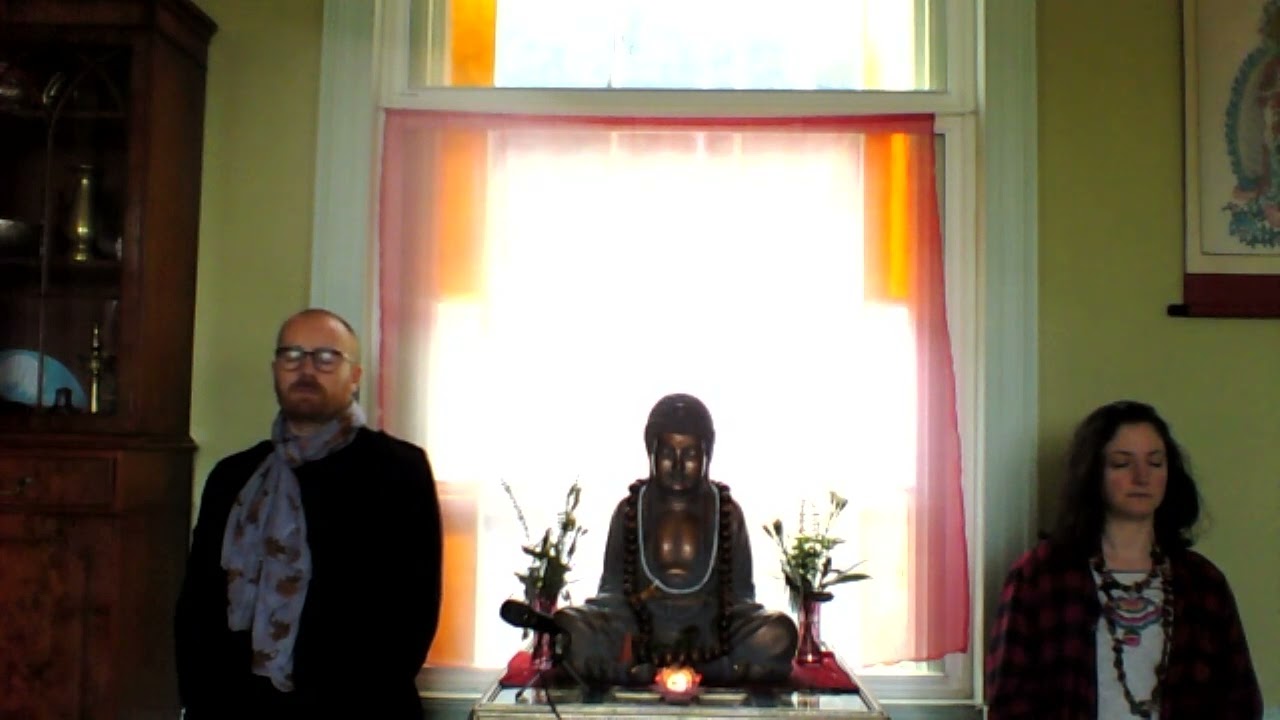
A Buddhist practice session from Bright Dawn's Pure Land community led by multiple speakers. The service includes meditation, chanting of Amitābha, and detailed commentary on the five lay precepts, with focus on the precept against taking life as an ethical mirror for practice.
Chapters
Good morning everybody, welcome. No one joining us on Zoom yet, but somebody may drop in at any moment. We'll begin as we always do with Dharma Glimpse, just a little snippet from somebody. Sometimes that someone from our community has written, but today I'm just going to read to us from the Book of Dharma Glimpses from, uh, Bright Dawn Community. Over to you.
Acknowledging limitations. Recently, our group has been exploring the topic of realizing enlightenment through whatever means we have as a group. Humans tend toward the dramatic and glamorous, so sometimes we think we will get to enlightenment by a grand gesture or event. I've been exploring the concept of enlightenment through acknowledging limitations over the past few weeks and find it very liberating. There are so many judgments we have as individuals, as a society, or culture about what we should or should not be doing. For instance, someone with a very strong work ethic can feel very useless unless they are constantly engaged in some result-oriented task. When we encounter limitations in life, whether financial, physical, or mental, we tend to judge ourselves and feel guilt. In the past few weeks, I've had a chance to choose a different response to my own limitations. Rather than feeling guilty or defeated, I've experienced acceptance. After acceptance sets in for a while, I was able to see reasons to appreciate these limitations and have been able to use them as a springboard for new opportunities I could not have seen before. To me, this is a glimpse of enlightenment, and it keeps me going when things seem too challenging. As long as we are in resistance to a problem, we cannot see the way out. By resisting, we are in a state of mind that believes in duality. There is a problem and then there is me. They are two separate entities. By practicing acceptance, we become one with limitation. And thereby are empowered to move past it. Namu Amida Butsu.
So we have a period of—
we have a period of quiet sitting together. Invitation to begin with your awareness. On the breath, noticing cooler air entering at the tip of the nose, warmer air leaving. Not trying to change the breath, just noticing how it is moment to moment. And if, when something else catches your attention, noticing what you're noticing— oh, here's a train of thought about such and such Oh, now my attention's been caught by the bird. Oh, now I'm noticing a feeling in my back. So just taking that step back to name what has caught your attention and then returning to the breath.
We're going to move into a period of chanting.
Now, excuse me, we'll recite the name Amitābha together. Amitābha is the Buddha of infinite light. And what is the light? Simply love. Buddhism isn't particularly about trying to describe the world. It's trying to describe and support spiritual experience and the experience of being human in the world. So Pure Land Buddhists don't necessarily believe that if you walk far enough, eventually you will get to the Pure Land, many millions of miles away, away in the West, as it's described in the ancient texts. But we do recognize that sometimes we have the experience in our practice or spontaneously of stepping into a realm of loving kindness, that there is a sense that the pure land is here all around us. We just need to sort of tune into the right frequency. So when we're speaking about the Pure Land, we're speaking about this trusting that there is a field of loving kindness that is available to us. And sometimes we have the experience, and practitioners through the ages have had the experience, of not just being able to kind of tune in themselves and or step into that place themselves, but of something of that energy coming towards them from its own side. This is what we call Amida Buddha, the Buddha of infinite light, sending loving kindness towards us, particularly in those times where we can't find the capacity to generate any ourselves. So as we chant the name Amitābha, which is the Sanskrit for Amita, just playing around with the idea, experimenting with the idea that we can trust in this loving kindness that surrounds us, and maybe even that it's coming towards us.
Amitabha. Amitabha. Amitabha. Amitabha. Amitabha. Mami. Amitabha. Amitabha. Amitabha. Amitabha. Amitabha. Amitabha. Amitabh. Amitabh. Amitabh. Amitabha. Amitabha. Amitabha. Amitabha. Amitabha. Amitabha. Amitabha. Amitabha. Amitabha. Amitabha. Amitabha. Amitabha. Amitabha. Amitabha. Amitabha. Amitabha. Amitabha. Amitabha. Amitabha. Amitabha. Amitabha. Amitabha. Amitabha. Amitabha. Amitabha. Amitabha. Amitabha. Amitabha. Amitabha. Amitabha. Amitabha. Amitabha. Amitabha. Amitabha.
We'll now recite the refuges and precepts. The refuges are traditional, three refuges traditional across the whole of Buddhism, and describe or point to three of the main ways that we can access or be inspired by this energy of loving kindness. Kindness. So the first thing we take refuge in is the Buddha, the individual who started this tradition 2,500 years ago. The title Buddha meaning awakened one. So as well as taking refuge in that individual, also in all other awakened beings wherever we might find them, whether they call themselves Buddhist or not. In the Dharma, which means both the teachings of the Buddha, as they— the words that appeared from his mouth, and also the sort of reality of those teachings that we can encounter in any moment. And in the Sangha, the community of people putting those teachings into practice. And then we'll recite the precepts, which I'll say a little bit more about later— excuse me. So please repeat after me. For refuge I go to the Buddha.
Refuge I go to the Buddha.
Namo Buddhaya. Namaste for refuge. I go to the Dharma.
For refuge I go to the Dharma.
Namo Dharmaya. For refuge I go to the Sangha.
For refuge I go to the Sangha.
Namo Sanghaya. Namo Sangaya!
With faith in the Three Jewels—
I pray that I may not take life. With faith in the Three Jewels— I pray that I may not steal. With faith in the Three Jewels— I pray that I may not fall into sexual misconduct. No blame.
No blame.
Be kind.
Be kind.
Love everything.
Love everything.
Innumerable are sentient beings.
We vow to save them all.
Inexhaustible are deluded passions.
We vow to transform them all.
Immeasurable are the Dharma teachings.
We vow to master them all.
Infinite is the Buddha's way.
We vow to fulfill it completely.
So I'll say something about the 5 lay precepts, which we recited just now in the form, I pray that, etc., etc. These are the precepts, the ethical guidelines that were given to lay people in the Buddha's time. So not to nuns or monks, but ordinary working people who wanted to follow the teachings. Of the Buddha, and they have been recited in various languages throughout history since then. It's about 2,500 years, and that's part of the reason we still recite them to this day, because it joins us up with that community. If you were starting from scratch, you might choose a different 5 things to put at the top of your list. And at the same time, when we really drill down into any one of them, actually we find that it opens and opens and opens, and we can discover the whole of an ethical life through the window of one precept. Someone said to me recently, why do you have to tell people not to kill each other? Surely that should go without saying. And I guess At some points in history it hasn't gone without saying. No, it's— it still isn't true. Maybe if you're showing up on a Buddhist retreat or to a Buddhist practice session properly, you know that you shouldn't be killing the other people in the room. And yet there it is at the top of the list reminding us just in case we'd forgotten. The literal translation is something like, 'I undertake the training to refrain from taking life.' And there's all sorts of things that we kill, even when we think we're living a pretty decent life. If we're not killing actual human beings, we contribute to harm in all sorts of ways. We might kill somebody's enthusiasm or their spirit or their kindness. That's one way that we can take life from people, by, by doing or saying things that create a sort of deadening effect in the people around us. Even if we're living a vegan lifestyle, we're still inevitably causing harm to other living beings. The whole of the farming— it's not the whole of the farming system. Most of the modern farming system causes a lot of harm to the planet, and yet we have to eat. So most of us at some point collude with that so that we can sustain ourselves. And we do things to harm ourselves as well, but that fall under this precept. Feeding ourselves, physically feeding ourselves things that are harmful, mentally feeding ourselves things that are harmful, killing our own spirit, killing our own liveliness. And the parts of us that are doing that think they've got good reasons. You know, it's a kind of self-protection. The reason this precept is framed as in the original, I undertake the training, and as we do, I kind of pray for support that I'll be able to manage this, is because they're not supposed to be heavy things that weigh us down and that we used to beat ourselves up with, which is so easy, particularly if we've some experience of other religious communities where rules were used in that way. You must be good, otherwise something bad will happen. They're pointers to things to be curious about, to check in with that every now and again. Oh, am I doing anything? Am I doing anything that's a bit like killing? Am I doing anything that moves me in the direction of hatred, as, uh, Reverend Koshin Schomburg put it in a talk that we listened to. He said, I try to avoid things that move me in the direction of hatred, which is very wise. And what do we do when we discover that that has happened? We try to bring that energy of loving kindness to it. Reverend Koya Kabose who started the Bright Dawn Center, where the reading is from. Gyomei. Thank you. Gyomei Kobo Tsai. His son is Koya. He talks about acceptance transcendence. The first thing we need to do is embrace the activity. Oh, this is here. That's interesting. I'm doing that. Okay. I wonder why that's happening. Allow it to be true. It already exists in our lives. So finding ways of seeing it clearly, bringing that friendly energy to it. And then maybe it's possible to take a step beyond. Well, like we heard in the reading, first you have to accept your limitation, and then maybe something new appears. So the precepts are mirrors. They can be mirrors like this, and, and they can be really good to practice with if, if we take them in that spirit and can find ways to stay curious and kind towards ourself. Through that process. And I guess that's the great thing about being Pure Land Buddhists, being devotional Buddhists, is that when we can't quite manage that ourselves, we can trust that the Buddha is gazing on us kindly, whether we're keeping the precepts or not, whether we're managing to be curious about keeping the precepts or not. And the more that we trust that kind gaze the easier it is to engage in this kind of investigation I'm describing.
Namamitabha.
So we now have a time for prostrations, which is another way of— an embodied way of taking refuge in those things I was describing. Do you find a place with some space in front of you?
We do a pre— preset prostration, swipe down to the ground, and feel free to join in with as much or as little as your body allow. We dedicate the merits of this incense offering to all Buddhas and bodhisattvas throughout space and time. May it be fragrant as earth herself, reflecting our careful efforts our wholehearted awareness, and the fruits of understanding slowly ripening. May we and all beings be companions of Buddhas and Bodhisattvas. May we awaken from forgetfulness and realize our true nature. Salve, Padmasahaja. Om Shanti Namah Shivaya.
And we'll turn to our seats and bow to our seats to thank them for supporting us.
And we'll recite the closing verse together, which is on the top of the piece of paper.
Blessed by Amitābha's light, may we care for all living things.









