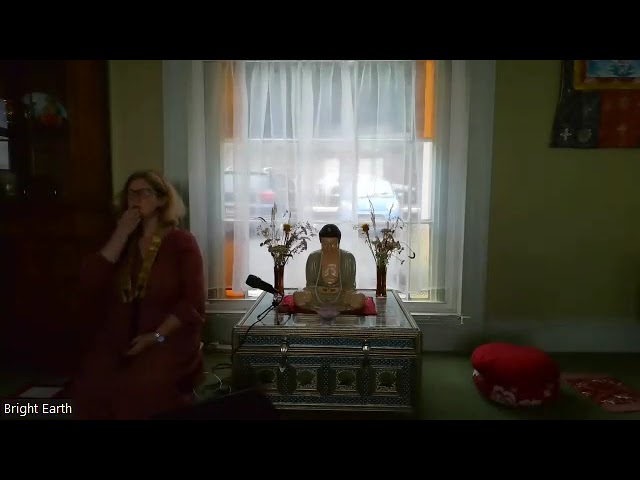
Satya Robyn leads a Buddhist practice session with guided meditation, readings from Mark Nepo's The Book of Awakening, and call-and-response chanting of the Four Refuges and vows. The group reflects on living in community and Pure Land Buddhist themes, then covers temple announcements about residential rooms, an open day, and upcoming retreats.
Chapters
Good morning everyone. Welcome to Rob and Chris joining us on Zoom. And this morning I'm going to begin with a reading from, uh, Mark Nepo, and it's from a book of very short pieces called The Book of Awakening, and it begins with a quote from the Talmud. When Akiba was on his deathbed, he bemoaned to his rabbi that he felt he was a failure. His rabbi moved closer and asked why, and Akiba confessed that he had not lived a life like Moses The poor man began to cry, admitting that he feared God's judgment. At this, the rabbi leaned into his ear and whispered gently, 'God will not judge Akiba for not being Moses. God will judge Akiba for not being Akiba.' So then the commentary— Mark's commentary on this is We are born with only one obligation: to be completely who we are. Yet how much of our time is spent comparing ourselves to others, dead and alive? This is encouraged as necessary in the pursuit of excellence. Yet a flower in its excellence does not yearn to be a fish, and a fish in its unmanaged elegance does not long to be a tiger. But we humans find ourselves always falling into the dream of another life, or we secretly aspire to the fortune or fame of people we don't really know. When feeling badly about ourselves, we often try on other skins rather than understand and care for our own. Yet when we compare ourselves to others, we see neither ourselves nor those we look up to. We only experience the tension of comparing, as if there is only one ounce of being to feed all our hungers. But the universe reveals its abundance most clearly when we can be who we are. Mysteriously, every weed and ant and wounded rabbit, every living creature has its unique anatomy of being, which when given over to, is more than enough. Being human though, we are often troubled and blocked by insecurity, that windedness of heart that makes us feel unworthy. And when winded or troubled, we sometimes feel compelled to puff ourselves up, for in our pain it seems to make sense that if we were larger, we would be further from our pain. If we were larger, we would be harder to miss. If we were larger, we'd have a better chance of being loved. Then, not surprisingly, others need to be made smaller so we can maintain our illusion of seem— seeming bigger than our pain. Of course, history is the humbling story of our misbegotten inflations, and truth is the corrective story of how we return to exactly who we are. And compassion, sweet compassion, is the never-ending story of how we embrace each other and forgive ourselves for not accepting our beautifully particular place in the fabric of all there is. So there is also a little meditation at the end of this piece, and maybe I'll read that out too, and we can do it if you would like to. Um, and it begins with filling a bowl with water and looking at your reflection. So instead, you'll just have to imagine looking at yourself in a reflection of water. And as you look at yourself, allow yourself to feel the tension of one comparison you carry, one person that you're jealous of, one, thing that you feel like really fail at, that someone else really gets perfect. And if it feels okay, just allow yourself to feel the pain of that measurement, that measuring yourself against another. And then when you felt that, look at your reflection again and see how is it— how it is to, to, to not compare yourself with anyone. So just see what you see and allow yourself to feel what makes you unique and let this move through you. Namaste. As we chant together today, you might want to imagine Amida looking at you. And loving you just as you are.
Om Nami Devi. Om Nami Devi. Om Nami Devi. Free. Om Amideva Om Amideva Om Amitur Omami te wa free. Omami te wa free. Omami te wa free. Om Namite Wah. Om Namite Wah. Om Namite Om Ami Deva. Om Ami Deva. Om Ami Deva. Om Namideva Sri. Om Namideva Sri.
Om Namideva For refuge, I go to the Buddha. For refuge, I go to the Buddha, the one who is awake and full of love.
The one who is awake and full of love.
Namo Buddha.
Namo Buddha.
For refuge I go to the Dharma.
For refuge I go to the Dharma.
All that guides us to wisdom and compassion.
All that guides us to wisdom and compassion.
Namo Dharmaya.
Namo Dharmaya.
For refuge I go to the Sangha.
For refuge I go to the Sangha.
All who live in the Buddha's light.
All who live in the Buddha's light.
Namo Sanghaya. For refuge I go to the Earth.
For refuge I go to the Earth.
The holy ground of awakening.
The holy ground of awakening.
Namo Bhumya.
Namo Bhumya.
With faith in the Four Refuges.
With faith in the Four Refuges.
And in light of our human tendencies.
And in light of our human tendencies.
We pray that we may become aware We pray that we may become aware of when we fall into wrong speech.
Of when we fall into wrong speech.
We pray that we may become aware.
We pray that we may become aware of when we become intoxicated. Of when we become intoxicated.
No blame.
No blame.
Be kind.
Be kind.
Love everything.
Love everything. Innumerable are sentient beings.
We vow to save them all.
Exhaustible are devoted passions.
We vow to transform them all.
Immeasurable are the Dharma teachings.
We vow to master them.
Infinite is the Buddha's way.
We vow to follow it completely.
Mimi Dabu. So the talk was about being who we are. Um, I, uh, a year and a half ago maybe started to realize that the person that I was currently, not in the past, was someone that didn't want to live in community. And that was a real problem in various ways, partly because I'd made a promise to, to stay in the temple for a certain amount of time, partly because maybe Casper didn't entirely have those feelings and we lived together, and partly because— probably even mostly because I hold living in community as a bit of an ideal, as a spiritual, uh, something to aspire to. And I really liked the idea of being the kind of person who suited living in community, someone that was flexible enough or that, um, you know, didn't need privacy or that didn't get tired by being around other people. And so for a while there was a, a difficult conversation, several difficult conversations that went on around that in my head and outside of my head. Um, and it became necessary to have those conversations because the levels of discomfort from the parts that weren't suited to, to living in community, or, you know, to living in a community where we were running the community, especially. Um, they got kind of loud enough that I had to pay them attention. And even though it was very difficult, there was a relief in being able to admit to myself that this was true about me, that it's just who I am. And now that we've been in our new place for 2 months, 2 months today, um, I feel more resourced to offer the Dharma. I feel more resourced to come here and run practice and then go somewhere else to offer a book group to run an Open Morning, all those things, all those good things, because my living conditions are different. And I think, well, in my experience, it's often ego that gets in the way of us seeing when we are not something that we hoped to be, or we're not that yet, or we're just not that at the moment. That we are not handling something or that we, we need some help with something, or we, um, we are kind of pushing ourselves outside of our comfort zone in a way that's not sustainable. Um, and it can be really painful to see that because we don't wanna be that person. We wanna be that other person that seems to handle that really easily. And there are two things in Pure Land Buddhism that help us— actually, three. The first is the concept of bambu nature, this wonderful ground that we all come from, which is that we are fallible human beings, that we are driven by our greed, hate, and delusion. That we are sometimes in control of ourselves and our thoughts and our feelings, but often not. We're doing the best we can with a kind of a, you know, ragtag of karma, a ragtag of personal history, of childhood, of, uh, of society, the society that we're living in now, and all the challenges that that presents. So we're all that, we're all bamboo. And, and this teaching encourages us to just be more and more honest about who we actually are. And that teaching is difficult without the second, which is that we are accepted exactly as we are. And I kind of hate this, but Amida already sees all my flaws. All the ones that I haven't seen yet, they're just waiting for the right conditions to become clear, to blossom into, into consciousness. And is really, Amida is really fond of me. I just really know that. I know that Amida's like, oh, Satya Robyn, there you are. There you are again doing that thing. I know. 'Uh, it causes you pain, and I know it causes other people pain, but that's the best you can do right now. And, and it makes sense that that's the best you can do, knowing me as Amida does.' And the third thing was a little slip of the tongue in the precepts today. We usually say 'I,' um, and today I said 'we.' and you all very obediently copied me. Because it is we, it's we that take what isn't freely given, it's we that kill little insects, and it's we that indulge in wrong speech pretty often. So we're all in this together, that we are all Bambu. That, that there aren't certain people that aren't bambu. And if you did have someone in mind when you were doing your meditation, I had someone in mind who, uh, it's like my nemesis. I, I write a newsletter and there's someone that writes one much better than me, and she's got so many people that follow her. She's so popular.
She's really nice.
I hate her. She was the one that came to mind. But what I need to remember is she is also bambu, that I know, I, I do know her a little bit, and I know that she struggles with her mental health sometimes. I know that she's got, you know, she has parenting challenges. I know that, that her life is not rosy. Um, that we are all struggling and bumbling around. And doing the best we can. And that sometimes it is tempting, certainly I feel tempted sometimes to think, well, those other people, they're just struggling a little bit more than me, uh, because I've actually got this. And as, uh, Mark Nepo says in his piece, that we often need to do that. We need someone else to be smaller because we need to be a little bit puffed up. Which is why humility is such an important quality in Buddhism. So here we all are, bom bu, gathered in the shrine room to say thank you to the Buddha, which we will do now by making prostrations.
6 rounds past some sorrow.
There is no fixable.
So we are emancipated from the scene of friction.
How can we rest in peace?
Do not be afraid.
While we still have strength, let us cheer the Dharma, let's destroy the delusion, seek the path to attainment. So before we do the closing verse, announcements. The temple does have a residential room free at the moment. So if anyone has any ideas of anyone who might be interested, either short-term or long-term, then do speak to Jāme or maybe send out some invites. Two rooms will be at some point, yeah, in that time. We do have various things in the calendar coming up.
We've got—
I think most of you know about them, but we're doing an open day soon and a retreat day, and then there'll be Bodhi Day before we know it. So do keep an eye on the calendar. And I think you're all on the newsletter and the WhatsApp, so it'll be on there as well. And I think that's all. I'll come back in and say hello to you guys after I come back. Any— oh, give us your money, Donna, announcement, which I always forget. Anything from the stewards, John? Oh, have you got volunteer morning? Next week. Is that right?
Next week?
Yeah, pretty sure.
Right, yeah, volunteer day next week. Couple of hours in the garden after practice, after cup of tea.
Oh yeah, we'll do that as well. I forgot that last time as well, didn't I? You can have a day off. I knew there was something. Blessed by Amma Charitra Swami, may we care for all living things and the whole universe.









