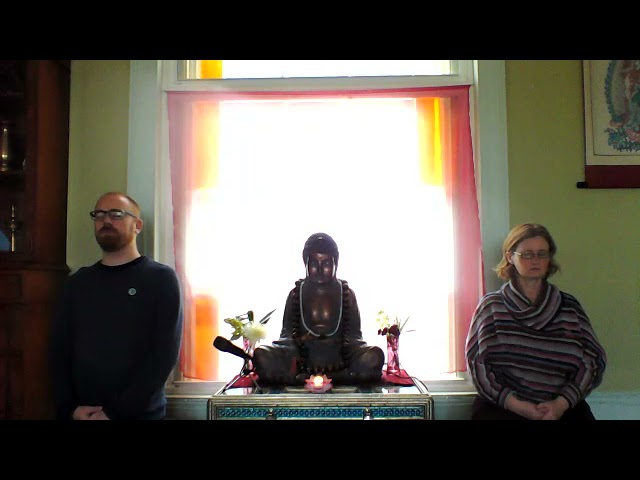
Caspar leads a guided Buddhist practice session with in-person and Zoom participants. The session includes a Dharma story about Dogen, meditation instructions, Nembutsu chanting, recitation of refuges and precepts, prostrations, and an incense offering.
Chapters
Good morning. So we're very lucky to be joined in the shrine this morning by Aya, Sei, Val, Pema, Kuspa, and Satya Robyn. And on Zoom this morning we have Judith, Marie, Paul, Philip, and Johanna. And I think that a couple of you haven't been before, you haven't got your videos on so you can't wave or say yes or no, but welcome, special welcome. And I will hand over to Caspar, who's leading practice.
Thank you, good morning everybody. I read a little story. When there's new people here, I just have to pause and check, is what I plan to say okay for new people? I thought, well, I'll just start with it and then maybe it'll shift somehow into being okay for new people. I read a little story this morning. Dogen, who— Dogen Zenji, who created the Zen school of Buddhism in Japan, he traveled to China and brought back a specific form of meditation and teachings with him. And one of the things he did when he was in China was collect a load of little stories that are just like one or two paragraphs long and used them as the basis of essentially doing what I'm doing. He'd start by telling one of these stories, and then he'd give a commentary on it, and then they'd all sit quietly for 40 minutes. And the one that I read, the story was about a Chinese Buddhist master who fumbled the rice cakes. They would often use rice cakes as food offerings to the shrine.. And the story begins by saying, oh, the Buddhist master dropped the rice cakes and they rolled over the floor. And then all the monks in the shrine room turned, put their hands together, and bowed deeply, grateful for this amazing teaching. And the Zen master looked at them and said, you guys don't know the half of it. Like, you haven't really twigged what's going on here. You might— you think, you think you know something about the significance of this, but you— there's definitely something hidden that you haven't realized. And presumably at that point they all bowed deeply again and went on with the meditation. And then in the evening, one of them came up to him and said, what did you mean when you said that this morning? And the Zen master said, I don't know half of it either. And there's no context for this story, or I don't have any more context. So I don't know if this was a very elderly monk who was from, you know, who just was in a kind of fumbling stage of his life. And perhaps there's some teaching about aging and impermanence here. Or somebody who is very fit and healthy and just made a mistake, and the monks appreciated, oh, the teacher is human as well. That's okay, we can all relax a little bit in this meditation. Sometimes rice cakes appear in these stories as a sort of symbol of the mundane world. They're very ordinary, they're not particularly nutritious. Maybe there's some esoteric meaning that hasn't been unraveled yet.
You don't know the half of this.
Exactly. I also don't know the half of it.
Thank you.
And that's the point, you know, that we don't really know what's going on most of the time. We can get closer. You know, there is a spectrum of things that are more or less true, and we can get closer to aspects of the truth. We can learn more about our own habit patterns in the world. We can learn more about impermanence or aging. We can learn how to make offerings to the shrine in a good way with food and candles and light and flowers and incense. Maybe we learn that the Buddha accepts all offerings, whether they've been dropped on the floor or not. I once was in a big Tibetan center as a weekend event with hundreds of people and maybe 60 or 70 monks and nuns, and I volunteered to bring in this tray of food offerings for the shrine. I was very young in my Buddhist Korea then. And in Tibetan Buddhism, they have quite strict rules about all this sort of thing. So I carried this box— in my, in my memory, it's like one of those old plastic bread crates full of food offerings— into the shrine room, which was a huge marquee, and there were two rows of monks and nuns. On the first rows of chairs. And as I leant over to put this box on the floor, every single monk and nun on the first two rows of chairs went like this, and I sort of froze and looked around. I was like, on the table. And yet the Buddha would still have accepted those offerings, I'm sure, even if they'd been on the floor, because that's what the Buddha does. Our job is to show respect and be grateful and, and to live a good life. And we don't always manage it. And the Buddha's part in the dance is that they will accept us and love us just as we are, regardless of how well we're managing the dance. And also in this, you don't know the half of it, there's something about how it is to go back to the same teaching again, a sutra or text that I read 15 years ago. When I go back now, I find something else that's helpful I didn't notice that was there the first time, because there's layers and layers and layers. Of things that are true. And it's really helpful to remember this when we're dealing with other people or other living beings of the world, that we don't really know what somebody else's story is, what somebody else's truth is, what somebody else's causes and conditions are. And of course we should still be working vigorously for good in the world, but also holding some of these ideas a little bit lightly and just trusting that although we know something, and maybe what we know is really good and useful, There's always something else that we don't know. There's always something else to learn. And someone said to me recently, much better to be a student than to be the person who thinks they've already learned everything. So fumbling the rice cakes, we only know the half of it. Namaste. So now we have some time for meditation, quiet meditation together. Invitation to notice your body for a moment. Notice the weight on the chair or the floor, some places where there's more weight or more pressure, somewhere there's less. And then bringing awareness to the breath, noticing cooler air entering at the tip of the nose. Warmer air leaving. Noticing the quality of the breath— is it smooth or stuttering? Is it long or short? Noticing the pause between breaths, not describing this to yourself particularly, just paying attention. Any thoughts when thoughts or feelings or sensations appear, noticing what they are and then gently returning awareness to the breath. As Pure Land Buddhists, we're encouraged to become aware of our own flaws, of the habits of greed and ill will and so on. Our foolish nature, as it's often described. And one of the things we learn is that these kind of thoughts and habit patterns You can't use them to become enlightened, or at least you can't use them on their own to become enlightened. So we keep in mind that as well as our small mind turning over and over in the way that it does. There is also unconditional love and perfect wisdom present in the universe in the form of the Buddhas and Bodhisattvas, and also that there is that kind of spaciousness within us if we're able to see through the ordinary small mind. So one of the main practices of the temple is Nembutsu, reciting the name of Amitābha, the Buddha of infinite light, which is an invitation for that unconditional love, that perfected wisdom. An invitation for us to remember that that is also present. Honen once described the human condition as being like villagers in a, in a, in a village, I guess. With the full moonlight shining down on them, but only people who looked up noticed the moonlight. So Nembutsu is an invitation to look up and notice the moonlight, to remember that our own small lives, our own small minds, isn't the only thing that's present. So we do this in many different ways, and this morning we'll do it as we often do, by chanting the word Amitābha.
Amitābha. Amitabha. Amitabha. Amitabha. Amitabha. Amitabha. Amitabha. Amitabha. Amitabha. Amitabha. Amitabha. Amitabha. Amitabha. Amitabha. Amitabha. Amitabha. Amitabha. Amitabha. Amitabha. Amitabha. Amitabha. Amitabha. Amitabha. Amitabha. Amitabha. Amitabha. Amitabha. Amitabha. Amitabha. Amitabha. Amitabha.
Amitabha.
Amitabha. Amitabha.
So in a moment we'll recite the refuges and precepts together. I did paste the link into the chat for the words, but you might need to do it again if people have joined since I did that. The refuges are the way that we entrust ourselves to that unconditional love and wisdom in the form of entrusting ourselves to the Buddha and all awakened beings who embody that energy, to the Dharma, the teachings that describe that energy, and things as they are in the world that point us to that, as well as to the reality of suffering, both of these things together, and to the sangha, the community of people who are entrusting ourselves together. And the, the Five Lay Precepts that we recite are the guidance for ethical conduct that the Buddha gave to lay people. That he was teaching 2,500 years ago. And there's various different sets of precepts and various different translations of them, but these cover most things, more or less. So please repeat after me. For refuge, I go to the Buddha.
For refuge, I go to the Buddha.
Namo Buddha. For refuge I go to the Dharma.
For refuge I go to the Dharma.
For refuge I go to the Sangha.
For refuge I go to the Sangha.
With faith in the Three Jewels, with faith in the Three Jewels, I pray that I may not take life.
I pray that I may not take life.
With faith in The Three Jewels—
With Faith In The 3 Jewels I pray that I may not steal—I pray That I May Not Steal—with Faith In The 3 Jewels—with Faith In The 3 Jewels I pray that I may not fall into wrong speech-I Pray That I May Not Fall Into Wrong Speech-with Faith In The 3 Jewels—with Faith In The 3 Jewels I pray that I may not fall into sexual misconduct- I pray that I may not fall into sexual misconduct.
With faith in the Three Jewels, with faith in the Three Jewels, I pray that I may avoid intoxication.
I pray that I may avoid intoxication. No blame, no blame, be kind, be kind, love everything, love everything.
Innumerable are sentient beings. We vow to save them all. Inexhaustible are deluded passions. We vow to transform them all. Immeasurable are the Dharma teachings. We vow to master them all.
Infinite is the Buddha's way.
We vow to fulfill it completely.
Now we have some time for prostrations.
Another way of entrusting ourselves.
Make sure there's some space in front of you. Namoha miyahu. Namoha miyahu. Namoha miya. Namoha miya.
In gratitude, we offer this incense to Buddhas and bodhisattvas throughout space and time. May it be as fragrant as Earth herself, reflecting our careful efforts, our wholehearted awareness, and the fruits of understanding slowly ripening. May we and all beings be companions of Buddhas and bodhisattvas. May we awaken from forgetfulness Realize that truth. Back to each other.
Back to our seats.
And we'll recite the closing verse together. Do unmute if you're on Zoom and want to join in. Bless by Amitābha's light. May we care for all living things and the holy land. Namomi tabu. Thank you, everybody.









