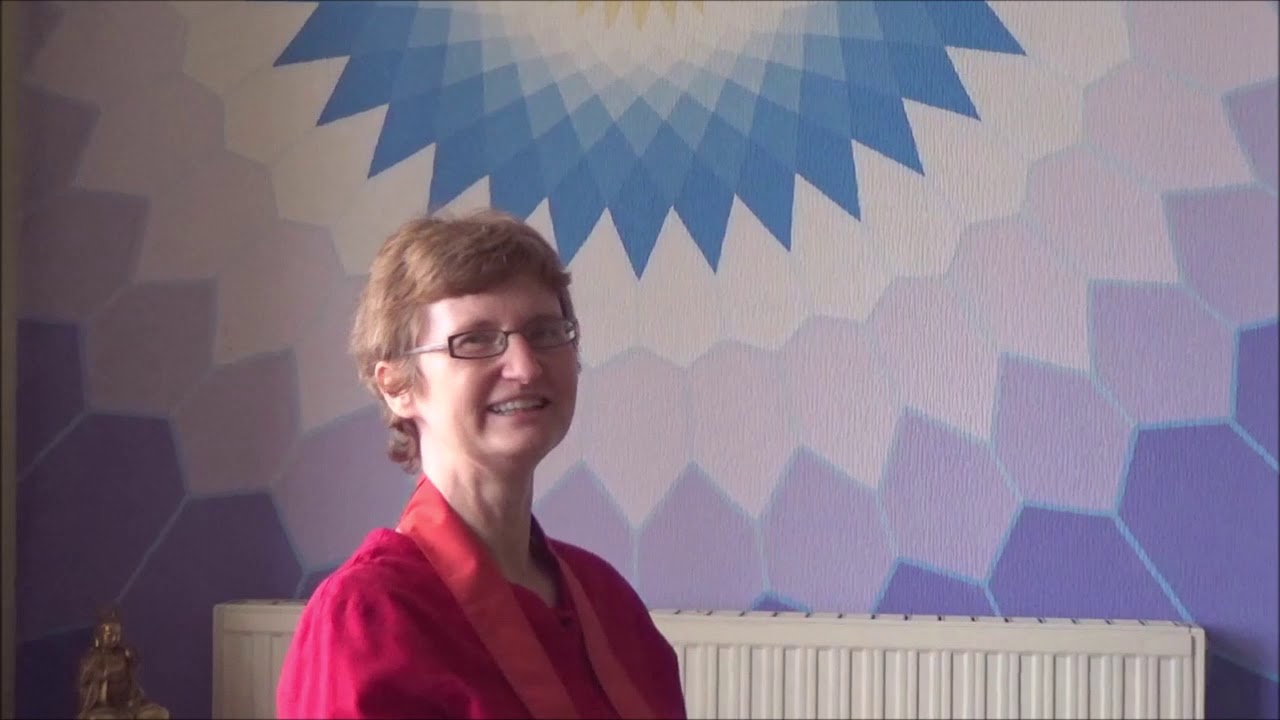
Reverend Satya Robyn explains why people practice Pure Land Buddhism, using refuge and a snakes-and-ladders metaphor to describe spiritual practice. The talk covers taking refuge in the Buddha, Dharma, and sangha, the role of chanting Nembutsu, and practical steps for newcomers, followed by Q&A and communal chanting.
Chapters
Good morning. It's really lovely to be here. I've been looking forward to this time knowing that I'm going to be speaking to— well, I knew that at least Emma and Mark were coming, so I thought, nobody else comes, I'll just speak to you two. But there's more of us here. My name is Reverend Satya Robyn, and I run the temple here with Caspalito, my husband. We've been here for 5 years now. For some of you at least, this is your first time inside the Shrine Room, so welcome. So I promised— we did service this morning— I promised people that I'd talk about snakes and ladders, so I'm gonna have to work that in there somewhere. If I forget, let me know. But the topic of this morning's talk is 'Why bother?'— a slightly ironic title. And I was thinking about how busy we all are and about how many different calls there are on our attention every day. I mean, it might be different for you, but for me there are all sorts of different things that are required of me in various areas of my life and all sorts of things that are invited I'm invited to, that I have to make some kind of decision about. Do I do this or this? And for you, at least this morning, the decision was to come here and to invest an hour of your time, unless you've run from the shrine room at any point, and your energy. And some— especially coming somewhere new takes for me, a bit of, you know, a bit of extra oomph. So why bother come here today? Why bother with spiritual practice? And I'd be interested, before we start, just to get a bit of a show of hands. Who in the room has already had some experience with Buddhism? Just put your hands up. Okay, good, good, good. And who's already had an experience of a formalized spiritual practice, whether that's Buddhism or a different religion, yeah, and who has had some experience of some sort of spirituality, whether that's through books or experiences in nature or anything like that. Yeah, so most people have had some experience of the third thing, and the third thing is really what the heart of my talk this morning is about. I will talk about Buddhism, but Buddhism really for me is the particular outfit that spirituality wears for me and the way that I meet spirituality. So before coming into the room, while you were all getting your chairs sorted, I was stood just along the hallway looking out the window at the road. And the way this building works, the temple works, is that there's two floors below us, below the level of the car park, and we have three cats in the temple and a little dog and three rabbits. And one of our cats is called Roshi, which is an honorific for Buddhist teachers, so it's quite appropriate that he's, he's starting this talk with me. And Roshi, when we moved in, for some reason became frightened of this floor of the building. So he's really happy to be downstairs one floor, and he's very happy to be downstairs two floors, which is the flat that we own where he lives most of the time. But, but the stairs up to this floor are scary for him because they take him into the territory of this floor, which is really not a safe place to be. I think it's probably because the window is on the stairs and the cars kind of rush past. I think once he comes up and sees through that window and the cars kind of go past, he's like, "Ahh!" Runs back downstairs. So I was stood at the window and I heard a little "meow" and I looked down and Roshi was at the bottom of the stairs. And I said, "Meow." And he said, "Meow." This is the whole talk, I'm just going to carry on. And I said, "Meow." And I just stood there looking out the window. And as I stood and looked out the window, I noticed that Roshi came up a step. And I stood for a bit longer and came up a few more steps. And this is Buddhism. Buddhism is finding relationship with something or someone or someplace that helps us to feel more safe, that helps us to feel like maybe the monsters that rush past the window aren't quite as frightening. They seem. And certainly in my experience, life is frightening. There are frightening bits, there are uncomfortable bits. And so for me, what Buddhism has brought me, why I bother with this, is that I am less frightened than I was when I first encountered Buddhism, and I've come up a few more steps, and then sometimes I go down again. But for me, at the top of the stairs is something that I call the Buddha, which is a steady presence which isn't afraid and which is standing there comfortable and meow back at me and encouraging me. So I'll maybe say a little bit more about Buddhism because that is the topic of this talk. And having however long I've got to give you an introduction to Buddhism feels a little bit like— I was thinking earlier, it's a little bit like saying, 'Could you just teach someone to speak English in 20 minutes, please?' Or, 'Could you explain to them about this 100-year period of history in this country?' So there's many, many things I could say, and that kind of brings me into snakes and ladders thing, which I'll talk about a bit later. But I'll choose the thing to start with that most Buddhists would choose, because there are lots of different kinds of Buddhists, just like there are lots of different kinds of Christians. Most people in this country are familiar with how different different Christians can be. If you think about Quakers or Catholics or Unitarians, there's very, very different expressions of the same teaching came from the same man. Buddhism is just the same. So people in this country tend to think Buddhism, meditation, so if I go and do Buddhism, I'm going to do meditation and I'm going to become enlightened, I'm going to become really peaceful. There's lots and lots to Buddhism. That's one very kind of narrow aspect really which the West has sort of picked out and isolated in some ways. So what most Buddhists, maybe all Buddhists, would begin with is refuge. We talk about refuge in Buddhism, but my Buddhist teacher Dharma Vidya talks about refuge as how it is for a refugee, that if we're a refugee, we have left our home. We've left our family. We've left all the things we know. We maybe don't have any money or belongings, and we're going— we're lost. We're away from where it's safe. So refuge is finding that place where a refugee is at home again, that they're at home. They feel safe. They have enough to live, they have connections. Refuge is what Roshi was taking on the bottom step when I first met him. And so Buddhists speak about taking refuge in the things that are permanent. The Buddhism says that pretty much everything is impermanent, apart from 3 things. Most of us take refuge in many, many things. I could start listing a few from me. People that know me already would be able to shout out from the crowds what my refuges are. Chocolate. Yeah, correct, correct. First refuge, chocolate. Trashy detective novels. Working. Overworking. I was just about to say that one. So we, you know, we, you could all tell me your own refuges. Some people really take refuge in status or in money or in family connections or in nature or in heroin or in cigarettes or— so there's all sorts of things that we take refuge in. Exercise. And some of those are sort of down the un— heroin's kind of down the unhealthy end of the scale, and then maybe, you know, yoga is pretty much over here. But we all use these things to help us to feel more safe in this world which is impermanent. So the Buddha said that there are four— there are three things that we all face, that we all get sick, we all get old, and we all die, that those are the things that we can't escape from. And in that situation, that kind of, that scary, you know, scary cars rushing past the window. We need something to help us to feel a little bit less wobbly, and a lot of this stuff we sort of do without even knowing. We learn to seek refuge very young in a lot of the things we seek refuge in, and the Buddha says— Buddhism says that all of these things that we take refuge in are impermanent. That chocolate is great when you start eating it, and then after, you know, half a bar, it starts feeling a bit, you know, you start feeling a bit full and it gets a bit sickly. You know, I try and change bars, get a different bar, then that helps for a little while. I like very expensive chocolate, so I'll buy really expensive chocolates, and then I get the hit, you know, it kind of keeps going for a while, but there comes a point where actually I I know the most expensive vegan chocolates in the UK. I can tell you where I can buy them all, and I've enjoyed them all. And after a while, even the most expensive vegan chocolate, the pleasure fades. It's impermanent. We can take refuge in being an amazing runner, and then we get an injury. We can take refuge in our husband, and then, like my friend's husband, they get stung by a hornet and die. That happens just like that. And this is the world that we live in. We live in the world of samsara, it's called in Buddhism. We never know what we can— we never know when the thing that we're leaning on is going to kind give way underneath us. And so Buddhism says that there are three things that are not impermanent, and they are the community of people who practice in a spiritual way. So that's this lot of people in this room. You can see that community, sangha, sangha, as just Buddhists who practice properly, but I like to see sangha as really any community that puts something at the center of their lives that isn't the impermanent refuges that I was talking about just now. So anyone who is interested in a life of meaning and integrity, those people are a great support to us. And when I say that the sangha supports us, I don't mean that we can rely on one person 100% of the time because we're human, but we can rely on the bunch of people. We can rely on a bunch of people around us. That my experience is that when I need something, it's often not the person I think that's going to give it that gives it. I know that when one of our sangha members, Ed, who died a couple of years ago, when he got really sick, somebody appeared in his life who was with him for that time and was just what he needed. And that's, that's, that's sangha. That's how community works. Nice to think about him. The second permanent refuge is Dharma, and Dharma is a word you might know. It's the teachings of the Buddha, so it's all the the good advice and the lived experience of the Buddha that has been passed down to us today. So Shakyamuni Buddha lived in India 2,500 years ago, the Buddha that we all think of as Buddha. There's lots of Buddhas, but that's the one that, that brought the teachings to India 2,500 years ago, which then became Buddhism across the world. And he lived for 40 years after becoming enlightenment— enlightened, and did a lot of teaching, so a lot of people came to him and he gave a lot of advice, and so that was all written down after he died, but it was all written down, preserved orally and then written down, and so we have that. There's big thick books that are in my study and in the library that I dip into, And we also have, unlike Christianity, Buddhism is an open canon. So rather than the Bible being like, you know, like the Bible, done, that's your teachings, Buddhism is an open canon. So the people that the Buddha taught also taught, and those teachings were included as a part of the canon, and then they taught people who taught people who taught people. They taught people who taught people who taught people who taught people, da da da da da, who taught Dharma Vidya, my Buddhist teacher, who taught me. So there's that direct line from him. When I talk about Dharma, I also like to include wisdom from other spiritual traditions. I'm a big fan of, as we were saying last night, a big fan of mystical Christianity, of Sufism. I found a lot of very wise teachings in other spiritual traditions and also in places like the 12 Steps have a huge amount of wisdom in them, that spiritual wisdom. So that's the second one. So Sangha, community, Dharma, the teachings, and the The third one is the Buddha. The Buddha is also something that we can rely on that won't go away, that won't come away from underneath us when we lean on it. And when I say the Buddha, if you like, I can mean the man who lived 2,500 years ago and the qualities that he embodied. My experience is is that it's not just a man who lived 2,500 years ago, it's also something that's much more present to me in a very real way. And we're kind of moving towards talking about spiritual experience. So my experience of refuge is that, is that I know that I'm okay. And I know that I'm okay even when I'm really not okay. Dharma Viji says, "I'm okay." No, Dharma Viji says, "I'm not okay, you're not okay, and that's okay." It's like a variation on the usual way of using that. And that sense of refuge sometimes is attached to a place. So for me, this room is very much a refuge because we practice in here. So for however many hours over the past 5 years— we'd have to add them up, it's a lot— we've been in this room hanging out with the Buddha and each other and the Dharma. And the garden has got Buddhas in, so some of the Buddhas in the garden are kind I've got a special sort of sense of relationship when I go to those places. I also have a relationship with the hills, and there are spots on the hill where I can go and I feel that kind of sense of refuge. So it's sometimes it's a place, sometimes it's a person. So my Buddhist teacher, Dharma Vidya, has has really come to symbolize an embodiment of Buddhism for me, because he's the one that I have learned the most from. So sometimes when I hang out with him, we're just drinking coffee and talking about politics, but sometimes when I'm with him, I really connect with that sense of feeling okay, that sense of refuge. And that's why teachers are really helpful. It's really helpful to have real-life teachers sometimes. Sometimes it's a feeling that I just— my body just knows that I'm alright. And sometimes it's, it's none of those things, but it's a knowing that even though I don't feel it, it's still there. So for Roshi on the stairs, if I had come away out of sight and I'd stopped meowing at him, he would, he would know that I was still in the building or that I was still around because he's come to rely that I'm there. He knows that he gets his food and he knows that he gets his strokes, and if he jumps on the bed in the middle of the night, that we'll wake up and stroke him. He, he knows that we go away on holiday, but then he knows that we come come back. So a lot of my experience as a Buddhist is not feeling, oh my God, I'm so connected to the Buddha, I feel amazing. It's remembering that the Buddha is there because I've had that experience in the past, and I know that I can have it again at some point. And those sorts of things all build up over time we do the same things, we have ritual here that we do together, we do the same things and they take on a bigger power. Like things that we do at Christmas that take on power, or things at weddings that people repeat. These things— we haven't got much ritual left in our society, but ritual is hugely powerful and holds— it's like a container for meaning, and the more that we do it, the more meaning kind of seeps through. Yeah, so this, this sense of refuge— I won't talk for much longer because I want to give you a chance to ask questions— this sense of refuge for me, I was thinking this morning in service about how to describe getting to this place. And it may be that most of you, all of you, already recognize this place, even if you've just had kind of glimpses of it. Buddhism for me is like a mechanism that helps me get to this place where I feel okay. And I was thinking about it a bit like a clearing in a forest, you know, like this space, and maybe Bambi's there, and some sunlight coming through the leaves and lighting everything up, and it all looks really beautiful. Beautiful. You just, you come up into this clearing and you just can lie down and feel wonderful in the sun. And that different people have very different routes to get to this refuge. So some people will be Christian, some people will never do anything spiritual or religious, but they'll, you know, they'll do running or they'll do gardening or they'll look after animals or whatever it is, different people will find different routes to this clearing. But then I was thinking, it's not quite that simple, because it's not like there's a clearing and then there's like a distance that people come. It's a bit more like, um, snakes and ladders, that there are all sorts of spaces where we come across a ladder that takes us straight there. We can be over there and then choo! We can be there. So Buddhism is also a bit like a very elaborate network of ladders which gets us to that good place, and some of those ladders we're familiar with. So maybe we realize that coming to service once a week or once a fortnight is a kind of a reliable-ish ladder for us. To get us to that place of feeling calm. We may find that a little bit of daily practice at home is a ladder that takes us there. Sometimes it takes us there and sometimes it reminds us that there is there. So we don't always get there but we remember and that's a kind of— my metaphor's breaking down but that's— it's not as— doesn't feel as nice but it's it still reassures us, if that makes sense. And the more that we practice this kind of moving around the board, the more easily we find the ladders, because the Buddha says that ladders are everywhere. And when we open our eyes, as Kasper was saying in his talk this morning, the world is ladders, the world is suddenly ladders. This morning when we were walking around the Buddha as a part of our practice and chanting, I saw a huge red fox at the bottom of the garden just slipping off behind the compost. Absolutely gorgeous. I mean, I know he's probably trying to eat our rabbits, but I can still appreciate his beauty. And that is a ladder that takes me into that relationship the world where suddenly I feel safe and alive, because I guess that's the thing that safety allows us, is it allows us to open to the world and to experience the world, the scary world. It feels like there are a million things I could say and haven't said. And I'm also wondering if that might be enough for now. Just sum it up. I'll sum it up because you're meant to say what you're gonna say and then say it and then say you've said it, but I don't know that I can sum that up. Okay, so we talked about refuge as being the goal of Buddhism. And the common thread that runs through all kinds of Buddhist practice. And refuge is being in the scary world, and the scary world's not changing, but us feeling different, us feeling reassured. I think about one of the things I was thinking this morning was that I'm a bit scared of medical emergency. I'm a bit scared of— I'm not very good around ill people or people in pain. And when I'm in a situation where there's an ill person If I know someone like Kema's there, who knows what they're doing, or a doctor, then I feel so different because suddenly it's not my responsibility. I'm alright because they're there. That's the kind of feeling that refuge is. It's like, I'm alright because the Buddha's there. The Buddha's got it. It might still— might hurt. This person still might die, but I'm okay. So refuge is what it's all about. And when we take refuge, it allows us to go out into the world and be kinder. That's really what Buddhism, what all practice, what all religion should be about. That's the goal. And in Buddhism, there are three things that help us to take refuge that aren't impermanent, and they are the good folk that we practice with, the teachings that we've received, Tai Chi Chi saying something. And the Buddha, the Buddha himself as the person who was in India 2,500 years ago, but also the embodiment of the Buddha, the Buddhaness of the Buddha that kind of extends and is always available, which of course I haven't mentioned this word yet, but it may be obvious, which is love. That's what it is. And in coming into relationship with, with refuge, with love, with the Buddha, we feel more settled. We can go up a step, we can go up two steps, at our own pace. We don't feel rushed. And one day we get to the window and we can see the world, and we can see that the cars are just, you know, moving across they're not going to hurt us, and we can enjoy the view. And there are many different ways to step on that journey, to step onto the snakes and ladders board. This temple here is one of those boards, and you've stepped onto the board this morning by coming into the room. You might want to step straight off, that's fine, find another board. Or this might be the board that's for you. I don't know. I don't really mind. I just want you to find a board. I want you to find a space where you can have those kind of adventures because they're really cool and they change everything. How's that for a summary? Okay? Yeah, Casper's nodding. So thank you very much for bothering this morning, and we will carry on recording if you've got any questions you've got, and then we'll maybe stop recording and see if there are any more questions. And any questions are allowed, anything about Buddhism that you've heard or that you don't know, or anything about what we do here, or anything about anything I've said, I'm moving to be. Maybe you're enlightened or sleepy or whatever. Hot flush. Can't tell me hot flush.
I was just thinking what you were saying. So it's very male dominated, all the Buddhas, isn't it?
Well, that's a good— yeah, good question. I think that like probably most of history, the head figures are often male. In this songha, we're quite lucky because we have quite a lot of emphasis on female energy. So actually, my book that I just wrote about— this isn't a plug— but the book I just wrote about the Buddha, I use he and she interchangeably in that book because I don't see the Buddha as male. I see that we use he because because that's kind of what we do, but I think that the Buddha is beyond gender, personally. We also have the attendants of the Buddha who are Taishi Chi, who's a very female traditionally— sorry, Kuan Yin is a very traditionally female figure, and Taishi Chi, it can also be seen as female or male, that they're kind of sex-changing. I would say that that that's more about patriarchy and the history of how the sexes have worked than it is about Buddhism. That would be my take on that. But there are areas of Buddhism, there are some groups in Buddhism where women are not allowed to do the things that men are allowed to do, and that's something that's being worked on. This school of Buddhism, we're very lucky, because pretty much there's more women higher up than there are men, I think. So Dharma Vidya is very good at balancing. Does that help? Yeah, yeah, just interested.
Yeah, can I ask an ancillary question? You may. At the back you've got— that's a Tara, isn't it? That's Vajrasattva. Because when I was in India, I seem to remember Taras, which are like female.
Yeah. Tara is female, yeah, and so that's a Tibetan deity. There's lots of Taras in Tibetan Buddhism. Vajrasattva is just a feminine-looking statue, I think.
It's maybe worth saying that we do use the word Buddha in two ways. So you said this, but I just want to say it again to make sense of of what you were just talking about, that the Buddha can refer to the historical person who lived 2,500 years ago, who was a man.
He was definitely a man.
And had his, you know, and was a human being and didn't get everything right the first time. So he had to be convinced to let women join the sangha, for example.
Which a man did.
Yeah, which a man did. And then he was convinced, and the nuns' community went on to flourish. But there is also this sense particularly in the Buddhism of Tibet, China, Japan, Vietnam, and so on, that the essence of the Buddha, this love, unconditional love and wisdom, is sort of, is available throughout the universe and manifests as all of these different faces that we use to give it, which sometimes embody particular qualities. So Kwan Yin is an embodiment of compassion. Tai Chi Chi is an embodiment of strength and courage, for example. So there's a sense that that energy of enlightenment, of nirvana, of unconditional love, is moving to us through all of these different figures, which are all called Buddhas. So there's the historical Buddha, and then there's all of these other Buddhas that appear at different times in different places, some of which are male and some of which are female.
I was talking to a friend yesterday about— he said, 'Is the Buddha like God? Is the Buddha like a real thing that you relate to?' And I guess that it's worth saying that it doesn't really matter to start with whether you think it's real or not. Caspar says that that when he was younger and struggled with whether these things really existed or not, he thought about how— can I use your story? Yeah. He thought about how coming into relationship with a fictional character could be helpful to him. So characters on TV that are inspiring, or in books or literature. So if it works, then do it, and it doesn't matter too much whether it's a real being out there or not. Practice it. Does it make you happier? Does it make you more kind? Does it make you feel more settled? And don't worry too much about the rest of it.
Easy to say but hard to do.
Easy to say.
Hard to do for Western minds that are trained to pick things apart.
Yeah. Any more questions? Why was the Buddha against women ordaining? How did he have to be persuaded? Yeah, because in his day women weren't as good as men. I say in his days, as if we're past that, but yeah.
What he said was he thought it would make life difficult, perhaps for the male community, I don't know, and also in the context of the time. And Ananda, who was the disciple that he was talking to, said to him, well, yeah, it might make life difficult, or it might not, but I 'Are women capable of becoming enlightened?' And the Buddha said, 'Well, yes, obviously they are.' And Ananda was like— and then Satya Robyn said, 'Okay, fair point, we'll create the nuns community.' And there was sometimes friction between the nuns community and the monks community because they were made up of human beings and they were celibate communities.
And sometimes that worked and sometimes it didn't work. Some rules developed the way around how to work.
And women were more vulnerable at that time in society, so they did end up taking on extra rules about, for example, not going out. Well, all the whole community was advised not to go out after dark, for example, and various things like that.
So I would see the Buddhist teachings as something that is alive and that responds to the time that it's in. So it landed in India 2,500 years ago and took on took all sorts of cultural, you know, stuff that was around at that time, and then it came to another country and took on all that stuff. So our job really is to try and work out what is a helpful spiritual teaching and what is cultural accretion, what is the stuff that just, you know, is already in the culture that kind of infects it. And of course it's impossible to have a pure dharma without the people because it's something that the people— it comes into the people and is created by the people. But there's always that, you know, I kind of feel like when I'm, you know, when people quote certain things in the Bible and say, oh, it's so, so blah blah blah, we never really know, do we, whether that's the word of God or whether it's the word of the person who was listening to the teaching and thought they'd change it a bit. So I like to take those things with a pinch of salt and think, what's the kind thing to do. What's the, um, yeah. I've got a question. It's sort of more for Gaspar, but it's, um, you mentioned that in this school the Lotus Sutra is revered. I didn't realize that.
Why is that? Why is it? It's a very, um, powerful and significant teaching that was transmitted into China and really changed the way Buddhism was understood in China at the time. And it became, in, in China and in the countries that Buddhism was transmitted to from China, it is as significant as the Bible is to the Western canon of literature. And for philosophy. And so the schools that— the school in Japan— Buddhism came from China and arrived in Japan, and they basically all practiced one form of Buddhism, and one of the most central texts was the Lotus Sutra. And then our school, Zen, Shingon, all of the other schools that emerged out of emerged out of that. So it provides the sort of the context. Does that make sense? Yeah. So that's a question about what I said in service, and some people were here and some people weren't.
Could ask another one if—
well, let's see if there's any more questions for Satya first.
Bodhisattvas then, so they can become enlightened, but they sort of choose to sort of turn left, sort of thing, do they? I mean, how does that work?
Sorry. You can take that one.
So bodhisattvas are beings that can go to heaven, they can go to nirvana, they can, if they want, kind of come to the end of this being in this world of samsara, where they kind of go round and round, but they make a choice to come back and save everybody else. So that's an embodiment of the ultimate sacrifice, really, is that they care more about the people around them and the other beings, whether they know them or not, than they do about their own well-being or their own kind of satisfaction. Does that make sense? So Bodhisattvas are revered as idealized figures that offer, that offer things, that give things. Yeah, so I think I'll pause again there because I want us to have a little experience of the practice that we do in this school of Buddhism before we finish., and I'll just say something very quick about if you are on the first square of the snakes and ladders board and you are interested in exploring this form of Buddhism, what you might want to do next. We do have leaflets in the hallway, and there is a purple leaflet which gives information about the practice we do here, which we can— which you can go away and do at home if you want to try at home. And we also run 4 events a week here, which are all open to people who've never been before. So we do Wednesday evening service, Friday morning at 9 o'clock, Saturday at 9— sorry, Friday 8 o'clock, Saturday 9 o'clock, and Saturday at 6. So there's also a leaflet that's got all our times, and you can just kind of turn up to any of those. Next Saturday morning, we do have a special service for new people, so people who haven't been before. Which just means there'll be a bit more extra introduction, but not different apart from that. Or you might want to go away and explore other forms of Buddhism or other spiritual practices. So, you know, you know where your path will be, or the Buddha knows where your path will be. You just have to keep listening and find out. So we'll finish with some Nembutsu, and I could speak for another hour about what Nembutsu means. The way that we take refuge in the Buddha in this form of Buddhism, in this school of Buddhism, is by saying the name of the Buddha, the Buddha of Infinite Light. When you say someone's name, when I say Claire or Dave or David, then that kind of conjures the quality of that person. So when we say the name of the Buddha, it sort of conjures the qualities of love and wisdom and accepting. The Buddha accepts us just as we are, we say. So when we say the name over and over again, or we chant it, we're really entering into a kind of a relationship with that, those qualities. They kind of come towards us, and the idea is that they come towards us even if we don't really know what we're doing, or if it's working, or, you know, that you say the name and those qualities appear. So we do that in different ways. We either say the name Amida Buddha, Namo Amida Buddha, I call out to Amida Buddha, or we chant it, and we'll do the chant that we do when we do prostrations in the shrine room. And the words are Namo, I call out to, Amida Bu, which is short for Buddha. Namo Amida Bu, Namo Amida Bu. And as we chant, you might just want to shut your eyes and start joining in with everyone when you've roughly got the tune. Don't worry too much about getting it wrong. And if you want to, you can just imagine just hanging out with the Buddha, hanging out with a being that embodies love. And we'll do that for about 5 minutes, and then I'll get quieter. As we get quieter, we'll just sort of sit in, in quiet, and then Maybe— has anyone got a bell? Can you stop me thinking? Tony, could you pass Kayla the singing bowl? Not the huge one, just a little one. And then Kayla will just ring the bell after a few minutes of silence. Thank you. Didn't know you were still on duty. Namoh Amida Butsu.
Namoh Amida Butsu. Namoh Amida Butsu. Namoh Amida Bu. Namoh Amida Bu. Namoh Amitabhu. Namoh Amitabh. Namoh Amitabhu. Namoh Amitabha. Namoh Amitabha. Namoh Amitabha. Namoh Amitabhu. Namoh Amitabhu. Namoh Amitabhu. Namoh Amira. Namoh Amira Bhoo. Namoh Amira Bhoo. Namah Amira.









