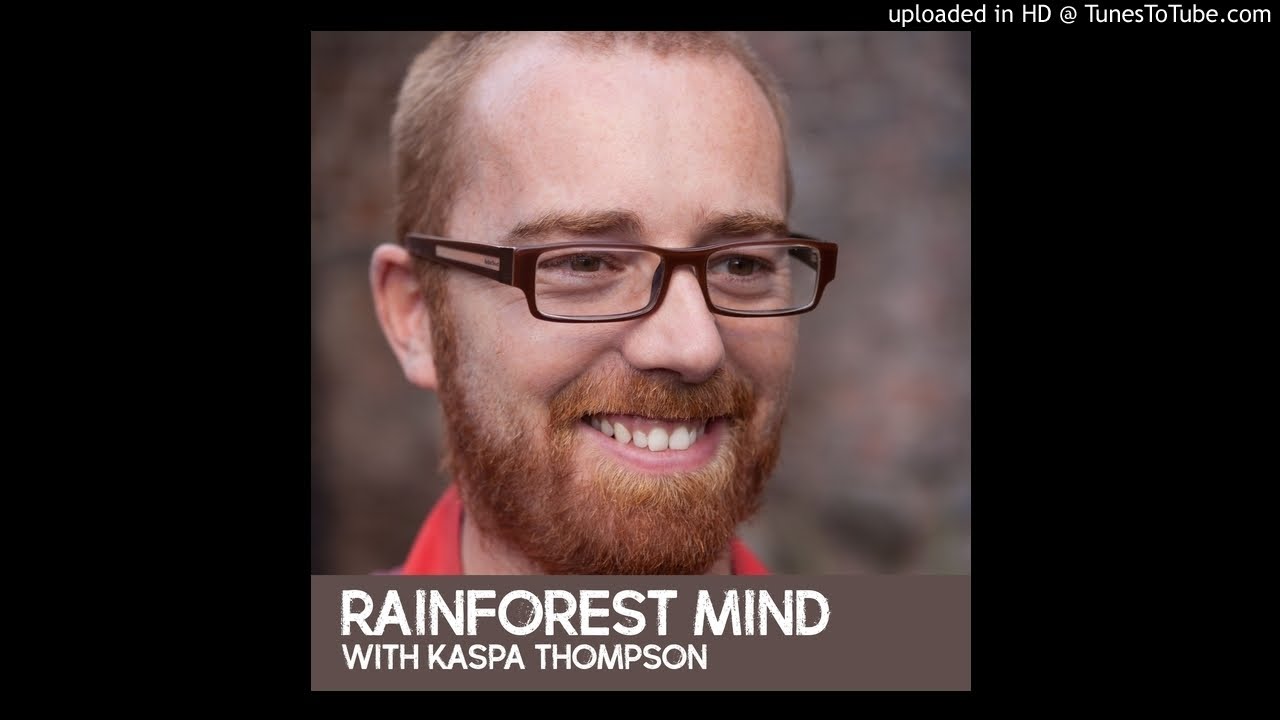
Casper Thompson explores being versus doing through a listening exercise on a Bristol street, referencing Dogen's meditation teaching about body and mind dropping away. He argues things are lovable just as they are, not perfect.
Chapters
It's Rainforest Mind with me, Casper Thompson. We're back after a long hiatus.
The last episode—
we, I'm not sure who that is. The not the royal we, maybe it's you and me, listener.
We're back together, unless this is your first time, in which case we're together for the first time, so welcome.
Anyway, I'm back after 7 or 8 month hiatus. The last episode was May last year, and it is very nearly the last day in January of 2020. Today's episode takes us to a street in Bristol on a damp Saturday afternoon where I stood in silence with my eyes closed and listened, and I'm gonna unpack some of that experience for you in today's episode. If you like cityscapes, you can take up my invitation to go and listen to your own urban environments. Just sit on a bench and see what sounds are around you. But I also recommend the Bang Olufsen podcast Sounds of the City. They're not paying me to plug that, I just really enjoyed that series. I'll put a link in the description. I'm looking forward to recording new episodes over the next few weeks.
I've got a feeling—
I've got some ideas, I should say, about who guests might be, and of course there will also be episodes like this one where it's just me speaking into a microphone. Anyway, without further ado, let me transport you to a street in Bristol.
It's Saturday afternoon. The sky is full of white and grey clouds. The ground is damp because it's been raining, but it's not raining right now. I'm standing on the pavement of a busy street in Bristol with my eyes closed. And I'm listening to the noise of the street. I'm listening to the noise of the city. Cars come by. Each car sounds different to the one before, although I have to concentrate to pick out individual cars because the road is so full of traffic. Occasionally there's noise from people, voices getting closer and getting further away from me. And as a voice, a conversation between two people and footsteps approaches me, I notice my heart starts to beat more quickly. What are these people going to think of me standing in the middle of the street with my eyes closed? And then the voices pass. The footsteps, the rhythm of the footsteps stays exactly the same, and I guess, oh, they don't think anything of me at all. What else can I hear? The cooing of pigeons, doors opening and closing, trolley wheels, the faint beeping of a pedestrian crossing further down the road. The noise of litter behind me, or something blowing in the wind. When I'm not worrying about what people think of me, it's possible to relax, or rather, I notice that when I'm simply listening, something in me relaxes, my whole body relaxes, there's a kind of ease in standing. And just listening. The city doesn't become music exactly, but there is a soundscape here that isn't completely unpleasant. It has its own rhythms. There's an intimacy with the world that emerges, a closeness to experience. The street mostly smells like traffic fumes, and I have a strong sense of things completely being themselves. I guess everything is doing that all the time, but we so often try and make it about us. And yet when I was just listening, it was very clear The wheels are turning because that's what they do. The engine is sucking in fuel, igniting it, spitting out fumes, creating motion because that's what that system does. And of course, I couldn't help being aware of the cost of living in a city. While it's possible to find a sense of ease while it— here on the street. It's very different from the sense of ease I find sitting on the hills here and listening, for example. It's the sort of ease that comes from knowing, oh, I have the capacity to be with all of this, and all of this includes an understanding of the stress on the human body and mind of being surrounded by noise and pollution and light and constant messages from signs telling you to buy things or go here or don't go here. And many, many more people than we kind of evolved to live with in a tribal groups. Another person walks past speaking on the phone, perhaps. I can't hear the other end of the conversation. Again, the footsteps don't falter. And later, when I talk to the two other people from the Wild Therapy training group that were supporting me to have that experience, they confirm nobody paid any attention to me whatsoever. Why am I telling you about an experience of listening to noises on a busy Saturday afternoon in Bristol? Because I want to talk about the difference between being and doing, or rather, I want to talk about the fact that being and doing are often set up as opposites to each other, and I want to knock that down. In the same way as in the, uh, when we talked about wilderness and civilization as being opposites in one of the very early episodes, I quoted, uh, Nick Totton's book Wild Therapy, who said that actually civilization emerges from wildness. It is a part of wildness. It is an order. We structure order. We create straight lines in the midst of complexity. They're not opposite to one another. One contains the other. Again, with being and doing, very similar, because we're always being something and we're always doing something. We always are and we are always doing. So what is it about those two? What do people mean when they say being versus doing. I guess, um, it's something to do with— doing is often to do with busy thoughts, not paying attention to our surroundings, rather the mind is elsewhere, a sense of a sort of internal busyness that creates a kind of frenetic energy. Doing often refer— that's doing. Being often refers to perhaps slowing down of the mind, a settling into the activity that we're doing in this moment, rather than paying attention to fantasies about the future or worries about the past. I once heard a meditation teacher described meditation as the act of paying attention to things that we don't usually pay attention to. And I think there's something wise in that statement, and also something that helps point to the difference between being and doing. When we're in a doing state— and you can imagine the quotation marks around whenever I say doing, if you like— when we're in a doing state, We're usually paying attention to things that we mostly know about— people, things that have happened already, encounters that we've had, or imagining encounters that we've going ahead, going to have— and going around in circles, the mind going around in circles, more or less. This is what tends to produce a feeling of busyness. It produces kind of stress and anxiety. Or, of course, we put a lid on that process, which tends to lead to symptoms more like depression. Whereas paying attention to the things that we don't usually pay attention to invites us to stop going around in circles, because that isn't how reality works. Our bodies are constantly in a state of process, changing from one thing to the next. So sometimes in meditation we pay attention to physical sensations, and I often invite beginners in meditation to listen because the world, even the ordered world of a city, is complex, surrounded by things that aren't us, expressing themselves, going about their business, changing in the way that they change. And giving our attention to those things things. We have to stop going around in circles, um, because we discover freshness, newness. We discover things, uh, unfolding in the way that they unfold, rather than going around and around. We encounter something that we don't know already, and that cuts through the usual thought process of paying attention to the things that we do know. So I think a city can do this. The natural world is particularly good at doing this because, of course, the ecosystem of the natural world is much more complex than the ecosystem of a city. So this is one of the real benefits to meditation in the sense of paying attention to things that we don't pay attention to, and particularly the benefits of paying attention to things outside of ourself, going into new places. So some of that sense of ease I experienced on the street was simply a result of encountering something that wasn't myself, and in doing so, stopping traveling in circles for a short time. And I suppose, why do I want to talk about that? Because, you know, you could still see being and doing as different ends of the spectrum, but I really want to name that busyness is also a way of being. It's a subset of being, and that we, we are existing all the time. Partly just the pedant in me that longs for correctness. And partly something about honoring lived human experience, and partly something about this koan that I've been struggling with, which is my whole life about idealism. And beingness is idealized in many Buddhist schools or spiritual circles or therapy circles. There seems to be some belief that we should just exist in a being state and be less doing and less busy. Fair enough. But the reality is we're human beings, we have responses, we do go around in circles. And actually, they're not perfect circles, because in those circles there's often a small amount of trying to work something out, to find something new in an old situation or in a new situation. So the circle wobbles and changes slightly. And for me, there's been something really important about recognizing— for example, let's go back to that city street in Bristol where I was standing with my eyes closed. What I had hoped for is what Dogen describes as the dropping away of body and mind. And what I discovered was sometimes that happened when I was just listening. And sometimes my body and mind were very present. It was present in those moments when other human beings were coming and I was worrying about being judged or about disturbing them. I don't want them to be worried about their own safety. Who's this weirdo on the street with his eyes closed? My body and mind arrived in those moments, and that's how it is to be human. That's how it is for me to be human, and it's how it is for most of the humans that I know. There is something really valuable about what we might call the being states— paying attention to things that we don't usually pay attention to, dropping out, uh, of thought and into a more embodied sense-based experience of the world. But I don't want to shame us for having natural human responses to worrying about things. You know, that's part of life too. There's something useful in that as well. So I'm going to invite you now to take a couple of moments to do what I did. Interactive podcasting, is that new? I don't know, probably isn't, is it? And to simply listen to the place that you are in. So take one headphone out if you're listening on headphones, or otherwise just open your ears to what's around you, noticing what happens in your body, what happens in your mind, but mostly giving your attention to the sounds And they say dead air is the enemy of good radio. I guess technically we're not on the radio. Anyway, go out if you're brave, um, go out and try it. I took, you know, I had somebody with me keeping an eye on me when I was doing it in the middle of a city. You might like to do that, you know, if you do it on a park bench somewhere or on a bench in a city nobody is going to think anything of it at all. I think it was the standing in the street with the eyes closed that made me particularly fear for my own reputation. And it's really nice to do somewhere out in the countryside.
In the second half of today's episode, I want to talk about a phrase that speaks to the experience that I had on that busy Bristol street, but that gets under my skin. And I've tried recording this little bit of the podcast a couple of times now, and I keep getting muddled, and I think it's because we are trying to attempt to put words to something that is almost uncontainable. And this is the experience of what Dogen called body and mind dropping away, the experience of intimacy with the world. The phrase that gets under my skin is "perfect just as it is" or "perfect just as they are," and it's the word "perfect" that rankles me. And yet I know exactly what they're trying to describe. There was something, quote, perfect, unquote, about that experience that I had. It was in some ways, it included perfect moments. But the reason that word rankles is because the experience I had, whilst allowing me to be in a state of ease, didn't cut out the suffering that was around me. It meant that I wasn't adding to it, and maybe even being in that place of ease introduced some different quality into the situation, into the circumstances around me. But there were people experiencing suffering, and even though I was in that place of ease, I was still conscious that I was beaming— breathing in fumes from the traffic. For example. And I've heard this phrase, just as you're perfect just as you are, applied to things that were really quite shocking. I was reading a teaching recently that began by talking about fairly innocuous things being perfect as they are, encountering household objects, broken, then broken household objects, and then talking about a hypothetical child that had been killed as being perfect, just as it was. And that was really shocking, and no doubt it was intended to shock and get you thinking about what the word really meant, but it was partly shocking because I imagined myself as a parent or a friend of somebody who'd been killed reading those words and really struggling to, to find perfection in that. It's a phrase that's used in Buddhist circles, and particularly in Zen Buddhist circles. The Buddha himself was really clear about this duality between suffering and not suffering. His first truth for noble ones is about the existence of suffering. He goes on to speak about how we can find ways out of it. Or find different ways of relating to it.
But the first truth is: this is in the world.
Sickness, old age, death, not having what you want, being associated with people you don't like, being separated from people you love. This is in the world. Those don't necessarily fit with people's ideas of perfection. So I prefer to think of everything being lovable just as it is. And I don't mean love in terms of desire. It's not about grasping after things, wanting to own things or consume things. I don't mean some sort of soppy, wishy-washy idea of love either. I'm talking about the heart opening and feeling a great sense of kindness and compassion to the circumstances one finds oneself in. And that kind of love can include celebrating the things around you. It can include immense joy for what's happening in the moment, and it can also include grief and sadness, and awareness of the cost. It's big enough to encompass all of those. As a Buddhist, I might say the Buddha's heart is big enough to encompass all of those, or the— and occasionally our hearts are big enough to encompass all of those. For me, this language speaks to the experiences that I have more accurately. Things are lovable just as they are. And it's not always me that manages to love them, and some days I definitely can't do that. But those experiences of finding ease in myriad circumstances, of my heart opening in lots of different situations, teaches me that even if I can't manage it, inherently things are lovable. It's only my own greed, hate, ill will, and ignorance that stop me from seeing that. Love doesn't mean letting people off the hook. It doesn't mean not taking a stand for things we believe in. It just means that our eyes and ears and hearts are open and full of understanding. You know, a parent can love the child even when the child is really playing up. That's what we're talking about. Right now, in this moment, if I pause, I can hear a songbird in the garden outside. It's faint. It could be a robin, could be a blackbird. I can hear the hum of my computer's fan. I can hear my clock ticking. I can hear my one foot shuffling. I can feel some tension in my neck. I realize that I'm hunched over the microphone in an uncomfortable way. I can notice some anxiety about how this bit of the segment is going. How is it going to be received by me and my high standards? By you, who I might know or who might be a stranger to me. I can hear someone upstairs, above my office is the kitchen in the temple. Most of those things are easy to love, to be at peace with. My own anxiety is harder for me to be at peace with. But I know that sometimes I manage it, and I know that other people manage it. And as a religious Buddhist, I trust that the Buddha can manage it, other higher powers are available. So for me, this is one of the most important things, most important gifts of the profound experience of just being with the world, or with another person, or a non-human living being. That when we do experience that ease in the body and the mind, and there is that sense of intimacy, naturally affection arises. And that teaches me that from their own side, things are lovable, and I can trust that that is true whether I'm in that state or not. Thank you for listening today.
Be sure to subscribe on iTunes or Stitcher or wherever you get your podcasts.
Leave us a review there as well if you like.
You can find my website at caspertaylor.com. Thompson.co.uk. That's K-A-S-P-A-T-H-O-M-P-S-O-N.co.uk, where you can find old episodes, blog posts, and details of my therapy practice. I look forward to speaking to you again. In the meantime, take care and enjoy listening to wherever you find yourself.









