Satya Robyn leads a Buddhist practice session that opens with a Star Trek: Insurrection reference, then moves through guided chanting, refuge vows, and meditation instruction. The talk explores how meditation teachings have shifted across Buddhist traditions, touching on a Jodo Shinshu liturgy controversy.
Chapters
Welcome everybody on this warm, light summer evening. Hello if you're watching the recording later, and apologies because I think probably it's going to get dark over the course of when we're doing practice, and I haven't put the light on, so the video will get darker. We're going to begin today as we always do with a Dharma glimpse, this week from Bright Dawn, and Angie has agreed to read for us.
Thank you. Trek in the present moment by Douglas Sanyo Reagan. Resting near a small waterfall, Picard and Anit sat— sit on rocks, the captain staring through binoculars at their destination, cave set in distant mountains. Just ahead, the babbling of the waterfall silences as the water becomes a fine mist flowing more like sand than water. Picard wonders how Anit is able to do this, but she has no answer for him. They sit in silence and enjoy a perfect moment in which time slows and they are together. In this poignant scene from Star Trek: Insurrection, we are witness to a wonderful example of the Buddha's teaching, the miracle and beauty of the present moment, the moment of wonder, of sublime clarity, and our fullest sense of oneness of ourselves within the universe, when all is still, calm, and in virtuous harmony with all things. The Dharma teaches us that this awareness is an achievement of enlightened beings, the moments when all things become clear. Picard gazes awestruck at the hummingbird stilled in flight. They sit in silence, absorbed in reflection of the sublime beauty and clarity of their surroundings. Picture yourself in that location, in that situation, the stresses of life removed and the unification of oneself with all that is. This example of stillness of our minds, our hearts, and the fact that we may see the core of our existence is reflected in Anit and Jean-Luc's tranquility and peace. Examples such as these should remind us to always live and be in these precious yet fleeting moments. Happy and joyful, we are able to visualize ourselves free from the ties of samsara. When we still our minds, we are calm, at peace, and centered within the universe as it really is. We remind ourselves of the true purpose of this life. To be free of the continuation of our suffering. The perfect moment, the present moment, is all that really is. The past has come and the future yet undetermined. May we all become awake to the present moment, to live in harmony with all beings. And to treasure the many moments we have in life, regardless of what those moments contain. Let us remember to often be still and observe the pure beauty that surrounds us all, once a day and every day. Namah Amida Butsu. Thank you.
Obviously, if I'd known there was a Dharma Glimpse based on a Star Trek film, we'd have heard it ages ago, but I only found it today. So we go into meditation, an opportunity an opportunity for that stillness to arise. Um, we just create the conditions by sitting in a particular way and being quiet and being still, perhaps anchoring our attention to one thing like the breath. We're creating the opportunity for that stillness And it might be that in the stillness what we notice is the beauty of the present moment and feel a sense of interconnection with all the things around us. But it might be that we notice our own human nature, that that's the thing that comes into focus. These are both useful, meaningful— let's say, maybe useful is the wrong word— these are both meaningful experiences. So neither hankering after blissful moments nor rejecting them when they appear, and not hankering after insights, but neither rejecting it when it appears. Simply sitting still, creating the conditions to notice what arises when we create the right conditions.
Yeah. Oh, Mani Teh Wari. Omami te wa ri. Omami te wa ri. Omami te wa ri. Oh, Mami, they worry. Oh, Mami, they worry. Om Mani Deva Hari. Om Mani Deva Hari. Om Mani Deva Om Mani Padme Hum. Om Mani Padme Hum. Om Mani Padme Hum. Om Mani Padme Hum. Oh, ma mi se wa mi. Oh, ma mi se wa mi. Oh, ma mi se wa mi. 3. Oh, Mami, they worry. Oh, Mami, they worry. Ama Nisewa. Omani. Nisewa. Omani.
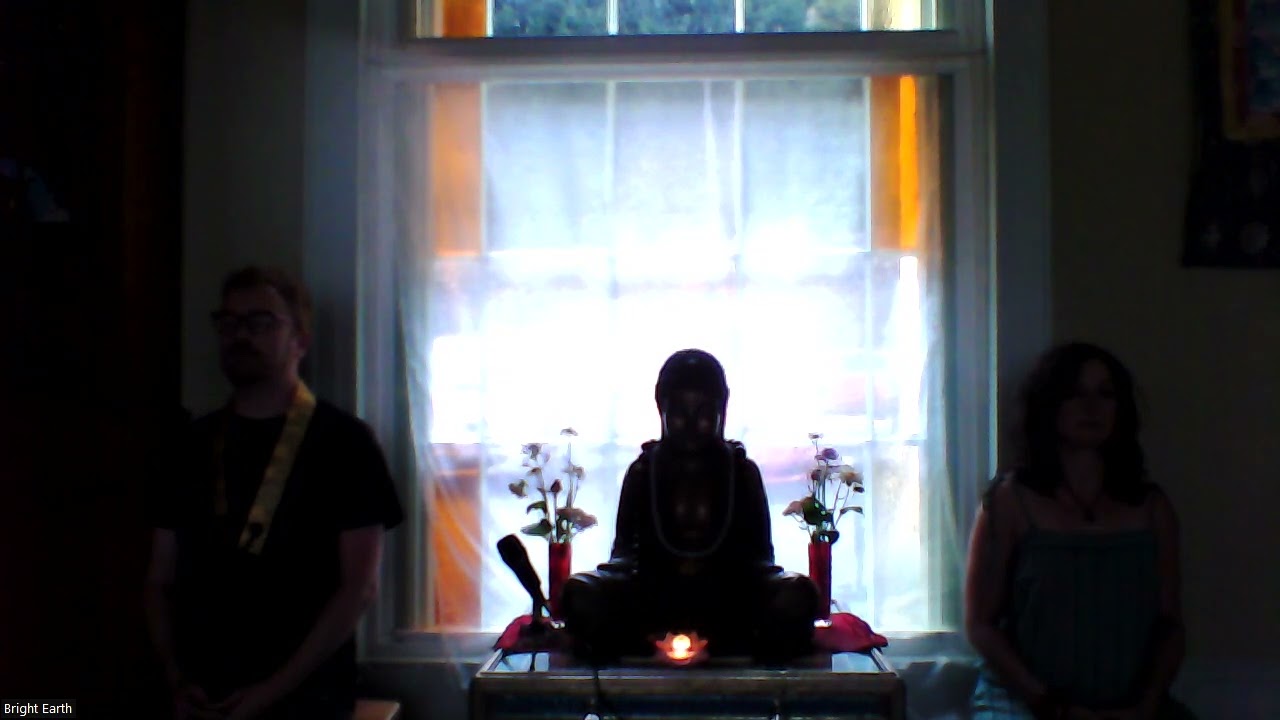
Apologies if you're watching on YouTube and can now only see a silhouette of the Buddha. And nothing else. The advantage of us not having the light on in here, of course, is that we can enjoy how beautiful the shrine looks in the candlelight, which we don't get to do very often, usually just on New Year's Eve. Um, which says something about samsara, right? We can't all get our wishes fulfilled. There is a truth beyond that, of course, of contentment, but I think you can only get to that contentment if you go through the experience of not having all your wishes fulfilled. Anyway, the shrine is very beautiful this evening. For refuge I go to the Buddha. For refuge I go to the Buddha. The one who is awake and full of love.
The one who is awake and full of love.
Namo Buddha.
Namo Buddha.
For refuge I go to the Dharma.
For refuge I go to the Dharma.
All that guides us to wisdom and compassion.
All that guides us to wisdom and compassion.
Namo Dhammaya.
Namo Dhammaya.
For refuge I go to the Sangha.
For refuge I go to the Sangha.
Those who live in the Buddha's light.
Those who live in the Buddha's light.
Namo Sanghaya.
Lamao Satya Robyn. With faith in the Three Jewels, with faith in the Three Jewels, and in light of my human tendencies, and in light of my human tendencies, I pray that I may become aware, I pray that I may become aware of when I take life, of when I take life. I pray that I may become aware, I pray that I may become aware of when I take what is not freely given, of when I take what is not freely given.' 'I pray that time may become aware—' 'I pray that time may come aware of when I fall into sexual misconduct.' Of when I fall into sexual misconduct.
'I pray that time may become aware—' 'I pray that it's okay to be unaware of when I fall into wrong speech.' When I have fallen into one stage— 'I pray that time may become aware I pray that I may become aware of when I become intoxicated.
Of when I become intoxicated. No blame. No blame.
Be kind. Be kind.
Love everything. Love everything. Innumerable are sentient beings.
We vow to save them all.
Inexhaustible are deluded passions.
We vow to transform them all.
Immeasurable are the Dharma teachings.
We vow to foster them all.
Infinite is the Buddha's way.
We vow to forfeit completely. This morning Satya has an email about a new controversy in Jodo Shinshu. They've changed one of the verses in the liturgy, um, that's been recited for years into a slightly different wording, or as some people say, a significantly different wording. And not only that, they changed it without going through the right consultation process, according to the critics. It's all really blown up, according to this newsletter. And, um, everything changes. David McMahon, the Buddhist scholar, one of the good ones, I'm assured, both in terms of his scholarship but also in terms of how he treats people, has got a new book out at the moment, a kind of history of meditation through the ages. And one of the things that he draws out is how different the teachings of meditation are from the Buddha's time until, uh, modern Buddhism in the West, and different in different places. For example, a common meditation instruction in the time of the Buddha would be to give your awareness to— I can't remember the exact word, but basically to, to almost become disgusted by your own body, to notice the pus and the blood and the bile and how it decays. This was an antidote to becoming, uh, attached. Of course. Whereas now meditations on the body are much more about discovering stillness and peace and perhaps noticing sensations rising and falling, but the emphasis is very different. And, and even into, uh, secular mindfulness meditation classes where you might begin the course by allowing a square of dark chocolate to dissolve on your tongue and really appreciating and savoring all the flavor notes. Even in the Dharma glimpse we heard just now, which is a sort of classic modern Zen teaching, you know, echoes of Thich Nhat Hanh's teaching, just dwelling in the present moment, really appreciating the beauty of the present moment. Things that I take a great deal of solace in. It's very different from this other strand within Buddhism, which is about noticing all the suffering in the world and practicing to get away from that. And actually, in— you, you maybe not so much in, in modern Buddhism, but there are still schools of Buddhism that practice a more escapist version of Buddhism. And even within Pure Land, you find that message. Pure Land, fairly recent in terms of Buddhist history. If you look at the rhetoric that was around 800 years ago in Japan, plenty of this world is awful, let's all just go to the Pure Land, which is a different place. And you know, in Hōen-in and Shinran's time, there was civil war and fire that went through the capital city and an earthquake and famine as crops failed. There was a lot of suffering to get away from. Buddhism is a broad church that contains quite different things. And it has shifted and changed over time. And yet there is something we can take refuge in. What we do here is new. It's not Jodo Shinshu Buddhism, it's not Jodo-Shi Buddhism. It draws on, uh, it draws on Japanese Zen, it draws on Vietnamese Zen to some degree, um, it draws on general Mahayana Buddhism, it draws on IFS, other psychological schools. I believe, like, uh, Koyo Kubo said, that Buddhism should be reformist. It should be responsive and alive and changing, because although people today, um, like in lots of ways very similar to the people of 2,500 years ago. We're also very different. Our conditions are very different. We need different teachings to bring us through suffering into enlightenment. And the moral of this story isn't exactly do what suits you or feels comfortable or what you feel like. You know, there's so many practices to choose from. How, how do you pick? From this disparate collection. The moral is that there is a way from where you are standing to enlightenment, to the Pure Land, and that is the path you should follow. Does a practice create more peace? Does it leave you feeling less entangled? Does it leave you feeling less tense in your body? Does it mean you can be kind to others more easily and to yourself? Does it lead to more of those moments of bliss that Picard had? There is something trustworthy at the center of it all. I'm going to need a break.
Namah Amida Buddha.
In gratitude, we offer this incense.
To all Buddhas and Bodhisattvas throughout space and time. May it be fragrant as Earth herself, accepting our careful efforts, our wholehearted awareness, and fruits of understanding slowly ripening. May we and all beings Be companions of Buddhas and Bodhisattvas. May we awaken from forgetfulness and realize our true mind. Amen.
I think everyone here knows about the meditation marathon. From 11 till 5 in the center of town on Saturday. But if you've got any questions, come and ask them after practice. Namamitubhu. Namamitubhu. Blessed by Amitabha's light, may we care for all living things and the holy earth. Namamitubhu.









