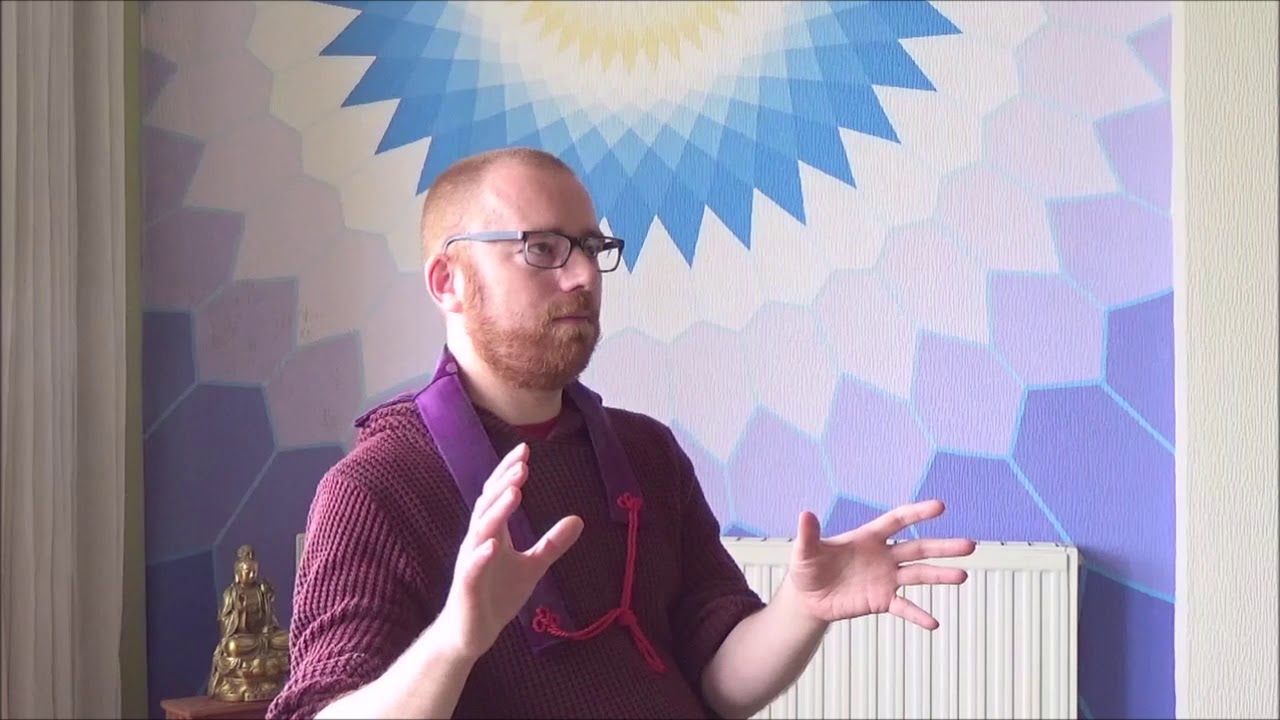
Kasper delivers a dharma talk on Pure Land Buddhist practice, explaining how mindfulness of Amida Buddha and acceptance of yourself as you are can lead to gradual change. The talk covers nembutsu chanting, encounters with healing presence, and includes audience questions about bringing difficult parts of yourself into relationship with a loving presence.
Chapters
Thank you.
Good morning, everybody.
Good morning.
Welcome to the temple. So this talk I titled "The Buddha Will Fix You." And this morning when I was sitting in meditation, I had a really good idea of something I could say in this talk. And by the time I'd rung the bell to end the meditation practice, those thoughts had disappeared, and I can't recall what they are. They might come back to me. Luckily, I've got some other things I can say instead. So I want to begin by reflecting on the meaning of the word mindfulness, particularly thinking about how my teacher, Dharma Vidya Dave Brazier, understands the meaning of the word mindfulness. It's most commonly used these days to mean something like awareness. We do mindfulness meditation, you might do awareness the breath, you might pay attention to your body, or your thoughts. And there's good benefits that can come out of all those practices, but it misses something of the original quality of the word mindfulness when the Buddha first used it 2,500 years ago. The teaching that a lot of mindfulness teachers and communities often call back to is called the Satipatthana Sutta. And in that teaching, the Buddha says to his disciples— he's leading them in a meditation, essentially— and in that teaching he says, 'With your mindfulness in front of you, notice the breath.' Then, 'With your mindfulness in front of you, Notice the body. With your mindfulness in front of you, contemplate the Four Noble Truths, which is a teaching on how to live a good life in this world of impermanence and suffering. He doesn't say, 'Be mindful of the breath,' or 'Be mindful of the body.' It says, 'With your mindfulness in front of you.' And the reason this word mindfulness is used, obviously it's an English word translating a Sanskrit word and a Pali word. The translator, I'm going to get this wrong now because I haven't got the name in front of me, but I want to say Miss Davies. Said he used the word mindfulness because of the connotations of 'to remember' that it has in the English language. And we still use that, you have that sometimes, we say, 'Be mindful of your manners.' Means remember your manners. Be mindful of such and such. It means keeping something in mind, which is slightly different to just paying attention to what is happening. And for Buddhists, the best thing to keep in mind is the Buddha, this wholesome embodiment of love, compassion, wisdom. I guess— well, you can even just try in your own minds now If you bring to mind somebody that is mean-spirited, or that gets under your skin, and doesn't behave well in the world, notice what happens in your body, notice what feeling that creates. And then bring to mind somebody that you know, or know of, or remember, who is loving and kind and warm and friendly, and see what changes in your body and see what feeling that evokes. And very quickly we can see straight away, I can see I can see in my own case that I'm more relaxed when I'm keeping in mind a loving presence. And I know that from that place, I'm more likely to be loving myself. I'm more likely to be kind to myself. The central practice of this strand of Buddhism that we practice here in this temple, Pure Land Buddhism, is called Nembutsu, which is a word that has two halves. 'Nem' translates as mindfulness, and 'butsu' as Buddha, from Japanese. 'Nembutsu'—mindfulness of the Buddha. So this is the practice that we do in this tradition, keeping the Buddha in mind. And we do that particularly through saying the name of Amida Buddha, who is a Buddha that represents unconditional acceptance, unconditional love. And for Pure Land Buddhists, for many Pure Land Buddhists, this isn't simply an imaginative exercise. As an imaginative exercise, it works very well. Reminding ourselves that there is good in the world means that we're more likely to be good ourselves. But for many pure land Buddhists, there's an existential truth in this. There is unconditional love available in the universe. We have access to that spirit that the Buddha had access to in his own time. It isn't just restricted to the physical body of the person that lived and died 2,500 years ago in India. I don't know the exact mechanism by which that works. What I do know is that in my practice, I can experience being met by something that feels real, that feels other than myself, and that feels completely loving and kind. And doesn't require anything of you. Ah, I've remembered what I was going to say. I was thinking about how to talk about the— really there's two profound truths in Pure Land Buddhism, and one is that you are accepted just as you are without needing to do anything differently. In the way that a perfect grandparent welcomes their grandchildren. However well-behaved they're being, there's still a sense of holding them in love. It doesn't mean they don't still go on the naughty step sometimes, and we have to live with the consequences of our actions, but it's done in the container of a loving atmosphere. I realize not all your grandparents are like that, but these archetypal loving ones can And that in and of itself is a deeply profound spiritual experience, religious experience, if you like. And we don't need anything more than that. It's powerful for its own sake, the experience of knowing, or experimenting with knowing, or trusting. I am accepted in this moment just as I am. I don't need to do anything different. In a very minor way, I had an experience of this this morning before coming up to give this talk. I was, I was actually cleaning my teeth and beginning to notice some nerves about coming and speaking here today, and something just switched in my mind. The idea arrived that, oh, I don't need to dress as a Buddhist to give this talk, which is a strange thought, but you know, I've got a robe that I could wear. Traditionally, monks and nuns in our order wear all red clothes. The the other style of ordination, which I'm in, not a non-monastic priest, we don't have to do that, but often I do wear all red as a kind of sign that I'm plugging into something. This year particularly I've been keeping my hair very short, this is the longest that it's been for weeks, and a shaved head is a sign of being a Buddhist. And I realized that while there is some benefit to faking it till you make it sort of thing, wearing the clothes and then feeling your way into what you're doing, there was an also an element in that of some small part of me thinking, oh, if I look like this, if I behave like this, then I will get a particular result from the world. I'll get more respect, more affection, more attention in the way that I wanted. This little voice that kind of lives over here somewhere just whispering up to me, 'Oh, just, you know, shave your head before you go up.' And I realized in that moment, 'Oh, I don't have to do that,' because I have a deep sense of already receiving love, affection, warmth, acceptance from my spiritual practice, from taking refuge in the Buddha. So I don't need to manipulate the world in order to get it, which means I can just be myself, and there's a real relief in that. And again, when I'm being myself in that relaxed way, actually I'm more likely to connect with the people in the room. I'm more likely to be easy with people. I'm more likely to be warm with people. And that begins to hint at the second aspect of Pure Land Buddhism, which is that change is possible. And you will find that teachers often emphasize one or the other of these aspects. Aspects of the teaching. You don't need to do anything, you're accepted just as you are. That's really powerful actually, and you could just live in that teaching your whole life, and that would be wonderful. And you can sort of put a full stop after that, you don't need to say anything else. At the same time, people who do live in that state do change. For the better. And that's important to us, that also, that shouldn't be neglected. And some people only emphasize the tools in Buddhism that lead to change. Do this meditation, follow these precepts, listen to this teaching, try and behave in this way. And then you can end up putting the cart before the horse. In the way that I was doing when I was thinking, if I wear the right clothes, then I'll get a particular result. If I do this meditation, I'll get a particular result. If I follow these precepts, I'll get a particular result. There's some truth in that, and there's something really important missing, which is that actually those results are the natural outcome of anchoring ourselves in something that is completely loving. And completely wise, coming into relationship with something that accepts us just as we are. If I look back on my own life, I can see some of the bad habits that I've dropped away, not particularly through me doing any kind of efforting into it, but simply through continually being immersed through my spiritual practice and in relationship with my teachers and peers in a relationship of loving kindness. And now I suppose I want to suggest a mechanism by which that might happen, because Buddhism, you know, the tools in Buddhism are useful. So the first most important thing is nenbutsu, in the sense of mindfulness of the Buddha. It doesn't have to be be coming here and saying the words that we use, but understanding that there is something wholesome that you can take refuge in somewhere in the universe. And you could put your own words around that, give your own name to it, but beginning to trust in that is the first step. The second step is that when you are in the loving embrace of the Buddha for me. It's much easier to begin to notice the things about yourself that cause trouble for yourself and others. Often we shy away from examining our own nature because either we've already internalized shame about the things that we shouldn't be doing but we are doing, Or we expect to be shamed by the world around us for our bad habits. Somebody's gonna tell us off, somebody's gonna judge us. There's some critical figure in our lives or in our minds that stops us from getting close to examining, "Oh yeah, when I do that thing, in the long run, things get worse for me." Or, and sometimes and, in the long run, things get worse for the people around. So beginning to know the nature of our own darkness as well as coming into relationship with the light. Both of these halves are important to mature spiritual practice. The other day I had a really powerful experience of this. I was working with a friend of mine, we were training together, and at the moment 3 of us swap therapy sessions so that we can learn more about the model that we're using. So maybe we'll work for 40 minutes and then we'll pause and talk about what happened. Oh, when you did this, I really liked it. When that happened, it was really powerful. This bit threw me. Can you say more about what was going on there? And so on. It doesn't really matter, I'm just giving some of the context. So, a couple of weeks ago, I was in the client role, my friend was in the therapist role. And I'd been looking at some quite subtle habits actually in my own life, which on the surface might seem positive, but I'd beginning— I'd been beginning to know the downside of them. So one is the habit of really keeping myself upright and kind of making sure I know how to get things done and moving through the day. With some effort, quite an efforting part that really wants to get things done, get the, you know, take things off the list and be available to people to help people. And another part that is its opposite, if you like, that knows that I need to rest and I'm desperately tired and just wants to hide under the duvet. And those two parts work in opposition to each other, because the more I'm upright like this being available to people, the more the part that wants to go underneath the duvet is going, "Come on, please, please, please." And then at some point it takes over and I just go, "Oh, I'm exhausted now." And actually, because this being available to people is come from an efforting place, it's coming from a place of, if I'm not available to people, I'm worried that something is going to go wrong. It's that same kind of manipulation that I talked about at the beginning. Because it comes from that place, as well as the benefits that it has in getting me through the day and getting things ticked off my to-do list, it also keeps me slightly unavailable. It means that I get wore out and it means that I'm less likely to genuinely be connecting with the people that I'm meeting because it's coming from this strong place of thought. And obviously there's much, you know, that's not like the worst of habits to have. I could have shared things that really cause trouble in my own life, but this happens to be the one that I was talking about on the day that comes to mind, on that Friday. Anyway, as we began investigating where this came from, we started to approach a memory in which I was an infant. And I knew from the place— I'd been supported by my therapist to be in a place where I was feeling very warm towards this infant in my mind's eye that was— that appeared in this memory. And I knew that what that infant needed from me was simply warmth and connection and love. This was— this infant in my mind's eye was representing some insecurity some wounded part of me that felt like it hadn't got what it wanted in exactly the right way. I mean, there are other infants in my system that are very satisfied, but this particular aspect of myself is holding some pain. And my friend asked me, 'Oh, are you, are you in a place where you're feeling warm and loving towards this infant in your mind's eye. And I just checked how I was doing, and what— when I checked in with myself, I had a strong sense of the presence of something else. In my system.
I—
when I checked in with myself, I saw a glass ball, like a marble, but about this big. And I thought, oh, that's not part of my inner psyche, that's not a memory that's anything to do with me. I don't— why is this glass ball appearing? And then I remembered that Medicine Buddha carries a glass ball sometimes. Medicine Buddha is a sort of mythical Buddhist figure who is an embodiment of healing energy. And in that moment, I had a real strong sense of something, some loving energy that wasn't mine, that was close and next to me. That was lending me love and support so that I could be with this painful part of my own experience in the way that it needed, so I could meet this, this insecure, this insecurity, this pain, this woundedness in a way where I wasn't being overwhelmed by those feelings, and actually I could offer some Well, I could offer that atmosphere that I described as the grandmother's— grandparents' loving embrace to this wounded part of myself. And I could do that because I had such a strong sense of some other loving presence that wasn't anything I'd created in that moment. Now years ago, if I'd had that experience, I would have then worked very hard to explain explain it away. It would have been something, some part of my own unconscious process emerging and supporting me that I hadn't known about previously, or it would have been triggered by something that my friend had said. But through my years of practices, the more I find that I'm able to trust that there is something that isn't to do with my own habit patterns, that isn't to do with my own unconscious mind. And there are places of loving kindness in my own heart, in my own unconscious mind. This didn't feel like one of them, and I so strongly rejected the spirituality and religion of my childhood that even now there's a part of me that feels very risky in naming this, the otherness of this experience. And yet it's so important to spiritual practice, the essence of what enables us to flourish, the essence of those profound truths that I mentioned in the beginning of being accepted just as you are, leading to that sense of relaxation. Is this relationship between me as a limited ordinary human being and something that isn't that, that is wise and loving and compassionate and accepts me just as I am? And we can see this operating in the material world by looking at our relationships with other people, and some of them feed us, and some of them trigger us into states that aren't helpful, that are tiring, that take work. My spiritual practice suggests that there is something available that occasionally appears in human forms, like when great teachers appear, but also is available when those teachers aren't present. And as that wounded part of me received that loving kindness, it relaxed. It was able to let go of the pain that it'd been carrying because it, I, had an experience of, 'Oh, I'm accepted just as I am.' And as that relaxed, those habit patterns that I'd started that exploration from, the kīpī, upright part, and the no, you need to go to bed right now and rest for 1,000 years part, were also able to relax and not work so hard. Because they had the sense of, oh, we don't need to manipulate the world in order to get those results now, so we can relax as well. That was the upright part. And the tired part said, well, if you're relaxed, I don't need to worry about you getting overtired because you're taking care of yourself. Sadhguruji. So the invitation is, in your own spiritual practice, to pay attention to yourself, to notice your emotions, your habit patterns, your thought processes, and to bring those specifically into relationship with something that is loving and kind and accepting. Naming. Oh, here's the part of me that wants to keep eating. Okay, I'll offer that to the Buddha. I'll experiment with the idea. I'm quite a visual person, so for me I might even, you know, when I think of my habit pattern of eating all the time, the image that comes to mind always is of Pac-Man eating those little pills. So if I was doing the spiritual practice, because I'm quite a visually oriented person, I might imagine bringing that Pac-Man into a light of loving kindness that comes from outside of me, and just noticing that it begins to relax. This is a practice that we call 'chi kwa' in this tradition, peaceful abiding, because it often leads to that state of peaceful abiding. So this is how the Buddha can fix you. Simply by loving you over and over again. And your job is to keep coming back into that relationship and to bring more and more of yourself into that relationship. And over time, all those different parts of yourself begin to relax and experience that sense of settled peace. Of course, over time for a Buddhist means— usually means more than one lifetime. I'm not saying that every single part of you is going to experience that in this lifetime. Yeah, so here's the thing that I remembered that I was going to say, and it is something— if I can find the words— to put around it. Something like, when we take refuge in the Buddha and experience ourselves being accepted just as we are, there is something— when I do that, there is something about my perception of time that changes. It is like that moment I plug into something eternal. I plug into something, and I somehow, somehow in that moment I experience something of eternity, because I don't need to change, and I'm being held in that moment by something loving just as I am, and that truth will always be true, whether I know it or not, that truth will always be true throughout time. So there's something of the quality of eternity and there is also the aspect of practice which is about the change that happens over time, which isn't about eternity, it's about one step in front of the other. So both of these aspects come together in in Buddhist practice, the aspect of eternity, experiencing myself being accepted just as I am and not needing to do anything. Timelessness, maybe, is a better word for it. Yeah, the experience of timelessness. And the experience of time. This is me, as I am now, bringing these things that I want to change transform, let go of, to the Buddha in a process that takes time, and that I see working when I look at the history of my own life, and I look at the people who've come into this practice, people in this community whose lives have changed over time as well. And it doesn't, as I say, it doesn't have to happen in a Buddhist context. Those are the That's the language that I use, but I believe that it has to have those components in relationship with something other that is completely loving and an investigation into what am I really like at the moment. Thank you. Namaste. Namaste, Bhu. I can't see it. It's 10:02. So let's just spend a few minutes trying this together. Well, you don't have to, but that's what the invitation is. You can just sit quietly otherwise. So finding a position that's comfortable, and perhaps we'll begin by reciting the prostrations chant, for those of you that know it, a couple of times, which is saying the name of Amida Buddha, the Buddha who accepts us just as we are. And as we're chanting, bringing to mind or experimenting with the idea that there is a light, that there is something available. That accepts you just as you are. And then as we go into the silence, any thoughts or feelings that you notice in yourself, any habit patterns, just connecting those to that sense of the Buddha, to that sense of the light. And if you notice the relaxation and you become quiet and peaceful, just allowing yourself to settle into that peace. And if something else comes across your mind, bringing that too into the light.
Nam-myoho-renge-kyo. Nam-myoho-renge-kyo. Namoh Amitabh. Namoh Amitabh. Namoh Amitabh. Namoh Amitabhu. Namoh Amitabhu. Namoh Nita.
In your own time, open your eyes, bring attention back into the room. So I guess there is time for a couple of questions if anyone has got anything they want to ask about what I've said, but no pressure. Can I just ask about the name of the Buddha that you've survived the class for? Medicine Buddha. Okay. So in Mahayana Buddhism, which is the— particularly which is the Buddhism of northern India, Nepal, Tibet, China, Korea, Vietnam, and Japan, there's a sense that the universe is full of these Buddhas that all have slightly different positive aspects to them. So Manjushri carries a sword that cuts through ignorance. Kuan Yin embodies compassion. Tai Chi embodies strength and stamina and creativity. Medicine Buddha embodies healing. Healing. And Dolma Rinpoche says, in a sense, this is all the same thing coming towards us, just showing us different faces at different times, whatever is appropriate for us to relate to in that moment. So there would be other mantras. Each of those has their own particular mantras associated with them. So the way we say 'Namo Amitabha,' there's particular words that you you would use to invoke Amida, who's the Buddha of acceptance. There's other words that you would use if you're connecting with Medicine Buddha, for example. But we don't need to know those? No. I mean, if it appeals to you, you can go and find out about it, but no, you don't need to. One is enough. One Buddha is enough, actually. Or, you know, whatever it is that you're relating to.
Okay, to say something.
Yeah, yeah, I also had an experience with Medicine Buddha actually. We bought a Buddha that we didn't know what it was from secondhand shop, and he was holding his marble in front of him, and he brought me exactly what I needed at that time. So I went on YouTube and found a really lovely mantra, and I chanted that mantra that mantra a lot, or listened to that mantra, and Medicine Buddha was involved in something I really needed to happen. So I think that if we're open, then various things come to us. And if you want to do a bit of research, you can, but that's not— as Kasper said, that's not necessary.
Yeah, until we found that particular statue, I've never heard of Medicine Buddha carrying a glass ball, is usually shown holding a flower, but there you go. He also carries a marble sometimes.
I was just thinking about what you said about how you were years ago to how you would, how you would have taken it now, and that's quite tricky too. So sometimes you might have a sense that the Buddha's brought something that you need at that time, or a message, or— but it's hard to— how do you get over starting to acknowledge it but then thinking, no, no, that's not what it means, and the other voices in your head are saying— how do you get to the point where you can receive those things?
I mean, I would say don't worry about it, but I realize that isn't necessarily what somebody in that position wants to Notice those voices, let them know that you've noticed them. Oh, there's the bit of me that isn't sure about this. Oh, there's the bit of me that wants it to be something different. Okay, so you're both there as well. And even in that act of noticing, you can create some space between you and that aspect of yourself that is doubting. And then you can notice, oh, and there's a part of me that is interested about it, ultimately. So that's one helpful way forward. And I suppose ultimately, when I say don't worry about it, what I mean is, for a long time, the way that I thought was, well, it doesn't matter whether it's my imagination, because it's helping me be more kind. And more loving and more, more with the people that need me to be with them. So actually it's an interesting question, and coming to this place has added a depth of something to my spiritual practice which I really appreciate. But it wasn't necessary to answer that question in order to experience the benefits of the practice.









