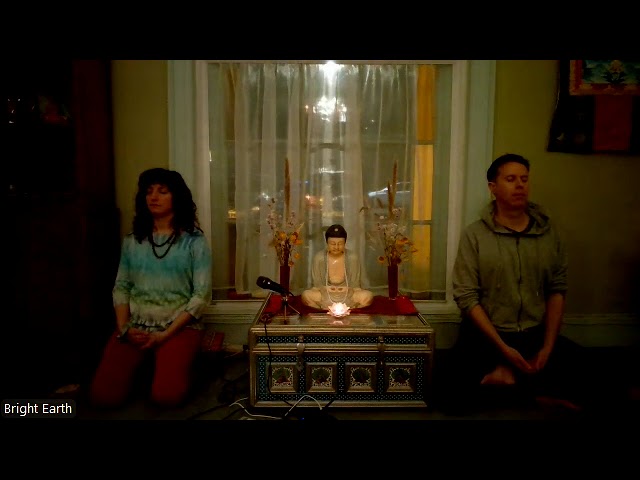
This content was created by Satya Robyn. This content was uploaded by Satya Robyn. This is a YouTube video titled "The deep presence of trees" (recorded March 26, 2025). The excerpt is from a group Buddhist/meditation gathering and includes a Dharma reading (from The Lion's Roar / Valerie Brown's "Finding Myself in the Garden"), a teacher's dharma talk on trees (including a passage from Hermann Hesse), guided meditation/chanting (Amitabha), call-and-response recitation of refuges and precepts, a prostration practice, and community announcements (work hour, Hanamatsuri, donation request). Multiple participants are present and labeled Speaker A–E (a facilitator/teacher, a reader, chanters, and congregation responses). Themes include trees as teachers, grief and healing, interconnection with the Earth, and cultivating compassion.
Chapters
Welcome everybody.
We're going to begin tonight's practice with a Dharma glimpse that was from The Lion's Roar, which is like a Buddhist, um, magazine.
From Finding Myself in the Garden by by Valerie Brown in Lines Rural magazine. 12 years ago, when my husband David and I moved into a barn house outside of Philadelphia, I started dreaming about the garden I would plant. But the marriage was choked out by sadness, isolation, and an ambiguous love. David moved out during an excessive heat morning in July. And as he drove away, my heart shattered into pieces, activating the seed-like emotions of shame, despair, and isolation. As a lawyer, I knew nothing about compassionate and loving divorce. I had a well-tended adversarial mindset that contributed to the marriage ending. A nagging voice in the back of my head was saying, 'Dharma teachers don't get divorced. They live happy, contented, well-rounded family lives.' The divorce was a necessary ending laden with potential. I set out to reclaim my inner gardener, to water the seeds of peace, understanding, and love within me. I replaced rotten wood and painted my barn house. I removed heaps of junk and diseased trees that threatened to fall on the house. I replaced the cottage roof and painted over graffiti. Then I turned to a small koi pond that at one time had been a source of joy, but over the years had become like my marriage— stagnated with muddy water overgrown and empty of fish. Shovel by shovel, I worked with a couple of friends and helpers to move plants and rocks, remove overgrown weeds, and reclaim the soil with organic matter. Each month brought a new challenge in the garden. Groundhogs, carpenter bees, wasps, and hard as rock clay soil. And while the garden was being reborn, my brother was dying. He died in February of last year, and this was followed by desperate months of quarantine, isolation, and physical distance, by the disproportionate impact of COVID-19 on Black, Latin immigrant, and low-income communities, by the unlawful police killing of George Floyd and others. And by worldwide protests supporting Black Lives Matter and calling to defund police. It was a sunny day in July, and it had been nearly one year that I'd been living unpartnered. I walked outside and looked at the place that had not long been a hole in the ground with stagnant water. Now there was the sound of running water from a glazed fountain. There were hummingbirds, black butterflies, and goldfinches, and my Niger seed feeder. There was pink echinacea, papuya, feathery white— this is where I can't pronounce the words— artesemia, schimitania, vivid red crocosmia miri, a hybrid, and lemon yellow cor— Pocis verticillata. I don't know if Dave knows any of those words, but yeah, okay, that's good. I went over to the giant staghorn fern and took it down to give it a good watering. Days earlier, I'd noticed that a tiny song sparrow had built a nest of pine needles behind the plant. As I put the nozzle deep into the cavity of the fern, I stopped. There, huddled together, lay 5 tiny brown speckled eggs. In the Plum Village tradition of Thich Nhat Hanh, we're invited to wake up to the suffering within and around us, to hold suffering with care, get to know it, and transform it into compassion, peace, and love. We are invited to cultivate a safe haven with each breath for ourselves and for all living beings. The making of this garden taught me to dig deep, deeper still, to know that love is a digger. Namamidabu.
And move into a short period of meditation, so getting out any little kinks that you need to get out in the body. And just gradually inviting whatever level of settling is possible for you in this moment. We're going to move into a period of chanting. I'm going to chant Amitabha. The name just purely of Amitabha Buddha, the Buddha of infinite life and light.
Amitabh. Amitabh. Amitabh. Amitabh. Amitabh. Amitabh. Amitabh. Amitabh.
Amitabh.
Amitabha. Amitabha. Amitabha.
Ame taba.
Ame taba. Ame taba. Amitabha. Amitabha. Amitabha. Amitabha.
Ame Samba.
Ame Samba. Ame Samba.
We're going to recite in call and response the refuges and precepts, which are written on the little liturgy sheet next to you or under your chair. And if you've not heard them before, then you're welcome to listen, or if you feel like joining in, then you can, of course. For refuge I go to the Buddha.
For refuge I go to the Buddha.
The one who is awake and full of love.
The one who is awakened to all of life.
Namo Buddha. For refuge I go to the Dharma.
For refuge I go to the Dharma.
All that guides us to wisdom and compassion. All that guides us to wisdom and compassion. Namo Dharma.
Namo Dharma.
For refuge I go to the Sangha.
For refuge I go to the Sangha.
Those who live in the Buddha's light.
Those who live in the Buddha's light.
Namo Sangha. Namo Sangha. For refuge I go to the Earth.
For refuge I go to the Earth.
I can't remember the next line, and I don't think we've got it printed out.
Dave?
I don't know it, sorry.
Okay, apologies. Pause. Next line: imagining happening something beautiful about the Earth. Just imagine Satya Robyn said something really beautiful about the Earth. Namo Bhumi. With faith in the Three Jewels, with faith in the Three Jewels, and in light of my human tendencies, and in light of my human tendencies, I pray that I may become aware I pray that I may become aware of when I take life—of what? Take life—I prayed that I may become aware—I pray it's time to come away from—"when I take what is not freely given"—what did they say?" "What she said." Freely give him—"I pray that I may become aware—I pray at some point be comfortable there—of when I fall into sexual misconduct," of when our four intersections come out. I pray that I may become aware— I pray that I may become aware of when I fall into wrong speech. Of when I fall into wrong speech. I pray that I may become aware— I pray that I may become aware of when I've become intoxicated. When I become intoxicated. No blame. No blame. Be kind. Love everything. Love everything. Innumerable sentient beings, we vow to save them all.
Inexhaustible art of interconnection, We vow to transform them all.
Immeasurable are the Dharma teachings.
We vow to master them all.
Infinite is the Buddha's way. We vow to fulfill it completely.
Namaste. So I thought tonight I'm going to do part 2 of, um, of, um talking about trees, um, trees as teachers, as inspired by adding our fourth refuge in taking refuge in the Earth. I'm going to share a little bit more from Hermann Hesse's The Trees again. There's loads of talks in this. I could just keep doing a different paragraph every Wednesday. Trees are sanctuary. Trees are sanctuaries. Whoever knows how to speak to them, whoever knows how to listen to them, can learn the truth. They do not preach learning and precepts. They preach, undeterred by particulars, the ancient law of life. And then a bit further down it says, when we are stricken and cannot bear our lives any longer, then a tree has something to say to us. Be still, be still, look at me. Life is not easy, life is not difficult. Those are childish thoughts. Let God speak within you and your thoughts will grow silent. So that last bit there reminded me of this little thing, little practice I guess, that I do often on dog walks, which is Like, I'm really drawn to trees, and particularly to really mossy trees, like, yeah, a bit of moss. And what I'll often do is I'll go up to the tree and stand like close facing the tree, and I'll just put my forehead onto the mossy tree trunk. And it's amazing. Like, I highly recommend going and giving it a go. Maybe, maybe this is something you already do. Maybe you already hang out with trees. Um, definitely highly recommend. There's something that happens, apparently physiologically, there is something that happens when we put, when we put our forehead, when we rest our forehead onto something. Apparently it does send really calming signals to our nervous system. Um, yeah, and it's amazing because I'm there and I've got my forehead against the mossy tree trunk, and whatever preoccupations, anxieties, losses, worries are going on for me, they just gradually move into the background as I really drop down deep into that experience of being there with the tree and really attuning, attuning to the tree and feeling some sense of the attunement that nature can provide back. And it's that real stilling I experience, this real stilling, as that— that's the very deep power or energy of the tree. It's there with me, and I'm there with myself and with the tree, with the Earth. And it's also interesting because my forehead is also— well, the top of my head and my— the very top of my forehead is also where I was split when a tree branch landed on me, um, a year and a bit ago. And because, because I can still kind of feel the scars sometimes, if I put the upper part of my forehead, I can feel that. And that, and that, and that's also part of like this unique kind of, you know, it's informed my relationship with trees. So it's interesting to be with that as well, you know, to be with some harm that was obviously unintentionally caused by tree, some tree, and to also be there with this incredible connection and interconnectedness that is there. And I feel like these, like, just the power of the natural world to provide in, in, in just like a very short period of time, a profound sense of stillness and connection and interconnection is, is incredible, you know. And the fact that that's actually readily, readily available to us all the time. Like, even, you know, I mean, we're privileged enough to not, you know, not live in like the middle of a massive city, but even in cities there's a little bit of green. And yeah, I just feel incredibly fortunate to have this amazing, you know, all these blessings, all these blessings. And obviously we're kind of wanting to move away from a, uh, a one-sided, like, utilitarian kind of just taking relationship with the natural world, you know. Um, so I think in that moment, yeah, I am— when I'm there with the tree, I am really grateful of the power of the tree as, as a resource. Yeah, and I'm also sending some love back. I'm also— I'm like, you know, allowing that cycle to be complete. The amazingness of trees. And I'm always reminded of how they're there communicating in incredibly intricate and complex ways through the mycelium webs. And yeah, just, and, and how that's a great reminder for how we are profoundly, profoundly, inexplicably interconnected with absolutely everything in a constant dynamic relationship. Most of which we're completely and utterly unaware of. I'm going to read a little bit more from this and then close this part of the talk. For me, trees have always been the most penetrating preachers. I revere them when they live in tribes and families, in forests and groves. And even more, I revere them when they stand alone. They are like lonely persons, not like hermits who have stolen away out of some weakness. Notice some reaction to that. It's not a weakness to steal away and be hermit, but like great solitary people like Beethoven and Nietzsche. In their highest bowels the world rustles. Their roots rest in infinity, but they do not lose themselves there. They struggle with all the force of their lives for one thing only: to fulfill themselves according to their own laws, to build up their own form. To represent themselves. Nothing is holier, nothing is more exemplary than a beautiful, strong tree. Namu Amida Butsu. In a moment, when Phee dings the bell, I'm going to move into prostration whilst chanting. And as always, you can join in or you can watch.
In gratitude we make this offering to all Buddhas and bodhisattvas throughout space and time. May it be as fragrant as Earth herself, reflecting our careful efforts, our wholehearted mindfulness, and the fruits of understanding slowly ripening. May we and all beings be companions of Buddhas and Bodhisattvas. May we awake from forgetfulness and realize our true home.
So now we're going to bow one way and then the other. Chime. Our seats. We tidy our seats. Do we have a work hour this weekend? Yes, we have a work hour this weekend on Saturday at 11 till 12.
Come and enjoy doing some work in the Spring Garden.
I, um, yep, obviously on the 12th of April we've got Hanamatsuri, so that'll be a really lovely celebration.
And we have the golden bowl in the hallway if you're able to make a donation, or donate online.
Blessed by Amitābha's flight, may we care for all living things.









