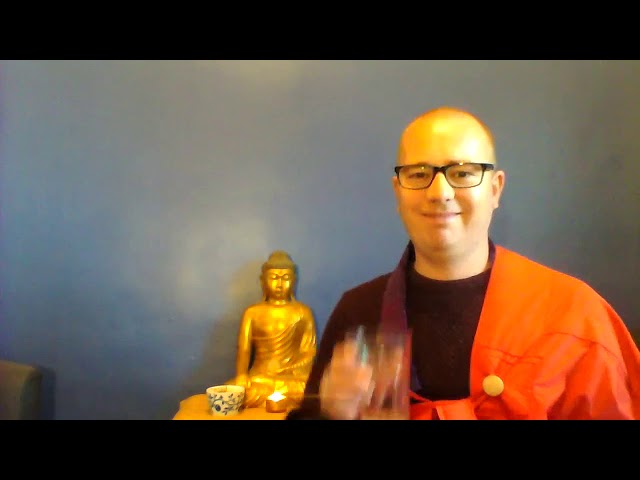
This content was created by Satya Robyn. This content was uploaded by Satya Robyn. This is a YouTube video titled "Wednesday evening nembutsu service 6th May 2020" (recorded May 6, 2020). The excerpt is an English virtual Nembutsu/Amida Buddhist evening service led by a primary officiant (Speaker A) with responsive liturgy by another participant (Speaker B) and contributions from Satya Robyn, who joins in chanting. The content includes mokugyo-led Nembutsu chanting, group chanting of Namo/Amitabha, a dharma talk reflecting on the parable of the River of Fire and River of Water (contrasting qualities of Shakyamuni and Amida Buddhas), meditation posture and breathing guidance, and recitation of the evening service and vows. Metadata indicates this is a YouTube recording of a communal Zoom/virtual shrine-room service.
Chapters
So we begin with it as we do in the shrine room, with some Nembutsu chanting using the mokugyo. This is my baby mokugyo, and we start with this vigorous chanting as a way of inviting people to join the service. You're already here. Traditionally, in big training temples in Japan, the lay congregation gather, the mokugyo starts, and then the monastic community will come and join them from another hall where they've been doing some extra practice before the public service. And it's also a way of waking up all the invisible spirits and deities that you find within Buddhist metaphysics and Japanese religion, and encouraging them to come and join us as well.
So please do.
So it's Namo Amitabha, the form of chanting. Please do join in wherever you are.
Namo Amitabha. Namo Amitabha. Namo Amitabha. Namo Amitabha. Namo Amitabha. Namo Amitabha. Namo Amitabha. Namo Amitabha.
Alas, people busily engaged in secular matters, wasting away day by day, night by night. Like a lamp in the wind, how long can it last? In the six realms of vast samsara, there is no fixed abode. How can we escape from the sea of affliction? How can we rest in peace? Should we not be afraid? While still young and strong, let us each hear the Dharma. Let us strive and diligently seek the path to eternity. In the shrine room, this is the time where we practice walking and chanting, and we use the phrase Amitābha, the Sanskrit version of Amida Buddha's name, meaning limitless light. Limitless in the sense that it does not measure us at all, and limitless in the sense that there is no boundary to the light. It can reach us wherever and whenever we are. On Zoom we can't walk, so we will sit and chant Amitābha together. Excuse me, make sure I've got my right bells.
Amitabha. Amitabha. Amitabha. Amitabha. Amitabha. Amitabha. Amitabha. Amitabha. Amitabha. Amitabha. Amitabha. Amitabha. Amitabha. Amitabha. Amitabha. Amitabha. Amitabha. Amitabha. Amitabha. Amitabha. Amitabha. Amitabha. Amitabh. Amitabh. Amitabh. Amitabh. Amitabh. Amitabha. Amitabha. Amitabha. Amitabha. Amitabha. Amitabha. Amitabha. Amitabha. Amitabha. Amitabha. Amitabha. Amitabha. Amitabha. Amitabha. Amitabha. Amitabha. Amitabha. Amitabha. Amitabha. Amitabha. Amitabha. Amitabha. Amitabha. Amitabha. Amitabha. Amitabha.
Miriya, nice to see everybody. There's 13 people in the virtual shrine room this evening, which is really lovely. I've been thinking about a famous image, and I think it's from Shandao. I didn't really check any of this before I came to service, I just had the picture in my mind. Some of you who've been to the temple may remember that there are two big wall hangings, Japanese paintings, on the stairs as you go up to where the bathroom is and the residence rooms. And one of those paintings is of the parable of the River of Fire and the River of Water, which I always think is a strange name for it because it's one river, but half of it is fire and half of it is water. So it should be called Half a River of Fire and Half a River of Water, but maybe that doesn't have the same ring to it. So the story, the parable, is of a traveler who is going through the woods, and there's bandits and wild animals chasing him. And he comes to a river with a narrow bridge crossing the river, and you can hear the bandits and the wild animals getting closer behind him. And this river, to the one side of the bridge, the river is made up of hot roaring flames, and to the other side of the bridge. The river is made up of tumultuous, stormy water, and the path itself, the bridge itself, is just a few inches wide, and it's a white path crossing the river. And he comes to the edge, to the first bank, and he hears a voice in his ear encouraging him to move forwards. And he realizes if he doesn't, the bandits and the wild animals will get him. And if he isn't careful moving forwards, he could fall into the fire or fall into the water. But the voice is encouraging in a, in a skillful way, in a calm way, like the best kind of teacher. And he also hears from the other side of the river a voice encouraging him forwards, saying, 'Come and meet me. Take your first step across the river of fire and the river of water.' And so step by step, he crosses from the side where all the bandits and the wild animals are to the other side into safety. And the river of fire and the water and the bandits represent the three passions that we get caught up in, or the three poisons rather: greed, hate, and ignorance, greed, ill will, and delusion. And the voice encouraging him forwards that he hears from behind him is the voice of Buddha Shakyamuni, the Buddha who lived and died in India 2,500 years ago. It's the voice of the past encouraging him forwards, to move forwards. And the voice on the other side of the bridge is Amida Buddha, the Buddha who is present to us now through the spiritual practices that we do. The Buddha accepts that, accepts us just as we are, the Buddha whose name we've already been reciting this evening. So it's a sort of— it's an image, a tableau of the spiritual journey. Telling us that with the support of these two figures, we can make it from one side of the river where there's these bandits and wild animals, across this narrow path where there's always the temptation— or the, the word's gone out my mind— but where there's always the temptation or the possibility of falling into one side the other, but it is possible to make it from one side to the other with the encouragement of these two Buddhas. And I was thinking about the characteristics of these two Buddhas. What do they each embody? So when I think of Shakyamuni Buddha, I think of him meeting his disciples one by one and giving them just the practice that they need, the encouragement to do something. To go and do meditation, sitting meditation, to go and do walking meditation, to go and study the precepts with this senior disciple, to go and help this community, to go on an alms round. He's encouraging them to take the dharma and make it active in their own lives. He's encouraging them to train. To do something. And when I think of the energy and the qualities of Amida Buddha, who's sitting on the other side of the river, this is the Buddha who accepts us just as we are, who doesn't need us to do anything in order to be loved. We don't need to train, we don't need to keep the precepts in order to receive that love. The love is already flowing towards us. Their compassion is already flowing towards us. When we really examine both of these Buddhas, what we discover is that they both have each of these qualities. Shakyamuni Buddha accepted people just as they were. He didn't discriminate about who he gave spiritual teachings to. He welcomed everybody into the community. Sometimes they stayed and sometimes they didn't, but there was a spirit of welcomeness. Amida Buddha accepts us just as we are, but also can see that it's good for us to keep the precepts and to do our spiritual practice. But they often embody or exemplify these two different qualities. Amida on the shore in front of us, sitting, radiating light, sending love to us without us needing to do anything to receive it. Ready to welcome us with open arms, and Shakyamuni whispering in our ear, encouraging us to take action, to put one foot in front of the other. And I think— and some of you that read the temple newsletter perhaps will pick up that this is the same themes that I already wrote about earlier this week, presented in a different image. That the mature spiritual life has both of these qualities: the quality of experiencing ourselves loved and accepted just as we are, and the quality of us choosing to make an appropriate response to the situation that we find ourselves in. The quality of engagement, of training, of doing some practice. Both of these things come together in the spiritual life. This is the alchemy of self-power and other power, I suppose, if you want to put fancy words to it. But essentially, it's understanding that sometimes we're in the position of knowing that there's nothing that we can do. And that we're still loved just as we are. And sometimes we're in the position of knowing that we're loved just as we are and seeing that there are things that we can do and stepping forward and doing them. And both of those places are really important. So the bandits and the animals behind us, the river of fire and water in front of us, Shakyamuni Buddha encouraging us to put one foot in front of the other, to take action, to engage with our training, to follow the precepts. Amida Buddha sitting on the other side of the river telling us that we are already loved just as we are. Nam-myoho-renge-kyo. Sanaa, we're going to have a period of meditation. So just a note on posture, if you can notice your hips and your pelvis, if your pelvis is tilted forwards you'll find that you sit upright, but there's— it introduces a lot of tension in the lower back. If your pelvis is kind of tilted backwards, then you slump over and you're more likely to fall asleep in meditation. If your pelvis and your hips are kind of pointing upright, then you'll find that you'll be in a really nice position for meditation where you can breathe easily and still have that quality of awakeness that we're looking for. So finding a comfortable upright position and just sitting, noticing the breath, noticing feelings in the body, noticing thoughts coming and going. Knowing that all of these different aspects of our experience are loved by the Buddha.
Satya Robyn.
Thank you, everybody. If I remember, I'll put up an image of the River of Fire and River of Water on the Amida Mandala website under the news section later on if you want to check it out. Right now we are going to recite the evening service together, which is on pages 13 and 14. No, oh no, hang on. Yes, it is on pages 13 and 14. Sorry, I was just looking at the wrong thing. Pages 13 and 14. If you haven't got the service book, the link to download it is in the chat box, and if you're on YouTube, I will put the link in the description. I've been reciting this for years, but always— well, not always, but often— with another person next to me, and I find if I'm just doing it on my own That's when I lose a word here and there. And I have to say, when I did drama years and years ago, I used to be equally as terrible at remembering my lines, so no improvement. Anyway, we're on page 13 of the service book.
With body, speech, and mind Humbly I prostrate and make offerings both set out and imagined. I confess my wrong deeds from all time and rejoice in the virtues of all. Please stay until samsara ceases and turn the wheel of Dharma for us. I dedicate all virtues to great enlightenment. The ground sprinkled with perfume and spread with flowers, the great mountain for land, sun and moon, seen as a Buddha land and offered thus. May all beings enjoy such pure land. Hidam Guru, Ratnamandala kam niryatayami. By the grace that I receive through Amitabha's vows, may I be moved to deeds for the benefit of all. By the grace that I receive through Amitabha's vows, may I be moved to deeds for the benefit of all. By the grace that I receive through Amitābha's vows, may I be moved to deeds for the benefit of all. The purpose of our practice is to be a pure container wherein the common passions mature as higher wisdom. The preliminary outlook comes with bowing and contrition, facing up to my obstructions and seizing life's first essence. Devotion to my teacher ends my smugness and ejection. Held by his compassion, I will find a straight direction. By refuge vows and precepts, recitation of the sutras, I grow through every challenge. Embodhisattva aspiration. Cooperation in a sangha brings so many joys and freedoms. Through gentle words and gestures comes collective transformation. Settled faith and inner cleansing brings us home to life's great meaning. In the Four Divine Abidings, Buddha's light is always with us. Multitudes are disconcerted by impermanence and difference. With Dharma as true refuge, we dwell within the Pure Land. Now gratitude is overflowing, going forth, returning richly. I offer gifts of Dharma, Buddha's path bliss bestowing. Innumerable are sentient beings, we vow to save them all. Inexhaustible are deluded passions, we vow to transform them all. Immeasurable are the Dharma teachings, we vow to master them all. Infinite is the Buddha's way, we vow to fulfill it completely. Invocation of Achalanatha. Hail to the mandala! Let us so be engulfed within its praises evermore, that by our own wills and vigilance may we our fetters cut away. May we within the temple of our own hearts dwell amidst the myriad mountains. Hail, hail, hail, invocation of Maha Kala. Let us be engulfed within the mandala of the Sangha of the Buddha. Hail, hail, the arrow of emptiness. Invocation of Vairochana Buddha. Hail the beneficent mystic, the treasure.
Hail the golden bell that rings but once, peace upon the pillow. Makura Om. Makura Om. Makura Om.
So we'll bow to each other and to the Buddha.
The original and sacred vows are the unique and essential path by which to enter the Pure Land. Therefore, with body, speech, and mind, we are devoted to the teachings that all may attain the state of Nam-myoho-renge-kyo. Unique and Essential Grace. Years ago we used to say Unique and Essential Path. It got changed about 10 years ago. It's still in my mind somewhere, the old words. Thank you for joining me this evening. If you want to join the Nembutsu Circle, drop me or Satya a message and we'll make sure you've got the link for Saturday. Otherwise, look forward to seeing you at one of these events again.









