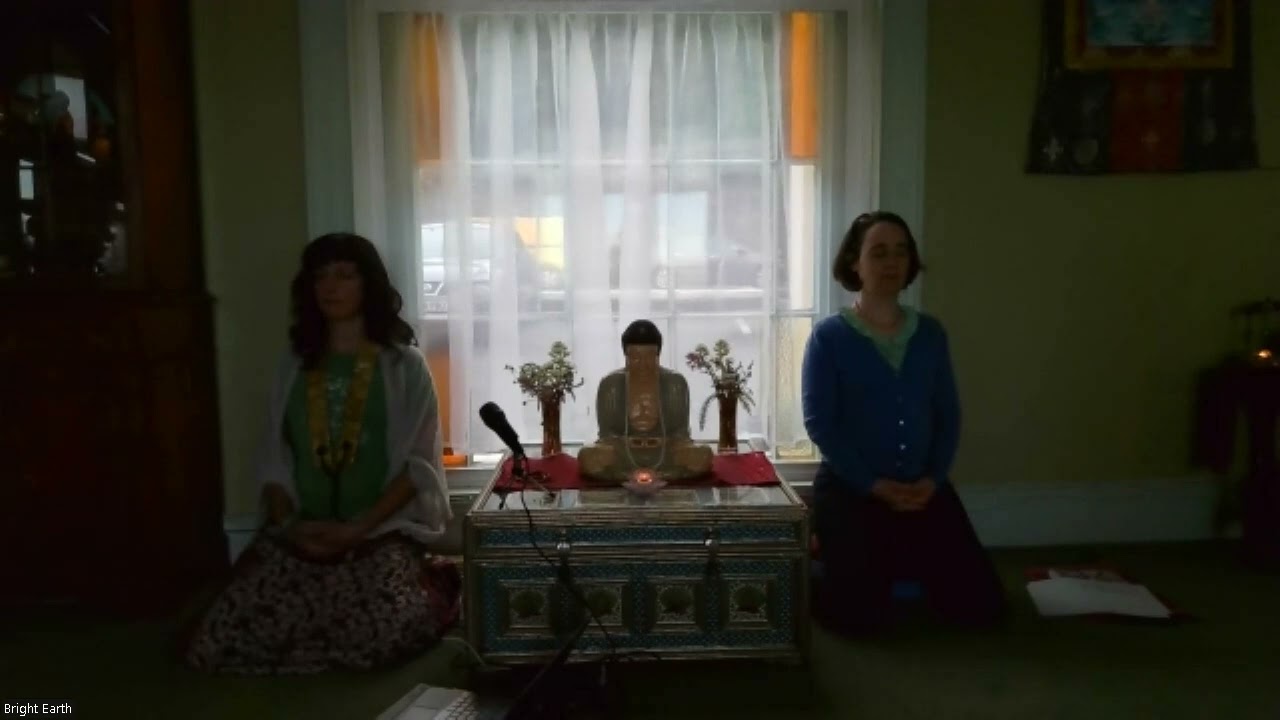
A sangha gathering with group chanting, refuge vows, and a Dharma teaching. Helen's written reflection on a dream about a tiger and hummingbird explores trust and the Great Mother, while participants chant the Nembutsu and other traditional Buddhist mantras together.
Chapters
Welcome to this little select gathering practice session. We also have Claire joining us online. So we're going to start with a Dharma glimpse written by Helen and read out by Angela.
So Helen has written The Tiger, The Hummingbird, and Trusting the Great Mother. I recently had a rather vivid and unusual dream. Which is something that happens often for me, perhaps an advantage of a strong and untamable imagination. I bought a tiger cub, something wild, beautiful, and deeply alive. She padded through the dream world, silent and sovereign, carrying a presence that stirred something primal. She was me, or the part of me that guards the gates, the one who watches, who calculates, who has survived by staying sharp, by staying in control. And my first instinct: build it an enclosure, make it safe, make me safe. So I poured myself into the plan, carefully lovingly— carefully lovingly even. I made it nice, I made it secure. I planted honeysuckle along the edge because part of me still wants beauty. Still want softness. But then a wasp walked over the honeysuckle, and I panicked. If the wasp has touched it, I thought, I can't enjoy it anymore. That's the OCD voice, the perfectionist vigilance, that deep fear that if joy isn't pure, it isn't safe. Somewhere in all this, I'd bought a hummingbird too, a tiny, bright, and impossibly tender bird. It loved cuddles. It trusted me. The hummingbird flickered through the stillness, a flash of iridescent vulnerability, trembling and fierce in its fragility. Both lived in me, the predator and the prey. Later, the tiger escaped, not violently, not to hurt. It just mated with the neighbor's dog. It was bizarre and chaotic, and my whole system, inner manager included, went into alarm because something wild had acted beyond the plan. And while all this was happening, the tiny, gentle, trusting hummingbird died quietly, unnoticed. I had left it in the back of my car. It wasn't cruelty, it was control. It was fear disguised as order. I was left with this: the dream is not a puzzle to be solved, but a mirror reflecting the dance between my vigilance and my yearning. I see how I've built entire worlds from my need to understand, to assimilate, to wrap the chaos of life in neat narratives. And here, beneath it all, is the tender realization that maybe, just maybe, I don't need to earn my place in the universe. Because something deeper has stirred, a truth not learned but remembered. There's a great mother beneath all this, not the mother of form or history, but the one who holds the roots of being, the one who says, 'You don't have to perform to belong. You don't have to fix yourself to be loved. You don't even have to understand to be safe.' In the lap of the Great Mother, I'm already accepted, already held, already free. So today I breathe a little deeper. Maybe I can loosen the grip just enough to let the hummingbird land, just enough to trust. Namomi debu.
Thank you, thank you, great mother. So in your own time, your own way, heading into meditation.
Thai Atta, Om Bekken Je, Bekken Je. Ma bacon jay, ratsa samangate soha. Satya Robyn jay, bacon jay, ma bacon jay, ratsa samangate soha. Thai Attha oom beekin je bekkin je maa beekin je ratsaa sammaangatee soo haa. Thai Attha oom beekin je bekkin je Maha vekhunje ratsasamungatse soha. Satya Robyn, vekhunje, vekhunje. Maha vekhunje ratsasamungatse soha. Thai, Thai, Om, Om, Bekken Je, Bekken Je, Ma Bekken Je, Ratsasamungatse Soha. Thai, Thai, Om, Om, Bekken Je, Bekken Je, Ma Bekken Je. Mahabhakunje Ratshasamungate Soha. Satya Robyn, Mahabhakunje Ratshasamungate Soha. Thai, Thai.
For refuge I go to the Buddha.
For refuge I go to the Buddha.
The one who is awake and full of love.
The one who is awake and full of love.
Namo Buddha.
Namo Buddha.
For refuge I go to the Dharma.
For refuge I go to the Dharma.
All that guides us to wisdom and compassion.
What guides us to wisdom and compassion?
Namo Dharma. For refuge I go to the Sangha.
For refuge I go to the Sangha.
Those who live in the Buddha's light.
Those who live in the Buddha's light.
Namo Sanghaya.
Namo Sanghaya.
For refuge I go to the Earth.
For refuge I go to the Earth.
The holy ground of awakening.
The holy ground of awakening.
Namobunyai.
Namobunyai.
With faith in the Three Jewels and the Four Refuges.
With faith in the Three Jewels and the Four Refuges.
And in light of my human tendencies.
And in light of my human tendencies.
I pray that I may become aware I pray that I may become aware of when I take life. I pray that I may become aware of when I take what is not freely given. I pray that I may become aware of when I fall into sexual misconduct. I pray that I may become aware— —of when I fall into wrong speech.
Of when I fall into wrong speech.
I pray that I may become aware— —when I become intoxicated.
When I become intoxicated.
No blame. Be kind. Love everything. Love everything.
Innumerable are sentient beings.
We vow to save them all.
Inexhaustible are deluded passions.
We vow to transform them all.
Immeasurable are the Dharma teachings.
We vow to master them all. Infinite is the Buddha's way. We vow to fulfill it completely.
So about a month ago, I went to the Beltane Bhakti Gathering, which is a 5-day bhakti yoga event of long, long days of chanting and singing and music and dancing and fire ceremonies. And in— so the mornings start with a Vedic fire ceremony, which is a very, very ancient ritual, um, from India. And its, its whole purpose is about giving back to the Earth, to the Mother, recognizing the infinite gifts and ways that we're nourished and supported, um, and how that just keeps, you know, we just keep being supported by by the Earth, by nature, by the Divine Mother. And this is— the fire ceremony is a way of giving back, of giving back. So a pit is dug in the ground, um, like a Shiva lingam, to represent the masculine and feminine harmony of energies. And a fire is made within it, and people sit around the fire and they offer little amounts of a mixture of grains of rice and dried fruit and seeds and spices and flowers and petals and honey and ghee and all these things that traditionally people thought it would be really nice to eat, and therefore would be nice to receive these different forms of nourishment, to nourish the mother who— and the Earth who gives so much to us. And there's many, many different chants which are said and There's— and then on one of the days at the Bhakti Murti, there's a specific Divine Mother puja, or a fire ceremony, in which the thousand names of the Mother are recited. Um, and after each one a little offering is made into the fire. And I have mixed— I always have mixed feelings when it comes around to this one because I really love these ceremonies, um, and they're quite uncomfortable, uh, you know, where they're like kneeling on the ground, haven't had a bad night's sleep, or up since 5, like, um, it's very— it's often very smoky. Um, not always, but it's quite often quite smoky. So it's physically a bit, you know, it's a bit uncomfortable, and I think it's supposed to be a little bit uncomfortable. Um, and the thousand names always just go on and on, and I'll be like into it, and then I'll be like, oh my God, are we halfway there? Surely we've had 500. And This time was really different. So this time what I did was I just listened more. So I listened to the pujari, the person who was leading the ceremony. I, I listened to the mantras and the names and the words that they were saying more. And that made a radical difference. Somehow I wasn't sat there going, how many, how many more hundred names have we got? Or at least every time I kind of had that thought, I actually just listened. I just, instead of kind of getting in my head about it, I just listened, or I just turned my attention more. To the actual practice and was much, much more engaged and immersed and obviously got more out of it as well. And, and was really amazed by how— what a radical difference just listening, deliberately listening more made, you know, by really just repeatedly switching my focus back onto the person holding the ceremony and to the fire. To the— the fire is— it transforms into the mouth, the mouth of the Divine Mother, which we're feeding with all these things. And it reminded me of one of the things that somebody has said to me before, is that why we chant— the one of the reasons that we chant the Nembutsu is to hear it. To hear it coming back to us, to hear the name. And that, that repeated orientation back to listening, listening to the infinite, listening to the Nembutsu coming back to us again and again and again is, is transformative. It's like, you know, listening to a meadha talking back to us as we talk to them, as we speak to them. And of course meadha is speaking to us in many non-verbal and silent ways all the time anyway. And there's also something that happens when we hear, when we hear the Nembutsu coming back to us again and again and again and again, and we keep reorientating and reorientating to them, to their gravitational field. There's a phrase that, as I was musing on this, kept popping up. I kept hearing, um, uh, oh, I've just had a name blank. Um, name of a Brazilian, um, a dance and kind of spiritual, uh, teacher. That a family member and some people I know have gone to their sessions, and I went to one of their sessions, said is that she says, we never dance alone, we never dance alone. And she said it at the end of an ancestors dance that we've been with, that we've been doing. And it's like the dance was about connecting with and embodying and relating to and from and with our ancestors or the ancestors through this dance and through, through like specific movements and gestures and stories that were being like expressed through the dance. So the context was that, you know, she, she, she meant that our ancestors are always here dancing with us. Our ancestors are always here with us, whether or not we are dancing with them, on whether or not we are acknowledging their presence, their influence. And she also would have— she also would have been referring to the connection of the divine as well. And I guess that, that phrase that I really love, you know, we never dance alone, we never chant alone. Perhaps when we're in these deep forms of expression, we're even closer to— or it's even easier to trust that, to trust that the presence is with us and we're not alone in our expression. And we can hear the Nembutsu coming back to us. We can hear our ancestors. And we can hear the birdsong which is accompanying this talk as a beautiful reminder of the power, the transformative power of listening and having that intention to listen, as I was reminded of during the thousand names of the Mother. In that fire ceremony. Namu Amitabha.
Namo Amida Butsu. Namo Amida Butsu. Open. Namo Amida. Alas, people busily engaged in secular matters Take no notice of life wearing away day by day, night by night. Like a lamp in the wind, how long can it last? In the six realms of vasamsara, there is no fixed abode. Until we are emancipated from the sea of affliction, How can we rest in peace? Should we not be afraid? While we still have strength, let us each hear the Dharma. Let us strive and diligently seek the path to eternity.
Let's— I am the Taoist light. May we care for all living things on the earth.









