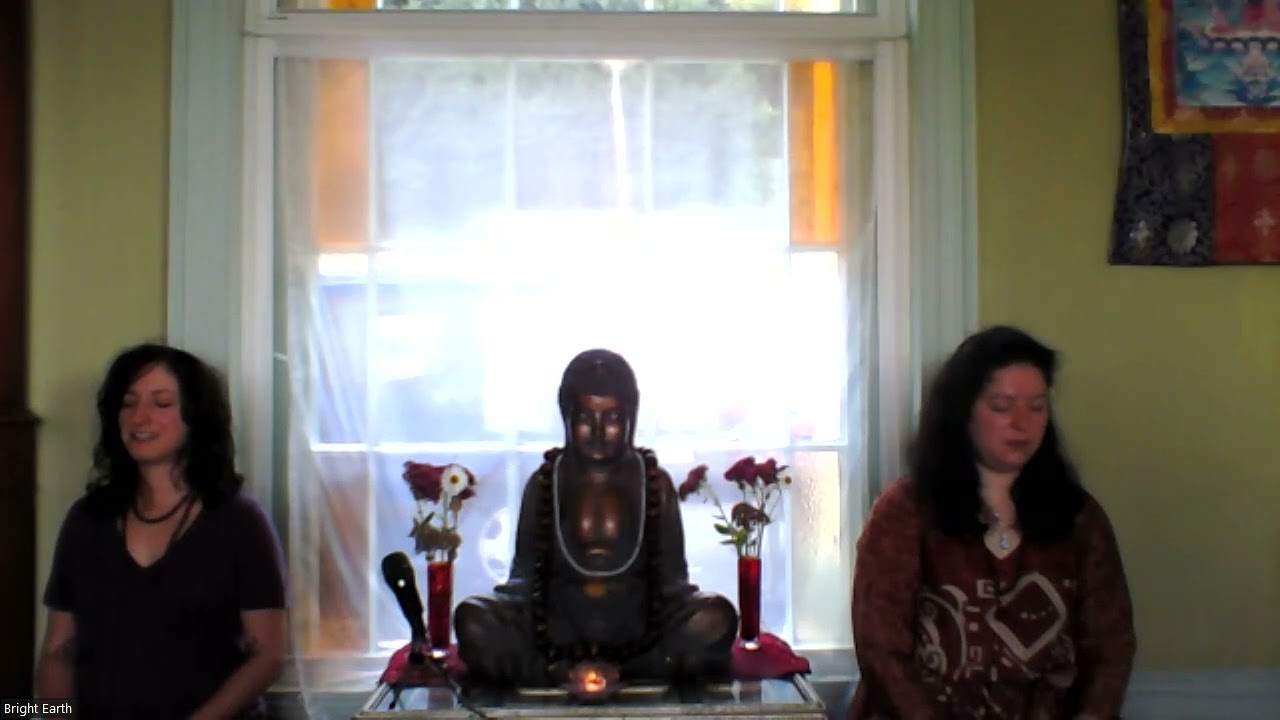
A guided Buddhist service for newcomers led by Satya Robyn, featuring meditation, chanting, and a Dharma reading on non-binary identity across languages and cultures. The service includes the Three Refuges, prostrations, and a transference of merit.
Chapters
Morning everybody, it's lovely to see such a full shrine room on a Saturday morning. So we'll start as we usually do with a a Dharma glimpse. And a Dharma glimpse is something, a short bit of writing that's written by someone within our community about a moment that's really struck them, a moment of insight, a moment of truth. And this one's going to be by Maria, read by Maria.
Thank you.
Good morning, everyone.
The other day I was on the phone to my mom and we touched upon the topics of gender identity. In particular, I was trying to explain the concept of non-binary to her. There was a lot of cross-cultural work going on, of course. My mom was born and grew up in the Soviet Union. Only to watch it break down and dissolve into chaos when I was very little still. She then had to adapt to a new Russia, a completely different entity yet again, never ceasing to go through rapid changes. I have only witnessed a part of this journey, and trust me, it is quite hard to keep up. As I was struggling to describe the non-binary concept in Russian, I suddenly realised that it wasn't just the cultural barrier that I was experiencing. The language itself became a barrier and a constraint. Russian in itself is very gender-centric, similar to German and French, but even to a stronger extreme. For example, we would assign genders to inanimate objects, such as a table, which would be a 'he', a plate, which would be a 'she', but then a window would be an 'it'.
Doesn't make sense, does it?
It occurred to me that as we grow up within this linguistic environment, it must be having some kind of an effect on our psychology and our way of thinking. And I know it from personal experience, as I have learned a few languages and have observed just how much my barriers have expanded as a result. Being aware of this kind of constraint, I started thinking how hard must it be for a person to suddenly realise just how much they don't fit within the environment they live in, if even the language itself refuses to give them any frame of reference to who they are and how they relate to the world around them. And how equally hard it can be to reach out of the cultural dogmas you grew up in and take a leap to accept a new concept or way of thinking, which is what my mom was trying to do on a call with me. This conversation stuck in my head for a very long time. I remembered my own struggles when I was growing up and trying to find my place in the society that tended to be quite judgmental of that which is different and unusual. What is universal though, be it Russia or the UK, is our human nature and instinctive fear of something different. We like stability, we do not like our lives to be disrupted, we like to close our eyes and ears when the world around us is screaming change. But what we need to be is brave. What we need to be is kind and empathetic. What we need to be is accepting of people as they are, without labeling or judgment, and also a bit curious and eager to learn, even if your own language tends to stand against you. Namaste.
Thank you very much. We're going to move into a short period of meditation now, so just taking a moment to have a little shuffle around. See how your body's feeling this morning, noticing the parts of the body that are in contact with the chair or the floor. Maybe feeling how the spine is sitting, raising upwards from the pelvis. Imagine there's a string just on the top of the head, and it's just allowing the head to be in a comfortable position, chin slightly Satya Robyn, maybe inviting the belly to become soft. Noticing the sounds that are around you, sounds that are further away, sounds that are closer. And inviting the awareness to rest lightly on the wave of breath on the surface. If you find that you've fallen down a rabbit hole of thought, that's okay. So if you've noticed that, then that's a moment of awareness. You might just gently invite yourself back, perhaps to the birdsong. We're going to move into some chanting. And we chant a few different mantras here. We're going to do our most simple one today. We're going to chant the name Amitabha, Buddha of infinite Satya Robyn. And as you chant, you might want to imagine just pouring yourself into the sounds and allowing those sounds to pour themselves into you. So this is this kind of flow or connection or communication that opens up.
A mi Satya Robyn. A mi Satya Robyn. Amitabh. Amitabh. Amitabh. Amitabh. Amitabh. Amitabh. Amitabha. Amitabha. Amitabha. Amitabh. Amitabh. Amitabh. Amitabh. Amitabh. Amitabh. Amitabh. Ameeta. Ameeta. Ameeta. Amitabh. Amitabh. Amitabh. Aami taba. Aami taba. Maani taba. Ame Satya, Ame Satya, Ame Satya.
In a moment, we're going to recite the refuges and precepts. So the refuges, the three refuges, or the three jewels, are things that— three things that unite Buddhists all over the world. And in the same way that in a storm you might go and seek shelter in a strong building. So you might seek shelter from the storm of life, grounding, centering through the Three Refuges, which are refuge to the Buddha, to the ideal of awakening and those who've trod that path, to the Dharma, to teachings of truth, of insight that help bring us closer to love, to awareness, and to the Sangha, so to the community of enlightened beings and also human beings who are all going for shelter in the storm of life to the Three Refuges. And then after the refuges, we'll chant the precepts, which are ideals, ethical ideals. That the Buddha taught that if we move in the direction of those ideals, that we can live more harmoniously within ourselves and with each other. And you can find these written down on the white sheet of paper that is either under your chair or next to your cushion. And if it's your first time, you might just want to listen, or you can join it, and it's totally up to you. For refuge I go to the Buddha, the one who is awake and full of love. The one who is awake and full of love. Namo Buddha. Namo Buddha. For refuge I go to the Dharma. For refuge I go to the Dharma. All that guides us to wisdom and compassion. All that guides us to wisdom and compassion. Namo Dharma. Namo Dharma. For refuge I go to the Sangha. Those who live in the Buddha's light. Those who live in the Buddha's light. Namo Sangha. Namo Sangha. With faith in the Three Jewels. With faith in the Three Jewels. And in light of my human tendencies. And in light of my human tendencies. I pray that I may become aware— —of when I take life. Of when I take life. I pray that I may become aware— —when I take what is not freely given. When I take what is not freely given. I pray that I may become aware— when I fall into sexual misconduct. I pray that I may become aware. I pray that I may become aware of when I fall into wrong speech. Of when I fall into wrong speech. I pray that I may become aware. I pray that I may become aware of when I've become intoxicated. No blame. No blame. Be kind. Be kind. Love everything. Love everything.
Innumerable are sentient beings. We vow to save them all. Inexhaustible are deluded passions. We vow to transform them all. Immeasurable are the Dharma teachings. We vow to master them all.
Infinite is the Buddha's way.
We vow to fulfill it completely.
So as this is a newcomers practice, although we also have plenty of familiar faces here as well, which is really lovely, I was thinking to myself, why come to Buddhist temple? Why, why go to practice? Why come to service? And I was thinking about some of the reasons that I went a long time ago to my first Buddhist practice group. And, um, at the time it was because I'd, I'd heard some Buddhists chanting, and I'd been really struck by it and I thought, oh wow, I need to— what is that? You know, can I, can I experience that? And, and I was also looking for something that might help with my complete instability of being at the time and emotional turbulence. And I was also interested in meeting people who lived differently, who held different values and lived by different values than a lot of the people I was meeting. And when I talked to the people, some of the Other reasons that seems to bring people to this kind of thing is a desire for greater peace, for some firmer ground beneath them, for some quietness, greater internal quietness. Maybe because they've got some kind of longing. Maybe there's some longing, some yearning you can't quite put your finger on that tugs away at you, that calls to you. I know I've often experienced that, and that kind of yearning or longing can lead you to paces of spiritual practice. And is it here? Is it bringing me here? Is it bringing me somewhere else? Is it in the mountains? And if you go to some Buddhist groups, there can be an emphasis that that greater peace and awareness and calm can be achieved through like, like, like lots of practice, you know, through daily meditation and paying real close attention to behavior and ethics. And all of that's really valuable. And that's also something that's included within these practices that we do here. And what there's also an emphasis on here, which is something that I really appreciate, is that, that we're not alone in this, that we're not cultivating these things by ourself, that there is an infinite, indescribable force of love and awareness and truth that is supporting us. Just as we reach out to them, it is reaching back to us as well. Rumi says, that which you seek is seeking you. That which you seek is seeking you. And you might hear that force, that presence, called different things for you. Buddha, Amitabha, the infinite, other power, other power, because we don't have to power ourselves completely through this. And I find that that makes all the difference. So there's an invitation here to just Hold the possibility that you're not alone. You don't have to do this by yourself. Namaste. So we're going to move now into prostrations, which means that we'll be standing up and facing in the direction of the main shrine, the wind by the windows over there. Just realized we have two windows both sides of the room, and, um, And as much as your body is able to, bowing and bringing the body to the floor and then standing back up. And you can think of this in lots of different ways. You can make sense of this in lots of different ways, as a kind of embodied meditation, as a surrendering of the self to the other, to something bigger. As a bowing of, as of reverence, a moment of appreciation, of thanks. But really, I just invite you to do it and see how it feels. Let's see how it feels today for this time. I will also chant Nam-myoho-renge-kyo.
Namoh Amida Buddha. Namoh Amida Buddha. Namoh Amida Buddha.
Dedicate the merits of this incense offering to all Buddhas of Buddha Bhagavan's activities across space and time. May he pray for it to serve itself, reflecting on our careful efforts, our wholehearted awareness, and the fruit of understanding slowly ripening. May we and all beings be companions of Buddhas and Buddha's activities. May we awaken from forgetfulness and realize what you know. Turning to Essence. And then we're gonna bow first to one side and then the other. So, um, just one side. Then we bow to the main shrine, tidy our seats, bow to our seats. Um, we're now going to have a transference of merit. Yeah, so, um, to a friend of mine called Jackie, and I also offer the space up to anybody else who may have lost somebody in the last few weeks. Anyone whose name you want to bring to the roof, please do.
Oh, well, thanks very much to Reverend Master Saito, who died earlier this year, and he's being interred in the Stupa in Telford tomorrow. That's a memorial ceremony to his community there. Satya Robyn, of your land of peace.
So we're going to say our closing verse, which is— if you want to read on the piece of paper, it starts, 'Blessed by Amitabha's light.' Blessed by Amitabha's light, may we care for all living things and the holy earth. Namaste. Namaste. Thank you very much. There is a golden bowl in the hallway, which will very happily receive your donations of anything you're willing to and able to give. Thank you very much, and you're welcome to come and join us for a cup of tea next door if you like.









