How to Scale Revenue Consistently for Any Tech Services Company
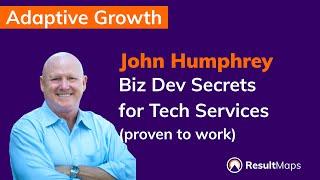
Scott Levy talks with a services executive who built a point system to track daily business development: Connect, Create, Engage. He maps weekly activity points to revenue targets, weights pipeline stages from 10% to 90% confidence, and argues founders must measure monthly to avoid cash crunches.
Chapters
Coaching introverts and teaching them this system which sounds so easy, right? It almost sounds like that couldn't possibly work. Well, it does. I can go out in 90 days and build a $5 million pipeline. People think it's hard, but what's hard is laying somebody off. What's hard is collateralizing your house down at the bank. What's hard is deficit spending when you're trying to start a business. That's hard. This is easy. This is just being a good person and helping other people succeed.
I'm really excited to talk about KPIs related to business development because that is really the lifeblood of the business. Getting cash in and how to make that less the process drudgery that I think everybody can make it. People get caught in overthinking it and really turn it into something that is easy to track, is pretty fun to track and is motivating to track. Give us an overview of the different companies that led you to start this and the successes you've had.
I was a senior manager at Accenture back in the 90s and had met a guy that started going to lunch with and you know you're dreaming about build a better mousetrap and of course you know, Bruce Scott. And so it occurred to me as we were talking about how to build a better consulting firm, pretty bold idea since we were both at Accenture, at Anderson Consulting at the time. And he came very clear that I was going to be the sales and marketing guy and he was going to be the sort of the finance and the technical architect cause we were going to build custom software and that sort of thing. And I was self aware enough to know that I had never been formally trained in sales. So I quit in 1995 to get a job in the enterprise software space around Y2K and all that.
And literally I didn't realize you guys had met before that.
Yeah, yeah, we had. We had met.
So that was part of the plan, right?
Yes, it was part of the plan. We had met in like 1990. Anderson had purchased a company called Bank A that it was a software company, it's a startup and in financial services. My background was in, in banking and, and so you know, we hit it off and I'm like, okay, well I got to go learn how to sell. So I quit and starved to death for a year and then finally figured out that selling was kind of a Gantt chart. If I just worked my work breakdown structure in the same manner on every deal and I didn't chase deals that I Couldn't do my process that I would win. And so fast forward and then I had a really good friend that worked with me. We would sit around on a Friday afternoon and think about, well, what are the things that we can do like above the sales funnel to always make sure that we had enough deal flow. Because the dilemma that a salesperson has is this oscillation between I got a lot of pipeline. No, I don't have any pipeline. No, I got a lot of pipeline, then I don't have any. And it is really hard to start that process over. So we created this little contest between ourselves and we would, you know, and it had to do with writing a decent piece of content. Now this is back in. We just got email and Mosaic had just been started, right? So, you know, we were at a pretty progressive company that did self evident web apps for things like hr. And it's pretty cool. And so we came up with all these categories and a point system that we kept in a spreadsheet. And we called it the big dog contest. You know, if you want to run with the big dogs, you got to get off the porch. And every week Matt and I would total up our, our activities that whether it would go to a networking event, take somebody to dinner, write an interesting piece and email it to a client. And somebody won and somebody lost every week. And you know, you'd win a ball cap or pay for the golf game on maybe a Friday afternoon. And we got serious about it and then it became kind of a competition. And you know, we woke up and we were like two of the top guys in the company two years later. And so that was. That was the genesis was that.
Was that Lawson Software?
Yeah, that was at Lawson.
And then a little company that's a seminal name for anybody that doesn't know their tech history. Jeffrey Moore was on the board of.
Lawson Guy, Bill Lawson and Richard Lawson. Bill was kind of the accounting ops guy and Richard was the visionary. And we had self evident, we called it sea self evident applications in 1998 where if you had a life event, it looked like Candyland. And you'd say, where are you on your life event? And you'd say, oh, I had a baby. And then it would automatically update the payroll system so all the deductions happened. And new person, new dependent. He was a great guy. And so long story here for about five more years, my income went up by 50%. And then Bruce kind of calls me and we'd go to lunch, you know, once a quarter and be like, hey, I Sold our little business that we had, we had started some little side business to Tactica Technology Group and we'd like you to come be a partner and start an Oracle practice. And I remember the conversation was like, I got to take a 50% cut pay, go be a partner in that firm. And so, you know, that began the journey of we, we did, we were. I wasn't there for nine, maybe nine months when the company was sold to Hitachi.
Hitachi, yeah.
And I lasted a couple years there and then I launched Pariveda in 2003 by myself. You know, Bruce was a co founder, but he came in October. I started June 1st of 2003, got a few.
So you immediately, I remember, I remember going to like dinner or something. You guys were just starting. This is maybe this was a Thursday night and like the next Monday, the first client was right there.
Yeah, well, I called, I called one of my ERP clients and I said, hey, I just quit my job. You know, I took my relationships with my clients very seriously. And, and you know, there's lots of stories about our, our, the manager on this particular account that was managing this implementation of the supply chain, you know, distribution software, she couldn't show up on a Saturday work session because somebody had run over her mailbox. And so I said, kristen, you go to Dylan Gage, I'll go fix your mailbox. I went to Home Depot, I bought concrete, I bought, I rebuilt her thing, set it in and then bought everybody lunch and showed up and showed up with lunch. And so that kind of endeared me to the folks at Dylan Gage. So I called Terry Hanlon and I said, hey, I just quit my job, I need a customer. And he hired me.
So what is interesting about that, right? It sounds like a cute story on some level. It's just that that happened over and over and over, over and over since I've known you and I've watched it then go happen to the people you coached. And it's not that everybody built a mailbox, but everybody created value built relationships and those relationships authentically. Not like, hey, I'm going to build this relationship so you'll give me something. Just, I'm going to go give, I'll use, you know, the go giver mentality. I'm going to dig my well before I'm Thirsty, which was a book you first recommended to me, fantastic book. And I'm going to cultivate this network. And again, not again. The word network gets thrown around. What is that really? Personal connections. Right? Actual authentic personal connections with people you happen to care about.
Yeah. You know, I tell people today when I'm teaching my Connect for Life workshop, the most valuable asset that you have that's not on your financial statement is your network. Like, what would you really give if, if somebody wanted to buy your, I mean, if you could. Right. If I was going to buy your network off of LinkedIn and everybody that I approached was just like you. I mean they could be you and that was transferable. Of course it's not, but what would it be worth? And for me it would be worth tens of millions of dollars.
So, you know, you did well, you say that. I just want to make sure we clarify that's not hyperbole and actually think it's far underestimating because we're talking about that company you started with. Your buddy exceeded $100 million. I don't know what the exact figures are, but it exceeded 100 million in sales. I know one of the former employees who you coached, their company went from 0 to 100 million. So right there, like there's two. And you've coached I don't know how many other companies that have had similar successes.
I think we have 15, at least 15 entrepreneurs that left Pariveda to start their own companies. And all of them were successful. They didn't all have big private equity exits. But you know, I can think of maybe five, six that sold.
They're all having outlier success. Everybody I talk to, everybody has made, I don't know what everybody's revenue is, but I think Everybody's north of 10.
Even though, oh yeah, these are, these are companies that were, you know, 20 to 50 million at a minimum. I'm getting work now because CEOs of current services companies knew, you know, our friend we were talking about when he was just snot nose sales jockey before I sort of turned him into a delivery guy. Talk to him now. You wouldn't think that he started in sales and learned delivery. He learned how to be a CEO and built a magnificent company. So yeah, it's, it's worth investing in it and, and you know, it is amazing. I teach, you know, I probably do one on one coaching every week with, I don't know, 20 to 25 people. Some get it, some don't, you know.
And you've actually reduced it to, you know, people. This is a word, this word gets thrown around a lot. Key performance indicators, KPIs. What are the KPIs? I should have. And there's like a long list and we're intimate with it. Because we've had to research our articles and talk to people, but you've taken this idea that we talked about of nurturing that network and letting that be your business development and created KPIs from that. Can you talk about that a little?
Yes. Yeah, sure. And I think what's really fascinating to me is how it's almost more relevant today than it was 20 years ago when I started the company. Because now content is a real thing. It's not just a little bit of dipsy doodle on your website. It's like, if you're not producing content, if you're not nurturing your network, if you're not figuring out how to get a warm introduction to a net new client, if you're not doing those three main activities every week, every day, you're not going to build a pipeline. And so inside of Connect, Create, Engage, there are three different discrete activities that we score.
And these are your buckets. These are the buckets into which you create these as your kind of KPIs. You're going to hit a certain number of points and you've got different activities within those that you use to accrue those points. And those points represent the meaningful activities you're doing to achieve those ends.
Yeah. A point system is kind of like the foundation of the house. It's the meat and potatoes, the blocking and tackling, whatever cliche you want to assign to it. So there's three things. There's messaging, which is reaching out, nurturing your network, messaging, somebody inside of LinkedIn sending a note to somebody in Facebook, or there's meetings, any kind of meeting, in any venue, virtual, physical, and then there's events. So anytime where there's like four or five more people gathered, it could be a traditional networking event. It could be you got together with the five guys that you went to college with 10 or 20 years ago and you're having a beer night. Well, that's an event. Because what we're trying to do is hack your brain into doing these activities on a regular basis. Right in the creating phase, it's all about content creation. I read an article in the Gartner group that said 89% of buyers today do all this research before they ever engage anybody with the company. So if you're a knowledge worker and you're not actively creating knowledge out in LinkedIn or you pick a platform, then what's the point of having the knowledge? And if you're really a giver, then you're giving that knowledge away. You know, never worry about whether you're going to monetize that knowledge. So we have things like commenting on somebody's post, writing an original piece of content and publishing it in LinkedIn or speaking, you know, you can, you know, when you are speaking that's the pinnacle of sort of knowledge worker and content creation because you're now an expert. So if you're on the speaking circuit at a, at a trade show or something like that, and then the engagement is the last one and that is all about getting that net at first net new meeting in either a new division of a multi billion dollar company or a net new meeting at a client doing discovery. And then the outcome you're looking for is the proposal. So when you put all of that together, we created this thing called the Net Connector Score. Sort of ripped rifted from net promoter score. The net Connector score is how many points do you have to do a week on an annualized basis to hit your financial target? You know, so if you've got to do a couple million dollars, then that's going to break down into, you know, what's your average deal size, what's your conversion rate? Because I know that points lead to meetings, meetings lead to proposals, proposals lead to revenue, revenue leads to growth to.
The tune of 10 million, 50 million, 100 million in revenue starting from zero. Like that is the thing I really want to underscore here. This is not theoretical because I've watched this play out and just it was the third or fourth time I was in shock. Like, just like again.
Yeah. I think the fun thing is that at Parmaida we didn't have any commission. Salespeople, yeah, you know, they wear that as a badge of honor on their sleeves because like hey, you know, you don't have to talk to a salesperson but you know, it can. Coaching introverts and teaching them this system which sounds so easy, right. It almost sounds like that couldn't possibly work. Well, it does. You know, I can go out in 90 days and build a 5 million dollar pipeline.
I think it's different.
It's.
Well, so yes. And again I've seen you do that multiple times and it's putting that together with the idea that yes, these activities everybody kind of says you should do, of course you should do. But it's different when you get them, I would say on the clock, but like on a scoreboard and you've got a target for the week. And I've had success from that. That I still do, you know, is directly, directly attributable to using the Connect Point Systems. And that's one of our KPIs on our weekly dashboard. How much, how many points am I generating? How many points is the team generating? It is. It changes the game and it's.
It's impressive how quickly it can anecdote, right? So I have a client. I'm building out an entire sales team, had all the sales team in place, and I was teaching my. My weekly sales dojo, and they finally got the guy that they wanted to be the sales manager. He came over from a very successful firm, really good guy. I went to lunch with him the week before, the week he started, just to make sure that, you know, he didn't think I was a threat. You know, like, hey, man, I'm just a tool. Just use me. Right? And so he's sitting in this workshop and we're talking about Connect Points, which is our application that keeps score. And, you know, sales guys don't want yet another tool. Right? And I'm sure this wasn't the most honest answer, but he. He set his guys up just meeting their new sales manager, right? He says, so, what do you guys think about this program? And they went around the horn and. And now, granted, I was sitting in the room, he was in the room. So it might have been the right answer, but they were like, well, you can't manage what you don't measure. Basically, that was the gist of it. Like, why? This helps me make sure that not only am I doing enough of the right activity, but I look back at my week and I go, jiminy Christmas. I've done connecting and I'm doing creating, but there's nothing in the engagement category. I'm not writing enough proposals. That's kind of like confusing activity with accomplishment. So the, so the, the model allows the user to manage their own activity, and then, you know, gamify it with their. With their colleagues. And I think that there's some magic to that. Nobody wants to not be on the board. You know, it's a. It's like a club.
Totally. And it's motivating. Like, I've always loved looking at my numbers, whether I'm on the bike or I'm in the gym. I love that idea of like, hey, if you get your reps in. Or did the same thing when I was playing music. Like, I had timers or certain exercises I did for certain amounts of time against the clock. There's such power in doing it with this one, I guess it's actually fun.
Well, yeah, it's fun. I mean, and this goes back to Peter Drucker, who I think he's the one that said, you cannot manage what you do not measure.
Yeah, I know he's a big fan of it if he didn't originate it.
So make it fun, you know, And I get the call all the time, hey, I did this this weekend. Could I count it? I'm like, count everything. Because if you think you're cheating, all you got to do is set a higher goal. So, like, I know every week I probably have 40 points just baked into my week. 50 points just because it's on the calendar. Well, that doesn't count. I don't count it. So what I do is I say, well, I gotta have a higher goal. I gotta hit 80 or 100 points as opposed to 40 or 50. And then I get that tension, you know, that internal tension to go do the right activity. And so, yeah, you know, some people think it's hard, but it's. You know, what's hard is laying somebody off. What's hard is collateralizing your house down at the bank. What's hard is deficit spending when you're trying to start a business. That's hard. This is easy. This is just being a good person and helping other people succeed. You know, whether it's finding them a Honda mechanic or a used car guy that you know is reputable or. I've had people enrich my life all over the world. You know, I don't know. I mean, if you want to live a rich life, you unlock your network and you. You get help. You know, I don't do anything. Investments, real estate, travel, without talking to somebody like, hey, what do you think about blah, blah, blah, blah, blah, you know, and. And that pays dividends. And so if you, if you gamify this whole approach, what you end up with is a measurable pipeline. That's the first set of KPIs that we track, you know, as points, meetings and proposals. And then that translates into pipeline. And we can talk about, you know, metrics on pipeline, if you want to do that.
Yeah, I'd love anything you care to share there. Because this is, I think, incredibly helpful for technical founders or anyone who. And when I say technical, I mean people who enjoy making things, doing the work, solving the problem. It's a little counterintuitive how easy this can be if you let it be. And also just that you have to set the goal so you don't get lost just in delivery mode. Yeah, and it's so easy to get lost in delivery mode, you stop Selling now you're dependent on that one customer. Yeah, you're dependent on that one client. And I, and unfortunately I've experienced that. I talk to people who are experiencing that. Having these as your KPIs, your connect points, as your KPIs, saves you from that and allows you to actually grow the business and take your family to Jules Verne on the Eiffel.
Yeah. So what is it?
I'd love to hear more.
Everybody wants a predictable business model and I come from more of a sales background than a delivery background. I mean, I've sort of morphed myself. I started in delivery and, and, and then I, you know, nothing happens without a sale. I mean, that's kind of where I start. And yes, you have to be authentic. Yes, you got to do great work. Those things have to be in place. But you can have a lot of really smart people in a company. If you can't get a piece, you can't get a new deal. You're going to have less people in the company, you know, I mean, unless you want a deficit spend. I mean, I see a lot of companies make that mistake. So, so with the connect points idea as the foundation now, what you do is you start putting opportunities and there's a whole funnel we haven't even talked about around content. Right. You know, like what's a marketing qualified lead and how do you figure out the SEO and the organic and the, and the paid search and all that stuff is an additional tool that I try to bring people in to help with that because generating leads is hard. But let's assume that's part of this creation process and we're getting people to raise their hand and say, hey, come tell me more about that article you wrote on cloud computing or Snowflake or the Microsoft Azure Data Lake or whatever it is, it goes into the pipeline and we have a very discreet set of weightings that we do in the pipeline. So if something's in identification, which basically means it's a client, we want, they have a need, we're qualified to do the work, put it in identification, 10%. So that means if I put a million dollar deal in there, I'm only waiting at $100,000. Now by the time I move to discovery, I'm not only looking for requirements, but I'm trying to figure out, you know, what is the organizational structure, how do they make decisions, what's the formal and informal political structure look like? You know, how do I win? Is there an incumbent? Am I the Mike Holland fodder? Do I have a chance to win? Is it in my sweet spots? Like all of those things happen in discovery. And now that million dollar deal is worth 25%. So $250,000. But the end of discovery is what I call a pre proposal where I'm sending them a very, you know, very deliberate deck that says here's my understanding of the problem, here's the approach we're going to take, here's the value prop of fixing this problem, and here's my fees and here's an appendix on the company. And I send that because that works for me when I'm not there, right? And now It's a confirmation 75%. And I'm giving you these numbers for a reason. Now by the time I start finalizing negotiation and start dates and all that, all that kind of stuff, I'm at 90%. So we look at not only the total pipeline, but we look at the weighted average pipeline because the weighted average pipeline should be more than your next 90 days of forecasted revenue.
Ooh, I, you've mentioned this before. To me it just clicked. Yeah, yeah, it just clicked for me.
In the services space. The problem is none of the pipeline management tools put pipeline in the same vernacular as revenue. You know what is backlog? Backlog is work that's sold that hasn't yet been delivered. So if I sell a 90 day project and it's $10,000 a month for 90 days, let's call it June, July and August, I invoice at the end of June $10,000, that's revenue. What's in backlog? $20,000 and that's monthly. But pipeline in, in pipeline it just says $30,000. So we also try to kind of hack these pipeline systems to where I put revenue in by the month and then automatically total the amount and that gets, that becomes really important because my backlog in the next month, so we're coming in the end of May, I will be invoicing clients, let's say I do it on Friday the 31st, and then the backlog for June, plus my weighted average pipeline for June should be more than my overhead. Right? And in most services companies, and I've worked exclusively with knowledge workers. So we're selling, we're selling our brains and people are paying us for brains. That's. So that covers lawyers, architects, software developers, you know, you name it. That every 90 to 120 days, those businesses are, I always say they're out of business because they're. Their cost line goes above their revenue line, which Is a bad thing. Right. Because we do, you know, small projects, small teams, small projects, 90 day projects now. So when you get out into the future in month three and month four, your pipe, your pipeline and your backlog are sort of trailing off and your cost of course, are fixed and they go above the revenue line. And so what you have to always be doing is you have to look at this and, and the reason I started this weighted average thing by month out into the future is that I can compare revenue and backlog for a particular period and add it to the weighted average pipeline just for that month and say, do I have enough pipeline in August to make, to make money in August? And it totally changes the way you think about managing your pipeline. Right.
Because yes, it does.
You know, when people are just looking at the. Bring up the, bring up the CRM and they go, what's in negotiation? And let's. What, what I do when I'm managing it is I'm like, what, what revenue do I need in August and September and what deals? I mean, maybe I got something sitting here in Discovery. Well, maybe I gotta do a deal storm. Add brains and horsepower to that deal to move it along maybe faster than it might've gone so that it hits with enough oomph to get me through August and September.
Yeah, that's, that's interesting because I've seen companies stall around 20 million. I've seen them stall much lower. But I'm thinking of one case where company had this situation. Now they weren't using. They were using some different mechanics, but not too different. Certainly not as simple like, like, I like the simplicity of this. It's not simplistic.
Yeah.
But it's a simple concept you can understand that makes the math.
Yeah.
What's different so easy to think about?
Very few. I don't really even know of a pipeline tool. You know, and you can list them all that you don't have to.
Oh, I can tell you there's not.
There's not don't exist. So, you know, I built the custom one. I've done that three times. We built a custom thing at par Veda. We actually created a dynamic data link with a spreadsheet and that got updated from our billing system and our pipeline system and just put it all right there. I built a, you know, we built one in.net that we used. I've done it in Salesforce before. I was at a. Helping a client and we built it in Salesforce. They're still using that today, two or three years later. So yeah, it's, but it's all metrics driven, right? It's, you know, what's my forecast for the year? And by forecast I mean my budget, not what I think I'm going to sell. Like you start the year and you do a million a month and okay, well how much pipeline do I need to do a $3 million in a quarter and how much of my next quarter is in my backlog? You know, you need to know those numbers. If you don't know those numbers, you're just guessing. And so by getting a predictable revenue, you always know, do I need more? Because everybody always says, well, I don't have enough money. Well, how do you know? Because I don't see a bunch of things in negotiation that are about to close. Okay, well you don't know like, it's almost like this activity. Well, what's the right activity? I don't know that either. So when you think about most of these services companies, especially founder led companies, that they get stuck, right, because they, they get out of the box on the charisma and the network of the founder and then they try to hire a salesperson that doesn't work and then they hired another one and that doesn't work and they hire a sales manager and that just costs them more money before they fire those guys. And they don't know what they're hiring to. Like, they don't know all of the.
Like, they're, they don't have their outcomes. It's, they just don't.
Very interesting that they're doing it, you know, so, and, and it, and when a business gets above 10 or 15 million, the pipeline's a tricky thing. Knowing whether you have enough and how much you know, it's usually about 20% of your total pipe. So if, you know, if you got a $10 million pipeline, you probably have a 2 million dollar weighted average. If you're, if you're good and you know, depending on your average deal, if your average deal is 50,000, you need like 250 deals. If you've got 125 deals in your pipeline and it's only 5 million and you got a million in weighted average and your cost is more than that on a monthly basis, yeah, you're screwed.
I'm curious too, as you're talking about this, like you've ridden this curve from multiple perspectives. Growth, you know, hitting that first million, hitting the first 10, hitting the first 50, like very few people do that, let alone do it multiple times and then go on to, you know, 100 million more. What do you see hold founders back and hold CEOs back such that they hit a ceiling and they don't progress past a certain point?
Well, I think they all hit a ceiling. Our friend had a very high ceiling when he did it, and then he started hiring salespeople and busted through it. But, you know, I think that entrepreneurs, by definition, are rainmakers. You know, that definition of a rainmaker. And my experience is that those really, those guys that do that, they don't know what they do to make it rain. They can't tell you, oh, I did this, and then I did this and I did this, and people ask me all the time, well, how, how did you figure it out? I said, well, I started as a consultant. When I say my life was a work breakdown structure on a project, I understood that and I figured out cause and effect. I mean, that's what I did. As a consultant, I do this. This happens. Oh, well, you do these 25 meetings over here, and all of a sudden you have a lead. Oh, that's interesting. Let's do that again. And so I think what happens is founders don't know how to. They don't know what they're doing that causes the results. And so therefore, they don't know how to teach it. And if you can't teach it, you got to have somebody like me to help you. So that's on the business development side and then on the management of the, you know, they don't know their, they don't know their metrics. You know, like, if you take the EOs, we've talked a lot about, you know, traction and that sort of thing. They stress that you got to know your numbers, you got to know your dashboard, you got to know your metrics, you got to know them every. Like, what are you supposed to be working on today? And, and I think that's what Result Maps does, is gives you the framework to make sure that everybody's pulling on the same rope. What's an analogy? That they talk about the people that.
Get it, want it, and have the.
Capability to do it, capability to it. And then that's the other thing. We put the wrong people in the wrong seats.
Yep.
You know, we, we think that, you know, they're a good guy or a good gal, and they've been loyal to us. And so, I mean, I have a client that. It's really funny. They've got all kinds of people in the wrong seats, and they're having a challenge from revenue. They lost a client. And so what they did is they exercised this 30 day out in my contract. It's like the exact opposite of what you should be doing. You should be doubling down on teaching these guys and figuring out who are the people that can sell their way out of the problem. Most problems that companies have that are small are problems that you can sell your way out instead of thinking about cutting and where I got to cut the bone and the muscle. When you have enough revenue and you have enough pipeline, you can, you can come out of those things. And, you know, even in a recession, Scott, companies don't start, stop spending money. You just got to beat the other guys in a smaller pie. You got to work harder. So that means you got to be really focused on your sweet spot. In slow recessionary times, you don't go start a new offering or in a new industry. You need to be able to say, yeah, we've done a thousand projects in financial services or distribution or healthcare or whatever, energy. And you just go deep. And you know, if people trust you, they'll buy from you. And so the last thing I'll say about that is I think trust, at least the way I see it, is now more with the individual than it is with the brand. We used to say, I'm going to buy Anderson or Accenture because of the brand. I know what I'm going to get today. They would say, I know what I want. I need that guy who knows how to manage a complex Microsoft Azure data lake. Right. And I, and I don't, I don't care who you bring along, because I trust that you're going to bring the right team to be successful. So it's not only poured kerosene on the solopreneur, but a lot of times the solopreneurs are the ones that have those deep relationships, are the ones the executive trusts the most and say, tell me what you need to get the job done. And you might use different integrators, you know, and just source them. So the network is valuable because you develop trust between the constituents in the network. You're there serving. They know your heart. You know, the triangle of trust is authenticity, empathy, and logic. You do those three things. That's what develops trust. The metrics that we run just give you. They create collisions in the marketplace where people go, aha, you could help me do this. Yes, I can. Happy to.
So many collisions are happening in my brain right now as I think about this. And we're kind of sitting back talking about it. Usually when we're talking, it's in the heat of, you know, I don't know how many projects we've been on together and how many efforts it. There's this idea of having a channel that you own. When you are going to market with a SaaS product or you know, maybe an informational product. What you are advocating creating is your own channel. Yeah, it happens to be called the.
Network.
But that becomes a form of channel.
And I know where I'm good. Like I'm not good at the Fortune 100. I don't play the schmooze game. I'm a really good hundred million to two billion dollar guy which is perfect for small to medium sized business. And the reason I like those companies across a narrow number of industries that I'm an expert at is I can talk to the executives, I can get to the people that really make the decision and that, and that care about the quality of the work. You know, I, I give every, every client has a 30 day out. Every client. And I give a money back guarantee every month. Hey, before I invoice you for June, are we good or do I need to give you your money back for May? I mean, isn't that what the EOS system says is what's your guarantee?
I mean, exactly. They have your guarantee, you have your process.
Like if you didn't think I earned your money last month, I'm going to give you your money back. And if you want to end engagement, you know, that's why I don't, I don't need a long msa. Right. What am I going to do? Go against the attorneys for my client and win? I mean talk about a waste of time. If you want me gone, I'm out. Just give me a notice just so I can prepare. And it works so beautifully. You need to make it easy for people to fire you. You know, and it's not that you're doing a bad job. Sometimes they've just learned what they can learn from you. I always try to work myself out of a job. But yeah, and services business is really, really fun. But it is, it is not easy. It's not for the faint of heart. And you got to understand your metrics and what really drives value for your company and for your clients.
More from Scott

Build a Self-Running Business with EOS - Entrepreneur and Implementer Explains


How to Create a Company Vision That Actually Inspires and Aligns Your Team | Leadership Guide
How to Create a Company Vision That Actually Inspires and Aligns Your Team | Leadership Guide

Company Vision vs Accountability: EOS Expert (750 Sessions) Reveals What Actually Drives Engagement

How to CEO From $0 to $30M: The Brutal Truth About Small Business Growth (w/5-Stage Framework)

Leadership For Entrepreneurs: A Proven Way To Level Up Results Without Corporate Fluff


What is Strategy? The Ultimate Guide to Strategic Thinking in 2025 for CEOs and Owners
