Rethinking Execution #2: TK Kader (Founder/CEO Unstoppable) on Goal Setting & Growth Challenges
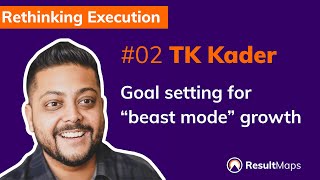
Scott Levy talks with TK Kader, founder of Unstoppable, about goal setting and growth challenges. TK draws on his experience at ToutApp and Marketo to discuss how leaders approach execution and scaling.
Chapters
Hey everyone. Welcome to the new economy. I'm Scott Levy, CEO and founder of Result Maps, where we're on a mission to help the world be its inspired best. That means helping CEOs and leaders build healthy cultures of relentless execution so you hit your numbers and thrive no matter where your people are or what challenges come your way. One way we do that is bringing you these sessions with leaders who've learned to thrive even as they navigated uncharted territory and thorny challenges. The idea is to get you actionable, learning you can put into practice immediately to lead and navigate at your best as you thrive forward. Today I talk with TK Cater. He's founded a few companies, the latest of which is Unstoppable, a company that is redefining the way entrepreneurs educate and arm themselves to thrive in business and in life. I'll include A link to tkkader.com in our session notes TK's experience includes navigating from headcounts of 0 to 80 and then up to 1300 people and beyond. He's done it in turbulent global markets with some of the best. After leaving a job at Ray Dalio's Bridgewater, he founded ToutApp and grew it from zero to 80 people before its acquisition by Marketo, where he became senior vice president of strategy and helped the company get to acquisition by ado. Along the way, he pitched and won investment in Toutapp from Eric Reiss, who you may know as the author of the book the Lean Startup, as well as Andreessen Horowitz, the legendary venture capital firm that's in companies like Facebook, Lyft, and way too many more to name. These are not just well known names, these are authors and proven business minds famous for their systems thinking, clear focus and relentless execution. And getting to know tk, you get the sense that his ability to cut through the hype, help people focus and get from one step to the next is a big part of his success. For that reason, I asked him to tackle one of the most hyped subjects that I hear so much frustration around goal setting and maintaining focus in your organization.
We've talked a lot about goals through your coaching practice and I know you've got some specific ideas around what works and what doesn't. When you were building up tout, and then as you went from there to Marketo, from Marketo on up to Adobe, what changed about how you tracked your key metrics and how you set goals to impact those metrics?
Yeah, well, when you think about those stages, they're Wildly different stages in terms of maturity of the business. And so when you think about TAO, there's almost three parts to it. There's the 0 to 1 million ARR which was one stage, the 1 to 3 million ARR which is another stage and the 3 to 7 million ARR and beyond 7 million is when we sold was another stage and then Marketo was close to half, half a billion ARR without giving the exact number, but in that zip code. So all very different stages and maturity levels of the business and so approaching goal setting for those different stages. We're all quite different as you might imagine.
We've talked about kind of the pros and cons, a little bit of objectives and key results. What did you find when worked well with those and what did you find were some of the challenges around, you know, getting a list of objectives?
Yeah, objectives and key results when you're going from zero to one was like it was too much, too early, too soon type of thing. So we didn't mess around with that as much for that. It was really on a day to day, week by week basis on are we seeing product market fit? Are we our customers actually resonating, our users resonating with. So it's a little bit more day to day metrics driven around our SaaS business okr started to become super important. Once I had a leadership team, an executive team, we had a Monday morning meeting and we were trying to look at a bunch of different aspects of the organization and managing forward beyond just users and revenue. And that's when I really started to adopt OKRs. We adopted in a small way, in a lightweight way at the 1 million mark when we raised our A and we were bringing on initial leaders, but most definitely at the 3 million mark because there was just too many leaders and an executive of about probably 6 people across the VPs. So super important for us to have one language we were all speaking and managing to. And okrs were very powerful for that. When you double click on that stage, when you start to get beyond three and this goes into the Marketo journey as well. The biggest pitfall we came across was that you would do the OKR planning meeting. And it was a very powerful exercise because it forced everyone to think about what's possible, what's not possible, where do we push, how do we aim a little bit higher than what's possible. But one of the greatest pitfalls or one of the toughest challenges was staying tethered to what everyone agreed to once we came out of that meeting and Being able to keep revisiting those okrs and keep tracking, checking the status of those and permeating those OKRs through the rest of the organization, that itself became a bigger challenge than doing the act of creating the okrs itself.
You mentioned that you had a Monday meeting.
How frequently were you guys reviewing? Did you have a certain cadence of meetings you used to check in and make sure everybody's staying aligned?
Yeah. For ToutApp, we ended up developing one dashboard that we all looked at that were tied to specific OKRs. Those OKRs had actual results or metrics that you would measure. So we track those red, yellow, green on those and each person that owned that would give an update for our Monday morning meeting. Interestingly enough, the same thing, much different scale SaaS business. For Marketo, we had to develop the same thing where we had key objectives across the org that each of the execs owned. And based on that, for that, I think it was a Tuesday executive team meeting, we would get together and one person would be responsible for pulling that up on the screen and for all of us to update on it and talk through potential issues. And that act of having that meeting that kept us tethered to those objectives and key results and course correcting along the way ended up being one of the biggest discipline pieces that was a game changer for both organizations.
Super interesting. What was the difference in headcount between tout? Well, some curious about these inflection points when what stage did you get a leadership team around you at tao? How big did the team grow to before the acquisition? And then what did the people underneath you as SVP of strategy at Marketo look like? What were the headcounts?
Yeah, so for Tao, at our peak we were at about 80 people. We had probably about four VPs under me. We had a VP of product, VP of engineering, VP of sales, VP of customer success. So all the major areas there. We didn't really have a VP of marketing, we had a Director of marketing and we also had a senior Director of Business operations. So those were the kind of key players that was at TOUT in terms of Marketo at its peak. I mean it's probably bigger now under Adobe, but we were about a 1200, 1300 person company. And that also our executive team, it's still the same functions. Right. So I owned overall corporate strategy and I owned alliances. And in there there was the cmo, the cfo, the CEO, the coo, the cpo, Chief Product Officer. And I also owned alliances and business development. So that rolled into Me. So those were kind of the key players in the Marketo space. What was interesting was with Tout, you had to get the executive team on board and then they had to make sure it permeated down below. With Marketo, there was added complexity because we had our core team and they each had their organizations, but then we also had other GEOs. So at one point I was running Europe and so you had to make sure Europe had its own executive team and the GM there rolled into the CEO, but you still had to manage that as a region. At one point I ran the ANZ region and same deal over there. ANZ itself was probably a hundred person organization that needed its own executive team and set of okrs to manage that region. So it became a little bit more complex to operate all those, but the principles were still the same.
I remember when I first heard you speak, you were talking about some of the challenges moving around different places. When you were over Europe and these other regions, when you weren't actually traveling, did you evolve any ways of making sure you stayed connected with some of those people in different places? Because I know that's on a lot of people's minds right now.
Yeah, I mean this is a challenge. When I was, I was commuting between Europe and America. When I had, when I was running Europe and had a normal job which was strategy and alliances and M and A. I think one of the things we got really good at was being able to update each other on a recurring basis. We had one repeating meeting that that meeting was like church on a Sunday type of thing. We must have that meeting no matter where we are in the world, whether it's through zoom or blue jeans. We use blue jeans at Marketo or in person. But that was a must have meeting no matter what. And that allowed us to ensure that we were driving, number one, a certain momentum in the business and sense of urgency. And number two, we were looking at what matters and adapting and we didn't get distracted on our goals. And that us coming together on a routine basis and looking at the same things on a routine basis got rid of a lot of noise and helped us focus on the issues that matter. And that was really powerful.
You've got this great system for focusing on goals and shorter than 90 day cycle. This idea of a beast mode which evokes the image of the Seattle Seahawks running back powering through all these defenders. Can you talk a little bit about how that developed, what it is? Well, first what it is, how it developed and then what elements of that Carried over as the company grew and you were in maybe a larger environment.
Yeah. So the idea behind a beast mode is it's a 45 day challenge with a very specific goal. And generally speaking, whether it's in your personal life or in your career or in your organization, everyone's trying to do a whole bunch of things and they're trying to keep up with as much as they can. And one of the things I noticed in running different size organizations was if there was an event that was coming up or there was quarter end coming up or there was some sort of crisis, all of a sudden the entire org would mobilize and react to that crisis or event and be able to move mountains and you would get these bursts of productivity. And so the aha moment for me was well, why wait around for a crisis if we were to get ahead of it and say, you know what, this one strategic initiative is really important. And if we were to focus on it for 45 days, we could move mountains and then we could go back to the normal programming. So we're now calling the shots. We're not reacting to a crisis. We're saying this is super important. Let's go get it done. And that's where the idea of purposefully doing a 45 day challenge was born. We said let's set a goal to go crush this. Whether it's a cross departmental initiative or it's something within a team or it's just me in my own personal life, I started using 45 day challenges. There's probably like three interesting cases. The first 45 day challenge we did as an organization tout was we had dreamforce coming up. That one was a little bit more reactive. Dreamforce is kind of the big salesforce conference. That that's like, that's the big. That's the super bowl for our industry for. And so we put a 45 day challenge down. We were eight person company and we did a 45 day challenge to go own Dreamforce. And because we kind of put everything else away and just doubled down on that, we ended up having two booths. We came out of it by accelerating our path. We actually hit a million ARR right after that we hit cash flow break even. At that point we had two term sheets. One to buy the company and one to fund our series A during that dreamforce event. And so that was the first taste of when you actually doubled down on a goal and nothing else matters how you can move a lot of mountains. And so then we started applying it for different inflection points in the business. We did it for product releases. If we wanted to get a big major feature out, we did a 45 day challenge. And what I found was it translated into my personal life. I saw different employees doing their own personal 45 day challenges. The other interesting thing that was really powerful was I was able to use it in larger organizations as well. I remember when this was after running Europe and after running Australia and after it was like my second year, I took over the alliances business and the leader had just left and alliances business was in a lot of trouble. They had not hit their number. And so I said and you had a team that was scared for their own success. The organization was dysfunctional. And so I said, all right, let's do a 45 day challenge to bring it to what matters, which is we pick our top 10 partners, reforged alliances and get revenue flowing through our organization. And so it's also a great method to rally a team together and bring them forward on a certain goal. And so since then, now I teach it, I use the 45 day challenge in different scenarios, whether it's proactive or reactive. Either way it's very powerful in getting people organized, focused on a goal to go execute on it.
I love that, I love the focus it brings because it forces you to put away the noise, as you mentioned, and even the things that maybe they're not noise but they're not the most important things. What are the biggest challenges you see as you coach CEOs, coach founders and just advise companies? What are the biggest challenges you see for CEOs as they try to set goals, drive alignment and power through the different challenges of growth?
Yeah, I mean I do a lot of different type of engagements. So I've got my unstoppable SaaS school which is founders that are probably like zero revenue kind of a product. So they follow a program to get to that first, if you will, million of ARR. Then I have CEOs who have 3 to 10 million ARR but they're in the dead zone. They don't quite know how they're going to get to 100 million dollar company and beyond or drive to profitability, whatever their goals might be. And then you have turnaround companies, companies that may be at 300 million ARR and they are private or private equity buyout and they need to do a turnaround. So there are different stages I operate in and the challenges for CEOs as you might imagine, are very different. On the 0 to 1, the biggest challenge for CEOs and founders, if you will, is to get them into the mindset of let me try to conquer the street I live on before I try to conquer the world. Like, you know, for founders, it's a challenge of really extreme dichotomies. On one hand, you have to go after a really large TAM total addressable market. You have to have dreams of building a billion dollar company, but you have to do and has to be infinitely scalable. But you also do very unscalable things to do to conquer one small street corner. And that's tough for early stage founders to get their head around. So that's one thing to teach and deal with at that stage on the anywhere from a million to 10 million ARR stage. And how do you break, hit escape velocity, get to 10? Because once you hit 10, then it becomes easier to grow from there. And how do you not fall into the dead zone? A lot of that is getting founders to actually do less. Interestingly enough, the secret to going from 3 million ARR to 10 million ARR is actually not to do more, it's to do less. And that's counterintuitive. So that's one thing that you have to deal with. And then when you think about the later stage companies, it's almost always easier. If you've got a company that is like at 300 million ARR and never turned a profit and is part of a PE buyout and they don't know how to like turn around, you're almost better off asking the founder to leave the building because they know too much, there's too much scar tissue there. You almost need a fresh set of eyes coming in. They don't know any better. And they're just like, well, let's just, we're not married to anything, let's just fix everything. And so, and getting the team to think ruthless terms like that, where nothing is sacred. So depending on the stage, it's very different on what I work on. What I found though is it's almost always a 50% mindset thing and the other 50% is just raw execution in your own development.
Were there mental barriers around that mindset as you pivoted from say 5 to 7 to 10? Like, did you, did you have. I talked to a lot of people that initially have trouble pulling themselves out of the day to day to focus a little more strategically? Can you talk about that a little bit?
Yeah, I mean, first of all, like, if you think about the early stages, which you probably can relate to as you're scaling, it's like narnia like, you go into the office and a bunch of stuff happens, and you're leaving the office and you're like, what just happened? And every quarter, if you're doing your job right, every quarter, the business is completely different and your job is completely different. And when you are living life in that way, it becomes really easy to just keep reacting to everything that's coming your way versus taking a step aside and saying, all right, what's the strategy here? And I think that that was one of the biggest lessons learned for me as I went through it. It becomes really easy to just put out fires and put out fires and keep reacting, keep reacting. But that doesn't necessarily mean it'll get you to the next stage. It helps you survive. Sometimes all you really need to do is survive and you'll get there, but other times, you have to take a step back. Having the discipline to almost treat yourself. The CEO as a pro athlete is one of the things that I learned that you have to embrace where you have to. You know, like, if you think about the best basketball players and football players, they don't play the game for 80 hours a week. They put a certain number of hours to train, they put a certain number of hours to play the game, put a certain number of hours to celebrate, for a certain number of hours to recover. But we only think about the game time footage. So what you have to realize is you're a pro athlete and you have to put time into training, put time into playing the game, put time into recovery, put time into celebrating. You have to do all those things and find time for it, and you have to learn to do that as a leader. You have to learn to do that and get your team to do that as well so that they're running at peak performance. And that's one of the things that you learn as you scale that fast.
I find that really true. The way that we met was through the Capital Factory in Dallas. And I know just from getting to know you a little bit, it's really important to you to give back to the community, give back to the entrepreneurial community, the communities you're in, the communities where you feel roots. I'd love to hear a little bit about why that's so important to you and some of the different efforts you have going on there.
Yeah, well, I think for me in my life, I've always had certain people that did more than they probably needed to to help me. And they came out of nowhere, never asked for it, but, you know, they really went out of their way to serve. And so I was on the other end of people that really gave when they didn't need to. And so I've. Because of that and because of all the help I've had in my own life, I've come to value paying it forward. I think there's also a lot of reward in paying it forward when you actually do it. And so I'm a big believer in paying it forward. And so I run a YouTube channel where I talk about living a more proactive life and building SaaS businesses. It's my hope that people that were where I was 10 years ago when I was starting out my SaaS business, no network and no connections and no prior experience, I was able to hook into people and people were able to help me. And I want to do the same kind of pay it forward because that helped me along the way. That's kind of why I do it. The secret is it's just as rewarding for me as it is helpful for others. So it's a win win.
You put such great time and effort into these YouTube videos, distilling what can be very complex concepts into something that's easy for people to take in. Was that something that you became passionate about while building a startup or leading your teams, or is that something relatively new? How did that evolve? Is that a skill that really helped you successful up to now?
Yeah, it's a good question. You know, when you. Sometimes it's hard to connect the dots, like I think Steve Jobs said this, hard to connect the dots looking forward. When you look backward, it connects pretty well. I've always been about teaching, for the lack of a better word. Another way to put it is I realized much later in life, one of my superpowers is to just figure the shit out of a complex topic and then turn around and be able to look at something like. And give what I call the hey man version. And the hey man version is like the hey man. Okay, like, it's really complicated, but here are the three things you really need to know. And once you figure that out, then it becomes easier for you to understand. And this is the one thing you really got to turn right. And I realize that that's one of the things that I'm unfairly good at. At least that's what I've been told. And I've always been good at it. And like back to high school and middle school, when I was the guy, I don't know why I was the guy that would make the summary study sheets. So whenever there was an exam. I would, I would create these three page study sheets. I'm like, here's all you need to know for this exam. And before I knew it, a lot of people just wanted copies. I'm like, sure, like, here you go. And I didn't do it for them. I did it because that's how I studied best, like by codifying information. So I've always had that. And the secret to this again also is that by creating these videos, we're up to doing two videos a week now, all on how to build SaaS businesses. And it helps me codify my own strategy. And so it's super helpful for me. And all I'm really doing is creating those study sheets, except now it's in YouTube forum and it's twice a week instead of before an exam and people follow it and download my guides and join my schools. So, you know, it's like it's impossible to connect the dots looking forward. But that's kind of how it panned out. I've always enjoyed it. I've always loved it. Fortunately, there's a business model around that and so that's awesome. And it's also a ton of fun. So that's kind of how that came about.
You've worked for Ray Dalio, you raised money from Andreessen Horowitz and a whole list of, I'll say, very well known people in the venture capital world.
Were.
Acquired by Marketo that was backed by a well known PE fund. Along the way, you've been able to learn from a lot of high performers. By any definition, are there any real, just clear principles that you went, okay, these three things I've taken away from each of these. It's a common thread between all these people.
Yeah, I think if you think about. You mean. You're right. That's why I was smiling. That's also an example of like I didn't plan that. I just happened to. Yeah. At the best hedge fund in the world, raised from one of the best VC firms and work with one of the best PE firms. Number one, all three of them believe in being very contrarian. They were contrarian before contrarian became cool is what I like to say. Now everyone thinks they're contrarian, but they're not. That's. That's the other funny thing about being contrarian. So whenever they all did their thing and started their thing, they were all very contrarian in how they approached it and that they continue to find ways to be contrary when it can be lucrative. So that's Number one. Number two, for all three of those firms, they deeply believe in systems like, don't just do the thing, think about the meta and create a system around it so that you can repeat it. And systems level thinking is something that is not really taught that well. And people kind of talk about it, but they don't really embrace it. Use the word principles. That's another way to think about it. But it's one thing to think about principles, it's another thing to develop those principles, write them down, codify them, and have systems where people stick to those principles. And all three of those firms did that and continue to do that really well, which is why they outperform everyone else. And then the third thing is all three of those firms are ruthless about picking the top 1% of a certain type of people. And let me preface that in that I'm not saying the top 1% as in like, only Ivy League grads. I didn't go to an Ivy League school. But they're very purposeful about the type of human they bring into their org. They're very purposeful about particularly more Vista and more Bridgewater than Andreessen Horowitz. But those two, they do personality testing. They want a certain type of personality, they believe in a certain type of human, and they double down on that. And so also embracing that, like, you can't really change people. You need certain type of humans to have performance. And it's not just Ivy League grads, it's a certain type of human. And so that's the third thing I learned from working at the three best firms in the three industries.
It's a unique base of experience. For sure. Throughout knowing each other, you've been a big believer in. Get a note card, get your number one goal there. Get a note card, get your top three to five non negotiables for the week. Get your top three things for the day. Can you talk a little bit about the importance of that and why you're such a big believer in that approach?
Yeah. What I found, at least with the people I work with around performance and driving performance, is we tend to have faulty memories, faulty attention spans. And so today our attention spans and what we focus on gets hijacked on a microsecond basis. And so what I found was having a physical representation, I have one right here with a bunch of stuff I need to check off. Having a physical representation of what is important to me prevents from someone else hijacking my attention or my focus or my mental discipline. And it's funny because, like, even in a digital world, physical is very contrarian. And so it almost captures the attention of your mind right away. I'm like, oh, right, this is a thing. And I need. Like, it's almost as important as this. Like, and I'm like, this is reminding me of what I committed to actually getting done. And this is trying to hijack my attention. And so I'm a big believer in committing and reminding myself. And it's a system, right? It's a system that allows for me to prevent my attention from being hijacked.
I know you read a lot. Do you have favorite books on management in particular or books that have influenced your ideas on management and leadership?
You know, it's funny, I have not read a lot of books on leadership. That's something I realized recently, and I don't know why. Maybe it's because I don't know if leadership can be taught versus, like, I haven't formed it yet. But the closest book I've come to that teaches leadership in a really good way is actually, I'm reading it for the third time. It's Think and Grow Rich by Napoleon Hill. It's very old school, but he's got a whole chapter on leadership, and I think it's very on point. And I think. And that one. That one is really good. The second book that I recommend on leadership that I actually did read and enjoyed, it's called the Score Takes Care of Itself. It's by Bill Walsh.
I was gonna say that sounds like. That sounds like a John Wooden.
Yeah. He was a football coach for the San Francisco 49ers, and he took over the org at a time when they weren't good at all. And his style of leadership was, again, very much about systems all the way down to. He wanted to make sure that the gardeners that took care of the lawn inside and outside followed a system and a level of excellence that was the same caliber as what's expected from the players. So the entire organization needed to hold themselves to a certain level of excellence. And he created systems so that people could check in on themselves on that excellence, and that elevated the Entire team. Obviously, 49ers have done well since then. And so a great book, it's called the Score Takes Care of Itself. And the whole premise of the book is if you have the right systems in place and everyone's focused on executing on those over and over and over and over, then the score, or the results, if you will, takes care of itself.
Outstanding. Well, this has been great. Really appreciate it.
This is awesome, man. Yeah. Great questions. This is a lot of fun.
More from Scott

Build a Self-Running Business with EOS - Entrepreneur and Implementer Explains


How to Create a Company Vision That Actually Inspires and Aligns Your Team | Leadership Guide
How to Create a Company Vision That Actually Inspires and Aligns Your Team | Leadership Guide

Company Vision vs Accountability: EOS Expert (750 Sessions) Reveals What Actually Drives Engagement

How to CEO From $0 to $30M: The Brutal Truth About Small Business Growth (w/5-Stage Framework)

Leadership For Entrepreneurs: A Proven Way To Level Up Results Without Corporate Fluff


What is Strategy? The Ultimate Guide to Strategic Thinking in 2025 for CEOs and Owners
