Rethinking Execution Episode 6: Cameron Herold on Vision, Alignment, & Growth
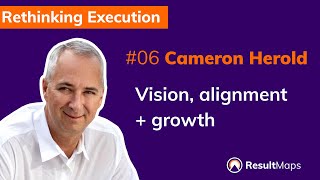
Cameron Herold explains vivid vision, a three-year strategic document he learned from a sports psychologist in 1998. He scaled the practice globally and recommends a 4-5 page readable plan with quarterly color-coding, shared with employees and partners. Herold also covers the CEO/COO two-in-a-box model and founding the COO Alliance for second-in-command operators.
Chapters
Hey, everyone. Welcome to the new economy. I'm Scott Levy, CEO and founder of Result Maps, where we're on a mission to help the world be its inspired best. That means helping CEOs and leaders build healthy cultures of relentless execution so you hit your numbers and thrive no matter where your people are or what challenges come your way. One way we do that is bringing you these sessions with leaders who've learned to thrive even as they navigated uncharted territory and thorny challenges. In this session, our guest is Cameron Herold, founder of the COO alliance and the Second In Command podcast. These two endeavors grew organically from Cameron's body of work. It's one that's earned him a reputation as the CEO Whisperer. Because while he's helped hundreds of companies scale through prior consulting and coaching, he has the unusual distinction of having scaled multiple companies to 100 million in revenue as their Chief Operating officer. So when we talk about bridging the strategy execution gap that occurs on this journey, he's been there and done that more than once. As you might expect, he's spoken on the topics of leadership and growth all over the world, 26 countries in total, and is the top rated lecturer in the entrepreneurial Master's program put on jointly by EO and mit. I came to know his thinking and methods through his books, which you'll find outstandingly useful if you check them out on Amazon. We'll put links to them in the show notes. What really strikes me about Cameron's approach and what we focused on here was that alongside his focus on execution is a relentless focus on the people side, especially when it comes to developing and aligning people to make sure your company grows and is successful.
The first thing I want to ask you about is vivid vision. So we were talking a little about it just now. Like to hear as much as you can share about how you happen to realize this was such a powerful concept.
Yeah, I think it's actually fairly systematic of the way I've approached everything, which is. I don't think I've ever had a unique idea. What I do is I take the best ideas from some of the best people on the planet and I try to synthesize it and simplify it so that, you know, we can use them. I was the dumb kid in school, so back in 1998, so I guess 22 years ago I was invited to a lunch with 120 other CEOs in Vancouver and they had a high performance sports psychologist speaking on visualization used by Olympic athletes and 16 of the 120 entrepreneurs showed up for the lunch. So there were 16 of us sitting there, sports psychologists with some of the best Olympians in the world. And he was talking about looking into a crystal ball and we're like, oh, shit, this is gonna be the dumbest thing we've ever attended. But it turned out to be probably one of the biggest systems that we ever learned at the time. And it was myself, Brian, who is the CEO of 1-800-GOT Junk. It was called the Rubbish Boys at the time. And then Dan Leonello, another friend of ours, we went back to my office and I was running a barter company at the time. Dan was running a computer business and Brian was doing the Rubbish Boys. And we all wrote our vivid visions, what we were then calling painted pictures for our companies. And that was really where we learned it was from that guy. And then I started speaking about it globally. And now I've got dividvisions being used in about 26 countries around the world.
What types of iterations did you have to go through? Did you find it was too broad at first or too specific, or you've kind of got a formula now?
Yeah, I think it was.
Over years of coaching entrepreneurs, I realized a few things. Number one is you can only lean so far out into the future before it becomes too abstract and not tangible enough. And it needs to be far enough. If it doesn't, it just seems too much like today. So three years seem to be the good friction point. You know, if you went out five years, it was too far. If you went 10, 20, like a beehive, people couldn't wrap their heads around it. If it was a one year, it just seemed too similar. So three years seemed to be the right one. That was the first part. Then it needed to be digestible. It needed to be like four or five pages, including kind of the design elements to it, maybe plus a cover page. But four or five pages of written reading. So it didn't take people all day to read it. Because you were going to have your employees, customers, suppliers, banker, accountant, everybody read it, hopefully every quarter. So you can't give them a 10 page document expecting to digest it. And then third was every quarter kind of taking a look at it as almost like a word document format where you start color coding every sentence. You know, green if the sentences now come true, yellow if you're working on it and leaving it, black if it's still something to happen later. So you start seeing it come true. Almost like building a home where you see the foundation and the walls being built and you're putting in the electrical and the plumbing, you can start seeing it happen. That seems to be a really powerful tool as well because it shows the employees that the vivid vision is starting to take shape and it gets them more excited and more brought in. Those would be three.
I like the interplay you found between here's your vision and it's big. We're not going to worry about how we're going to get there. And then one of my other favorite ideas from the book that really resonated was the dream wall.
I'll speak to both of those. The first one is we're going to worry about how it comes true, but not in the documents, right? So if you think about the vivid vision document, that four or five page written description of your company or your life's future, it's really after you describe what it looks like, then you figure out how to make it come true. Almost like a person building a home. If I'm going to build my dream home, I don't care about how they put in the plumbing or how they put in the electrical, or how they do the wiring or how they put the drywall. But they need to come up with blueprints and plans and elevation drawings. They need to have the plan to make my vision of my home come true so the workers can work off the plan without driving me crazy every minute, without me worrying about details I don't need to worry about. In the business world, the CEO needs to worry about and articulate the vision that is so clear that the leadership team can put the plan in place to make the vision come true. And the employees can work off the plan aligned with the vision. But yeah, you're kind of. You see the whole picture and the way it all fits.
It's interesting to see it distilled from both the big kind of beautiful vision. And I know your focus right now is with the the COO alliance and just raw operations. I haven't seen a lot of people bring together both of those elements. The hardcore business and that really leaning out into the future vision. Was that a process or was that something that you just felt like clicked with you?
It was a process that I learned by starting to work with Brian, who was my best friend. When I left my barter company that we'd sold, I joined Brian at 1-800-JUNK as his second in command. And when I walked into the company as the 14th employee, you know, we were only operating in 12 little cities. We just opened up really we weren't even operating in 12. I think we were operating in about eight cities. And we had 12 franchises sold when I left. Six and a half years later, we had 330 cities open in four countries. Brian showed me the vision of what he wanted to build, and then I figured out how to make that come true. And that's where we kind of figured out the vision and culture side with the operations and execution side and that kind of two in a box model where you need someone to be taking care of the vision and cheerleading and driving towards it, and then you need someone else with a very different lens to figure out how to make every part of it come true.
At what point did you kind of have an aha that, hey, everybody in our company could do their own version of a vivid vision and really energize themselves?
Yeah, I saw that from one of the women who ran our call center, a girl named Jackie Logan who reported to me. She was one of the seven business areas that I oversaw and she had a call center at the time, probably about 80 employees, really well run oiled machine. And she wanted to create a vivid vision for what the call center business would look at its own P and L, its own team, its own employee net promoter score and describe what it would feel like as a business within a business. And she created a one and a half page document that got all of her team super excited so they could start seeing why certain projects made sense and what certain things they were working on would make happen. Kind of. They saw meaning in their work a little bit more than just the project.
And a deadline in terms of translating that vision into reality. I know you've got, do you call it a framework? I mean, with Double Double, you laid out essentially a business operating system and talk a little about that system of going vision to goals.
Yeah, and what I tried to do.
With Double Double and with all of my books is to remember that every company is different.
Unlike a franchise where you can hand.
Them an operating system and they all follow the same system and they all.
Run the exact same model, every business is completely different. And you need a framework that can.
Be iterated, that can be made your own.
So I tried to make Double Double.
In all of my systems very tangible, take home step by step on how.
To do things, but not created in.
Such a way that it was so rigid.
And I didn't want it to feel like scaling up. I didn't want it to feel like.
What eos, EOS Traction. What Gino Wickman wrote with eos he came up with eos five years after Double Double. In fact, a lot of Double Double is in traction.
But he created a really good framework.
That he wants people to use each.
System and I didn't want it to be so rigid.
So I kind of pulled back a.
Little bit from that to make it.
More pliable and more, you know, you can't have a manufacturing company and somebody selling on Amazon and someone running a pool and spa business, somebody building software and have them run all of the same systems the same way.
So I tried to give them the.
Step by steps on how to do.
Stuff, but created in a way that.
They have to almost make it their own.
And did I see you've actually scaled businesses from sub 10 million up, I think three times?
Yeah.
Three different businesses that I built over 100 million, 1, 800 got junk. As an example, when I came in as the 14th employee, six and a half years later, we had 3,100 employees. We went from 12 locations to 334 countries and we went from 2 million to 106 million. We had no debt, we gave up no equity. And we ranked as the number two company in Canada to work for. That was the third company I'd done it for. So I did it with the chain of auto body collision repair shops. In Canada, it's known as Boyd Auto Body. In the US it's now known as Gerber Auto Collision. It's the largest collision repair chain in the world. And then on the house painting side.
We did it with another business called.
College Pro Painters, which became the largest residential house painting company in the world. And then I'd also done one about 60 million, which was a private currency company, kind of like what Bitcoin is doing. But we did it 20 years ago.
Did you find with each of those things, followed that kind of growth plateau, growth plateau pattern that I know Verne Harnish calls out in scaling up.
Yes. In a different way though, I've noticed a trend around the number one and three. And I'll explain how that works. When you go from one employee to three, the company changes. You know, when it's just you, no one to ask, you just do shit too much on your plate. You hire a couple people and then you go to 10 people and all of a sudden there's a team and.
It'S a little more complicated.
Somebody's actually managing somebody, not you. And then you go to 30 and you actually have managers managing people. And then you go to 100 and you've actually got people that you don't know the names of, but you're pretty sure you know the business area they work in. And then you go to 300 and you don't know them. You don't know what they do. You don't know what they get paid. You don't know where they work. You don't even know how we hired them. You don't even know who approved them. On the revenue side, it's kind of like 100,000, 300,000, a million, 3 million, 10 million, 30 million, 100 million. You know, at 100,000, you're basically a freelancer. At 300,000, you're a freelancer who's really replaced their wage. At a million, you're now a business, and you probably got some people. And then at 3 million, you've become a real company with, oh, shit, I got hit with taxes. At 10 million, you're having to leverage your balance sheet and utilize cash flow.
And pro formas and think that at.
30 million, you become a real operating company that's in the top 1% of.
All companies in North America.
And, you know, then you go to the hundred million, you become the politics start creeping in and you're doing acquisitions. And so I kind of see more an evolution and a change of the business as you hit each of those hurdles.
I know that I've Talked with several CEOs and investors who've talked about how important it is for the CEO to change as the company grows and changes. Do you find it's the same thing for the chief operating officer as well?
I just did a call this morning, a group call with about 12 CEOs and COOs that I coach. And we were working with them on what we call an activity inventory. Getting them to think about all the stuff that they're either incompetent at, competent, excellent, but they don't get energy from or unique ability and trying to work at getting a lot of stuff off their plate and either optimized or automated or delegated so they can work in their area of unique ability or their zone of genius. And often people get stuck that they're doing the same thing they've always done. They don't think about freeing themselves up, whereas I want them to get kind of 70 or 80% of the stuff off their plate so that they can.
Focus on growing people and culture and.
Execution and employee engagement.
At what point, or is it immediately, you feel like the CEO and the COO really have to transition more and more into that role, growing the business, growing your people?
I think it's pretty early because at the end of the day, the only reason we have people is to get more done.
Right.
To and to replicate ourselves and to bring in additional strengths that we maybe don't have. So then if your company grows too quickly, you know, the average manager who's maybe a layer below you or two layers below you, they can only take the company through three doubles. Sorry. Through two doubles of revenue before they're kind of out of a job. You know, someone managing a team at 10 million. When the company goes to 20, yeah, they're okay. When it goes to 40, they're scrambling. When it goes to 80, they don't have the skill set anymore. You know, Ben Horowitz in the Hard Thing About Hard Things, talked about one triple. I talked with Clayton Ask at infusionsoft.
He agreed it was two doubles. It's roughly the same number.
But I think you always have to be growing the capacity of the people. And if you grow two things, their skills and their confidence, they'll continue to scale. I think of every employee walking up two ladders. So if you're on a ladder and I shake the ladder, you get nervous, right? Well, let's say one ladder is the skills ladder, and the other ladder is the confidence ladder. If I'm trying to get you to go higher up the skills ladder and I'm shaking the confidence ladder, you're not.
Going to grow kind of off.
So I got to get your confidence.
Up and your skill up and your.
Confidence up and your skill up. So you're always trying to grow their confidence, praising them, you know, removing obstacles, coaching them, problem solving with them, cheering and then raising their skills. And I think most leaders tend to.
Miss sadly on the confidence ladder. They often work on the skill side.
But they forget that they're shaking the other ladder.
I would agree with that. That definitely mirrors my experience. And then I think the problem is it becomes what you model. Right. You think, oh, this is how a CEO or an executive should behave.
Well, in CEOs. CEOs often see the goals and we're stretching for the business, and we're frustrated with the little things that we could do better. And we notice the little problems and we forget that. Like, yeah, of course I praised that guy. Yeah. But that was six months ago. You also showed him seven new things to work on and eight things that were broken. That adds up to 15 things that he felt bad about and hurt his confidence. You should have praised him on 30 different things that he did really well.
Over the period of time.
You know, I go back to Howard Behar, who was one of the three CEOs at Starbucks. I think they have their fourth CEO in place currently. There was Howard Behar, Howard Schultz, and Oren Smith. When Howard Behar was CEO, his assistant would put on his desk every Friday 100 cards that he would handwrite notes to stores or employees or executives. And there'd be a spreadsheet with like, Bob Smith, anniversary number three, store number, you know, whatever in Seattle. So you go, hey, Bob, heard it's your third anniversary. Congrats, Howard Behar. So he didn't know who to praise, but every single Friday, he spent two hours a day handwriting notes. And this is a guy running a chain that had 13,000 locations. So he forced himself to praise. Right.
It's interesting too, because when I think of customer oriented organizations, most of my experiences, you know, there are fewer now. But going into a Starbucks, they had a great culture. I always felt like. And it was that same type of idea. How much do you feel? I know a little bit from reading the books that the leaders really need to reflect those values. This is what our company's about. And how does the vivid vision help that? I thought that was a really interesting detail.
You brought 1000%. Believers need to role model what they believe in, otherwise the employees don't buy into it at all. I have some actual very good insights into Starbucks for a couple reasons. My mentor was being groomed as a second command at Starbucks. So back when I was building 1-800-got junk, Greg Johnson was mentoring me for about 18 months. And then back in 1993, I was dating Howard Schultz's kid's nanny. So I had some very early insights into Howard leadership and culture and then some very deep insights, even going down to their offices. Every quarter, I would go down to Starbucks head office or Greg would come up to Vancouver.
So I saw at the very top.
Level, core values and obsession for team and obsession for growing people.
At the highest level, I was almost.
Embarrassed walking around the Starbucks head office with how often people would come up to Greg and say hello and say thank you for that card or thanks for the note or hey, it was good to hear. Like, it was, it was. It was bizarre to see that cult of leadership inside of a corporation. So, yeah, I mean, at 1-800-got junk, one of the earliest things I did was to let Brian know we had to build a little bit more than a business, a little bit less than a religion.
We had to build a cult.
And the cult culture, right, is where it comes from.
We had to build that culture to.
Really attract people into our organization.
And so we did all kinds of.
Things that turned it into that cult like environment. And part of that is living the core values. Firing people who don't live the core values, Hiring people who already obsess about the core values, reinforcing the core values. Talking about the core values, like reminding people of both core values. Most companies, the CEO couldn't recite them. Half the companies out there, they probably created a fancy acronym to make it cool. So now is it about the acronym or the core values?
And so, yeah, you really, really have.
To obsess over those things.
The other thing that reminds me of, and I love it, is I know that Whole Foods, who's here, started in Texas. They were very intentional early on about bringing on suppliers and vendors that they felt aligned to. It was interesting to me that you said, share your vivid vision with your contractors, your vendors, your suppliers, your customers, with everyone and the press. I mean, it's a tool. It becomes a tool for everything.
Well, I actually learned that from Starbucks back in 1993. Do you know the company that makes the lids for the coffee cups for Starbucks? Do you know the name of that company?
I do not.
You've seen the word on the top of the lid a million times or probably a thousand times. Solo. You ever seen the Solo cup? Yes. Solo cup got introduced to Starbucks back in the late 80s and they bought into the vision of what Howard was building and became a very aligned supplier.
That's where I learned the idea of.
If you get your suppliers, your accountant, your lawyer, all of those circles of influence bought into the vision, they'll conspire to help make it come true. Because today's company is boring. But what, what you're building is what they're excited about.
It's an exciting idea with all the different versions of visions. I see, with all the different. You know, you alluded to these, like very rigid methodologies. I love that idea of this is us, this is who we are, this is the world we see. How do you fit? Because it lets people really buy in.
Yeah.
And you're not showing the plan, you're just showing the vision of what you're building. So then it gets them excited about.
It or they go, you know, this.
Isn'T really the organization I want to be aligned with. This doesn't feel like the right fit for me.
The COO alliance, that was inspired because you felt like there was really a gap to nurture COOs. Can you talk about that?
A little, yeah.
I was actually at one of four masterminds that I'm a member of. I was at a Genius network event and there were a couple of second in commands that came to the annual.
Event and they just didn't fit in.
And you could see they didn't fit in. They were kind of walking around talking to these other entrepreneurs. The entrepreneur would mention interviewing and the COO wanted to spend two hours talking about the interviewing. But all the CEO wanted to go is that we gotta hire the right.
People, like go team.
And then they wanted to talk about marketing. It's like, wait, there's like we talk about interviewing for two days. So I saw that there was a huge need and because I'd been the coo, I kind of felt bad for them and not having a space. So then I started talking to some of my clients that I was coaching, recognized that their COOs really wanted a network as well. So we created the COO alliance as the only network of its kind. No entrepreneurs are allowed. You have to be in the second command role to the CEO.
It's interesting that you're kind of both personalities in one.
Right?
Because you, I think you mentioned you test out for both and you're clearly entrepreneurial.
Yeah, I test out much higher for the entrepreneur DNA and the entrepreneur like my corporate Colby profile is a 4393. So I'm a high quickstart. My disc profile of a 98D and a 74I. So a high entrepreneurial profile there. I'm definitely a high entrepreneur. But I think my because of the franchise training I had at College Pro painters and then 1800 got junk, I became very good at operationalizing things and creating very simple systems that allowed people to run with it quickly. Because I recognized that the perfect system couldn't be executed by 821 year olds. At College Pro Painters, you needed 800 franchisees all to learn something and do something. You had to simplify the system.
More from Scott

Build a Self-Running Business with EOS - Entrepreneur and Implementer Explains


How to Create a Company Vision That Actually Inspires and Aligns Your Team | Leadership Guide
How to Create a Company Vision That Actually Inspires and Aligns Your Team | Leadership Guide

Company Vision vs Accountability: EOS Expert (750 Sessions) Reveals What Actually Drives Engagement

How to CEO From $0 to $30M: The Brutal Truth About Small Business Growth (w/5-Stage Framework)

Leadership For Entrepreneurs: A Proven Way To Level Up Results Without Corporate Fluff


What is Strategy? The Ultimate Guide to Strategic Thinking in 2025 for CEOs and Owners
