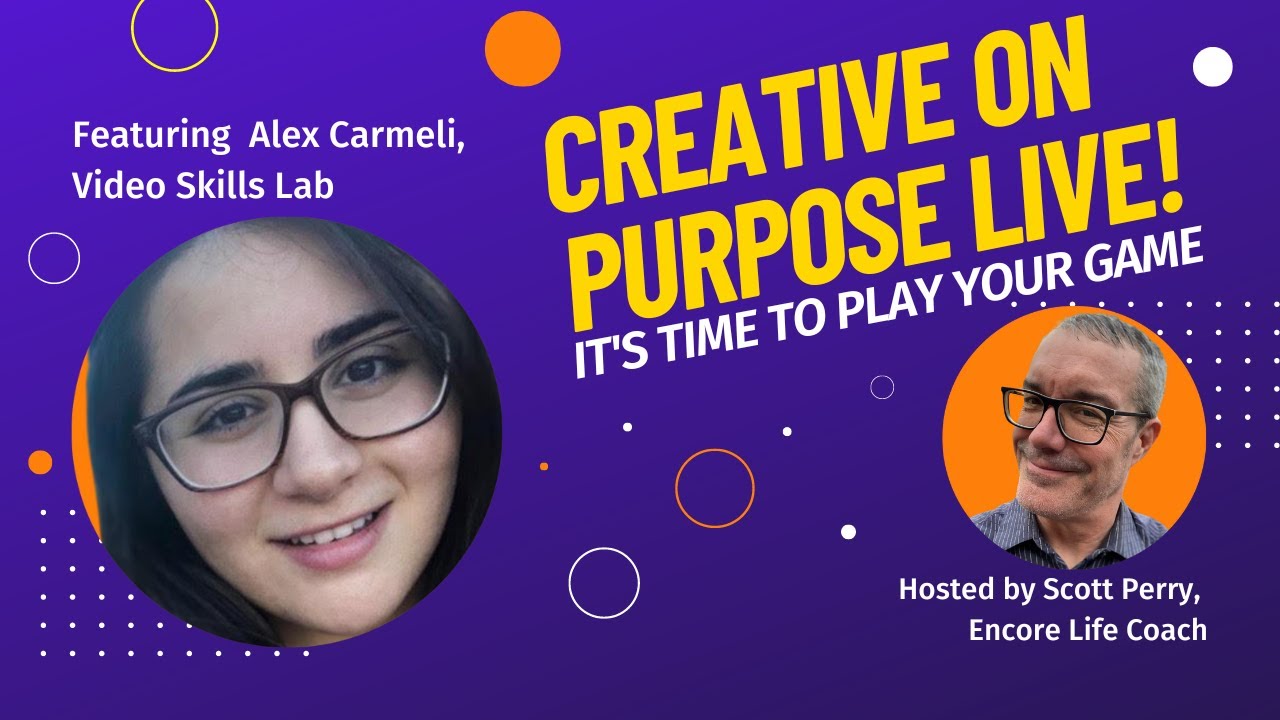
Alex Carmeli went from hating cameras to building a $9-a-month Video Skills Lab for entrepreneurs. She teaches people to stop overthinking and just go live, sharing how she grew an organic Facebook community with weekly trainings and a practice method she calls Cemetery Sessions.
Chapters
There at the speed of bytes, and boom, just like that, we did it. Hey, welcome to Creative on Purpose Live, conversations with insightful difference makers that inspire a life of greater intention and impact. I'm your host, Scott Perry, Chief Difference Maker at Creative on Purpose. And if you are ready to get clearer and closer to what you really want in life and business, visit creativeonpurpose.com to get started today. I'm thrilled to have my friend Alex here with me today. Alex, please tell our viewers who you are, what you're up to these days, and where can people go to learn more about you and the difference that you're making?
Yeah, I'm so excited to be here. Thank you, Scott Perry, for having me. Um, my name's Alex. I live in Austin, Texas. I'm here with my partner and my two dogs, and we've got a little baby on the way too, which I'm super excited about. But I am a video strategist, and essentially I help, um, entrepreneurs, coaches, and course creators to get on live video and sell their offers with ease and confidence, especially those of you guys who feel overwhelmed with the tech or overwhelmed with like the script writing process. Like, my goal is to sort of bring back the fun to video and lives and not have it be like this stressful thing in your week that you just dread. Um, and the main place that I do that right now is in my Video Skills Lab. It's a $9 a month membership where I basically give you live coaching and a library of resources and all this good stuff for like a really affordable price. So that's essentially like a little nutshell.
And it was my pleasure to get introduced to Alex and her work at an event that we both attended, put on by our mutual friend Laurel Portier, who's been a guest on the show a few times. And, um, really great to connect with you there and learn more about what you were doing and, and, um, have us both get our butts kicked by Laurel. Who's also quite the expert in video, especially around Facebook ads. The first question I'd like to ask you, Alex, is, because I don't think we really touched on this when we got together last October, but, you know, my guess always is that the 9-year-old version of ourselves didn't wake up one day and say, hey, this is what I want to do with my life. So my guess is, you know, if just how did you come to be doing this work that you're doing around helping people, uh, engage and, and, uh, step into doing more with video online?
Yeah, so I think it happened in a really odd way. I honestly, I was the person who was like, I will never use social media, I never want to be on camera. So it's very weird for me to be the person that's like doing this now. Um, but basically I started out, um, right when, uh, I went to— I was in Boston for college. I went to Northeastern. And when I was graduating, I was like interviewing for all these corporate jobs, just hated it at the time. I was competitively powerlifting too, and I was like, I just want to like coach. I just want to be in the fitness industry. And so the first like business I had was as a personal trainer, and I ended up building my first six-figure business. Eventually it turned into me like helping direct a bunch of other like multi-million dollar locations all around the Boston area. And like, I was learning how to coach other coaches. I was running my own coaching business. It was, you know, teaching me how to run, run and build teams. So it was like such a valuable experience. But I was literally working myself to the— into the ground. Like, I was getting up at 5 AM, getting home at 9 PM. I had no time for myself, like zero time for myself. I had zero time for my partner. I never saw my dog. It was just like I'm grateful because I learned so much. I don't think I could be in this position now if I hadn't done that. But I was just like, I, I— the one thing I was craving was like the time freedom. So I was like, I want to take all this stuff I learned in fitness and I want to bring it into something else like leadership. So in 2020, I ended up randomly— I was just like, I'm gonna quit and I'm just gonna go for it. I literally did not have one client. I did not have anything. I was just like, I'm gonna go for it. Like, I've done it already in person, how different could it be? Spoiler alert, it's really different. Um, but it's okay. What's interesting— I'll keep it short— but the— what ended up happening was in my leadership coaching business, it did okay, but people just kept asking me, how are you doing these lives? Like, tell us more about how you're making these videos. And I was like Oh, okay, so maybe this is what people want from me even more than the leadership. So I sort of ended up being kind of called to it versus me being like, this is the thing that I want to do.
Yeah, I really love that. And it's a real theme of this show and a big theme in my work, this idea that, you know, our lives are often talking to us because they want to speak through us, but Uh, we have this nasty habit of not paying very close attention. And so, you know, what I'm hearing in your journey is that there was this thing that you thought, oh, I'll never do this thing, which was maybe a signal that that was a direction worth exploring. And then at some point, life conspires to just put you in a situation where now, now I'm going to have to, you know, start to explore this, this thing that I said at one point I would, I would never be. Interested in doing. And, oh, we got just a real quick shout-out. We've got some people tuning in and another friend from October's event with Laura Porte. Petra is in the house. Good to see you, Petra. So there, I work with a lot of freelancers and coaches and people that also are trying to, you know, create content that's going to be posted around social media or to a YouTube channel and so forth. And I have got the same sense that you have that, you know, there's just a lot of resistance to getting on. Like, it sounds like you're like me, like you didn't have much problem saying, I'm just going to turn on the camera and do this thing. I've never, you know, as a former professional musician, being in the spotlight or being on camera has never really been an issue for me. But it took an empathetic leap for me to say, oh, there's people that are really struggling with this whole thing that could actually really benefit their business. And I'm just curious about your take on, number one, you know, why is it that, that so many people do have some fear, anxiety, or resistance around doing video, which is the thing that's being most rewarded by most platforms? And then how do you go about helping them kind of break through that resistance and start, you know, dipping their toe in the water and get— getting started?
Yeah, honestly, and to be honest, I overthought the whole process at first. Like, I would overanalyze like how I looked and sounded and all the things and do a million different takes. It's actually why I like lives. You can't do that. You just have to hit the go live button and it doesn't matter if you make a mistake. It's just like it's out there in the world and you just get better and better each time. Um, but I do think there's a lot of like overthinking, whether it be because of comparison where we're overthinking because we saw someone else's video and it was way better edited and better lighting, and they spoke more eloquently than we did. Or we just have these perceptions of what video needs to be instead of focusing on what's the message that I want my audience to get? Like, what's the takeaway? What's the transformation that we want people to have? And so for me, I would literally show up— like, I'm very casual. Like, I show up after I go out on a workout. I'll show up like, you know, like on my worst looking days. And like, to be honest, like, I just focus on the message. And what's funny is even when I show up on those days where things aren't perfect, like, sometimes it attracts more people because they're like, wow, this doesn't look as perfect as it should, or it doesn't look as— you know what I mean? So if you are someone who is struggling with the overthinking part I think breakthroughs happen in two different ways. Like, either you're gonna have a breakthrough because you reflect a lot and then eventually decide to take action, and then you get some sort of result. Or you're gonna take action, get a result, and then kind of have that reflection kind of come from there. And I'm a big fan of like, go and do the thing and have the breakthrough after you do the thing, because either way you're gonna have some sort of breakthrough. Either way you're gonna have to go through those mistakes whether you think about it a ton before or you don't. And I'll give an example. I just had a coaching client who like for so long was like, it was like months she was putting off these lives. And I'm like, what's getting in your way? What's happening? And she like, she knew what she needed to do. It wasn't an issue of not having enough information. And I was like, you know what, we're literally right now on the spot. I was like, we are scheduling the live right now. And so like right there on the call, I was like, pick a topic right now. When's the day you're doing it? And like, we literally scheduled it for like 3 days later and now she's supposed to do it tomorrow. Like, I think that's the best way to do it. Like, don't overthink it, do it, do the thing, and it doesn't matter. You're gonna grow with your audience.
Yeah, I love that. I think one of the things that, that, that I found and has been helpful with my clients that, that have struggled with getting started, and I'd love your, your take on this, is I don't know what it's like now because I don't spend a lot of time on Instagram, but at one point, Instagram Live, literally you would go live and then at the end it would say, you know, do you want to, do you want to post this or do you want to delete it? So you could literally go live, test drive, you know, whatever it was that you were going to do or say. And if you liked it, you could keep it. If you didn't like it, you could delete it. And so I would just, you know, tell people I got my start actually by— I go for a run at the local cemetery every day. So talk about not looking your best. I was a hot, sweaty mess with my, you know, dirty old baseball cap on and my sweaty t-shirt on. And I would broadcast live from the cemetery. I called it The Cemetery Sessions, and I would just kind of go off on whatever I was thinking about on my run that day. And it was a way for me to just like, okay, I'm just going to do this. Like it's scheduled, it's going to happen. Every time I finish my run, I turn on the camera and I just talk about what I've been thinking about. And if I really hated it, felt like I was really awful, I could just delete it. Um, but if not, I could keep it. But one of the things at the beginning especially is nobody's actually watching at the beginning, right? It takes time to get an audience, and it takes time for, you know, a video to get some traction. So I think sometimes we just get really caught up in our, our own feelings of personal significance and, and our internal narrative about, uh, you know, tied to ego and expectations and attachments to results and all that kind of thing. When in the grand scheme of things, there's so much going out there, especially now, that it's, it's actually going to get buried so quickly that even if someone does see it, um, it's not gonna, it's not gonna last too very long. But It became a really great way for me to just get some reps in and, and then for my clients get some reps and just like, just, just do it. Like your first video is not gonna be your best video. So let's get the, the first worst video outta the way cuz then we could do our second not quite as bad video.
Yeah. And I think one thing that really helps, like just on the subject of not having an audience is like a lot of my clients don't have an audience. Like most of them don't when we start. And no one is watching for like the first month or 2 or 3 or 4, like, and we're actively building their audience, they're actively getting better on camera. But what's interesting is a lot of my clients now, a year later, 2 years later, have videos from the first time you recorded, the first few videos they did are now getting traction because they are having so many conversations with people about their problems that they're pointing them back to those videos. Those people are going and watching them, they're commenting on them, they're engaging with them, they're getting pushed up in the newsfeed again. So all this work you've done that you felt like no one was watching then, you're still working for the future people that will be there. So if you believe that you're in this for the long term, you believe you're eventually gonna have an audience, record for those people. Even if it's right now something you don't have, it's gonna be an asset you're gonna use over and over again.
Yeah, I love that. One of the things that I know was really helpful for me was leveraging all the things I had learned from my background as a professional musician and, and from teaching other people how to play guitar. One of the things I did in my guitar studio was set up a couple— twice a year I would take my students to this local venue and they would perform on this really nice stage, you know, for an audience of their family and friends that were coming to see them. And of course, you You know, everyone's first performance creates a lot of anxiety, just like your first video would create a lot of anxiety. And one of the little pep talks I would give them before they went on is, it's, you know, the thing is we think it's all about us and it's really not about us. People are here to hear the song. So just serve the song and don't worry about you because you're not, you're just the vehicle. You're just the one that's the, you know, you're performing the song, but It's about the song and it's about that connection with the audience. And that kind of idea that if you, if you hop on video with this posture of generosity and service and trying to be helpful and useful to the people that need you to show up in their lives so that their lives can be enhanced by the difference you help them make. I think that's a real big anxiety antidote. Yeah, it's not about you, it's about the difference you're trying to make for other people. Uh, it's a way of building a little bit of, uh, boldness and courage before you even turn the camera on.
Yeah, I love that. I, I agree. Like, I think sometimes we take things way too personally instead of focusing on like really like what it is we're trying to do. So I think, I think it's great advice and I totally agree.
I love the, um, I'm just curious about, because, you know, you, you're, I do not leverage Facebook groups, but your, your primary endeavor, and just to put it up there again, um, you know, you're doing a lot of, uh, your audience building and, and information dissemination and so forth. Um, I, I'm curious just about how you got into that side of things, because I know it's something that a lot of people consider. A lot of people can be intimidated by the idea of like starting this group and how am I going to create content for them every single, you know, day, week, whatever it is, whatever tempo you have. So just, uh, if you don't mind just touching on a little bit, how did you decide to leverage the Facebook groups as your marketing and information dissemination vehicle? And, um, and how did you grow that channel?
Yeah, well, one, I think Facebook groups especially get a lot of hate. I don't understand it. Like, I love Facebook groups. Like, it has given me so much organic growth. Like, I didn't get into— you know, we met through Laurel. Like, I didn't actually get into spending ads until like 2 years into my business. Before, everything was organic. Everything was coming through my group. So I think they're a great way. I first got into using groups when I was— like I said, I was leadership coaching before I started this business, and I was the person who was posting on every single platform. So I would write a piece of content and they'd be like, okay, I'll post on YouTube and LinkedIn and Facebook, and I would just spend like hours every day like just putting content everywhere, and I literally was getting zero traction because I wasn't actually optimizing for each specific platform. I was just sort of doing all the things in like a really mediocre way, and it was just like not getting me where I needed to be. And so what attracted me to groups was number one, the fact that you can have them be private. Like, I kind of am very introverted And I was at the time, I was still new. I was really nervous about having my content be in front of my high school friends and college friends and all these people. And I was like, okay, what if I just have this private community of people that I can grow? And if your group is engaged, if your group has lots of members joining, Facebook will show your group to other people. And what's great about groups is people can very easily invite other people. So what I was doing was I picked a time to go live in my group every single Tuesday at 7 PM. This is when I was leadership coaching.. And I literally religiously for a year was like, every Tuesday at 7, it has to happen. So people were marking their calendars, people were inviting other people to this community. And I remember within 6 months I had like close to 1,000 people. This is all organic that had joined. So for me, 1,000 people was like, oh my gosh. Like I was excited when one person joined my email list at the time, like let alone like having that, like I didn't have, I didn't know how to do this at all. So it just ended up being the thing for me that worked best. I'm not saying that everyone should have a Facebook group. It's not the right fit for everyone, but if you are someone who maybe is a little bit more introverted and wants more of a private community setting, like it can be a really, really good space.
Yeah, I love that. I, it's, it's something that I, I think about, but you know, I agree with you, like, you know, there's lots of things that you can, um, you can find to complain about in, in any social media platform. And, and, uh, you know, obviously those platforms are businesses, and they're, they're businesses that whose intention is to make money. And at the same time, if you are using the platform for the, the intent of the, you know, the platform's intent, it does seem that the platform rewards those that create and share and engage, uh, with content that helps, um, you know, that helps keep people's attention on the platform. And I love that, you know, what I am hearing in your description of about your group and this journey of growing it initially organically is that you had a really clear, like, who it's for and what's the promise on offer for folks that join that, and you kind of had a little bit of a plan for, uh, you know, how you're going to roll out content and how you're going to engage with that group to maintain it as a, you know, safe and vibrant community of people that are all on a similar journey with you as a trusted mentoring guide along the way.
Yeah, I, I definitely— that's the difference too, is like most of the social platforms, when I was doing everything, there wasn't a customer journey in place. It was literally just like, get as much out there, survival mode. Now when I have groups, and this is what I teach to my clients too, it's like everyone who joins the group gets a private personalized message, a voice note or a video like welcoming them to the group. They get tagged in a welcome post with resources. There's a welcome video, there's a live that's happening every single week. Like, I also like groups because I host a lot of trainings like challenges and workshops Tops and Summits. So it's a private space for those events to happen as well. So like, they're seeing those events in that space. So it's not like, okay, this is just a space where stuff's randomly going to get dumped. Like, we're taking people through more of a process than just rank something random.
Yeah, I love that. I'd like to— if you don't mind, I want to circle a little bit back to your former, you know, your initial foray into entrepreneurship with your leadership coaching, just because it's, again, a subject that I, at least my coaching program is kind of adjacent to. And, you know, I'm just curious about what led you to initially go with leadership coaching and what was the primary problem that you felt like you were solving for people when, when you were doing that particular endeavor?
I think the, the biggest thing that I was seeing— this was from my time in fitness, um, just very brief background— like every single manager that came in, fitness manager that came into the company I was working for, came to me for their onboarding and they would spend like a month with me. So I was like, for a year plus, even more, it was probably like over 2 years that I was literally mentoring these managers, mentoring these coaches that were coming in. And the consistent thing that I was seeing was these people need to be able to develop teams. They're really, really good at what they do. So like they can sell, they can make themselves like really approachable to clients who wanna stay with them forever. But when we had these new personal trainers coming in, they had no idea how to teach or communicate in at a high level, like what it is that actually was making them a success. And so their team, they were selling, their teams wouldn't sell, their teams didn't know how to retain clients. So I think at the core of what I was trying to solve was like, okay, how do you not just be good at what you do, but then take what you do, your secret sauce, and like then give it to someone else? Because that's really, really tough being able to articulate and disseminate that to someone else. Um, so that was sort of the biggest thing that I wanted to come in and do. And it wasn't just in fitness, like anywhere you go, like you know, you're gonna have that problem with, with top performers in general. Like, they're not necessarily good teachers.
Yeah, that's so very true. It's especially true in my former occupation as a guitar teacher. So, um, the best guitar teachers I ever had were not the best guitar players. It's— and it was actually very rare for a really high-quality, top-performing guitar player to also be an excellent teacher. I can really only think of one example And I had dozens of teachers over the years. And I know for myself, I'm definitely not at the lead of, you know, guitar players, but I was an exceptional teacher and was able to be very successful at it. And what I'm hearing and what you're saying is something that I find to also be very true, which is leadership is not just about having a title and authority. Or, you know, being the business owner. And it's not about being the best at what you do. Leadership is actually seeing and stepping into and staying in your power and sharing it in a way that empowers the people around you to see, step into, and stay in their power and, you know, lead themselves. I mean, there's So many leaders end up, in my experience, acting like authorities and not acting like leaders. They're, they're dictating or micromanaging, and, and, uh, they're actually really unwilling to let go and let people step into their own power and navigate their, their own way into doing whatever it is they're supposed to do in their own way.
Right. And I think for me, I was always like, okay, can I go away for 2 weeks and everything would just stay the same? It would just be fine. Which is dangerous because you're like, oh, you don't really need me that much anymore because everybody's super empowered and everybody's really independent. But you also do because everybody wants to continue growing, you know what I mean? But I think it's a good problem.
Yeah, absolutely. I mean, when I was a guitar teacher, one of my first lectures to my students was, listen, here's the deal. I'm going to be your guitar teacher for now, and I'm going to teach you everything I— you know, everything that you need to do what you want to do with this instrument. But I'm not here to be your teacher forever. At some point, I'm really hopeful that you'll move on, that you'll move beyond my capacity to help you get, you know, where you want to go, because there's plenty of other people you know, behind you that I'm going to be able to help. And so a lot of times, I think leadership is kind of all about leading your way out of a job by turning other people into leaders so that they can do their thing in their way. And, and if you are an effective leader, it's never going to take you too long to attract quality people that you can then turn into the leaders that replace the leaders that are moving on because they've outgrown the position that they're in. I really love that. So as we're coming to the end of our time together, Alex, the final question is always just like some sort of final piece of advice or maybe a favorite quote or some sort of principle or exercise that will help the people that are tuning into this broadcast. Most of them are people that aspire to be business owners of one size or another, or freelancers, or, you know, create a creative enterprise or coaching business and either begin or to advance in the bit and optimize the business that they already have. And so, if there's just one final principle lesson takeaway that you could provide for the folks that are tuning in that would help them just step half a shade braver into the difference that only they can make and step into possibility with optimizing and growing themselves in their business? What would you, what would you share with them?
I think the, the biggest lesson that when I first learned that was the most helpful, and it's still something that every day I just tell myself when I'm doing things that are scary or tough, is just like, just be detached from the outcome. And that's really, really hard because it means that like you just have to like put your emotions to the side and just focus on taking so much action, taking so many steps that you're going to inevitably move forward because you're just the person who continues to move. And I think it means that you get past this fear of like looking stupid. And if you— I think that's another thing I say to my clients all the time is like, you should be more afraid of not having the life you want than looking stupid, or that someone will say something stupid to you. Like, it just doesn't matter. So be detached. Be more afraid not to have the thing you want than looking stupid. And eventually, if you keep moving, you're going to get where you want to be.
That is such fantastic advice. I really appreciate it, Alex. And Alex and I want to thank you all, our viewers, for tuning in today. And we appreciate the gift of your time and attention. And we hope that today's conversation inspires you to, uh, fly a little bit higher and be a little bit bolder in making the difference that only you can make in the world and whatever business it is that you are in or wish to get in. If you are listening, uh, on social media or YouTube, please drop a comment or drop a question in the chat below this video. If you're listening as a podcast, wherever you listen to podcasts, please take a moment to give us a 5-star review, leave a written review. It really helps more of the right people connect and collide with the content and the insight and inspiration our guests are sharing on the show. And for now, take the insight and inspiration from today's show and play your game all in and full out. Alex, thanks so much for spending this time with us and for sharing your, your wisdom and expertise with us.
Thanks for having me. It was really fun.
More from Scott



Stoics Don't Suppress Emotions, They Do This Instead #stoicism #emotionalintelligence #mindset







