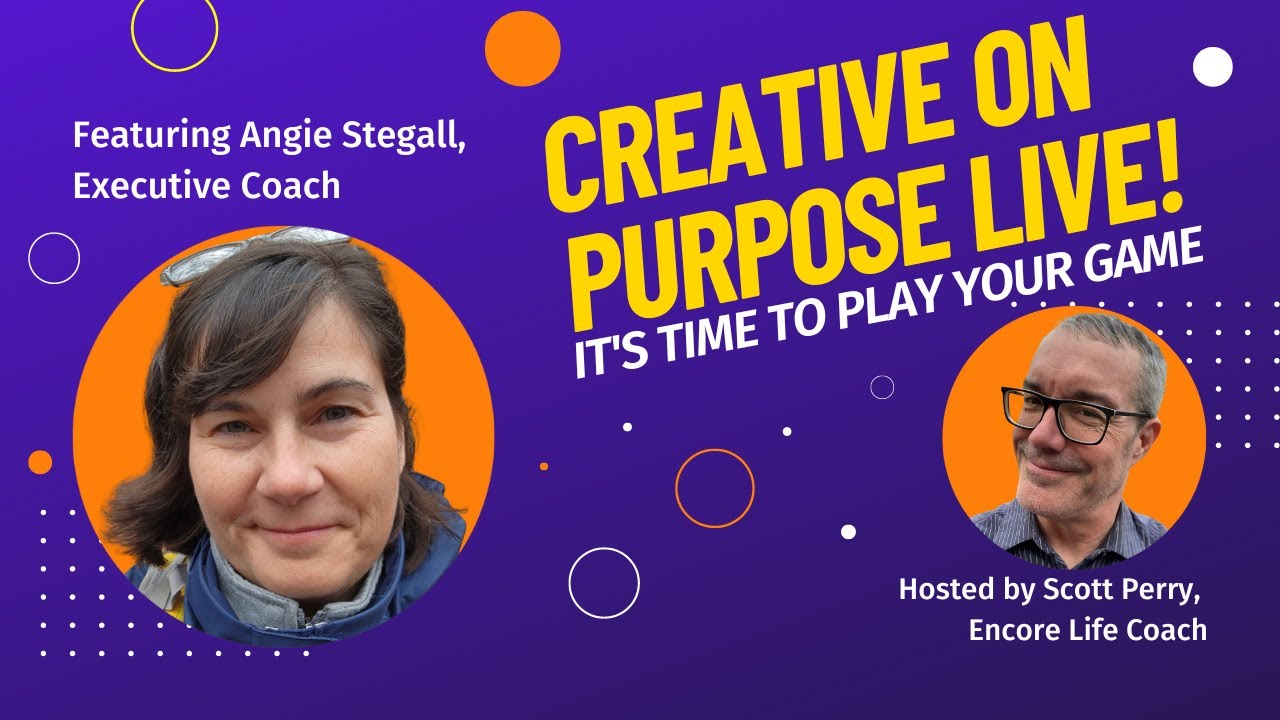
Angie Stegall, an executive life coach and forest therapy guide, talks with Scott Perry about slowing down to improve decision-making and executive functioning. She shares practical advice for solopreneurs on self-care as a long-term business strategy and how nature-based coaching helps creatives find direction.
Chapters
Ether at the speed of bytes, and just like that, we did it again. Ladies and gentlemen, welcome to Creative on Purpose Live, insightful conversations with inspiring difference makers. My name is Scott Perry, Encore Life Coach and Chief Difference Maker at Creative on Purpose. If you're ready to get clearer and closer to what you really want in life and business, visit Creative on Purpose today. So thrilled to have Angie with us. Speaking of today, our guest, uh, Angie, please tell our viewers who you are, what you're up to these days, and where can people go to learn more about you and the difference you're making.
Sure. I am Angie Stegall. I am an executive life coach and wayfinder. That's what I internally call myself. I am also a certified forest therapy guide and a certified Sparketype advisor. Gosh, I am up to all things outdoors right now. I can tell you more about that later. And you can find all about me at my website, angie@angiestaggall.com, and anywhere on the socials.
Awesome. Well, I would love to, you know, the first question always is, I'm just because I'm nosy. And if you don't want to disclose what I'm going to ask you, just tell me to take a flying leap. But I'm always kind of curious about how people come to be doing what they're doing right now. So, you know, everything that you shared sounds interesting and some of it intriguing because I don't know what all those things mean. But Um, tell me a little bit about like, how did you come to be doing what you're doing now?
Oh, it's a long story. I'll try and keep it short. Uh, my first career was as a licensed vet tech. So I was a nurse for animals and did all the nurse things. Um, quickly realized that was not going to make me any money at all and was going to ruin my body. So I just started doing a bunch of admin work and I ended up at Queens University of Charlotte in Charlotte, North Carolina. I was able to finish my bachelor's degree there at night. And when I finished my degree, I was like, I still don't know what I want to do with my life. And I got a mentor and she was a consultant and a professor at the college. And she said, you have really good admin skills and you're smart. She said, you should start your own business. So in 2003, I started my own business and I've been trucking along and making changes and pivots and learning ever since.
That's really awesome. Yeah, I love stories like that where someone says, hey, you should. And then it's like, okay, well, have you ever forgiven them? You know, sometimes the first—
I thank her every single year when I hit an anniversary. I'm like, Karen, you changed my life.
I totally get it. I, I've had a couple of mentors like that. I remember when I started my music career, uh, right before I started my music career, I, I had the opportunity to hang out for an evening with John Hammond Jr., who's, uh, at the time, you know, one of the more famous blues musicians. And, you know, we were just— I, I opened for him. We were sitting at a bar, and he was telling me, you know, hey, you should really go for it, you're really good, blah, blah, blah, blah, blah. And then like 2 years later, I bumped into him again, I was like, John, you gave me, you know, I can't, I've been wanting to tell you, you know, you, that advice you gave me changed my life. He was like, no, no, don't tell me that, you know. And he was so afraid that I had like thrown my life away to become a musician. I was like, no, it's working out great. So always kind of funny when those moments happen. The, um, the, I know, so full disclosure, Angie and I worked together a little bit a couple years ago, and I am, have always just been really fascinated by, um, the two aspects of your work. One is the wayfinding, uh, which is interesting to me because when I was a head coach in Seth Godin's programs, I created a program called Wayfinders where student leaders would help other students navigate the platform. But you also do this kind of nature therapy thing and that just, you know, as a kid that grew up in the country and grew up, you know, basically in the woods. I'm just really curious about that part of what you do. Why? How did that calling come about? And what is it that excites you most about what you're doing?
So the, the wayfinding actually is part of my certification. I went through life coach training with Martha Beck. Um, she is super woo-woo and is leaning more into the woo every year. And by the time I finished my certification, she was calling it the Martha Beck Wayfinder Life Coach Training. And it— that term fits so perfectly for me because a lot of people have lost their connections with themselves. Life is fast, it's busy, it's stressful. Um, we grow up with parents and communities who have a lot of expectations for us, and we, we fit ourselves in those little boxes, right, without really asking, is that really what I want? Who really am I? Is that what I really want to do? And wayfinding is all about helping walk people back home to themselves. Honestly, that's really what it is. And the nature therapy fit in because my husband and I took a 2-year sabbatical, an adult sabbatical, a few years ago because he was literally burned out from running his construction business and his body was falling apart. And I'd been at the hustle and grind for like 15 years with my business. I was so sick of marketing and sales. And we said, let's just shut it all down. And so we sold everything. We bought a motorhome. We drove 25,000 miles across the country. And during that time— so here's the thread— during that time, we were immersed in the outdoors because we lived off the grid in our motorhome in a lot of places. And we spent a summer campground hosting in Alaska, and we were in Utah for 3 months helping out at a bed and breakfast for a little while. And I got to know myself being outside without anyone else's input. And I thought, man, if I could take my clients out— and I had already sort of started to do that before we left on sabbatical. And I, I was so sure by the time the sabbatical was over and I re-engaged with my executive clients that the outdoors was the place for me and the work I wanted to do.
Yeah. Well, I love the, the, um, I love the Martha Beck reference. I remember we connected over that, uh, when you, you, I think you first reached out to me and I saw Wayfinding. I was like, oh, you should check out this conversation with Martha Beck that I had years ago. And I was like, oh, of course that, that all makes sense. And, um, it's been a couple of years since that conversation. Um, I don't, I find it difficult to believe that she could become more woo woo, but, um, I think people would say the same about me and I get more woo-woo every day. So I'm going to take, take, take what you say on faith. Um, but that's that part of it. And I'm a big fan of that word too. Um, and I love what you said about you help people kind of find their way back to themselves. Cause I feel like as an Encore Life Coach, that's helped helping a lot of people, um, in midlife. Find their next life's chap— you know, their, their life's next chapter's calling. Yeah, oftentimes the way to that is by looking all the way back, you know, really to childhood, because I think, you know, by the time we become teenagers, we've kind of already figured out like what are we really good at, what are we really interested at, um, what excites us, what lights us up. And so much of the time, we just need to reconnect with these things, as opposed to, I have to go out there and find myself and, um, discover who I really am and that sort of thing. So I love that aspect of what you do, but what you're saying about your experience and what you do as a kind of a nature therapist, it sounds to me like part of it is that you are able— people are able to wake up to themselves by taking them out of their everyday Right? 95% of what we think and do is exactly what we thought and did yesterday and likely to be what we think and do tomorrow. And so it sounds like you're taking people and putting them, like almost forcing them into a new context so that I'm imagining that that creates a little bit more awareness and mindfulness and presence. And, um, just curious about that part of it, the, the taking people out of their everyday and putting them into a new context. What have you seen to be You know, what were the elements of that that you feel really are points of leverage that help people get some velocity from where they are to where they want to be?
So I use invitational language. So I invite people to come out into nature with me and getting them out from the four walls that they're used to, getting them away from their teams who are like pecking them to death. Getting them breathing air, walking, getting them to slow down, right? In business, we are just like hustle and grind and go and fast and yesterday and 24/7. The ability to slow yourself down, the ability to sit quietly and just observe what's happening, that is the place where your executive functioning actually gets enhanced. When you let your brain just literally relax, when you close off all other voices, opinions, information. That's where your creativity gets enhanced. This is where you start to have original thinking. So the power of going out into the woods for a new perspective, um, is priceless to me. And sometimes it's not about slowing down. So I, I can tell the story about a client who came out to the woods with me, and she was like, oh, I just need to slow down, and this and that.. And as we're walking, she's getting further and further ahead of me. And I was like, okay, I'm noticing she's not slowing down. And so I called ahead to her and I said, hey, you know, just when you get to that bench, I want you just to sit down. She said, okay. So she got to the bench. I eventually get to the bench. We sit down and I said, tell me what's happening for you. And she said, I don't know, I just, I feel really like I'm energized being out here, and I just— ah. And I said, what do you need right now? And she said, I need to run. And I said, well, go run. And she said, oh, but that's not what we're doing here. And I said, if this is what you need to do right now, this is what we're doing. And so she took off and ran for 10 minutes and came back, and she was like, oh my gosh, I feel so much better. I said, I just want you to notice how you tried to stop something that naturally wanted to happen that you naturally wanted to do that made you feel wonderful because you thought we were supposed to be doing something else here. So I said, thank you for saying what was so for you. And there you go. Anytime you notice that, that's a pattern. Choose yourself every time. Yeah. So that's that.
Yeah, we're— one of the things that I think I mean, I think there's some, some of it is hardwired by biology and evolution, but definitely reinforced by institutionalized education and occupation and just society in general is to not trust ourselves. Like, you know, we just, you know, we, I'm sure with some of the people that you work with, you know, that are executives, you know, they're used to being rewarded for being right. Uh, and, and, and, you know, they, they have power because they have authority.
Um, and.
You know, there's a, and there's a lot of pressure around, like, if you're supposed to know what you're doing and you're supposed to be right all the time, that sounds, and so it can be really difficult for people to trust themselves. And you've, you've referenced Tussle and Grind twice now. And I love that, you know, it sounds like what you do is the antidote because what you're doing is helping people slow down, even if it's, you know, I mean, you can physically be running, but still slowing down the, the, the noise, the volume, the clamor in your head. And so it's like that cultivating of stillness. But the other thing that you pointed to that I thought was really interesting is by helping people slow down their internal, you know, their thought process, their dialogue, inner dialogue and all that, cultivating that sense of stillness. They're able to, like in this case with this client of yours, she was able to notice for herself that there was these instincts and intuition that her body was basically calling her to pay attention to and to act upon. So I really, I really love that. It reminds me of the, um, I think it comes from the military, but that idea of slow is smooth and smooth is fast.
That's right. We, you and I have talked about that a number of times.
Well, it's because we are programmed for speed. We all feel the need for speed. I want what I want and I want it yesterday, and I'm going to go as fast as I can to get it. But we forget that, you know, speed doesn't guarantee, um, velocities. You could be going really, really fast in circles. You could be really going really, really fast backwards, and you can be going really, really fast headed right to a cliff. If you don't know where you really are to start with and where you really want to be, or at least have a bit, some clarity about destination, you have no hope for increasing your velocity to get from where you are to where you want to be. You can go fast, but that doesn't get you anywhere except, you know, maybe further away from what you really want. So I really love that piece of it. You also mentioned executive functioning. And, uh, I'd love to hear just like, that is a phrase I know I've heard before and I should know what it means, but tell me, um, what that is and how it comes into play.
Yeah. So our modern world, how fast we're moving, how much cognitive load executives and leaders of any kind have. You, you end up with a lot of cerebral congestion. There's just a lot of noise in there. And the ability to have good executive function means you can assess the situation, you can think clearly, and you can make the best decision possible because you can open up your vision. And clearing out cerebral congestion to me is taking what I have come to call for years just beautiful brain time, right? Give yourself margin. There was a whole book written about it, which I love the concept of margin, um, slowing your mind down even if everything is moving very fast around you. If your executive functioning is on point boy, you can make some really spectacular decisions and come to some really powerful conclusions if you continue to clear out all that cerebral congestion. So executive functioning is just being able to like slow down, assess, and make really good decisions based on the facts in front of you.
Yeah, I love that. So quite a bit of what I help clients with is, is around decision-making, because it's not— I've stopped calling it making better decisions and started calling it making decisions better, because there's no such thing as a best decision. I mean, it's, um, there's so much, you know, I mean, and our decisions are not tied to the results, right? You can make a really bad decision and get a great result, and you think you're a genius, and you keep repeating that, and sooner or later you blow yourself up. You could be making really bad— a bad decision and get a really are a really good decision and get a really bad result. And then you think you're the world's biggest idiot and you start looking to the idiots that are making bad decisions and getting good results. And it becomes a vicious circle. So I also love the idea of, you said margin. I think of it as slack. Like how do you build slack in the system? How do you build margins so that, again, the hustle and grind that you were referring to earlier, we're so programmed to go, go, go. And sometimes, um, I mean, it's just so easy to burn. You mentioned your husband, you know, just you, so a recipe for overwhelming burnout and then you're no good to anybody.
That's right.
So I, and I imagine the executives that you're working with, you know, this, all this language, I mean, the fact that you work with executives and that you're talking about executive function just, you know, makes perfect sense. So I love that. Um, When, in terms of, in terms of, you know, just because so many of the people that are watching are solopreneurs, freelancers, coaches, creatives that are, you know, also business, small business owners, what would be like just one piece of, um, you know, a piece of business advice that leaps to mind, like, you know, around whether it's client acquisition or client fulfillment or, you know, just anything that you feel would be really helpful to someone that aspires to do what they do a little bit better or aspires to get started on the right foot.
Yeah. Couple of things come to mind. So I'm basically a solopreneur. I've never worked in corporate America. I don't, I don't do that. I don't speak that language. That's not my thing. I have a VA that I love and rely on quite a bit. Yesterday I had a long-term client at the end of our session say to me, Angie, I just, I just need to, I just need to highlight something for you. And she said, I'm trying to get better at doing this. She said, I just want to thank you for your business sense. And I was like, you're welcome. And she said, let me tell you what I mean. She said, in the world of coaches and consultants and creatives out there, she said, there's really wonderful work that gets done. But, but she said, there's also this business process that is very important. And she said, I have come to rely on the fact that you always have your Zoom links ready for me. Our calendars are always in sync. You're always reminding me that we've got a session coming up. You're always on time and you communicate beautifully with me. And I thought, hmm, I've spent a lot of time putting my processes and systems together so that they run smoothly and beautifully because that creates trust with my clients. So I would tell other business owners, entrepreneurs, solopreneurs, creatives, be thinking about what creates trust with your clients and with your vendors. So I do the same thing with my VA. Be reliable, use your words carefully, set your systems and processes so that they work beautifully. For the people who are in your business, who support your business, and who make your business a thing. Those are your clients.
Amazing. Yeah, well, it's— it's— as you're speaking to that, it reminded me of my career as a musician. You know, I, I made a living for a long time as a professional guitar player. Never the best guitar player on the planet, never the best singer, uh, never the best front man, um, but my band got paid the most and stayed the busiest and You know, people would say, why is that guy doing so well? I'm a better guitar player. I'm a better singer. Blah, blah, blah. And it was because I took care of business. You know, my band arrived on time. They arrived dressed to be on stage and not busing tables. And they, you know, stayed sober and delivered the goods and, you know, made the audience and therefore the venue very, very happy. And if you can take care of business, you'll stay in business. Even if you're not the very best in the world at what you do. So I really love that. And I love the idea of process. You know, I mean, we talked about trust and trusting ourselves. Trust the process. And you can't trust the process until you trust yourself. As we're wrapping up, Angie, the last question is always, you know, again, given what you do and given the kind of people that are tuning into this broad— broadcast podcast, What is one, a tip, a quote, uh, exercise, something that you would give the people that, you know, like you, are, are solopreneurs that are trying to make a difference through doing work that matters with people they care about, um, that probably could do a better job of also taking care of themselves? What would be that one tip or piece of advice that you would give, uh, the listeners to help make sure that they take care of themselves so that they can better serve others?
I really believe that business ownership is a marathon, not a sprint. And remembering that there are— who was it that said it? David Brooks, I think, maybe— that there are mountains after mountains. And every time you reach the top of a mountain, there's going to be another mountain. So take time for vacation. Take your weekends for rest and play and rejuvenation and fun. And, and turn off, turn off work in the evenings and nurture your relationships with your family and your friends and be in it for the long haul. It's a marathon. And it's a fun one if you let it be.
Beautiful. I love that. Play the long game. And that means taking care of yourself, for sure. Well, Angie, I really appreciate you lending us some of your time and expertise and experience. I'm sure it's really instructive and inspiring to the folks that are listening in. And for those of you that are listening in, you can feel free to get in touch with Angie anytime. There you go. She's at angiestiegel.com. Of course, it's always great to see you at creativeonpurpose.com as well. And, uh, you're welcome to leave comments, uh, and questions wherever you're watching this. And for those of you that are listening as a podcast, please be sure to give us a 5-star rating and leave a review. It really helps more of the right people connect with the, just the value and the goodness that's being delivered by my guests. Angie, Thank you so much for the gift of your time and attention, for the difference that you make, and for spending time with us today.
Thank you very much for having me, Scott Perry.
More from Scott



Stoics Don't Suppress Emotions, They Do This Instead #stoicism #emotionalintelligence #mindset







