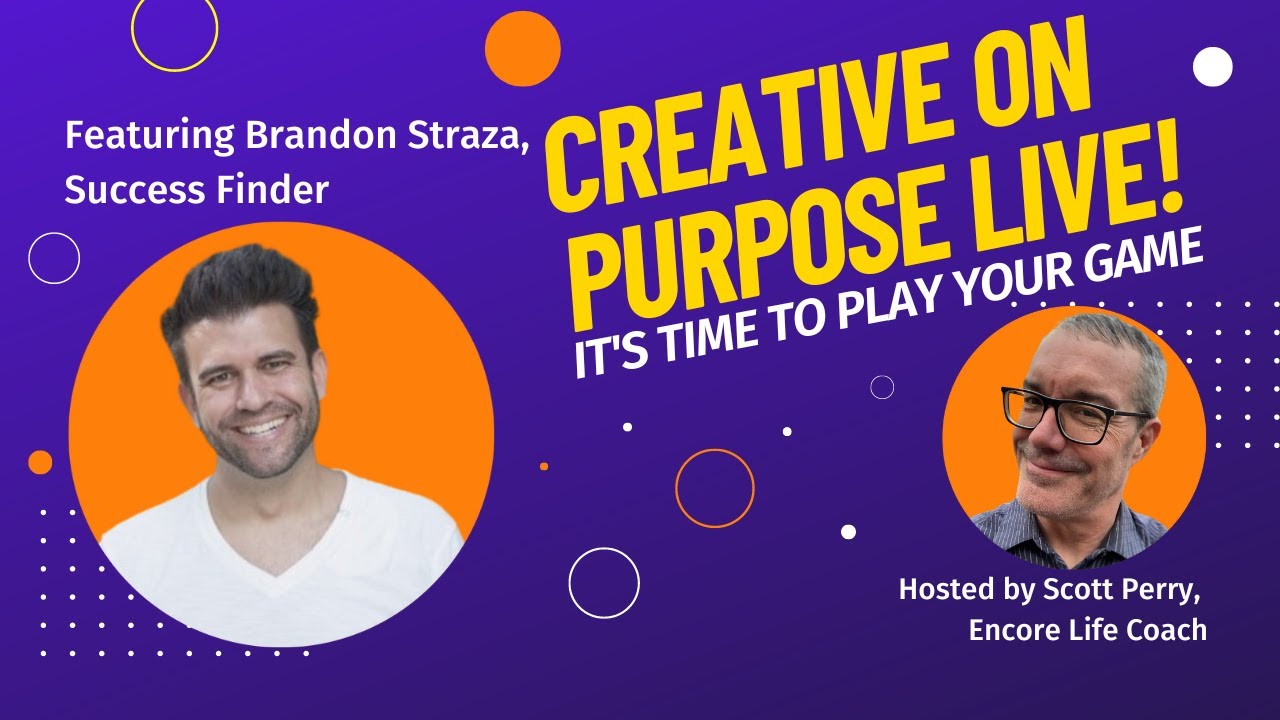
In this Creative on Purpose interview, host Scott Perry talks with Brandon Strazza, founder of TheSuccessFinder.com, about his entrepreneurial background, the origin and intentional design of the Success Finder platform, and his philosophy on work, authenticity, and community building. Strazza recounts early entrepreneurial experiences, the influence of his family’s business ups and downs, and how those shaped his DNA for solving problems. He explains why the platform uses the terms “leader” and “community” instead of generic labels, how it consolidates payment, courses, communication, and media into a distraction‑free, secure environment that serves both leaders and learners. The conversation moves to a critique of the guru‑centric model, emphasizing intimate, value‑driven leader‑learner relationships over large‑scale, resource‑heavy funnels. Strazza shares practical advice for aspiring difference‑makers: take time, find mentors and resonant communities, stay authentic, and view impact as a pebble‑in‑the‑pond that can become a mountain in the ocean. He also highlights the platform’s agile, feedback‑driven development process, where ideas from members of all ages shape features. The interview closes with a call to listeners to step into their power, integrate work and life, and use the Success Finder to make a meaningful difference.
Chapters
Forgot to remind you to fasten your seatbelt and put your tray in the upright position, but too late now because we are already there. Welcome to Creative on Purpose, a show about better living and making a bigger difference in the second half of life by developing and delivering the difference only you can make. I'm your host, Scott Perry, Encore Life Coach and author of The Art of Encore Living. Ready to play your game and live your legacy? Visit creativeonpurpose.com to get started now. Let's meet today's guest, Brandon Strazza. Welcome to the broadcast! Please tell our viewers who you are, what you're up to these days, and where can people go to learn more about you and the difference you're making?
Scott, thanks for having me on. My name is Brandon Strazza. I am the founder of TheSuccessFinder.com, The Success Finder. What am I up to these days? You know, a lot of it rolls around the world of family. My son, my wife, I don't want to exclude them because they are such an intricate part. I am a family person first and foremost, which you got to see just here a few minutes ago. Uh, what am I up to beyond family? I have been on a mission for over 4 years now, and we launched this last year, the Success Finder. I realized that the world of coaching, masterminds, self-education was such an ever-growing sector in our world, and such an amazing thing that I didn't have access to, didn't realize that I had access to until about 4 years ago. And when I saw that there was about, at the time, over a $50 billion a year industry, I'm like, wow, I was really fortunate and got lucky to get into the right mastermind, the right mastermind, the right community. But it made me realize how many people are not getting in the right mastermind? How many people are signing up for that guru? And so that's really what we built over at the Success Finder, was a place for leaders to communicate, educate, and monetize their community how they see fit. We wanted to create a safe haven so they were able to take all these different systems, these distracting systems, okay, from payment processing to courses to communication to video to audio and house it in one location. So not only was it a center of focus for the leaders, but also the results and a center of focus for the learners. And so that's what we've been up to, is building an amazing platform to help leaders and learners connect, work together, get what they need when they need it, when it matters most to them, and then move on with their day.
Yeah, well, as someone that is, uh, has been an active, uh, member of several communities inside Success Finder and now building my own, it's a Fantastic platform. Uh, really grateful to be one of the leaders in the platform and, uh, totally concur that it really does a great job of creating that distraction-free, pitch-free, spam-free, um, place where people can go to get what they need and then get on with making the difference only they can make. So, um, really grateful for, for you and for the work that you're putting into this. I know that it is largely a labor of love right now. Um, I'm guessing that little 9-year-old Brandon didn't wake up one day and say, "You know what I'm going to be when I grow up? I'm going to be a guy that builds a platform that helps leaders connect with the communities that they want to serve." So I'm just curious, and I may be wrong, maybe that was the exact thing that you woke up and said to yourself one day. But I'd love to hear a little bit about your background, the origin story. How did you come to be building Success Finder and doing this work and connecting with really amazing people, as both, you know, with the leaders and with members of their community. How did all that come to be?
Yeah. And it's actually not too far off. You know, the big difference was when I was 9 years old, the internet wasn't there, probably. And if it was, it was, you know, government or private facilities. So, but the entrepreneurial spirit was there. Did I know what the word entrepreneur meant? No, but I was raised around it. I was raised in a family that had their own companies, had their own businesses. Now here's the great thing about this, and some people would sit there and be like, uh, I saw the rise and fall of my family's finances. And when I say fall, I mean like bottom out. And I wouldn't be the person that I am today if I hadn't have seen the highest of highs and the lowest of lows of what that really meant, because it really shaped me to the individual. Why is it not too far off that I was thinking about platforms and technology and everything like that? Again, let's go back to the entrepreneurial thing. I started selling, uh, Kool-Aid sugar packets at— before I think I was like 7 or 8 years old. I would take the Kool-Aid packets, which was already sugar, and then I would take the sugar and I'd mix them in a baggie and I would go sell those for like a nickel until the parents kind of found out where that was coming from and I was sugaring up my buddies and my friends and the other kids in the neighborhood, and that stopped very quickly. Apparently it is not a good business plan if it goes against the authority, authority, um, figure in the household. But the entrepreneurial spirit was always there. I knew that I just wanted to work. I wanted to work. By working, I could solve problems. By solving problems, money would be the byproduct. The only reason to this day that I actually have a college education is because my mom literally continued. I, I have such amazing, loving, uh, parents, but my mom continued to push. She said, just get this piece of paper so you have something to fall back on. But all I wanted to do was work. So in college, at one point, I was working 3 jobs just because I'm like, this is what I wanted to do. Did I get the piece of paper? I did. I did follow through with that. Um, will I be as strict on that with, uh, my current 8-year-old Liam? No. If he wants to be a doctor, a nurse, an engineer, something in that realm, I'm going to be like, listen, I want you to go to college. But if he's looking to be in the business world, entrepreneurial world, or whatever that is, if he chooses to go, great. If he doesn't choose to go, he's going to have Dad, Dad's Rolodex. You know, let's see who you can learn from and you can work with them. You can get on-the-job experience. So it's definitely a different path in how I see things, but I had this. It was already in me. Uh, one of my dear friends, Dr. Jeff Spencer, who, um, you, you've heard, um, you know, many times, he says it's in our DNA. It's how do we extract that. If we're a champion, it's in our DNA. How do we extract that? So everything that is in me, it was not put in me by my parents. It wasn't put in me, you know, by something else. It was in my DNA to be an entrepreneur, to help solve problems. I could choose to take the path of a champion, or I could choose to take the path of the human mindset. I fortunately continue to have people around me. That's, that's, that's why I am where I'm at. Let's, let's not kid yourself. That's one of the reasons the Success Finder exists. It is the people around you. They can make more things happen by having that center of influence around you. It's not me. I'm taking ideas. I'm rearranging them like a Rubik's Cube, just like I did when I was a kid. To create what I have done to this day. I'm just taking other people's ideas and making them more efficient.
I love that. There's so many things to highlight. One, one of the last things you said reminds me of, you know, there's that old Jim Rohn quote that we're the, we're the product of the 5 people we spend the most time with. Lukas Rosheške, who is a mutual friend of ours, has talked about how actually, we're not just a product of the people that are in our immediate sphere of influence, but those that it ripples out to the secondary and tertiary connections as well. So it really matters who you are spending time with. And that's one of the features of Success Finder is you get to really, you are in control of who you spend time with. And in terms of leadership, Dr. Jeff Spencer, Laura Portier, Nick Peterson, yourself, Jeff Moore. You know, there are just so many people that you can put yourself next to that are going to help you develop your potential and deliver on your promise to make the difference that you're seeking to make in the world. So I love that. I also love your, your early reference to this idea, you know, that failure is in the eye of the beholder, right? So we can fail at things and use that to define who we are, or we can fail at things and use them as learning opportunities. And, you know, what I heard in your story was, yeah, I did this thing and it didn't work out the way I expected it to, but it just gave me some information that I could use to go into the next thing. But the thing that really resonated with what you were saying is this idea that I've been playing with a lot lately, which is, you know, all living things work. We all exchange energy. Plants do, do, you know, transfer solar energy and nutrients in the soil and water to create buds and fruit and branches and so forth. But humans are unique in that we build identity and forge meaning in our lives through the work that we do. And I'm hearing that in what you're saying, that, you know, who you are is very much informed by what you do. And so I don't know if you want to lean into that edge a little bit more, but it really speaks to me because so often I hear people saying, "That's just what I do. It's not who I am." And I'm like, "Well, if it's not who you are, why are you doing it?" So I'd love to hear your thoughts on that.
And I believe I understand what you're saying. But why am I doing what I'm doing if it's not who I am? It doesn't mean it defines me, but part of me is in everything that I build. Every relationship that I have been fortunate to say yes to, every relationship I have been fortunate to say no to, every piece of us is in something. Now, why else are we doing it? You know, who are you as an individual? It, it goes into it. Like, you look at the sincerity, the honesty, the, the, the blood, the sweat, the tears you are putting it into your product, you are putting it into your solution, whatever that is. So I believe that every bit of you is a part of what someone else is seeing, whether it's your business, your conversation, your relationships, whatever it is. If not, then you're, you're telling me that who you are is not— I'm trying to think of like the words. It's like, well, this is who I am over here in the business world, but over here I'm this person. How? So you're not the real person here. You're not the real person here. You're not the real person in either one. So I believe who you are is inside of the work that you do.
Yeah, for sure. Well, the way I frame it is, you know, I come at it through the thing that you hear so often, especially like on LinkedIn, you know, this idea of work-life balance. And I have yet to meet a person that's achieved work-life balance. And it— so it becomes like this delusion that's just really an invitation to shame and suffering if you seek work-life integration, if you can be who you are everywhere you go, whether it's in your personal life or in your professional life, then to your point, then work is a part of who you are. And work is a way that reflects who you are. What you do reflects, you know, who you are. You know, we're not all— we're not just one singular thing. And one of the things that I love about the Success Finder communities that I'm a part of, and one thing that I, and something I try to incorporate in my communities is let's bring our whole selves into the conversation, because it's only through that integrated approach that we're going to get not just the success that we want, however we decide to define that, but the joy, the equanimity, the ability to bring play and have some fun while we're doing what we're doing. So I really, really appreciate that framing. One of the things that struck me when I first got into Success Finder, and you referenced gurus earlier. So right now, a lot of people like me, and I'll just raise my hand and say, completely guilty. I spent a lot of my time building my business following the gurus and the influencers and trying to do what the gurus and influencers were doing or telling me to do, or, you know, purchasing programs. It took me a long time to understand that, um, gurus and influencers have a lot of things that I don't have. They have staff, they have much larger financial resources, they have, you know, experts that are helping them with copy, helping them with design, helping them build pages and all these things. Um, trying to emulate an influencer guru is again another kind of invitation to embrace suffering and pain. But leaders, you know, like those on the platform, they're not the kind of people— at least it strikes me— that have these huge teams and are— although many of them are very financially successful, they're not just throwing money at trying to build a huge list, construct a funnel. They're actually doing meaningful work with and for people they actually care about and leveraging their experience, their knowledge, their expertise. So I just, I didn't know if there was like any backstory behind how you chose the words that you're using in terms of leaders and communities, because it seems to be very intentional and it certainly resonates with a lot of us in the platform.
Every word, every piece, everything that you see on there was intentional. It is, it is breath. It is as it was spoken. And there was a reason why the word leader was chosen, why we went with communities over groups. So everything had something behind it. It wasn't just like, oh, wake up one day and let's just call it, call it a leader. We looked into it. So it was intentional. And I want to go back to something that you, you mentioned, if you don't mind, when it comes to the gurus and the teams and the money and the resources. You would be really surprised when you get behind the curtain. There's like the curtain and what everyone sees out front, there's behind the curtain, and then there's like the green room, okay, where all the— everyone's sitting back there and they're all the, the, the bumps, the bruises, the, you know, have everything that's happened along the way. And you'd— I, I believe most people would be very surprised on the names and the individuals that we think have big teams, and maybe they do, but they're playing on full tilt, meaning that they're one month away from not being able to, you know, take care of their financial obligations. So what we see, you know, the fake it till we make it— and you're seeing this a lot right now in the, um, the, the technology world, uh, whether it's Web3, whether it's technology, whether it's, uh, you know, these, these fintech companies that they're able to have these balance sheets constantly losing money and people are just throwing more money at, you know, a losing project. That is changing. And I do believe that that will bleed into and that will continue to change also in the guru coaching and leadership space, that this, this, uh, persona, this perception that we have is, is going to slowly crumble. And, and, uh, it, it, that, that's sad because some people are going to be hurt by that, and they're going to have held these people up on this very high pedestal, and, and when that comes down, they'll be crushed. But here's what I can tell you: every individual, every choice that you make out there, you can make a different choice. And if you go back in time and you sit there and we play— I think it's called Poor Man's Mentality You know, I call it like inflicting pain on yourself. Well, if I would have done— if I had just taken this path right here, if I had just gone with this leader, if I had just gone with this community, if I had just read this Knowledge Center piece, guess what? You did the best that you could do with the information that you had at the time. It's okay, because if we learn from the experience and we realize when the opportunity presents itself the next go around and we use the, the most recent information that has been given to us, us make a new choice. And that's how we designed the platform to get the person. We looked at, we looked at a couple different things. We looked at McDonald's and how they, uh, how they did their delivery system of their food. I forget it was— I forget what it was called way back in the day. And we looked at Disney World, and Disney World has controlled chaos. It looks like it's chaos, but it's controlled. They want these families to go this way, this to go this way. And so when we built the platform, it's like We want the members to come in and go through this path. Now, if they're being invited in, then it is going to be a different journey, and we also designed that path. But every platform was designed for the outcome that we get. And so every decision that you have made was designed for the outcome that it's going to get. Once new information comes along, great, take it and make a different decision. It doesn't mean that you made a poor decision last time, it just didn't work out. You can make a good decision and have a bad outcome and look like an idiot, or you can make a bad decision and have a good outcome and you look like a hero. So just take the information that you have at that moment and move forward. But yes, we were intentional with the word leader. We were intentional with the word community knowledge center. There was, there was, there was a reason behind all of it. And you're on our weekly calls. You get to see firsthand that we're like, listen, hey, I'm You know, the team's been up at 1:30 in the morning. We're a little fried right now. Here's some ideas that we have. Here's some language that we have. What do you guys think? So we actually, not only the leaders on our platform, but also the learners, so the members, they have been giving us feedback for the past 6 months. We had a 16-year-old that was in a community on the platform, and he went to the leader, the leader, or he went to the parent, and the parent went to the leader, and then they all came to us and said, hey, it'd be great if we could just tweak this just a little bit. I'm like, 'Ah, I like that.' We listen. We're agile, we're nimble. And why would we not want to listen to a 16-year-old? Why would we not want to listen to a 45-year-old leader? That's one of the things that we have, the magic that we're really capturing in this bottle at this moment, is the leader and the learner. Someone in your community— let me— I just thought about this— someone in your community had an idea, they shared it in your community, And I think we just implemented here just a few days ago.
Mm-hmm.
And so that's really the cool thing. It's not just me. Everything that you see there is a little bit of something else. If you sit there and say, hey, Brandon, why is the process flow for this? I'd be like, I might— if I don't exactly remember, I could go to a document and be like, oh, we got the idea from here and we implemented this and we just kind of like started connecting the dots. Everything on the platform is from somebody else. Or it's from something else that we have experienced and we've just arranged it to simplify it. That's the thing. Everyone's wanting to come up with this new amazing technology. This new innovation is not adoptable, not very quick. We're seeing that in several different domains right now, and I'm not going to go into that. But being innovative, it's not easy. And why recreate and simplify if some— if the Success Finder already existed? Okay, I would have just used that platform, but it didn't and it still doesn't. There are other platforms that have similarities, but how we do it, it doesn't exist. And so if it did, I just wouldn't have built it because let me tell you, the time, energy, effort, the resources, financial resources that have gone into it, it's not easy, you know, but this is the journey that we chose, myself and my partners chose to help solve a problem, to help the leader and the learner connect in a way that is intimate, that is secure. And I know someone's like, well, what do you mean secure? Tell me what platform you have been on that you haven't been spammed, hacked, spoofed, deepfaked. And we've removed those barriers. I haven't seen a platform that cares the way that we do about the leader and the learner and their experience. They come from it from the standpoint Okay, and that— there's nothing wrong with this. They just have to be upfront and honest with themselves. How do we make a buck? How do we sit there and actually— what is our— what is our— what is our financial model? And there are times when you have to go that route. Okay, my first company, I'm like, how am I going to make a dollar on this? I want to help solve a problem. I want to do something. This is like 15 years ago. I still have that company to this day, but as I was able to build a foundation How do I solve a problem? And anyone that I look to partner with, when they first came to me and they're like, all right, so what's the financial model? I thought about that and they looked at me like I was crazy. But you solve a problem, money becomes the byproduct. So you are able to have the intimacy, you can care about the learner, you can care about the leader and give them more. If you give and you lead with the give mentality, money will be the byproduct.
I so resonate with that. It's one of the things that I teach in one of my programs is that the things that we're normally chasing, fame and fortune, are actually byproducts of doing, doing work that's meaningful and fulfilling with intention, with integrity. If you pay attention to the process, the prosperity and the prestige will be naturally occurring side effects that you can they become renewing resources. You can continue to reinvest into what you're doing, and you can grow not just a viable business but a sustainable business that actually makes a difference. So that really, really resonates. And while you were talking, it reminded me a little bit of two other leaders on the platform that I think are worth mentioning. One is Dan Nicholson, who's been on the broadcast and has Scott Perry talked about something that you seem to be speaking to, which is as you are, you know, making these better choices, you know, what are the choices that you could— how do you make choices with the least amount of risk that require the least amount of effort that provides you with the most amount of optionality going forward? And I think you were referencing Jay's community, Base Case and Build, which is a program for young people. And that's another thing I love about the program. I was fortunate enough to present to Jay, to Base Case and BUILD, around my decision-making 3-step approach. And, you know, we have on that platform, it is one of the most diverse and inclusive audiences that I've ever seen. You know, there were, I don't remember what the youngest child was in the room, but it might have been 8 or 9 years old.
8 years old would have been the youngest. Yeah.
Yeah. And of course, you know, we've— I've been on calls that have people that are even older than I am, which is hard to believe. But it's really wonderful, you know, from all, you know, all persuasions, all types of ethnic groups and so forth. So it's just, I think it's that idea, you know, what I'm hearing what you're saying is the degree of intention and integrity that you've built to building and growing and developing and improving. And it has attracted people that operate with, you know, from that kind of same purpose-driven, values-driven place. And it's just really profound to hear how, you know, the way you approach the business actually begets the kind of people that you're attracting to be both the leaders and both members of the community. So As we're kind of winding up our conversation here, I would love to, you know, what the last question is always, you know, there are people tuning into this broadcast now and in replay that are aspiring or advancing difference makers. They want to create the impact that only they can make. And if you had just, and I have something in mind that I'm hoping you're going to say, but I'm open to—
Why don't you just say it?
I'll say it if you don't say it. But that, you know, if you had one piece of advice or one tip or, you know, one principle or practice that would help someone that's watching gain a little bit more clarity and earn a little bit more confidence to step into their power and potential to make a difference doing work that matters to them with people they care about, what would you share with them?
Yeah, well, now you're actually making me think about an answer as opposed to it coming organically. I'm like, what does he want me to say? So I'm just gonna say, uh, what comes to mind. Take your time. Take a step back. Take your time. It's not a race. This is not a race. Time will start and end when it's going to start and end. Find the right mentor, find the right leader, find, find the community that resonates with you, that you can bring value to, and start seeing how they're doing it. Start absorbing every little piece along the way. And as that's happening, don't try to be them. There's only one of you in all of existence. Don't try to be authentic. Don't try to be someone else. Just be who you are. And when you come from yourself— I always say the, you know, your authentic self— when you just come from who you are— we spoke about this earlier— your work life, your business life, your personal life, it's all you. It is your breath. Come from that place. Don't sit and expect that these results are going to happen. You have to have consistency along the way. You have to keep doing it over and over again and slowly tweaking it. A friend of mine, dear friend of mine, Steve Sims, says go from like good to great, or go from, you know, bad to good to great, whatever it is. And it's not— when you look back at your original work, it's, it's gonna not look what it is today, you know, 12 months later. Take your time. Find the right mentors. Find the right communities that resonate with you. Get involved with them. There— that's the great thing in the Success Finder. There are free areas, free communities that you can come into. Yes, there are paid areas, but come get in there, find that community that you can actually bring value to, they can bring value back to you, and move forward. Start putting your message out there on a consistent basis. Now, I don't know if that is what you wanted to hear, but I can only say like how I would see it. Now, once you tell me what the answer is that you were looking for, because I have— I, I almost have to guess that it isn't. I'll be like, oh yeah, that's better, do what he said.
No, no, actually, you're, you're— so this idea of take your time and be yourself, I think is absolutely brilliant. And so I'm glad I didn't feed you a line. But the— what was the line?
You got to tell me now. We're live. We still have like—
and I can't remember. Part of the reason I was hoping you'd say it is because I can't remember exactly. But you closed a call that we were on a few weeks ago with this metaphor of— is it the pebble in the pond or the ripple?
It is. The person that said this must be just like, you know, brilliant. Must be just amazing. Now, actually, I'm kidding about that person because I think I came up with the saying. Or it was implanted in me. The pebble in the pond becomes the mountain in the ocean, and right now you're a pebble. And here's the thing, even when the mountain goes into the ocean, you're still going to have different branches of yourself becoming the pebble in the pond. So just remember that the pebble in the pond becomes the mountain in the ocean, and that is you. And I am speaking to the person that is meant to hear this right now. So if this resonates with you, whomever you are, I'm speaking directly with you, not at you, not through you. I'm speaking with you in this, and you can make a difference.
Absolutely brilliant. All right, well, we got a two-for-one with Brandon, and I appreciate that. I want to thank everyone for tuning in. Brandon and I really appreciate your time and attention. We hope that today's broadcast motivates you to take a bolder step into possibility and to keep go-go going with the Finding, developing, and delivering the difference only you can make. You can visit creativeonpurpose.com to get started. And if you're watching on social media or YouTube, please leave a comment, share a question, or tell us your biggest takeaway from this composite conversation. If you're listening as a podcast, please leave a 5-star review. It helps more of the right people collide with these conversations. Now, take the insight and inspiration from today's show and play your game All in and full out. Brandon Strazza, thank you so much for lending us some of your time and expertise today.
All right, big love everyone.
More from Scott



Stoics Don't Suppress Emotions, They Do This Instead #stoicism #emotionalintelligence #mindset







