Catalyst Coaching Over the Shoulder Learning Session (8/15)
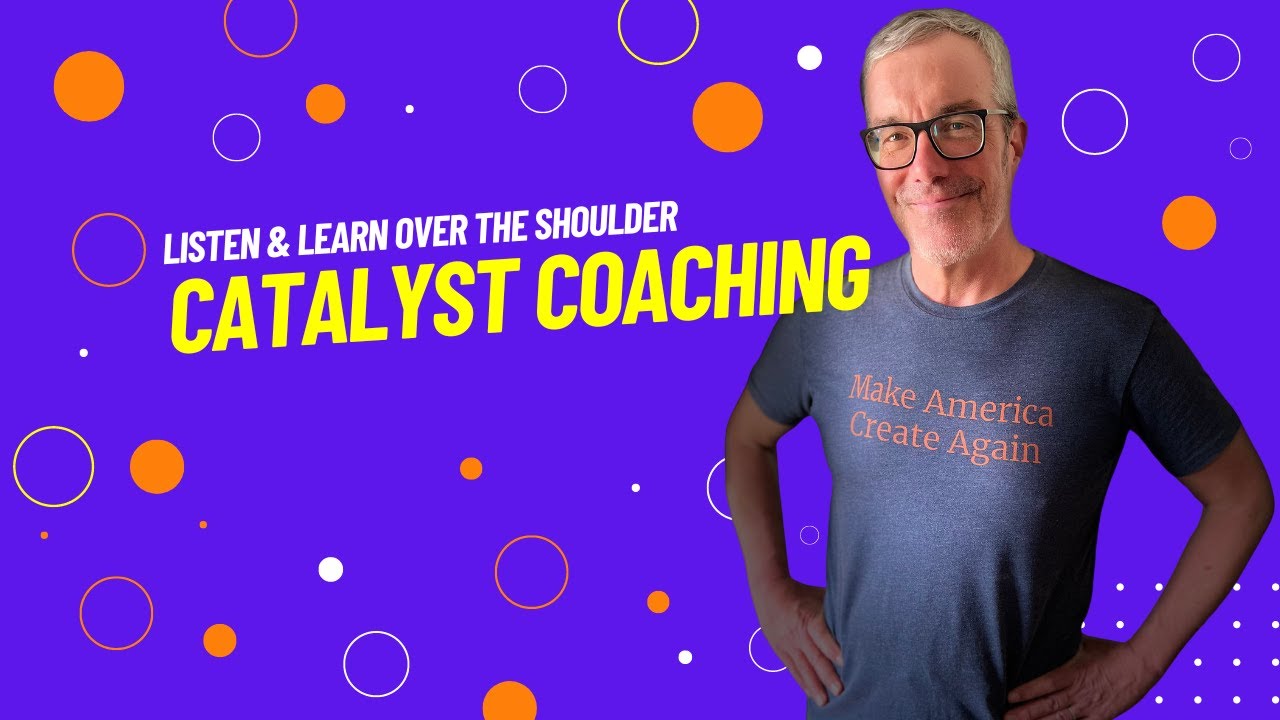
Scott Perry leads a group coaching call for Catalyst Club members including Kato, Kim, Jackie, and Penny. They discuss creative entrepreneurship, audience-building on Substack, and using frameworks like StoryBrand to turn ideas into offers through small experiments and 90-day sprints.
Chapters
Okay, so welcome to the Catalyst Coaching Call special session. Just to set the table a little bit, these calls are normally sessions where all paid subscribers, people that are known here at the Creative on Purpose subsect as the Catalyst Club, meaning that you're subscribed under a monthly, annual, or founder plan, are sitting in attendance as I provide one-on-one coaching to my one-on-one clients. Or members of the Arena Catalyst program. And today we are having a special bonus session where we are inviting those that normally are sitting in the stands watching to actually have a session, a one-on-one coaching session. So for those of you that are paid subscribers, members of the Catalyst Club community, you are invited to have a hot seat session And then for those of you that are normally not allowed in, the free subscribers, you're, you are welcome to learn over the shoulder and to learn as we provide coaching to people that are in the hot seat. So there is a specific format that we use and that format is if you want to— I don't need a ton of context. For those of you that are in the community, I know enough about what you're trying, you know, what your business is or what you're optimizing for to get, to have some idea. I'll ask for additional context if I need it. So you don't need to give a ton of context. What you want to do is simply say, this is the resource that I'm using. And by resource, I mean a blog post of mine, a workshop that we've had, you know, as a member of the subscriber community. If you want to reference something from the Guardian Academy or Man Bites Dog or any of the other things that are associated with, um, uh, the Guardian Academy publication, you may cite that as well because I'm deeply embedded in all those programs. Um, but don't cite a resource from outside of this ecosystem. In other words, if you're like using ClickFunnels and that's the resource that you want help with. I can't help you with that because I don't really know a lot about— enough about ClickFunnels to be helpful. In fact, if I were to try to be helpful, I'd probably be harmful or dangerous. So what's the resource that you're using? What did you do with that resource, with that learning, with that knowledge? How did you engage the field? And then what happened? What was the outcome of that engagement? And then if you have a challenge or a question that you would like my help with, you just simply say what that is. If you want to provide an experience just as a share, that is like if you just want to celebrate a win or share something that might be beneficial to other people, you can also do that. So you don't have to have a big problem. You don't have to have a big question. Just sharing is good enough. If that is clear enough, then what I want to do is open up to Jackie, Kato, or Kim first, if you want to volunteer for a hot seat. And then Penny is one of the Arena Catalyst members. So she's Uh, she's had a session yesterday during our usual Wednesday call. Um, and if there's time, Penny, I'm happy to, um, give you, uh, an extra session this week as well. Is that clear enough for everyone? Everybody got the, the, the, the boundaries, guardrails, uh, rules of engagement more or less understood? Fantastic. So with that, Who'd like to go? Pam, I know you want to go. Kim's ignoring me.
We don't have a microphone.
If you're not ready, Kim, that's fine. You can hold off. Kim, Jackie. I'm sorry, Kim. Kato, Jackie. Anything to kick us off?
We see how I was trying to hold back though there, Scott.
I so applaud your sitting in silence and holding the tension and giving everyone the— now, but now you're giving everyone the gift of going second or third.
Well, yeah, well, and I'm just like gonna blunder in because I was just curious what happens at these things. Um, but so what's going on is I'm working toward learning how to make picture books, taking what I know as a storyteller from playwriting and theatricality, applying that. We've talked about that before. Um, right now part of what I'm energizing myself toward is really starting to figure out my style as an illustrator because I did accelerate my storytelling skills to be able to write in this particular form, which is one of the most difficult forms I've ever tried to get into. And now I'm practicing in that and getting— so that's in the churn. And I, so I signed up for a different group people with, uh, in the UK, based in the UK for illustration, and they're illustrator-driven, uh, as far as they also use just visual techniques to create their stories, which I am astounded by. I didn't realize— I think in America we probably just have a different system of how we sit down and train people around story first and how those things were lining up. Even with the illustrator-focused thing I did with the US people, or, well, people from all over the world took it But this one is originated by, and it's also women. The other one was all like dudes that ran it. I was like, well, what'll happen? What'll it be like? And so I'm in this world and it is so supportive and fun in this. Like, they're goofy. So anyway, so it is giving me all kinds of confidence and new ways of looking at creating art. I'm very excited about what I'm drawing. And it's helping me to gain this kind of the confidence to move into the current way of drawing and systems and exploring all sorts of things and different styles. So this other piece that came in, because you also know that I've been keeping this group together with the WolfCryers Club and we are creating— we have the newsletter and we know in a year to 2 years we will all need audiences. And so we're creating one collectively. And I started realizing that right now we're learning— and you see this on Substack all the time because we went with Substack where people are teaching each other how to be on Substack. A lot of times that's a lot of the content. Or when they are writers or artists, they are mostly talking to other writers and artists. And that's what we are doing right now. But I realized because there's been this one other person in our Wolf Cryer group who keeps saying, yeah, but how are we going to find the grandmothers and the parents? So I started doing a little research, like how old are people having these children, how many children do they tend to have who are buying books, and what books did they read. So I'm looking up what was happening 25 years ago because I think that that will be things that they will resonate with, not to be derivative or copy, but simply to be informed as I am making work and also helping to lead this group through. Because I am imagining there might be a shift in the future that we could land on where we're something more like, you know, the Next New Idea Club, which which I just found out about, that, uh, what are they? They send you books. But I didn't know about it, or I'd kind of heard about it, but I looked it up and looked it up and I thought, oh, as a model, not as the thing. Perhaps that could be something to land toward around later when, when we might want to have an engine that helps these young parents. And then we have like a box of books that we'll send as a gift from your grandma or whatever. Who knows what it might be? It might be all these things, it might be none of them. It doesn't really matter what that where my landing spot is exactly, but I did think we could be purposeful in starting to at least consider it because right now nobody in the space is doing that that I have encountered beyond people that are trying to do the bargain books, but that's not what we're going to be talking about. We're going to be talking about artists and book relations, like how do we change the relationship between the people who read the books either to their kids or sometimes with their kids or however that goes. How do we change the relationship of us with that thing, which, because there's so many things in between. And I was like, well, if we start being purposeful in this early part where we're setting the stage and learning how to converse, and right now is artist to artist conversations, but we could perhaps map out a direction in this other way that nobody else is going toward. Publishers do, but the artist talking to that endpoint doesn't happen that much. But I think the technology might create a space where that could, if we decided to explore it. And of course, if it doesn't work, then it doesn't work. And then we just have these other places where we're going. Anyway, that was like what's in my thing, because I'm trying to be a good leader. And yet I have a machete and I have a couple ideas and some compasses and models and things. But it's mostly my force of personality. Brings us through and just go, let's try it. And if that way doesn't work, we go this other way. Anyway, so that was a lot of me saying the thing, but it did occur to me that there are these places we haven't considered that could exist that don't exist yet, and we would be building it. Yeah.
So even though you didn't articulate a specific resource or question, I'll I'll reflect all of that.
Well, I thought like the classes, and right now I've been in a very learning phase of—
I'm not going to address the class because I'm not in the class. I don't know the class, but—
Oh, okay. No, I get what you mean. Sorry. Yeah.
So no, no, that's fine. This is great. So, but I would say, so what I'm hearing, Kato, is that real— and this is, you know, one of the— you know, I love you and I love your project. I just— and for those that didn't see on Facebook, Kato had drawn some pictures based on my grandson Jasper, and she shared them with me on my birthday, and I shared them with her parents, his parents, and they were just delighted. They're really good. Um, and you know what I see, just to give you a reflection, Kate, on, on what I'm seeing in the way that you're approaching things, is it's like just a beautiful demonstration of engage the field. Like, the, these ideas that we often are in— that are encultured into us is, you know, around purpose. Like, what's my priority? What am I— what am I trying to achieve? What am I optimizing for? We have this idea that's kind of instilled in us through institutionalized education, occupation, maybe our parents is, you know, well, number one, we very rarely talk about purpose or any of those things. If we do, we talk about it like it's this destination, like you have to find your purpose, or we talk about it as this thing within us that we have to somehow discover, excavate, and, and employ. And what I have found is that purpose actually is an emergent quality, and it emerges from engaging the field purposefully. And so I love this idea that Cato is talking about. Like, Cato just had this idea, like, I think I want to write an illustrated children's book, so I'm going to learn how to tell that kind of story. I'm going to hone my illustration skills. I'm going to gather a bunch of fellow travelers on Substack and start conversations and support each other's work. So that's— and, and what happens is clarity and confidence emerge. Greater clarity about what you're aiming for, to speak to what you're saying, Kato, is already happening. Like, now I— now you have this idea, like, oh, maybe we'll do this thing. Like, you don't cling to— like, it's not like, oh, there's the the purpose and the destination. I'm gonna cling to that idea, I'm gonna put the blinders on, and then I'm gonna grit and grind my way through there. It's like, no, I'm gonna— there's this thing that's worth exploring, I'm gonna hold it loosely, I'm gonna test my assertions, I'm gonna try some things. And so it's this idea of purposefully micro-stepping your way towards something, holding it loosely enough to be so that you can change your mind. This is one of my other principles, like life comes with the reserve clause. You should always feel— you should always put yourself in a position to be able to change your mind. Because when we choose a goal or an objective or a purpose or priority or any of those things, we're making that decision without any idea of all the opportunities or obstacles that may lay ahead. And as those obstacles and opportunities arise, and just to, you know, give away the punchline, the obstacle is often a thinly disguised opportunity. We need to be able to adjust. We need to be able to tact and course correct. And what generally ends up happening is people end up ex— exactly where they need to be, even though it's not exactly where they imagined at the beginning. But you're, you end up somewhere really great. So I don't really, you know, since there wasn't, um, necessarily a question in there, um, I'm just reflecting, you know, some of the things that I saw. But I, there's one more thing that you said that I think is really worth highlighting because it's wise and true and it speaks to the resource of the Substack success training that we did. Substack is a wonderful place. We are all here because of the Creative On Purpose Substack. You know that the Substack is the center of my web, my marketing web. See, I didn't say spiderweb, Cato. Now I'm just saying web. And, and like any other new space, once it kind of— once the concept is validated, then the coaches coaching coaches about coaching come in, and the marketers marketing to marketers about marketing come in, and the Substackers substacking about Substacking come in.
Right?
Because, and, and, and they create, right? They're monetizing some sort of offer. They're pitching some sort of, you know, whether it's overtly or covertly or whatever. Um, and, and that's fine, right? Play your game. And it, but the other, the reason why I think that insight, that reflection is so insightful, Cato, is that when, you know, and I, I'm— I don't mean— I, I am not trying to pass judgment here. This is, this is— if you're a Substacker substacking on Substack about substacking so that you can make a living, that's fine. And As someone that has been a coach that coaches coaches about coaching and a marketer that markets to marketers about marketing, I, you know, I get it. It is a viable business model. And what I have learned, having also been on the receiving end of those kind of, um, offers, is that what worked for someone else in the past is probably not going to work for you now. All the Substackers that are substacking about, uh, Substack to Substackers are sharing tactics and tools and strategies that worked for them in the distant or not so distant past, which is fine. However, what we know is that as more and more people start trying to execute the same strategy, the strategy becomes less and less effective. And it's also important to remember that a map, which is what's being offered by people that are with, with these kind of offers, a map can only take you where other people are going or have gone or want you to go. If the only way for you to get where you need to go or where you want to go, and by leveraging your weirdness, uniqueness, your bespoke collection of experiences, talents, and perspective, is to use a compass. And that's precisely, you know, what, what I'm seeing you do, Cato. And so You know, since there's no question, I don't have any, any specific advice or reflections to share, you know, about things you can try other than to say I would encourage you to just keep doing what you're doing because it's obviously working. And since you don't have the urgency or need for an agenda or a very specific outcome at this point, Um, you know, you're in a great position because it will— your purpose and, and your endeavor will just continue to emerge, become more clear, and you will begin to collapse time because of that clarity, because of the confidence, and because, uh, you know, because your purpose— you're, you're purposefully navigating your cottywample towards your as-of-yet specific destination. So bravo. All right, that was a good one. Now, all I'm going to ask is that if we can try to stay on point with the format— here's the resource I'm using, here's what I did, here's what happened, here's my question or my share— that would be great. But again, we're being loose here because all of you that are engaging in this format right now are, are new to the format. So I totally get it. So with that, Kim, Jackie, either one of you ready to raise your hand and give it a try?
Well, Scott Perry, if I'd realized that one of the requirements was to utilize some of the tools that you've been so generously putting forward, I suppose I would have dived into them earlier in the week. But I have not done so. Full disclosure.
I give you permission to speak freely, Kim. Let's see what happens. Let's see what happens.
Okay.
Well, one of the things that is going on for me is that my 25-year-old daughter, who is, of course, an expert now, given her degree in marketing and all things branding, has decided to help out her mom, and she has given me assignments. And the assigned text that I am working with is called Building a Story Brand by Donald Miller.
Yeah.
Okay. I'm glad you're familiar with this, Scott Perry. So My, one of my patterns in learning something new, in starting in any sort of endeavor really, is that I'm really good out of the gate. You know, I'm, I dig my teeth in, I do some research, I do some homework, I come up with some stuff. And that first week out of the gate, I'm roses. So I encountered in this building a StoryBrand. His whole notion of story is built on the elements of story that we're all pretty much familiar with. The first primary being the hero, and the hero of a brand story is your customer. And so I created several very short stories about the customers that I work with. I'm also in the midst of completely redoing, with my daughter's insisted guidance, my, my website. And so my question to her, once I came up with these of course, brilliant, um, customer stories, is where we should lodge these on the website. And it's, to my daughter's credit, her answer was, let's hold off on that for right now until we get through the first part of the book. So I'm like, I'm seeing my child as a really good and patient teacher and guide. And I'm seeing myself as good out of the gate, and then I get distracted and everything falls to the side. So part of this is just simple sharing. I don't really have a question except that I think it's going to be interesting dance for both of us to adapt to each other's rhythms in this journey and also to incorporate some of the very valuable resources that you have been sending me pretty much every day, feeling a little bit overwhelmed. So that's, that's my sharing for today.
Okay, beautiful. Um, so I'm going to take the last part first, and then I've, I've got a couple things a couple of additional reflections. So many of us in this room have experienced Seth Godin's Akimbo workshops or Alt MBA or other things. And we have— we are familiar with the firehose to the face, right? The idea like a lot of insight, a lot of information, a lot of innovation kind of coming at us all at once.. And it can very easily lead to the kind of overwhelm that makes us just, you know, turn away or run away or become inert. One of the strategies that I learned, you know, so I was in one of the very earliest cohorts of the Alt MBA, and the first thing Seth does is he sends you like a box of books and, um, a list of like 100 resource— online resources. Like, this is all— there's no instructions, but it's kind of like, here's everything you should read before we get started, and we're starting in 5 days. And when that happened, I was like, okay, because I actually took— knowing that I was in for a month of spending a lot of time away from my family. I took my family on a vacation the week before Alta MBA. So I, I'm, I go to vacation with a box of books and a list of 100 resources. And I said, well, I'm not going to, you know, I'm actually on vacation. I will read one book while I'm on vacation and maybe I'll check out a couple of, of resources. And that's, that's what I did. So, and of course, I felt like I was coming in behind and, you know, lots of high-performing people, you know, read everything and had notes and had mind maps and had, you know, whatever. I share that story in part because number one, I didn't need any of that stuff. To benefit from the Alt MBA. The books all had great information. The resources had fresh insights and information. We are all, all born sufficient and whole and lacking of nothing to be able to achieve our life's purpose, heed our soul's true calling, or whatever, right? We, we have the, the ability We are inherently social creatures that know how to find our fellow travelers and our teachers. We have the capacity for reason and rationality. Doesn't mean we act rationally or behave reasonably most of the time, but we have the capacity to, you know, to think and to reason. And we are inherently creative creatures that understand that anything meaningful we ever do in life It's through engaging the field. It's how you learn to walk, talk, read, write, ride a bike, make a peanut butter jelly sandwich, and everything else that you've ever done. It's happened. You learn by doing. So I, like Seth and many others, Kim, share generously of the insight, information, and innovation I have collected over the years. And my advice to anybody is take what you need and leave the rest. And because the best, the best thing that you could do is take one insight from one article or anything else and do something with it, because that's going to, that's going to actually provide actual learning that might actually change your behavior, that might actually change your mindset, that might actually lead to some greater clarity and confidence in your endeavor. So, um, yes, I have a lot of information and insight that I'm sharing with the community, and I'm sharing insight and information from the people that I follow and respect. And there's, you know, and we all have access to a ton of other stuff, including Donald, uh, uh, I'm sorry, Donald— what's his last name? Miller. Donald Miller. I, I have read his— I, I read his book Blue Lake Jazz, which I personally would not recommend, is a great read. Um, and, um, and, and that's just my opinion.
He—
it was a best-selling book, so lots of people got something from that book. Um, I bought it because it had blue and jazz in the title, and it didn't have a lot of either, in my, in my opinion. Um, yeah, and And I am a little bit familiar with his approach. I know it's based kind of on the hero's journey, and, and I have worked, um, with, with story, you know, marketers who believe in the power of story. And, and so I get it. Here's the thing about Donald Miller's approach Russell Branson's approach, any guru influencer, any digital marketer with some sort of formula, blueprint, roadmap, mastermind, whatever. What is on offer with any of these things is either a tool, a tactic, or a strategy. Which is fine. The problem is if we start with tools and tactics and like, if you start with a tool like StoryBrand, it's a hammer and now everything looks like a nail, right?
Yeah.
Right. And a tactic is never a cure-all panacea or silver bullet. To, it's, it's often delivered as that, like, not succeeding in business? Try StoryBrand. It'll solve all your problems in 90 days.
Yeah. Right.
I would encourage you to invert philosophically. What do you actually believe? What is, what is your assertion? What is the, the, what is the thing that you are trying to prove or trying to disprove so that you can come up with a better assertion? Yeah, if, if, uh, and I'm just going to take your website as an ex— like, a website is also a tool.
Yeah.
I made my first 10 sales without a website. I made my first 10 sales off a Google Doc and a PayPal link. And everything I did after that just created a very bloated system that started to perform less and less effectively and efficiently, because system reliability says that the more components your system has, the less effective and efficient it is. What you need to do when you start from philosophy is then define the principles. Principles are the things that you know to be true. They are falsifiable, but to date they have not been falsified. And so from a first principle reasoning, first principle thinking perspective, What are the 3 things that need to be true in order for my philosophy, my belief to be realized? So I'll just share a quick run-through of my experience with this, because I, I've done it just the way that you're doing it or thinking about doing it or, or starting, and what your daughter is, is encouraging you, right? Like Okay, we're gonna, we, we're gonna start with the tools and then the tactics and then the strategy, and that will get us whatever we want. And that's the way we're wired. Like, okay, more tools, more tactics, that's the solution. But more never gets us closer. And so if you invert it, and the example I always use is, is, you know, creating a business where I work 2 hours a day and make more than enough money every month to sustain myself and my lifestyle, which is all— as you all heard at the very beginning of the, the session, it's built around my grandson's nap schedule. It's built around my ability to take care of my grandson 9 hours a day instead of working on a business 9 hours a day. My belief was that I could build a business where I only had to work 10 hours a week. To make a good living and fund and fuel the lifestyle that I wanted. That was my belief. From a principle point of view, I knew all I needed to do was to craft an irresistible offer for an engaged audience or an eager audience and deliver it, deliver that offer to that audience with a sales success strategy that didn't require me to become a full-time digital marketer. When I say irresistible offer, engaged, eager audience, what I'm saying is irresistible enough, eager enough, because it's a process. Once I dialed those two things in well enough, my my— what my belief became was that I don't need to be everywhere all at once on social media or be a full-time content creator for YouTube or my blog or for my podcast. That if I leveraged conversations, that was going to be the fastest way for me to put my offer in front of enough of the right people to get enough of them to sign up for my offers. And provide sustainability. So I came— my, my 2-hour-a-day strategy is creating. And right now, because I've been at this for so long, I have so much content, all I'm really doing is repurposing content. So I'm actually not creating anything new whole cloth, but I am sharing to my Substack 3 times a week. From Substack, I can share that social media, I can share it to YouTube, I can put it on my podcast broadcast if I want to. Um, but the content is designed to get people to come become members of the community conversations, the monthly calls, the paid subscriber weekly calls. And through those conversations, I earn the permission and trust to have a more direct conversation that piques the interest of the people that I want to serve. And, um, using all the things that I've taught in, um, Be a Blessing Marketing and Get Clients Now, I'm using these very simple tactical, strategic and tactical approaches to simply earn, earn goodwill, be a blessing, do, and, and make my whole marketing plan, my whole sales strategy, show up, do my work out loud and in public with people that I care about, and let that great work be my marketing, be my sales engine. And that has enabled me to develop a business that fuels and funds my lifestyle on my terms without compromise. And so, and I, you know, I, it's, you're this, the part of the, your story where, you know, you're sharing that your daughter's help. I mean, that's all what I like. I would kill for one of my kids to like come to me and say, hey, Dad, will you teach me how to play the guitar or whatever? But, um, you know, so that's, that's wonderful. But, um, you know, take what you need and leave the rest, right? So define what your priority is, define the plan as best you can that will get you there, prove viability, sustainability, and then define— decide what you're optimizing for, right? So in that story I told, right away I learned I— my priority is to fuel and fund my lifestyle, taking care of my grandson. I am optimizing for conversations because my assertion is that's the fastest path to cash for me, and it will do it in the least amount of time with the least amount of effort and help me collapse time to target as effectively as possible. Now it worked out a lot of— and but, you know, there, what I left out was all the things that I also tried that didn't work, because I— that, that path did go through Facebook ads and other tactical tool-oriented things that did not— that, I'm sorry, that did work, but it didn't work in a way that completely aligned with who I am, what I'm good at, and where I really belong. So it created dissonance that actually impeded my progress. But it's always a process of elimination. It's always a process. It's, you know, this whole thing about system reliability is it's a subtraction problem. It's not a— well, system reliability is a multiplication problem because each thing that you're doing is a is all the, the effectiveness of each component is a fraction. And when you multiply fractions, you get smaller fractions. So the first thing is eliminate all the fractions that you don't need, eliminate all the components you don't need, and then optimize the components, optimize whichever component is the least efficient. Because if you raise the floor on the least efficient piece, it will give you an exponential return on investment as opposed to trying to— the time and effort it requires to optimize the highest performing piece actually is going to be much higher than the time and effort it takes to optimize the lowest performing piece. And I can, I can direct you to resources, specific resources that will help you with all of that.
Yeah, I think—
so that's my—
you kind of lost me there. With that last—
what's that?
You kind of lost me there with that last one. It's like, why wouldn't you want to optimize your highest performing piece?
Let's think about it this way. If you're— if you're— if you want to become an Olympic athlete, okay, if I want to become an Olympic athlete, should I start counting, or should I start taking micronutrients and taking high-level— let's just say for the sake of argument, I'm going to be an archer, you know, and, and start taking high-level archery lessons. Mhm. I probably should drop a few pounds, um, get my eyes checked, right? Start working on the fundamentals. The fundamentals take bare— it takes 8— what is it, 18, 18 hours to competence, you know, 1,000 hours to mastery. I've written about this too, but the thing is, we, we go for— we try to push on the ceiling, but when you're pushing on the ceiling, you're getting into levels of complexity that require a much greater tax on your resources— time, attention, money, effort, etc. Okay. And so you're, you're actually diminishing your return on investment of those resources. You get a lot more return. Like if I wanted to lose weight, I could go to micronutrients. It's not going to help me much, but if I just eat fewer calories, move more, and drink more water, I'm going to get a very quick return on that investment. And it doesn't really cost me that much. So that's how that works. Jackie, we only have 10 minutes, but if you can be quick— I'll be quick. Penny and I have a call with Dr. Jeff Spencer here in just 10 minutes.
So I'll be quick. It's sort of a combination of Kato and Kimberly. Let's see. So my resource that I'm using— I don't know, you have so many of your resources, but I think that what really spoke to me today was when you talked about purpose not being the destination and that it's not to be— what did you say— discovered, excavated, and employed. And that sort of Cato was doing the right things in terms of experimenting and trying to figure out what's the next step to do. And I think on the Kimberly side, I'm a Don Miller groupie, I must admit. I have read the book. I listened to, um, what is it? I can't even think of the name. Every Wednesday there's a podcast that I listen to, and I think it's good information. But I think it's good information once you figure out what it is you want to do, when you figure out your philosophy, when you figure out, um, you know, where you want to head. I think, I think it's a decent framework. So I guess for me What, you know, what did I learn? And yeah, I'm trying, I guess, in some ways to experiment, but it's not going anywhere. I have, you know, looked back at what I like, what I enjoy, what I do well, and I know it's somewhere around speaking and storytelling and doing workshops. But I don't know what the topic is. So I decided, well, I'll post some things on Facebook and maybe I can see what gets the greatest engagement. And so far, the post that got the greatest engagement was about my husband's brother who celebrated his 50th wedding anniversary. And I go, oh, people are really interested in that. I'm not. And I am in a weekly storytelling group that started with me taking the Story Skills Workshop, and it's a Bernadette Jiwa Akimbo thingy. And so I tell stories every week. They're not related to anything. And, you know, I was— I just, you know, I told the story about when I was in the 6th grade and I kept talking and talking. And I visited my sister recently, and she gave me an award that I got in the 8th grade when I got the award for the best public speaker in junior high school. So it's something that's been going on and on. I don't have a topic, and I don't know how to find a topic. And I guess, Scott, you would say, well, just experiment. Put things out there with different topics and see what happens. And I don't know how to do that without confusing people, because I think in terms of, oh, it would be good to do something to help seniors thrive, or it would be good to do something to help Black women, or maybe it's about marketing because I used to do marketing, or maybe it's interior design because I used to do that. So the topics are all over the place. I'm not sure I have a specific philosophy or an assertion that I'm trying to prove or disprove, so I'm sort of stuck. So that's the long short answer.
No, no, that's great. Um, so real quick, there's a training, um, called Stealth Influence that Nick Peterson put together that talks about like there's primarily 4 levers that people respond to, and they're pretty equally distributed. There are people that really need analytical, like they need the data, they need the proof. Right? They, they, there are people that are, do respond to story. So story is a great lever. And, and there's other people that respond to kind of like anthropological information, like things about behavior, neuroscience, and that sort of thing. And I'm losing my my train of thought on what the fourth one is. But basically, we each have like a kind of a temperament, tolerance, preference, predilection to, to be, you know, in one or two of those, and we rarely use all four. So I'm a big fan of like, if you're a storyteller, sure, leverage your stories, but you can take that same information and turn it, you know, put it into a piece that gives the facts and figures that, you know, that, that speaks to the analytical. So there's a whole training on that. I'm happy to share that link, um, if anybody wants to just email me or, or message me on Substack. Um, the, um, so for you, Jackie, I— one, one of the, like, in today's training our today's— or yesterday's article, rather. I talked about, um, the step before the step, and this is the really important thing that has been missing so far from the approach that I've been teaching. Like, I, I've encouraged you and given you lots of— by you I mean the community— lots of, um, what I think is insight and information about how do I establish my priority. And then after you establish your priority, you kind of go through the process of, okay, what are the 2 or 3 things that need to go right for me to achieve that? You know, and then how do I, and then how do I define the step before, like, how do I, if you think about it, the analogy I use in the article is the priority is the bucket I want to fill. And the path is the hose that leads— that I've attached to the faucet and leads to the bucket. The hose has a ton of kinks in it, and what we all do is we put the hose in the bucket. We don't recognize that the bucket has a lot of holes in it, and we attach the kinky hose to the faucet, turn the faucet all the way on, and then we start randomly trying to unkink kinks in the hose. If you think of that analogy, what we are trying— what we are trying to do is increase the flow. To increase the flow, what we want to do is address the first kink in the hose because that automatically increases flow and helps us identify the next kink in the hose. It's the step before the step. So maybe the first step is make sure the bucket doesn't have any holes in it, you know, make sure, maybe turn the water on a little bit instead of turning it on full blast. Identify each kink in order, address them in order, because what you may find is that some kinks sort themselves out, some kinks that, that things that look like kinks weren't kinks at all, and all these things. It is perfectly reasonable, Jackie, for your priority to be to figure out what your priority is, right? And that's kind of where you, you have been as long as, you know, you and I have been talking, is like, I'm trying to define my thing. Again, oftentimes we think, okay, I'm a coach, and I'm a I'm a great coach and I've built a successful business. So what I'll do is I'll be a coach who coaches coaches about coaching, or I'll be a coach that coaches coaches about coaching business because I can, I can, I know I can do that because I did it. And I, I, my assertion is I can help other people too. Turns out I didn't really like doing either one of those things. So the, the thing I always remember is my friend, I had a, a guitar friend that was an amazing guitar player, but on his guitar right where he could see it was engraved, just because you can doesn't mean you should.
Mm-hmm.
Right. So rather than, you know, say, well, I can do this, so I will do this because it seems like it's the fastest way to build a business. The problem with building a business that you don't really want to be in is that it takes a lot of time, resources and so forth to achieve that. And I did this. I did this my first $10,000 months came from coaching coaches about their coaching business. What I just learned was I don't really like working with coaches. I don't really like talking about coaching businesses. What I do, you know, most of the people that are working with me began their connection with me like, Scott's a nice guy. I can't figure out what the hell he does. He doesn't have a niche. He doesn't have a clear offer. He doesn't have, you know, like, I'm doing it the way every digital marketer would say don't do it. I don't have a niche. I don't have an avatar. I have 60 years of experience building businesses, building creative careers, optimizing businesses, optimizing the careers. I, I can help a lot of people with a lot of different things. So all— so what I did was I simply started writing about the things I wanted to write about, invited people to have conversations about the things that I wanted to talk about, and over time people would say, that's really interesting, can you help me with that? And I'd say, I sure can, let's figure out— or I think I can. It'll cost you $100 an hour to find out. That's where I started. And that's the way I grew my business. I didn't come up— didn't start with a grand purpose or design. I didn't start with a website and all that kind of thing. I started with the conversations. Kato wants to write a children's book. She wants to illustrate a children's book. She's learning how to write a children's book and illustrate a children's book. And so She's gathered other people that want to write and illustrate a children's book to just start having conversations, and the purpose starts to define and refine itself. So I— we have to wrap up because Penny and I have to get going to this other call. But, um, you want to, to come up with the best point on the horizon that you can think of for right now. Hold it very loosely, allow yourself to change your mind, allow yourself to course correct and change your destination. And then what are the things that have to happen before that? What are the 3 things that would have to happen to make that happen? What's this thing that would have to happen? Like, what's— would be the smallest step into that possibility that would give me some information? This is exactly what we're going to talk about on Saturday. Like, you literally take Saturday's workshop about the 90-day sprint, and in 90 days, you would have a lot more clarity about where you're going, how you're going to get there, and what you should do next. Because it's always about engaging the field, collecting the data, analyzing the data, strategizing your next step, executing your next step, rinse and repeat over and over and over. Eliminate the next kink in the hose, identify the next kink, eliminate that kink, and on and on and on. And purpose emerges. Your business develops, iterates, becomes a thing. We do have to end it right there. Penny, I know we didn't get to your question, but I'll be happy— we'll figure— I've got your emails and we'll figure out a way to make you get a little bit of progress before next Wednesday. We are going to do this again next Thursday. All of you are welcome to attend. Anyone that is not a paid subscriber that would like to try out a subscription, you're welcome to do that. You can reach out to me to learn how. And yeah, this was really fun and useful. I hope it was, I hope it was useful and relatively painless for all of you.
Thank you, Scott Perry.
Thank you.
See you all Friday.
More from Scott



Stoics Don't Suppress Emotions, They Do This Instead #stoicism #emotionalintelligence #mindset







