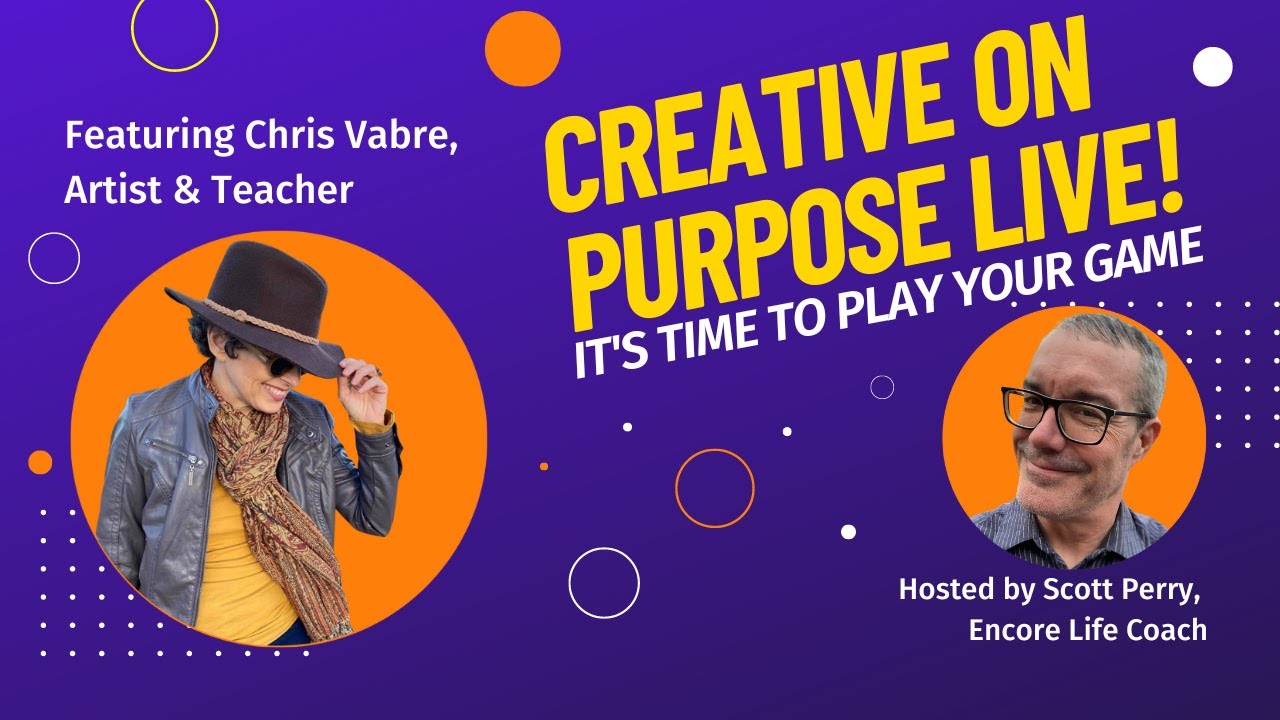
In this Creative on Purpose interview, host Scott Perry talks with visual artist and educator Chris Vabre about her lifelong relationship with creativity, the gap she experienced while working a conventional job, and her rediscovery of art through watercolor during the pandemic. Chris defines creativity as a natural, human instinct akin to breathing, and argues that institutional structures have boxed it in. The conversation explores common obstacles such as imposter syndrome and "Resistance" (as described by Steven Pressfield), and Chris shares how she helps students overcome these blocks through confidence‑building practices, reconnecting with childlike curiosity, and daily disciplined practice. They discuss her evolution from a jewelry maker and retail trainer to a Skillshare instructor and creator of her own watercolor courses, highlighting the challenges of turning a passion into a business—marketing, content production, and maintaining artistic time. Both hosts emphasize the importance of play, the joy of teaching, and the reciprocal way teaching sharpens one’s own craft. The interview closes with Chris’s advice: listen to the inner tug, dabble without pressure, and keep creating, as the possibilities are endless.
Chapters
Through the ether at the speed of bytes. And who would have thunk it? Technology man did it again. We landed just where we're supposed to be. Welcome to Creative on Purpose, a conversation about making a better living and a bigger impact by defining, developing, and delivering the difference only you can make in your life's next chapter. I'm Scott Perry, author of The Art of Encore Living. If you're ready to play your game and live your legacy, visit creativeonpurpose.com to get started now. Now let's meet today's guest. Chris, welcome to the broadcast. Please tell our viewers who you are, what you're up to these days, and where can they go to learn more about you and the difference you're making.
Thank you for having me, Scott. It's a pleasure to be here. I am Chris, usually Chris V on the internet, and I am a hopeless creative. Started before I could even hold a pencil or crayon and just loved all things creative. Right out of the gate, just did everything I could, just everything, anything creative I can get my hands on, sculpting, painting, sewing, you know, fiber arts, whatever. And then once I hit the work world, the working world, I abandoned it all, you know, for the, you know, just had to get my head into the work world. And for 20 years I didn't do hardly anything creative, just like spots here and there. And then I suddenly felt this void, this missing void, and realized that I hadn't done anything for my, my health, my, my, my mental health, my psyche, my— and, and I started being creative again, but it was like almost like starting over, you know, 20 years later. And so, um, my mission at this point is to help others who are just finding their creativity or just coming back to their creativity sort of, um, meld back into that natural you know, that natural thing that we don't think is very natural. And so, um, I am a watercolor instructor at this point. I have kind of landed on watercolors as my all-time favorite creative activity. It is— it, it brought me out of a panic attack during the pandemic. It has helped me relax in times of total stress, and it is my constant companion. I take it everywhere with me on trips, on, you know, daily, you know, trips into the city, whatever. It's always with me, and it has become my go-to. And I really just feel a mission to help others find a connectivity to watercolors. It's not an easy medium, and, uh, but it's a wonderful, wonderful way to connect with creativity. So that's a little bit about me. I love it.
Yeah, so I follow Chris on Instagram, uh, and love not only the artwork that she puts up there, but the videos that she puts up where she kind of walks you through how to do it. Makes me feel like maybe even I could pick up a brush and do some watercolors, and that's actually saying quite a bit. Um, so you've given us a little bit of your origin story in terms of, you know, it sounds like creativity was a childhood love that you lost for a little while while you were, you know, trying to— out there trying to make a living. Um, but you, you thankfully recognized that there was a hole that needed to be refilled. I love that. One of the things I always love about people that are like you that are just full-blown creatives is to really dive into like, what does this thing mean, creativity? Because it's, as you said, it's something that a lot of, it's, you indicated it's a natural instinctive thing that all humans do and you're not alone in having it kind of, beaten out of you by institutionalized schooling and occupation. So I'd love to just hear, you know, how do you define— how do you like— how do you— how do you define that term creativity? What does that mean to you?
Well, to me, you know, from my perspective, I see it as natural as breathing, eating, sleeping, you know, and I look back through history and I see, you know, the cave paintings on, on the walls of, you know, these ancient sites tell the story that, you know, art is a form of communication. It's not just a thing that few people are good at, that you can't be good at. It's something that is, I think, inherently placed in each human, and it comes out in a different way, you know. Um, one person might be really good with color, another person might be really good with structures, or, you know, there's, you know, even scientists are starting to recognize how creative they really are. I mean, you can't even discover something without creativity, you know. So I just think we have put it in this little box and institutionalized it and, you know, put walls around it. And I think they need to come down. They just— everybody's just sort of— I think people, maybe people are missing that part of themselves and thinking they can't access it. When it's just right there.
Hmm, yeah, I love that. Reminds me that the very first episode of this broadcast featured Massimo Pigliucci, who is a biologist, but also a founder in the Modern Stoicism community, who was there promoting a book. And he, when I asked him to define creativity, he said, well, I'm not really a creative person, I wouldn't know. And I was like, Massimo, you're here. —book. You created a book. You took something that didn't exist and put it into the world. And so it's just really funny to me how we do, you know, a lot of us, and sometimes the smartest of us, just can't, uh, can't really see that creativity is, like you said, this just this natural, inherent, um, intuitive instinctive human thing, and we ignore it at our peril. And so I love, uh, you know, the way that you, you see different people see, or, you know, are, have a natural instinct for various elements of creativity. And one of the things that we talk about here quite a bit is, um, treating your life like an art project, the art of living, right? It's a creative enterprise. And so one of the things I'm hearing in your story and what you're, you're sharing is that you have been able to, um, to enhance and master the art of living through reconnecting with your creative instincts and, uh, you know, and sharing your gifts and helping others, um, explore the edges of their creative abilities.
Yeah, that is so true. It's become such a joy to see students. I've been teaching on Skillshare since 2016, and now I have my own courses on my website and so forth. I have a membership, and through all these channels, I get to see— I have the privilege of seeing students go from, I don't know about this, you're gonna think I'm awful, I don't even know if I can post this, to, oh my gosh, I'm good. I can do this. I can share this. I can do it with confidence. I can, I can admit that I have my own style. And I was comparing myself to everyone else when in fact I had this beauty inside me I didn't even know was there. You know, it's been the best feeling.
Well, I'd love to explore that a little bit because I also see that and experience it. I was a professional musician for 30 years, and so Dancing with my inner— dance with imposter syndrome, what Steven Pressfield calls resistance. My inner critic is something I've been doing, you know, in full-blown creative endeavor for almost all of my life. What are some of the ways that you help your students negotiate and navigate that conversation that almost all of us have when we're, you know, trying something new and putting ourselves out there in a creative way?
Gosh, imposter syndrome is, is the biggest block, I think. And, you know, it's not like it ever goes away, no matter how confident or how skilled or how, you know, um, motivated we are to do a project. That imposter syndrome seems to creep in. And, uh, you know, I think The biggest way that I, I battle it in many ways, and I blog about it. I have a blog and I write a lot about creative block and how to bust through. I actually share a lot of tips in my classes too about this, because until we see ourselves differently, um, imposter syndrome will rule. And I think changing our own perception of our creative selves and our ourselves in general, uh, is the key to quieting those voices and just giving ourselves a chance to explore, you know, and play and, uh, just allow ourselves to be us, you know, and just, you know, find, find ourselves in, in it all.
Yeah, for sure. It's interesting, you know, one of the, the, the books that helped me give a name to it was Steven Pressfield's War of Art. He calls it Resistance with a capital R. And it's a seductive and tricky nemesis adversary because it can manifest as procrastination, it can manifest as addiction, it can manifest in so many ways. But one of the things that was always hard for me to wrap my head around in terms of the way Steven looks at it You know, his book is called The War of Art. Um, and what I'm hearing in, in what you're sharing is, you know, like it, it doesn't matter how accomplished you are or how far up the ladder you go. It's, it, it's always going to be there. In fact, if it's not, then maybe you need to get yourself checked out for, you know, sociopathy. I don't know. Um, and so it, it's less about defeating it in, in a, a, you know, all-out battle, but more about how do you dance with it? How do you negotiate and navigate, you know, with it and just interested in your perspective on this. I mean, one of the things that I have found and teach is that resistance, imposter syndrome, inner criticism doesn't like a moving target. And sometimes all you need to do is, as long as you are micro-stepping your way into whatever skill you're trying to develop, whatever creative endeavor you're trying to create, if you have that discipline of doing something with it every day, the voice will eventually get a little bit quiet and, and, and eventually it'll just sit in the corner and pout. It'll wait for a moment to get back in, uh, your head and, and take control. But for the most part, um, it's a lot of it I think is, is setting up that practice, uh, and doing something, you know, creative every day. Because I, again, I think that the inner critic doesn't like to, you know, it doesn't come out when you're sitting on the couch, trying to figure out what to watch on Netflix. It's, that's okay. But you know, if you're out there putting yourself on the line and doing the work and sharing your gift, that's, that's when it kind of comes out. But you, you know, you have to figure out how can you persist and maintain that commitment to your practice.
Yes, so true. I, you know, I think, um, to take that thought and take it one step further, I— what I have found is, yes, you're absolutely right. When you practice art, you know, it's like getting a new job. You know, you might not be great at it the first 3 months, and then you start to feel like it's getting a little easier, and then in 6 months you start thinking, oh, well, I'm pretty good at this. And then in a year you're kind of mastering, and then as you go forward, you just get better and better and more masterful. And I think art is exactly the same way. And as you do practice it, you gain that confidence. And confidence, I think, is the biggest enemy of imposter syndrome. And so what I try to do right away, and one of the things I do to help my students get quick results, is to instill confidence in them right away. Like, that is my go-to method. And, um, I think that, uh, when I'm doing something new, that's when the imposter syndrome comes out. That's that other step. It's like, I can be really— I can get really good at the art, and then when I start teaching it, uh-oh, guess who just showed up? That imposter syndrome is right there, you know, trying to make me feel bad, trying to feel like I can't do it, trying to make me feel like I'm never going to be good at this. And, you know, almost 7 years later You know, teaching has become— it still has its challenges. I still feel the imposter syndrome, but it— yeah, I get better and it gets easier. And I'm sure you can say the same of your show or anything else that you've done, your music, for sure.
Yeah, for sure. And, you know, we kind of— you, you've touched on this, and we kind of, uh, touched on it just as we were going live, you know. You said, oh, this is going to be fun. I said, oh, you bet it's going to be fun. I'm going to shut this thing down because it's supposed to be fun. And I don't mean just, I don't think it's just creativity that is supposed to be fun. I think, um, I think life is actually supposed to be more fun than most of us make it most of the time. And one of the things about getting back and reconnecting with your creativity or leaning into your creativity is that. If you can do it with that playful, childlike sense of awe, wonder, curiosity, experimentation, all those things, that's another tool that can really help, help you get past whatever resistance you're feeling about trying something new or putting something out there that maybe you haven't quite mastered yet and starting to earn that confidence that you're talking about. I love that.
I love that. That is another thing that I tried to talk about a lot with my students is that when you're a child, you don't even know what imposter syndrome is. There is no imposter when you're a kid. It's just all you. It's pure. It just shows up and it's just full expression. And so I do encourage my students a lot to get in touch with that child. And I do it myself. I have to go back and think, What would I have done if I was 7 or 8 right now? Or 6? Or, you know, and it really helps me to get in touch with those deeper, more pure feelings and expressions that we kind of push down in the name of professionalism or adult— being an adult or whatever. And it's a shame.
Yeah, I really love that. It's I don't know. I think part of it is, you know, just the compliance and conformity that happens, you know, in school, you know, do what you're told. And, you know, here's, here's the curriculum, you're going to do what everyone else is doing, and you're going to do it the way that everyone else is doing it. But I think you're absolutely right, that I do not recall as a child when I was creating a walker and a talker and a reader and a writer and a bike rider and a peanut butter and jelly sandwich maker, all creative endeavors. I don't recall having an inner battle with my inner critic or resistance or imposter syndrome. I was actually just pretty excited to try things and do them poorly on my way to doing them well. And it's the way that we master anything that's, that, that that we care enough about to master. So it's a great exercise to like come up with like, what's— how are you going to recapture that? How are you going to create that daily discipline that gets you to sit down and practice your craft so you can earn that confidence on your way to competence and on your way to mastery in something that— some sort of creative endeavor that you wish to excel in. I'm also, you know, one of the things that you do that I'm also really interested in is, you know, not only are you an extraordinary artist, but you're also a teacher. And I think there's a lot of, a lot of things that go into teaching that, you know, also involve that what we've been talking about in terms of inner critic and all that, but Just curious if there was a particular— if that was a calling that you had that you felt like you just had to heed this calling to teach others to create as well. And what's the value? How does being a teacher actually enhance your life as an artist?
That's coming from someone who's been a teacher. That's a great question. So I sort of fell into teaching accidentally, honestly. I unknowingly had been the one at the workplace. I came up in retail management, and I always was the one solicited to train the new people. I don't know what it was. It was just this natural thing that I connected with, and I was able to share the information in different ways for different types of learning types or learning minds. And I was patient and I enjoyed the process. And people came out of my trainings and with what they needed. And so it was effective. And I had never given that a thought. And I had just started a jewelry business. It was about 8, 9 years ago. I'd started— I still actually make my own jewelry and, and so forth for my own use. But I had a business where I was making and selling jewelry and on my website, Big Cartel, this call to action came up. Hey, become— teach your craft. Whatever you're selling in your store, maybe you can teach that to others. And so I created a couple of jewelry classes on Skillshare and really enjoyed the process. I really surprised myself because I thought, well, well, you know, it was just this kind of tugging in my heart that maybe I could be good at this if I could be good at it in the workplace, you know. And maybe this would be something someone would want to learn. And. And even though I've moved to art and watercolors, those classes still get students that really enjoy those projects. And it really gives me so much joy that, you know, that someone would find what I'm teaching valuable. And it just has become a fever. I, I just absolutely have become addicted to the feeling of people growing through what I'm sharing with them. You know, to, to be able to share that with another human being has become one of the my biggest joys in life.
So yeah, I love that. Well, it's— I love that the, the origin story of your teaching, because it was exactly the same for me when I opened a guitar studio. It was— I had, uh, in, in order to spend less time on the road as a musician and more time with my family, um, and we homeschooled our boys, I opened a music store in the hopes that, you know, that would bring in replace the income that I had been earning on the road. I could, you know, it's a small town, so the store was never going to be super busy. So it was, you know, we could homeschool the boys. I taught the boys how to run the register, um, and all that sort of thing. Um, but the, the store did well enough, but it never like got to that point where it really justified the amount of time and effort I was putting into it. So I, out of desperation, because people would come in every day and say, can you give lessons here? And I'd say, nah, I'm not, I'm not a teacher, I'm a businessman. And out of desperation, I used the empty back room to start giving lessons and hired someone to run the front of the shop. And I discovered that I love teaching and that teaching made me actually a better musician because nothing reveals the holes in your knowledge and the holes in your skill more than trying to teach, teach something that you know to someone else. Um, and I totally agree about the joy that a teacher feels when they see students excel or even exceed, um, their level of competence. And, and, uh, you know, I have a student, a guitar student that was up for a Grammy nomination, uh, last year. So it's like, wow. Um, and I think that, you know, there's this, uh, I've always hated this kind of thing that you hear people toss around. Oh, those who can do, those who can't teach. And I think, you know, I always respond with, actually, those who can do and those who think others can too, teach. Because it's, it's something— teaching only makes you better at your craft, I think. Um, so I'm just curious about, you know, is there a moment— it's, you know, you've, you've, you've started a jewelry business, um, you have a business teaching people about watercolor. Um, I'm just curious a little bit about that edge, you know, because there is, there is something, uh, I think there's, there's a different skill set that comes in when you're turning your craft into a business or your hobby into a business. I'm just wondering, you know, what are the other challenges? Or, you know, are there things that you had to kind of learn or navigate in order to make that, you know, make that leap from taking this thing that you kind of did for your own enjoyment, but teach it to others so they could enjoy doing it too?
Yes, yes. And just to— I mean, I remember the last question. Yes, absolutely teaching makes you better at anything that you teach on. It does show those holes, and it does show— it makes you better. It just explaining it just opens another part of your brain, I think. But, but yeah, you know, when, when I decided to make creativity my business, I started with the jewelry. I loved working with my hands, and it was sort of a sculpting. It's sort of a handmade sculpting sort of enterprise, and it was very satisfying. But when I started teaching, I had to ask myself, can I teach this for the rest of my life, and will I be happy doing it? And that's when I realized that my true love was really painting. It was my— was from the beginning. And even though I'm always going to be a multi-passionate creative, I'm— that somehow I always go back to painting, and it's always watercolors. And so that's what I decided. You know, they talk about your why. Watercolors was very, very closely tied into my why. And it's so deep, I don't even— I haven't even been able to quite explain it. It's just an instinctive love for this incredibly beautiful medium. And I think turning it into a business, I had to know that I could take it into the decades. That's the first thing that I really had to nail down. So, and it's okay to change, you know, I've seen a lot of teachers go from one to another to another thing. And, and you, you have done that too. You have evolved beautifully. And, you know, music will always be a part of your life, but you've found apparently a deeper purpose and a deeper why that is driving you into the decades. And, and, um, I think that's a big part of it. Um, but, you know, I— it doesn't make me love it any less, which I'm very grateful for. I was a little worried because I've heard people say that they, you know, once you turn into a business you know, the honest truth is that I don't get as much time to paint as I thought I would. There are so many business activities, you know. I write a blog, I'm about to start a podcast, um, you know, I, I'm creating courses which involve a lot of video editing and photography and marketing and, you know, other things. But, uh, so happily, when I get to paint, I'm very, very happy to do it. And And in the meantime, I get to share my love with others. And that's my biggest, my biggest, you know, my biggest why, I think.
I love that. I love that. Yeah, for sure. It's, it's— I still, even though I've not performed in public for several years now, I still have people come up to me and ask me about like, hey, I'd like to do what you did. I'd like to turn this, you know, love of mine into a business and make a living at, you know, playing music. And I always tell them, don't. And when they say, why? I say, well, because, and you touched on this, you know, what you don't realize when you decide to turn your hobby into a business is that there's lots of things you end up doing, spending 80% of your time doing the business part and only 20% doing that thing that you think you're going to be doing all the time. Um, I became— I was a full-time musician because I couldn't imagine doing anything else. And, and you're touching on this in your story, this, um, idea of calling, right? I mean, it's something, and it's a hard thing for many of us to do, um, to hear and heed the call of our vocation, uh, because it's not something we're ever encouraged to do in school. And certainly when you go into the working world, nobody's encouraging you to explore your unique gifts and build something around those. So I love all that. We are coming toward the end of our 30 minutes together, Chris. You know, this is a show that is very much for people like you that are advancing in some sort of vocational calling, uh, some sort of creative endeavor, and, um, I'm— or maybe just aspiring to and have been inspired by, by your story to, to begin. If there was just one final piece of advice, um, or a quote or some lesson learned that would— that you feel would really help someone, uh, step into their potential as a creative or as a business person half a shade braver and start to step into possibility and earn confidence in advancing in the unique gift that they can bring to the world? What would you tell them? Do it.
You know, just if you feel that tug, if you feel that pull, don't ignore it. It will— you can push it down and crush it, you know, so don't ignore it. Just dabble at it. You don't have to tell anybody. Just go and do the thing. And just if it makes you happy, keep going. Please keep going. It is— it can lead to things that you had never imagined. Look where I am. I would have never thought I'd be sitting here with you today, Scott, and, and talking about this. So the possibilities are endless. I love that.
Thank you so much. And we thank you for tuning in, Kristen. I really appreciate your time and attention. We hope today's broadcast motivates you to take a bolder step into possibility. And if you're ready to keep go-go-going with defining, developing, and delivering the difference only you can make, visit creativeonpurpose.com. Now, if you're watching on social media or YouTube, please leave a comment, share a question, share your biggest aha listener takeaway from this episode. If you're listening as a podcast, please rate and review this podcast. It really helps more of the right people collide with this content and inspire them to advance in their own creative endeavors. And now we'd like you to take the insight and inspiration from this conversation and go play your game all in and full out. Chris, thanks so much for joining us today and sharing your story with us.
Thank you, Scott Perry. So happy to be here.
More from Scott



Stoics Don't Suppress Emotions, They Do This Instead #stoicism #emotionalintelligence #mindset







