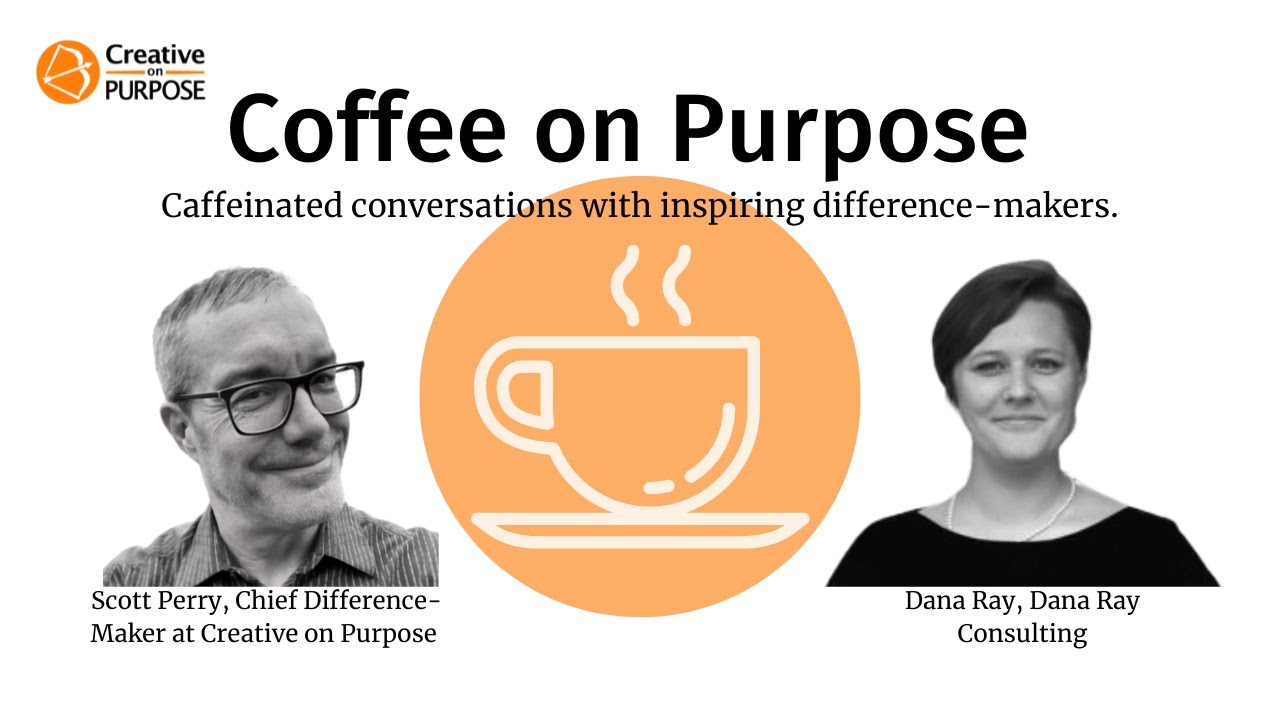
Scott Perry talks with language coach Dana M. Ray about vocation as the expression of your true self, not your job title. They explore how nouns versus verbs shape identity, why curiosity matters more than credentials, and how tension between security and adventure drives growth.
Chapters
We are live, ladies and gentlemen. Welcome to a brand new endeavor here at Creative on Purpose. This is not Creative on Purpose Live. This is Coffee on Purpose: Caffeinated Conversations with Inspiring Difference Makers. My name is Scott Perry. I am the author of Onward!, also Chief Difference Maker at Creative on Purpose and a head coach in Seth Godin's Freelancers Workshop and Creatives Workshop, where I met the inimitable Dana M. Ray, who is here to jump into the very first iteration of this crazy idea I have, where we're going to just have a conversation about a word. And we're going to unpack what that word, how that word applies broadly to people like you that are making a difference, making the difference that only you can make. So Dana, please introduce yourself to our viewers. Who are you? What are you up to these days? Where can people go to learn more about you and the difference you're making?
Yes, yes, yes. Hello, friends. I am Dana Rae. I work with unboxable leaders and organizations. So folks who don't fit in an easy category, who are looking for the language to describe and name who they are, what they do, and why it matters. And I get in there as a word person and listen to your stories and help connect the dots and put the words to the thing that is you, the you-ness of you in the work that you're doing. And because I believe that words are action, what we can say, what we can put into language, we can do something about. And I want to see more people who don't fit in easy categories, who don't fit in an industry norm, do the work that they feel called to do, which is tied to vocations, hence the perfection of this conversation with Scott Perry today.
Yeah, fantastic. So what I'm hearing you say is that you help people use words on purpose. Just had to slip that in there.
All right. Yes, I'm happy with that. Absolutely.
So the context for this conversation is, uh, Dana replied to something that I had posted on LinkedIn around, um, vocation because it's a subject near and dear to my heart. And she recommended this book by Parker J. Palmer, who I've been investigating recently. I had just recently read The Courage to Teach, which I loved, but had not yet dove into any of his other work. But you recommended Let Your Life Speak, and this is Parker J. Palmer's book about vocation. And I have listened to the audiobook 3 times on my infamous cemetery run, and I just decided that I would really love to talk to Dana about this word because she's, she's the word guru, and I knew that she would have a lot of thoughtful ideas. So how about we start, Dana, with defining our terms? What does vocation mean?
Well, first, a comment on Parker Palmer. A lot of my approach to my work is derived from this book, Let Your Life Speak. I read it at a pretty young age, I was really lucky to be surrounded by adults who were very interested and cared about the term vocation and what it meant to do work that mattered in the world. And so this book got handed to me probably in my early 20s, and then I reread it, I think, sometime when I was in grad school, so about 6 or 7 years later. And I was like, oh, a lot of what I'm doing now is actually from this book, and I had forgotten how essential some of these stories were. So one of the things that— the way that Palmer would describe it, and the way that I would also join in describing vocation, is that it's not a specific job, it's not a specific role, it's not a life stage, it's not the thing you're supposed to do. It's the thing that you are. And the you-ness of you in the world is perfectly good enough. And there are a lot of forces in our lives that take us away from what it means to be who we are and to figure out what that is and return to it and really root down into it. So this, this whole book is about, um, Palmer's journey to reacquaint himself with himself and to make choices that that are in line with the work that he was here to do, the, the hymnist, the Parker Palmer-ness, rather than being someone else.
Yeah, I love that. It was, uh, having written quite a bit about this, um, in my book Endeavor, I talk about how you can find a vocation, how the, the difference that you're, you're meant to make, or the difference only you can make, um, And one of the things that came up for me in revisiting this book 3 times in the last week is this idea that vocation is the expression of your true self, maybe even your original self, through the work that you're doing. And that doesn't necessarily have to be your occupation. No. You know, it could be a, um, side hustle. It could be just a relationship that you're in. It could be a real, um, you know, an organization or institution, spiritual or otherwise, that you're associated with. The thing that really comes up for me when we're talking about vocation is how important work is to the human animal. There's a great book called Work. I can't remember the author's name right now. It's about that thick. He could have said it all in about 30 pages, but it's still worth going all the way through. And one of the things that is stated early on is, you know, defining work as work is simply what living things do to transfer energy. So a plant takes sunlight and nutrients from the soil to create growth within itself. And human beings transfer energy in all sorts of interesting and wonderful ways. The thing that sets human beings apart from all other living things in this idea of work is that we actually use our work to build identity and forge meaning in our lives. And to me, that really speaks to the importance of finding vocation in your life. And again, it doesn't have to be associated with your occupation, doesn't have to be associated with what, what you do to earn a living or to, you know, take care of your obligations and responsibilities. It's the work that you're doing that helps you build identity, forge meaning. And you do that by doing that work with and for people that you care about, the right people.
I— Elizabeth Gilbert has a lovely set of definitions around this, the difference between a hobby, a job, a career, and a vocation. And that our vocation isn't necessarily connected to our career or our job or our hobby at all. Um, but we need a job to pay bills, and if we have a career, if we want one, that's great too. And then the vocation is the, the thing that you cannot avoid, the thing that is there for you. And interestingly, what you said about, um, work and meaning-making— Esther Perel just had an interview in GQ magazine And the final thing that she said was that as a human society, we have shifted our meaning-making away from religious institutions and community infrastructure to specific relationships and partnerships and our jobs. So there, there's been a transfer collectively in human culture, particularly in Western culture, I would say, where we are constructing meaning and where we're pulling it from, which I thought was interesting.
Yeah, there's also, um, that reminds me of a conversation, um, Ezra Klein had with Noam Chomsky, another towering genius of words.
Um, well-known linguist.
Yeah, yeah, he, he, he's got a couple good ideas. Um, and he talks about how, you know, the, the work and work and education and all these things in terms of power relationships and how You know, we, uh, he makes a very compelling case for anarchy in a pure kind of non-politicized, um, context that, that's another conversation worth, worth, um, tuning in.
Another word we would have to define.
Well, it's, it's about, it's about personal responsibility. Like we live in a, we live. In a world where institutional forces maintain the status quo through coercion and compliance. And, um, if you are going to break away from that, uh, you know, it's, it's, it's, it's, you're, you're fighting biology and evolution because we are You know, we are very interesting. We are one of the identifying qualities of being a human being is we can hold opposing ideas in our head at the same time and they won't explode. You know, we have this desire to fit in, to know where we stand and what's expected. We love us some status quo. At the same time, we have this aspirational nature where we strive and seek the edges of our ability and understanding. And, you know, learn and desire to learn and grow and improve. And those things are always— I think of it as toggling back and forth. Like, you're OK just as you are. And it's OK if you want to strive to be and do more. And all you're doing in that pursuit, whether you succeed or fail, is dragging your sufficiency up along with you. So just a ramble that came to mind.
I mean, that shoots me off in the direction of Esther Perel again of what we desire in life is security and adventure, and we live in the tension between those two things that we need.
Oh, I love that.
I actually, um, I don't think she used the word adventure, but that's, that's the essence of the tension she's describing.
In our living room, we have a sign that says "Adventure awaits," and, uh, we bought that when we, when we, at the end of 2020, I closed down my guitar studio and we are officially full-blown digital nomads and ready to execute on our digital nomad passports. And so we bought that as a reminder, like, hey, it's nice here, but there's something out there that you two need to go start chasing. So the, the, um, well, Scott, I have a question for you.
What in your life right now, what are the stories that are happening for you that leads you to listen to Let Your Life Speak for 3 times in a week? What's drawing you to this conversation right now?
It's this— again, the subject has been near and dear to my heart. So some of the themes that led me to this place and our other conversation— so Jacqueline Novogratz was on the Creative Unlive broadcast and we were talking about reinvention, and it just occurred to me, like, actually, I don't think that— like, reinvention sounds exhausting. And, and if I think about my life that way, I've reinvented myself many, many times.
Yeah.
Um, and I don't feel exhausted. And instead, when I, especially when I made this most recent pivot to become, you know, full-time with Creative on Purpose, when I look back, I actually see a through line in that I've always been a guide. I've always been a teacher, uh, or a coach, you know, whatever term you want to use. I've always been really invested in, uh, developing myself and doing that by doing, you know, helping others do the same. Um, so this idea of becoming, and then the other thing to— I can't remember the, the person that you, uh, the, the person that wrote the article for GQ, Esther Perel. Okay. So And you said it was between something and adventure?
Uh, security and adventure.
Yeah, so security—
she, Esther Perel is a relationship psychologist. Okay, she's looking at the dynamics between partners of—
clearly I need to, need to check out GQ magazine, which I've never done before. So I'll, I'll check out that article because it sounds fascinating. When I hear the word security, I hear that idea of of a fundamental human need. And what I've been arriving at recently is that our journey of becoming is actually tied to a similar fundamental human— I'm starting to believe that actually the most fundamental need after the existential needs of food, clothing, and shelter is worthiness and belonging. And actually, I would say worthiness is the precursor to belonging. Excuse me. Um, so all of that. So worthiness, belonging, um, our relationship with security, because security is a false, like it's, it's a trap because there is no real such thing in my mind. Um, you know, that's all tied up in this idea of, you know, what are you going to do? Well, I've got Mary Oliver right in front of me. Tell me what it, what is it you plan to to do with your one wild and precious life. Yeah, so, um, that's, that's why all this stuff is really bubbling up for me. And it's bubbling up because I think in the moment that we're in, you know, whether or not we're exiting the COVID the age of COVID or not, um, we have been forced to reckon with our, the falseness of, um, that every day is going to be just like the day before, and that, um, that, uh, you know, if you follow the rules and keep your head down and do what is expected, that you're going to be okay.
And you're making a lot of changes yourself, it sounds like. That's really cool.
Well, so one of my favorite One of my favorite pre-Socratic philosophers is Heraclitus, who has a maxim: no, no person ever steps in the same river twice, because neither is— are they the same person, nor is it the same river. So flux is something that I've been endeavoring to accept for a long time, and as I am in the second half of life, uh, putting a lot of thought into, like, what is, you know, how are you going to make a bigger difference with the time that you have left? How about you, Dana M. Ray? What does— what made you decide to hop into this conversation?
When I think about the curiosities that have always been in me, it's been around what does it mean to be a person and what does it mean to be a creator and a maker. From a really young age, I connected with language as a creative force and a thing that I could build worlds with and I could play with it. It quickly— I quickly abandoned Play-Doh in favor of language in elementary school, at least. And in the process of exploring what that means to me and the number of the bets I've taken in my 20s— I'm in my early 30s now— but the bets I took in my 20s that I'll do this for a couple years, and then I'll figure out what mattered to me from it, and then try to keep pursuing that thing in another context, closer to the thing I actually want to be doing, closer to the thing that I actually am, closer to the way that I can actually contribute. So personally, that has been a curiosity of mine for a really long time, and Spiritually, that's been a force as well. I grew up in the Christian evangelical subculture and was very much immersed in it in college, and I worked for a church after college. A lot of that has shifted for me in terms of its expression in the last 6, 7 years. But I grew up with— I grew up around a community of people who believed that our individual lives mattered and that our individual lives could change the world for the better and could take care of people for the better. And so that value and that belief was baked into me from pretty early on. It was baked into my own understanding of who I wanted to be as a grown-up even, or what I wanted to do with language as a kid. Um, and sometimes that can take the expression of a colonializing force in the name of doing good. But there's also something really beautiful about that being an assumption for you as a kid, that you will do good and you can, you are good, at least in the realm of work. So those are the conversations that I've been in for a really long time. And that's why I'm doing what I'm doing now with leaders and with organizations. Because I see so many people, and myself included, struggle with the difference between how do I pattern match and play the game to do the work that matters to me, and then what is actually mine to offer. And the tension between those things, especially if they themselves haven't defined what it is they want to be doing, what it is that they do when they are just themselves in a room and it is easy and joyful. What is the thing that happens? There's no effort, it just happens. And I think that's so beautiful about human beings because everyone has that thing they can show up in a room when they're not thinking about it. There's a verb that they are and a result that occurs. And I just want to help people see that and name that and do it. Do the thing.
Yeah, that's fascinating. One of the pieces I recently published was, um, playing with an old idea, um, but an idea that I collided with again, um, in reading The Art of Is by, um, Steven, um, Nachmanovitch.
Um, I don't know that one. The Art of Is.
Oh, it's a, it's a really great book. Um, and he, his mentor was a big fan of killing all the nouns. Um, which I think is kind of extreme. But it's around the, our attachments to identity, to what, to, you know, identifying as the thing, you know, as the noun. And instead—
Oh, the I am statements.
Yeah. Instead, pursuing identity through the verbs, through, you know, through the lived activities. And I, you know, I, I arrived at the, you know, in typical Akimbo fashion, how about a both and, you know, because I think the nouns right now in the moment that we're in are are really important. I mean, you know, we are using pronouns now, and we are in the midst of reckoning once again, you know, with a long overdue need to, to come to terms with systemic racial misogyny and all the other things. And so we need our nouns. We, you know, people have been marginalized and need to claim and step into the power of the nouns that they are. And We are also hopefully in this journey of becoming, um, coming to terms with the fact that actually we're all just human beings. Like, there's actually no such thing, um, as race from a biological scientific point of view. There's no inherent difference between someone with dark skin and someone with light skin. So, you know, that's, you know, there's challenging conversations to be had there. And, and we need to be able to, to speak those. One of the things that you were saying early on in your last comment really struck me was the idea of curiosity. And, you know, to me, that's, that's The, the, the, the, the secret weapon, like, how about if we recognized the harm that all of our, um, false certainties and, um, overconfidence has landed us. And instead we started to live into more beautiful questions. And I think Parker Palmer actually quotes Rilke in terms of living.
I was like, you said beautiful questions. And I was like, well, then we're gonna quote Rilke.
Yeah, yeah, yeah. There's, there's a great quote, and I don't remember it exactly, but it's about living the question, living into the question.
Yeah.
Um, which I think is also, you know, speaks to the subject at hand, uh, in terms of—
I don't remember the quote either, but I know it's from Letters to a Young Poet.
Yes, exactly right, exactly right. It is from that, from, from that essay or book. As we're coming to the end, I'm going to talk about nouns.
Hold on, I got to talk about nouns. Okay, it took me a while to figure out what you meant by nouns because the first— when you're like, we have to get rid of nouns, and I was like, well, just to be clear, I didn't say that. No, no, you were quoting that idea. Sorry, you were referencing a concept, and I was like, well, what is— what does that mean by nouns? And I realized that you were talking about names. What are the names we give ourselves? What are the names we give to our experiences? Of ourselves. And I think there's so many different types of nouns, and so giving a specific title to the name category of noun, I think it's really helpful. And to recognize that all of language is an approximation of reality. Language itself is not the thing. And so anytime that we use a name for ourselves, we are using the closest thing that we can find today to communicate our experience of who we are and try to say that to someone else. And so I think names are really beautiful because they do help us express ourselves to other people and help other people see us. But you're right, they're limited constructions. They are not the actual essence of humanity.
Well, it's to The takeaway for me in thinking about this statement that I don't agree with is it's not, it's not the nouns themselves that are the problem. It's the clinging to them. Like, I think that the problem is if we box ourselves, to your point, to what exactly what you do, right? Unboxable leaders. Well, a lot, a lot of people do put themselves in a noun box and, and silo themselves, you know, like I do this and then I do this and then I am this and It was a real epiphany for me to, um, stop shifting gears all day. Like, oh, I'm a husband. Oh, I'm a father. Oh, I'm a teacher. Oh, I'm a musician. And I got to keep like, you know, changing gears and switching hats. And I was like, well, what happens if I just show up as Scott Perry all, all day? Um, like maybe that would be a way to feel a greater sense of flourishing and fulfillment. Um, and not. Have any dissonance about, oh, I, you know, what's the mask I have to put on here? But I could just show up the way I am. So yeah, lots. Well, that's a whole nother conversation perhaps. I would love to unpack one last idea from the book.
Great.
And that was another topic that really fascinates me and is deeply tied to my work in living into My Beautiful Questions, the idea of humiliation that Parker Palmer discusses at some point in the later part of that book.
Can you point me in the direction of a section?
Oh, my audiobook tabs. I can't reach into my audiobook. It's somewhere in the end. And what this is, the context as I remember it, Um, you know, we spend a lot of our time avoiding humiliation, and, and that's part of the thing that holds us back, because there is no— what he says is something I'm paraphrasing— there is no humility without humiliation. Humus, return to the earth, the return to the ground, the return to the nourishing force where we can then, you know, grow in a more healthy, um, and human-connected, you know, way into our potential, into, into our promise and possibility.
Yes. He talks at length about his experiences with depression in his midlife, and that as being this— like, he, I love— he does use that phrase of like being pushed down to the ground. Of reality and who he is via depression.
What I love about this idea is it's something that, um, you know, you and I met in the Freelancers Workshop, and, you know, we are both fans, uh, of, um, Seth Godin's ideas and work. And he talks a lot about the, the importance of things that might not work and embracing the failure and, and You know, and not in the icky, like, oh, I'm going to lay in the floor at Starbucks. Um, you know, and that's kind of a false humiliation, but the idea that you're putting, you're, you're reaching towards edges where there is no certainty and where things might not work. And there's no shame in that. It's how you learn and how you iterate and how you improve. And to me. Um, in some of his other work, Parker J. Palmer, and I've heard David Whyte speak to this too, talk about the virtues of heartbreak. And I love that because you cannot, you cannot engage in any kind of meaningful work or relationship and not have at some point your heart be broken. And you get to decide, is it broken, shattered, and you're going to spend the rest of your life trying to put it back together and only to realize it will never be the same? Or are you going to allow yourself to be broken open so that you can be a, you know, an even more empathetic, uh, compassionate force for good in the world? And, and in your— and he talks a lot about self and service. This is the, the, you know, the heart of the vocational life is, um, again, I think of it as from the inside out. You know, I have to know who I am, what I believe, what are my values, core principles, what are my talents, my innate, you know, the innate qualities, but also the skills that I've learned. And who are the people out there in the world that share my values and need my talents to enhance their lives? That's, you know, how I can be of service. But then that will also feed, you know, I can take all that, reflect on all that, and it becomes like a renewable resource where vocation is just the way to continue to be energized and build, you know, develop passion and purpose for, for what it is that you're doing, even, you know, just the simple act of living.
Yeah, he uses the phrase the way closing behind you.
Yeah, yeah. And we didn't get a chance to talk— the other thing that— so I love that whole section because he talks about you have to shut the door behind you and face the open door in front of you. And the way doesn't always reveal itself, but when you shut the way, you know, when you leave a lot of ways behind, it can be equally clarifying. Ruth, his teacher, I can't remember her, one of the Quaker teachers, but the last thing that we won't get a chance to touch on, that was also, now I just, I lost the thread, but there was another, there's another element that he, uh, talked about. But, you know, I think that what you're pointing to is that idea that I always think of Robert Frost— the way out is through. Like, you actually— there has to be some forward motion, um, in all this.
Can I end on a quote from someone entirely different?
Sure.
Um, so one of the things I was thinking about before we entered this conversation is that if the only people who are talking about vocation and these experiences are white guys, then we don't actually have— oh, a grasp of reality. Um, I've been very influenced by Audre Lorde's work in Sister Outsider. Um, she's a Black queer poet, and specifically looking at Parker Palmer's Let Your Life Speak, she has an essay called The Transformation of Silence into Language and Action. And so I wanted to end on this quote.
Sure.
Um, I was going to die, if not sooner than later, whether or not I had ever spoken myself. My silences had not protected me. Your silence will not protect you.
Love it. Well, that's a perfect, uh, perfect moment to end on. Thank you so much, Dana Rae, for your time and, uh, sharing some of your wisdom. There you go. You can learn more about Dana and the fantastic difference that she's making at DanaMRay.com. And of course, it's always also great to see you over at CreativeOnPurpose.com. We hope that you got some value from this conversation that gives you some food for thought for your week ahead. And Dana Ray, I'm sure that I will see you out and about on social media and elsewhere. Thanks so much for your time.
Thanks, Scott. Bye, everyone.
More from Scott



Stoics Don't Suppress Emotions, They Do This Instead #stoicism #emotionalintelligence #mindset







