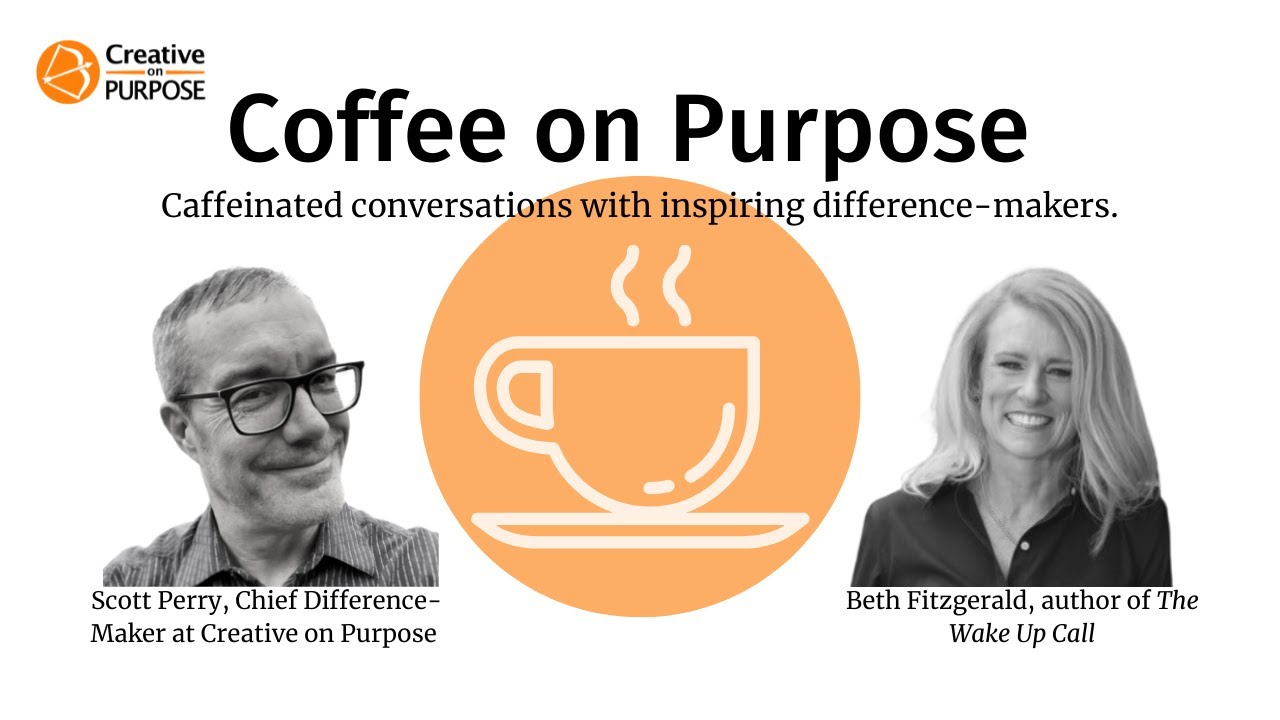
Scott Perry and executive coach Beth Fitzgerald discuss how everyone has influence, not just people with status. They share tools like "It's not about me/you" to shift perspective, the VIA Character Strengths Survey to clarify values, and the practice of taking small steps despite uncertainty. Fitzgerald says your gifts are meant for the world, not just yourself.
Chapters
The speed of bytes. And it says that we're live. So that must mean we're live because StreamYard never lies to me. Hey everyone, I'm Scott Perry, Chief Difference Maker at Creative on Purpose. I'm also a head coach at Seth Godin's Kimbal workshops, the Freelancers Workshop and the Creatives Workshop. This is a broadcast called Coffee on Purpose, a special Creative on Purpose live broadcast where I bring on someone whose work I respect, someone who inspires and informs my own adventures in difference-making.. And we choose a word or a topic and we unpack how it might broadly apply to those of you that also seek to make a bigger and better difference with the time that you have. And today I've got my friend Beth Fitzgerald. We're going to talk about influence. Beth, tell our viewers who you are, what you're up to these days, and where can people go to learn more?
Fantastic. Thank you, Scott Perry. I'm an executive coach. I coach leaders and their teams. I look to optimize and transform their performance. And I'm incredibly passionate about leadership, but not any kind of leadership. I'm really focused on value-based, heart-centered leadership. And I don't think that just happens for anyone. I think that you have to be intentional about curating that. So that's what I do. That's who I am. And you can find me at Beth Fitzgerald.com or Fitzgerald Coaching and Consulting on Facebook.
And if you're tuning in on LinkedIn Live, Beth is also on LinkedIn. In. And yeah, so Beth, you chose the topic Influence, which is a subject very near and dear to my heart, as are values and value-based leadership. So I may have to weave that in somehow. What I'd love to do is to start by defining our terms. What does influence mean? And how does it apply broadly to making a difference in the work that you do?
Well, the one thing I love about influence is I think that people think they have to achieve a certain status to have influence. And I disagree with that completely. As the mother of 4, look at a 2-year-old kicking and screaming on the floor and I will argue that child has a lot of influence. So, I think we dismiss influence because we don't think we're at the right level. And I would argue that everybody has influence because if you interact with other people, you have influence.
Yeah, I love that. One of the reasons why it's a subject near and dear to my heart is, um, it's, it's not really a secret that, that, uh, the ancient Hellenistic philosophy of Stoicism influences and inspires a lot of the work I do at Creative On Purpose. And one of the tenets of, um, Stoicism is that almost everything is beyond your control and you possess all you need to control to be able to thrive through any circumstance or situation. You control your thoughts, the way that you perceive yourself and your situation and other people, and you control your actions. You get to frame your choices, make your decisions, and take the next step into potential and possibility. And for me, that's where your influence lies. So it's— sometimes people think, Stoicism is very fatalistic, like just sit around and wait for things to happen the way they're going to happen. And that's not at all true. They believe that, you know, you have a duty to actually engage in the world. You can't possibly know what's going to happen next. And it is your obligation as a human being to step into possibility with and for the people that you find yourself with in a way that enhances the prospects and prosperity for everyone. So I love this idea that nothing is in our control, really. And at the same time, we always have the ability to influence what's going to happen next. So what are some of the tools that you, you use to— well, I think part of this is how do you, how do you help people? And since you and I are both coaches, I'm really interested in your take on this. How do you help people see or remind them of their agency, their ability to have influence on themselves and their situation and how others behave.
And how they impact others. The one thing that I, is kind of a go-to sentence that I have is that it's not about, it's not about us. It's not about me, right? And it's not about, it's not about you, even though you and I are on this call today. It's not about us, right? We came to talk about a word called influence that we're hoping, and the power of influence, right? So we're hoping to unpack it and share it with everybody that's on the call, but also to get a greater or deeper understanding of it for you and I. And so when you say to someone, it's not about you, it changes everything. Like the leaders that I coach will come with a problem and I'll say, okay, it's not about you. So let's look at it from another angle. And as soon as we do, The whole thing changes, right? And then, like you said about stoicism, and nothing has changed. The problem is still there. It's the exact same problem you came to me with. But now when I say it's not about you and you can look at it from a different seat or a pair of different shoes, you may look at it completely differently. And this goes, you know, this is in corporate America. This is also with my kids when they come home and say, you know, I had a test and the test was unfair. Okay. It's not about you. Let's go back. Like, this is a teacher. They made a test. You can either study harder or go to the teacher and get extra help or whatever. But, but it's not, it's not about you. It's not a personal attack on you. And when you can, when you can use that sentence and say, okay, if it's not about me, what is it about? How can I look at this differently? Very often it softens everything up and allows for an easier transition or solution.
Yeah, I love that. We talk a lot at Creative on Purpose about zooming in and out. And what I hear you pointing to is most of the time we're very invested in zooming in, like, what's in it for me? How can I shine? How can I get mine in this exchange, this circumstance, this transaction or what have you? And so It's a very— it's a valuable thing to be able to contextualize yourself in any situation, like to zoom out and see that in the grand scheme of things, actually, not only does this situation not really matter that much, but you don't matter that much either. But then to— I think it's once, once you get that contextualization, it's okay to zoom back in and do what you really should and need to do to bring about the best outcome, to influence the best outcome that you're able within for the people that you find yourself with.
Absolutely, absolutely. And to, to your point, when you're looking from a corporate standpoint and you're saying, okay, I'm focused on the bottom line, great. I have no problem with the bottom line. But if we're only focused on the bottom line, you're not going to be a very good leader. And you're not going to be able to pull back and say, okay, what is this person going through? Because if you can, if If you can look at that counterparty to you and say, okay, it was about A. Well, okay, we'll start with A, but can we go to where they are in their work situation? Where are they in their personal situation? What is going on in their whole life? And then you can back up and say, okay, now, yes, it's about a bottom line, but I can come at this from such a heart-centered value kind of, values-based place where everybody can be a winner in this. And we can still get to that bottom line that you're looking for, but from a much better and people-person place. You know, when we stop managing people, I won't care about it anymore. But if you're managing people, I care deeply about you and everybody that you're touching.
Well, I appreciate that you wove the values in because I think I was recently having a conversation with someone online that was asking what, what are the values that I would like to see most taught in schools. And I mean, when was the last time you heard about values even being discussed, never mind value development, character development, and that sort of thing being discussed in, in our school system, you know, whether it's public, private, elementary, high school or advanced degrees. What is the importance? And how do we help people see the virtue of dialing in their values and cultivating the values that they wish to express in the world? And how do— and to your point that you're just making, You know, in the corporate world, in business in general, you know, you hear it all the time. Well, it's just business. I'm just, you know, and it's like, okay, so, but, you know, is your business to be continuously out of alignment with who you really are and what you really believe? Because that doesn't sound like a very great way to cultivate fulfillment, flourishing, and a sense of thriving in an endeavor. How do you help people see the virtue of value-centered leadership and then lean into that edge and really start to cultivate and also articulate their values through the work that they do.
So that's a lot. But let me back up to the first thing you said. The thing that I find is that a lot of people don't even look at their values. They haven't explored it, which, you know, does and does not blow my mind, right? So one of the things I teach in one of my classes is career mapping. And one of the things that is their responsibility in this kind of list of 10 is to secure 5 important values to them. Now, if you go and look up values, I mean, there are like thousands that you could have as a value to you and, or virtue. When you can really nail down 5 to 7 values that are critically important to you and then work from there as your base, as your foundation, I mean, they're your cornerstone. So if you think, for me, one of my values is integrity and it's critically important to me. And so I will say things that are incredibly uncomfortable for me to say, but it's because I stand behind my integrity. And so, or I won't, do business with someone or something because I stand behind my integrity. And have I fallen off of that? For sure. You know, either usually very unbeknownst to me, but I'm buying a piece of clothing and then I'm reminded that, you know, Patagonia really is centered in something that I believe in. So should I really be buying my quarter zip from them instead of someone else that maybe I don't stand behind how they create their products? So truth is an incredibly important value for me. Again, That also puts me in some uncomfortable situations to speak my truth. I don't ever want to hurt anyone, but I will be truthful and I'll find a way to deliver the truth so that they know. And I will say, you know that if I am nothing, I am honest and truthful. So when you really sit down and take a moment to come up with 5 or 7 values, I think, and there could be more, there could be way more, but if you really find the ones that drive who you are as a human being, then you can really go and live those, but we fall off of those just because we forget. We aren't bad people. The people who aren't living their values aren't bad people. They just haven't sat down and said, what do I really deem valuable? What do I believe are the values I wanna stand behind and who make my brand, right? Everybody talks about branding. What is your brand? Because once you realize that something is non-negotiable for you, then it determines how you behave as opposed to the opposite. You behave and realize that maybe you didn't behave in coordination with your values. And then it's something either you regret or you have to apologize or whatever. So having that as a base is, I believe, critical.
Yeah, I love that. One of the taglines that we use at Creative on Purpose is to engage in endeavors that enhance the lives of others. Some of our founding guiding principles are intention and integrity. And one of the things that we do at the beginning of working with someone is to encourage them to take the Values in Action Character Strengths Survey. You can do this for free. I think it's via.org. They organize 24 values, I believe, I'm remembering that right, around 6 virtues. 4 of them happen to be the virtues of Stoicism: wisdom, temperance, courage, and justice. Thank you. I haven't completely lost my mind yet. What the reason that we do that is because we're trying to help people lean into the impossible work of making things better, of making, having an impact and creating a better world and creating, you know, greater sense of thriving and fulfillment for the people that they do their work with and for. And in the pursuit of clarity and also in the pursuit of finding fulfillment and a sense of flourishing, you those values become your yardstick. Everything that you do, you can put up against. I think in the VIA system, it's 5 core values that, you know, that are kind of the ones that you lean on the most often. And to your point, you can also decide, like, there's some values that are really low on my list that I would like to improve in. But you have this yardstick, and then every decision that you make goes up against that yardstick. And if it doesn't measure up, then you, you just made it—
you—
it's a— helps you clarify your decision-making. It helps you understand. And so often, I think, in this day and age, we, we reward certainty and overconfidence in things that you can't possibly be certain and overconfident about. And we see this in our politics and our economics and our, you know, cultural exchanges, you know, we, we reward those that just appear to have a great deal of certainty and overconfidence, um, and make decisions completely based on expediency and not based on ethics, morals, values, you know, the things that really matter. So I love that idea that, you know, Putting values first can be a great clarifier, can provide a lot of focus, can provide a lot of discipline. And also, I think it emboldens people to take, you know, to continue to take small steps into their potential and possibility and the difference that they're trying to make in the world.
Yeah. And it also adds ownership, right? You don't have values then, and it's not that you don't have them, but you haven't decided which ones are most important to you. But when you decide, you own it. And then that, and then that's you. And when there's ownership, then like you said, the yardstick is official and you can go from there.
Well, and so you're pointing to something else really important and near and dear to my heart at Creative On Purpose, which is agency, like reminding people of what they actually are in charge of. And, you know, again, we live in a world where A lot of the time we're told, oh, it's not your fault, or just do this and you'll get bread and circuses and we will entertain you. So I'd be curious about your thoughts on how do you use your influence in the work that you do to help people not just recognize the agency that they have over their thoughts and actions, but actually take ownership of those thoughts and actions?
So I didn't think we were going to go here, but I write a daily blog, right? And so every day I write these 3 small paragraphs. I put it on Facebook or it goes out in an email. And every day I'm encouraging people to think, right? And so we might be thinking about a value. We might be thinking about intention. We might be thinking about a lot of different things, but it's just a way for people to remember to think. And so you might act on it, you might not. You may look at it and say, I hadn't thought about that. But I use my influence every day to be on Facebook and my blog and to just encourage people to say, hey, this is what I'm thinking about. And I kind of write like, my husband says, you're like Jerry Seinfeld. Now let me just caveat that. I'm not funny. I mean, I think I'm funny, but I'm not funny. I think I'm very funny. But I write for daily things. So it's what I experience, right? So I'm on a hike and the tree fell down. Like everybody can relate to that, right? Or, you know, I'm coming out of the tunnel and I get a flat tire. Like everybody can relate to that. And then I tie it into how I thought that made me think about life or how I could be better. And it's all about being a better you. So, you know, at the end of the day, that's all I'm gunning for, right? Is a better me. There's only one Beth Fitzgerald and I can't be Scott Perry, so I might as well be a really good Beth Fitzgerald. And that's how I use my influence every day to just say, hey, this is what I'm thinking about. I want you to think about it. I hope it encourages you to do something either good for yourself or good for someone else in the world. And if we are all doing that every day, or at least thinking about it, we have to be able to make the world a better place.
Yeah, well, I think everyone would agree that one Scott Perry in the world is maybe already one too many. So thank you.
And my kids would tell you one Beth Fitzgerald is way too many.
Well, I love, uh, yes, like you, um, I'm, I'm hilarious, but nobody else seems to recognize that, uh, which is unfortunate. Um, the, I love your daily discipline and I love, I, I, I write less frequently, but I do engage with my, my list 3 times, um, a week and I do post on LinkedIn almost daily. And one of the things that I've learned from our mutual friend Seth Godin— you and I are both graduates of his programs— is he, he has talked in the past about how he intentionally tries to get under people's skin. That's one of the things that as a head coach in his programs, I have to explain to students early on when they get very upset is like, actually, he did this on purpose. Like, he did it with love, but he also did it on purpose. He's intentionally trying to get you to scratch an itch that you didn't know you needed to scratch. Um, to your point, to help you think. And I frame that as empathetic antagonism. I intentionally give you a perspective that is going to come at you sideways and make you go, huh. I don't know that that's true. But I'm curious to lean in and learn more. I don't have any answers. But I do— I love, I love, I love me a beautiful, provocative question. And I love a great discussion. And so I love that, that posture that you were describing of showing up to those that have given you permission, but also on social media, to start thinking. I think there's, there's not enough thoughtful deliberation, uh, going on in the world right now. It seems to be, seem to be increasingly, uh, embracing tribalism, and we just want to surround ourselves with people that think just like we do and, and want things to be just the way that we want them.
Uh, yeah, you know, I, uh, um I wrote today about the World Trade Center, and I said, let's not forget that that was an act of hate, right? And hate hasn't ever really gotten us anywhere. So let's go with love. Let's try that, right? Let's see if we can just spread the love in whatever way possible. So when I write my posts every day, it's not, you should, it's just like, hey, here's something, you know, it might resonate with you, it might not. If not, come back tomorrow. Tomorrow may resonate with you, but I'm gonna try to put positivity in the world, and I'm not gonna shy away from what is going wrong in my life. I share all my pitfalls and all as well. It's not a highlight reel all the time.
Yeah, yeah. I was recently having a conversation where I was— someone was saying something nice about something I had just shared recently in my newsletter. And it was something that I, when I hit the send button, I was like, oh Lord, this is like a worst thing I've ever written. I can't believe I'm— but I got nothing else and it's, it's time to send, so I'm gonna. And whenever I have those moments, it's always like the thing that gets the most positive feedback. Um, but the, the— my attitude is half of everything I write is below average and half of everything I write is above average. Um, I just don't— I'm not the best judge often. Of which is which. And so just as we're winding down our time together, I'm wondering about your thoughts on weaving in the role of uncertainty and, you know, knowing that things don't always work out the way we intend when we seek to influence a result. How do you embrace those kind of uncertainties and the inability to guarantee outcomes and results even as you try to influence situations?
Well, I think, you know, for uncertainty, that's life. Like, that is the entirety of your life. You know, that is one thing you can be certain of, is that your life will be filled with uncertainty. So if you're waiting for certainty, certainty, it very rarely happens. And if you're not going to have any action steps until you're certain, you're probably not going to move. But as far as moving forward anyway and failing along the way, I've never learned anything from my successes. It's all of my failures and all of my stumbling blocks and all of the things that have me kind of grappling through the mud that where I've learned the most about myself and about my journey. If we don't want to get dirty, then we're not going to grow. So you just kind of have to say, okay, any stumbling block, any uncertainty, any failure, any misstep, all of that has made us stronger. And it's also made us more resilient. And it also got us to a point where we wouldn't have otherwise been had we not taken that risk or waited for certainty. So, look, I'm as afraid as the next person about going forward in uncertainty. But I've learned over the past 8 or 9 years in this business that just go. And I think people hesitate because they think it's going to be an epic failure. But we don't take epic steps, right? You don't leap the crevasse, right? You take one step and then you take another step and you take another step. And there may be a misstep along the way, but there isn't a major epic failure. In taking baby steps. So take the baby steps and you'll be— I'm far more proud of the things that I have done that have been through mistakes than I am of the things that were an easy road, right? You look at something that was really hard and you say, I am darn proud of that. Darn proud of that. And it wasn't without its bumps and uglies. Yeah.
Yeah. Totally agree. I mean, one of the things that we talk about when we're helping people develop and deliver their endeavor is, you know, even the big failures are still opportunities. I mean, if it's, if it's an absolute, like, there's no way of reframing it as a win, you still have learned the valuable lessons and built the virtues of patience and humility and acceptance. And you mentioned resilience. I mean, these are, these are things that you must also cultivate if you're going to be engaged in an endeavor that seeks to break or bend the status quo in, in a better direction. Um, so, and just to circle back to something that you, um, shared earlier, it's also like that's also the opportunity to zoom back out. Because when we're framing things as failure, we probably have a little bit too much of ourselves and our ego tied to what's going on. And, you know, what a great opportunity to zoom out and see that in the grand scheme of things, once again, it wasn't as awful as we thought, and we're not as important as maybe we thought. And then we can zoom back in and do the work that we need to do.
Agreed, 100%.
So Beth, just would love for you to share, you know, we, you've shared lots of great insights and ideas around this idea of influence. If there was, you know, people that are tuning into this broadcast, see themselves as difference makers, they either aspire to make a bigger difference in the world, or they want to advance in the difference that only they can make. And if you had one parting piece of advice around influence to share with someone, what would that be? What would you do to encourage them to take a small, bold step into their potential and possibility?
That's a great question. I would say this: all of us have been gifted with a superpower, right? And so— and many superpowers. So whatever your gifts are, Scott Perry, are different than my gifts and so, and however you view it, whether it's the universe or a creator or whatever, we all have our own gifts. But the important thing to know about those gifts is they aren't for you. Alright? They're not for you. They're for somebody else. So if you never created this podcast, you would not be sharing your gifts with the world, right? And me as well. I have the same hesitation when I go to hit send on a post. Posts that I'm not completely loving, but, but I'm putting my gifts out there. And so I would say to anybody who's listening, you have superpowers that you were gifted with, but they weren't— they are not for you, they're for the rest of the world. So the rest of us who want your superpowers so that you can share them with us, I strongly encourage you to be brave, face your fears, walk into that uncertainty, walk into the place where you do have influence and the power to influence others, and, and bring that gift to us because we need it.
Could not agree more. What a fabulous way to end this broadcast. So thank you all, folks, for tuning in. We hope that today's discussion encourages you to step a little bit more boldly into an endeavor that makes a difference and that you will continue to fly higher in the difference only you can make. Beth Fitzgerald, thanks so much for the insight and wisdom that you shared with us today.
Scott Perry, the pleasure was all mine. Thank you so much.
More from Scott



Stoics Don't Suppress Emotions, They Do This Instead #stoicism #emotionalintelligence #mindset







