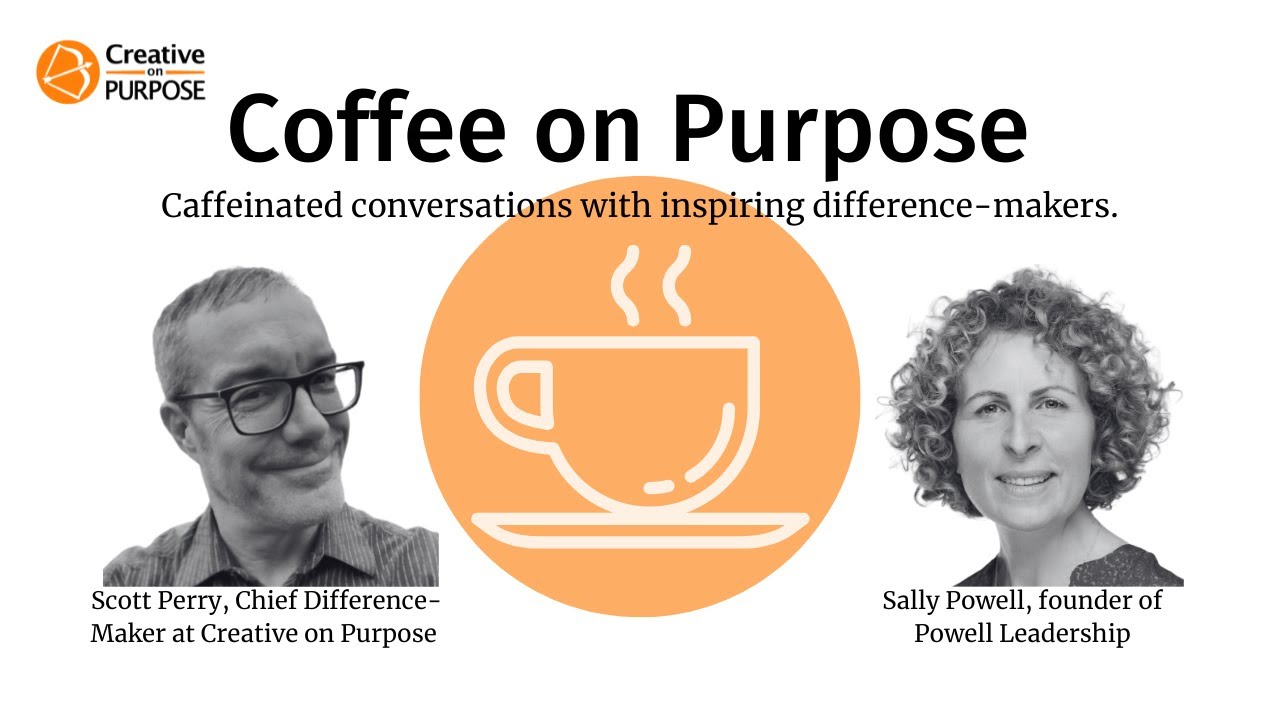
Coach Sally Powell explains fascination as a trainable mental muscle that reframes anxiety into excitement and combats burnout. She shares exercises like asking "What fascinated me today?" and a "cosmic insignificance" visualization to shift perspective and reclaim energy.
Chapters
And boom, just like that, ladies and gentlemen, welcome to Coffee on Purpose, caffeinated conversations with inspiring difference makers. My name is Scott Perry. I am Chief Difference Maker at Creative on Purpose, where I help people like you beat burnout and overcome overwhelm while making a bigger difference. You can go to creativeonpurpose.com and get yourself a copy of The Burnout Solution. And let's work together to make things better. I am delighted, thrilled to be with my friend Sally Powell from across the pond, as they say. And Sally and I are going to talk about a word near and dear to both of our hearts: fascination. But before we start, Sally, I would love for you to introduce yourself to the folks tuning in live and in replay later. Who are you? Where are you? And where can people go to learn more about you and the difference you're making?
Oh, thank you so much, Scott. I'm so looking forward to this. I am Sally, Sally Powell. I'm in Edinburgh in Scotland in the UK, and I'm a coach and a trainer. I train teams and I love the word fascination. My goal in life really is to unleash the part of yourself that wants you to just be more fascinated in you. When you get more fascinated in yourself, you can bring that forward to your teams. Most of the people that I work with are, you know, looking after teams of 20 to 30 people. It's their own businesses, which they founded, and they're trying to pivot between manager and founder and leader. Like, how do they inspire and grow the business that I think they were born to grow? So, yeah, fascination is at the heart of what I do. Oh, and if you want to find out more about me, you can check me out at sallypowell.org or you'll find me on LinkedIn and I have the curly hair, so you'll see my photo and recognize it as me.
Yeah, I wish I had Sally here.
I wish you had my hair.
So in full disclosure, Sally is a client or has been a client of mine. And while we were working together, this word fascination came up and it's one of my favorite words. It's a word that I've used in my work as well. But I kind of think of Sally as like the Fascination Coach. So one of the things that I love to do, Sally, is at the beginning of these conversations is like, let's just kind of define our terms, because fascination, that's not a word that you hear all the time anymore. Um, and so what does fascination mean to you, and how does it apply, um, with a little bit more detail to the work that you're doing with and for the people that you seek to serve.
Yeah, yeah, I love this. So fascination with me is, it's from the inside out. So fascination is getting, it's getting, it's more than curious. It's like really interesting, like what's going on there? And then like stepping back from that, okay, what is that telling you about something? And so obviously the work I do as a coach, you know, it pays to be really fascinated in people. Like I'm really interested in who's in front of me and who I'm talking to, but I want them to be that fascinated about themselves. 'Cause I think when you're that fascinated about yourself, then you start to become more fascinated about other people and the teams you build and the communities you're in, and it has a ripple effect. So it's like curiosity and some, and it's not a word you hear enough of. And yeah, 'cause I wonder why that is. Just before the call, I said to both of my boys, I said, "What does fascination mean to you?" And one of them said, "Oh, it's like when you get really, really interested, like really, really into something." And then the other one said, oh, it's like curiosity, isn't it? And I think it's both of those things, but I like the, oh, it's like, 'cause it kind of brings you out a bit. What about for you? What's fascination for you?
Yeah, I love that. I love that you asked your voice. What a brilliant idea.
It was cheating. Basically it was cheating. I thought maybe they'll give me something inspiring that I could like bring to the conversation with Scott Perry.
Oh, I think that's a wonderful approach. Fascination is a, a word that I've used as oftentimes as an antidote to anxiety. So fascination is usually about something— I think of fascination as being akin to awe and wonder, to your point, like things that are cute, like that inspire curiosity. And as an antidote to anxiety, you know, one of the things that in the work that you and I do as coaches is we spend, you know, we are working with people who are often sitting in the tension of here's who I am and here's who I seek to become. And there, you know, there's a leap that has to happen. They have to push through some resistance, the imposter, the fear, the anxiety, whatever it is to get from the person they are to the person they, they are becoming. And it could be, it can be frightening, it can be scary. And so, um, for me, fascination is, is a way of flipping the obstacle into an opportunity. Because if it, it doesn't have to be something that's fearful, it can be something that's fascinating because Anxiety and excitement manifest exactly the same way in the body. So it's just a matter of replacing the terms so that you can move your mindset and your posture from I'm hesitating and holding back and a little bit afraid to— I'm ex— to your son's point, I'm excited and I see possibility and I'm ready now to take a slightly bolder step into, into that. So in the work that I, that I do as a head coach in Akimbo Workshops, you know, we are frequently dealing with people that are in situations where they're confronting fear and maybe not always taking that bold step that they would like to take. And so I have written an article called "People Are Fascinating." And it's just a way of— because the alternative would say, "People are a pain in the butt." Of course, I'm a— you're a pain in the butt. I'm a pain in the butt.
Every—
the people. But But when we flip the script and say, no, they're fascinating, they're— because we are fascinating because we are full of aspiration and we are full of— and yet we embrace the status quo. We are full of anxieties, but we still love to get excited about new things. And so it's just a way of reframing. Fascination to me is a really fantastic way of reframing ourselves, other people, our situation, to see possibility and then to more boldly step with, to your point, greater curiosity, greater excitement. And let's see what happens next.
Yeah. And it's that I love that word, flip the script, because I think we get so— we're so stuck in a story, so stuck in this is the way it has to be or this is the way I've been doing it. And I think I can't remember the stat, but there's some crazy stat about how little we learn after the age of 30 as well, which is like Wow, but it's all just beginning again then. Like, there's so much possibility in these moments. So I think, yeah, this script piece, what I love to help people hear is, as you do too, is, is what are they saying? Like, what are the words they're using? I mean, I hadn't really even thought that I used this word fascination so much until we started working together. It's like, yeah, that really does matter to people, matter to me. And that's what I pick up in other people. It's like What are the things that really matter to you and are you getting enough of them at the moment? And are your team even seeing them in you? Because we play all these different roles, don't we? We play, like for me, coach and mother and daughter and, you know, friend and blahdy blahdy blah. And, you know, that can be exhausting. And I think maybe that's part of the burnout piece as well. We're desperately trying to meet all these expectations of all these roles. And then you throw in leader and then you throw in manager and mentor and champion and it's like, whoa, it's a lot, but I think if you can come at it through the eyes of fascination— I sometimes talk to people about, you know, if you're going to put a different pair of spectacles on, like, what would the spectacles you choose today? Mine would be kind of, you know, kind of sparkly. There'd be some glitter involved today. And then, like, what do you notice about your life through those glasses? I mean, you wear glasses, you don't need to, you know, but, you know, it just— sometimes to just play with some of this stuff as well, because it can feel very heavy, you know, we can make our lives feel very heavy. And I think just It's just, yeah, and maybe that's why I always love talking to you. It's just we can laugh at ourselves a bit because you do— we can take ourselves a little bit too seriously. Coaches can take themselves very seriously, and it's just, you know, just got to bring some play and some sort of liveliness into this as well. Have I gone off topic?
No, no, no, I love it. And I love— I mean, that's— I think that's what fascination does, is it opens up encourages us to see things through a different lens, from a different vantage point, from a different perspective, to consider a different point of view, to consider that someone else can be in this very same situation or even in this very same conversation and have an entirely different experience. Yeah. The one we're having, that we're currently having. And so it's a way of, again, a way of opening up. Possibilities that allow us to make a better choice that will make things better, you know, with and for everyone concerned. And I love, you were weaving in the burnout piece and the roles that you were just talking about. That's fascinating to me because I agree, like we, we get fed a lot of narratives that don't serve our, um, integrity or wellbeing. And what I mean by that is like when we talk about being defined by our role, mother, sister, coach, wife, whatever it is, like it feels like we spend our day like changing our hats.
Yeah.
Gears. And I, And I remember feeling that way. I used to have a signature line that said, Scott Perry, husband, father, teacher, musician. And it was like my priority list. Like, I want to make sure that I'm always like, take, taking care of my marriage. And I want to be taking care of my boys. And after I've done that, I want to be the best guitar teacher I could be. And then I want to be the best musician I can be. And then like, everything else is going to be over there. And I would go through my day, you know, when I began coaching, then that just got added to the list. And it was exhausting, exhausting to change gears all day. And one day I was just like, wait, what am I doing? What if I was— what if I was just integrated? What if I was just a— just showed up every— in all these roles as Scott Perry? And I'm just going to be the best Scott Perry I could be in this moment, on its way to becoming a better Scott Perry through through this moment. And it eliminated so much anxiety and created so much more fascination and just cleared all the noise and dissonance because now all I have to do is show up and be me. And guess what? I've been doing that, practicing that my whole life.
Every day.
Do that. So that's really interesting to me. And then the burnout piece is I've, I've been talking a lot about this lately because it's, well, it's, it's run rampant. You can't scroll through social media without hearing people's stories of burnout and overwhelm. And, you know, I, I consistently see it being talked about like it's this disease. It's almost like another virus running through the, the world's population. It's like that, that That's not, that's not true. Because burnout, burnout, I don't think is a disease. I think it's a symptom. And it's, it happens because you're giving something that you no longer possess, like your time, your attention, your energy. That's, you only have so much if we look at it as a finite resource. And when you're giving away something that you no longer possess, you're going to feel burnt out, you're going to be depleted. So what happens if— and I'm going to circle back to the comment you made about, um, fascination from the inside out, because I remember that coming up from our work together— it's like, now, now I'm turning time, attention, and energy into a renewable resource, because I, I, I, I'm fascinating. I find you fascinating. I am sharing my time, attention, and energy with you, and you You, and you're reciprocating. And so we're stuck in this. Now we're in this virtuous cycle where we're creating a moment of time where we are energized by the conversation and by the work. And, you know, time expands and our attention becomes more focused. And, um, we're just able to be more clear about Who we do and who we don't spend time with, what we do and what we don't do.
Exactly.
Yeah. So I, you know, and that's, and I think fascination plays into all of that. If you, you can create a mindset and a posture for living in and bringing fascination into your work as a fully integrated Sally Powell, Scott Perry, or whoever you are. Yeah.
And it really I mean, there's so much, there's so much there that you just said, you know, having been or still married to someone who's very much lived through a burnout, um, it's, it's very, it's very tough to be, to be the partner in that, you know, in that situation, and also to coach people who are fearful that it's coming. It's like it's, they've It's the thing they worry about, but in the worrying, they take themselves out of the present moment. And that's the sort of the damaging thing of this kind of this burnout, this language that we use around it. It's like it's somehow inevitable. Well, I'm on this track now. I've got all these people that rely on me. I employ them, I have responsibility for them, I pay them, all of that stuff that goes with it. Oh, it's just, it's inevitable, it's coming. And, you know, part of the fascination piece is like, would you want to get fascinated about burner? We can get fascinated about burner, or we could choose to get fascinated about all these other things. So again, it's not pretending that it doesn't exist in some form, but it's— yeah, there's almost like a— there's a narrative out there now that this is— this has to be one of those things that you get to. And I don't subscribe to that. And, you know, I can say that even having, you know, even been married to someone who's very much lived a very real version of that too. But I mean, that's his— That's his story. But yeah, it's interesting, Scott, because what I love about fascination and I, and I, and I, and I think it's such a valuable skill that we all need to kind of build. It is a muscle. And I think, you know, in the journey, the train of life, it can get like we let it get knocked out of us or it gets knocked out of us. And it's just, it's one of those such, those wonderful things, you know, along with joy and play and innovation and inspiration. It's one of those wonderful things in this bag, and that's the bag that I'm encouraging people I work with to spend more time in and digging in and getting curious about, and not the other bag, which is work, and it must be difficult, and, you know, hard, and, you know, anger and fear and disappointment and all that stuff. Let's not pretend it doesn't exist, but wouldn't you want to spend more time over here? Like, and that's a muscle. It is a muscle. I do believe fascination is a muscle that we need to keep training ourselves in because sometimes it's just got a little bit lax. And, and I don't think it matters where it's drifted away. You know, we could, we could say the schooling or whatever has been part of that. It doesn't matter. It's like do you want to bring it back? That's really the question. Do you want to be more fascinated about life right now? Well, what are some of the ways that you can start to make that happen, really?
Yeah. Well, you've highlighted two things that I— three things that I think are really worth amplifying. The first is to say that burnout is a symptom and not a disease is not to diminish that burnout is also very, very real. I mean, many, many, many people are experiencing the pain and the suffering that comes with feeling burnt out. And we don't have, we don't live in a cult. We live in a, you know, our educational and occupational institutions almost create, I mean, turn burnout into a badge of honor.
Like you should, you should get this.
Yeah, you should be overextended. You should be burning, you know, spending long hours doing work that does not fill your soul and fulfill you. And that is not fascinating. That's what people, you know, that's— you do this because your reward will come afterward. And it's just, it's a false bill of goods. And yet that's not to say that it's easy. You know, what I'm saying is, I think I find that burnout is— when I look at it the way that I was just sharing, it's simple to understand. It's still not easy to overcome. Because what it requires is, is making better decisions. Better decisions are, you know, being decisions based on who we are, who we seek to be, what is, you know, what aligns with our values, our guiding principles, work that has, you know, that fills our life with meaning and significance and identity that's worth cultivating. And you also mentioned the idea that fascination is a muscle, it's a skill. And I think that is absolutely true. And to that point, you know, fascination is a skill that you do and a muscle that you develop through doing the work of practicing fascination. Like, you, you can read my article and you can read a book and you can take a course, but until you actually start looking at the world and practicing fascination and bringing that into the way that you see and engage with other people in the world, you, you will not practice this fascination. So just, just one quick, um, I, I had this, you know, one of— I have an exercise to help you build your fascination muscle.
Oh, I love it.
And that I had— I have this, I, I have this, um, thing I've been saying to myself for a very long time, since I was a boy, where when I would find myself feeling anxious, um, when, you know, if I was getting picked on at school or You know, the, the girl didn't say yes to going to the dance or whatever it was. You know, those are moments when as a young person it could be, feel like devastating. And I, I just began saying to myself, isn't that interesting? And it's kind of like, isn't that interesting? Dot, dot, dot, question mark. Because what it did was it helped like objectify the moment so that it was, didn't have like all this value judgment. And self-value, you know, this worthiness tied to it and strong emotional attachment tied to it, made it a little bit more present. And then allowed me to bring in curiosity to look at things through a slightly like, oh, it's not good or bad. It's just kind of interesting that that happened and invites you to take the next step. And I think that you could, just replace the word interesting with fascinating. It's not— I mean, Spock in Star Trek, every time the humans were doing weird stuff and he'd just go, hmm, fascinating. And, uh, I think there's a lot of, you know, I think there's a lot of value to that, to just having like these, these maxims or these questions that we keep close at hand so that when we feel the anxiousness coming, flip it into something more healthy and that will promote well-being. And fascination is one of those things.
Yeah, I love that. And so one of the questions often used with people is like, is it simply, what are you noticing? It's because again, it gets you very present. What are you noticing is information about yourself. Again, it's not to judge, but it's just like, what's here? And, and I think part of my role as well is, you know, to get people excited about themselves. Like, what is interesting about you? What are you fascinated about? What do you want to find out more about? And then I— off I go, and they get on with their life. But, you know, it's, it's that— those sort of tools to keep coming back to, those sort of questions to keep coming back to. We are worth, um, investing time enough to, to, yeah, to be fascinated by ourselves. More fascination, please.
Yes, more fascination, please. That's really interesting because I was just involved in a group coaching session where we were talking about, you know, so you and I talked about Fascination from the Inside Out. In A Creative on Purpose, we talk about Trust from the Inside Out and Investment from the Inside Out. Um, and all of these things, you know, this work from the inside out is about creating, um, more self-empathy, more self-compassion, a greater sense of self-worth, uh, and a greater trust in our instincts and abilities. And, you know, to figure it out, to be more willing to step into uncertainty or embrace uncertainty and navigate adversity with the confidence that, you know, we've done hard things before and we can do the hard thing that's in front of us right now. And you brought this up kind of at the very beginning, and we can also do that with a sense of joy, with a sense of playfulness, with a sense of wonder. And you said, stop taking yourself so damn seriously and our situation. Um, one of the things that I've been playing with recently with my clients is, um, let's play, let's play a little game of cosmic insignificance, right? So when someone is in the throes of taking themselves too seriously and letting the weight of the world, you know, their situation kind of bear down upon them. To just encourage them to zoom out. Like, okay, if I were to zoom out to the level of your town or city, you know, how many people are paying attention to this thing that's absolutely eating you alive? Nobody. Okay, if I were to zoom out, you know, to the state, to the country, to the globe, to the Milky Way, and on and on, like, it's, you know, there's a point at which you just realize, like, you know what, I, I actually am just a meaningless speck, and this doesn't really matter. But then you zoom back in to your personal significance. Because yes, in the grand scheme of things, we are— we won't— we don't matter or amount to much. And on the personal level, this moment and this— the time that we have is all that we have. And any significance that comes is based— will come based on how we decide to show up and what we decide to do while we have the opportunity to do it. And so it's this toggling back and forth between between, you know, I don't matter at all and I matter a great deal. I don't matter at all and I matter a great deal. And it helped. I just think it's a way of, um, helping people, you know. I think that's— that whole exercise is fascinating.
Like, I love that. And is it— is that— it's that how do you want to show up? It's like, do you want to show up? Like, and how do you want to show up? And keep showing up. There's sort of the confidence piece that we think is, is going to come once I do it once. It's like, no, no, you're going to do it again and again and and see what happens and fail and move off the path and come on to another path. But that showing up piece, and I think again it's having the, yeah, the, the, the curiosity, the fascination to want to show up to things, you know, to see what might happen and what version of you might show up is really important in this as well. I do think for so many of us we put such a lot of expectation you know, huge amount of expectation on ourselves, particularly in these roles that we play. I was taught as a group of women that I coach and they have big careers, but actually we talk a lot about parenting on those calls at the moment. And they were like, it's not enough to be a parent. You have to have like a PhD in child psychology. You have to be a nutritionist. You have to understand dentistry. It's like, you know, what happened? Like, it's not enough to, to breathe and do yoga anymore. We need to be a breath specialist and we need to be a meditation specialist. And it's like, It's exhausting. It's exhausting. And maybe that also plays out into this, like, this fear of this burnout bit, because how could we ever meet all those expectations? It is ludicrous. It's absolutely ludicrous. And maybe the trusting is trusting that we're enough. Like, it's enough to be Sally Powell right now. It's enough to be Scott Perry right now. Like, that's enough. And I would hope that in my work, it's more spaces where people can feel 'Yeah, I'm enough right now. I'm enough for my team right now. It's enough that I got home at 5 o'clock and made a rubbishy dinner. Like, it's enough.' Um, I think we're getting there, Scott, but it's, do you know, it's like, I don't know about you, but sometimes it's like, 'Nailed it today,' and other days it's like, 'That was hard work.' Um, and maybe that's part of the just showing up. It's like showing up however, however you look and however you feel, but know that you're on the path that you're meant to be on. Yeah.
Well, I think it's— you're speaking to another opportunity for toggling back and forth. Like, you actually are enough just the way you are. And people like us also tend to strive to be and do more and better. And on any given day, we're going to fall probably very far short of, you know, our aspirations and expectations. But, you know, did you do— was, was it good enough? Well, yeah, it's, it's good enough because it is what it is. You are sufficient even as you strive. You're sufficient even, even as you fail because you're in the arena and you're doing the work and you're, you know, on the path. Um, and you know, that what you're saying about the parenting is really fascinating because we conflate productivity with progress. Like, yes, we have this feeling that we have to, like, be a child psychologist and a behavioral, uh, psychologist, and we have to make sure that the kids are playing sports and playing an instrument, learning a foreign language, blah blah blah blah blah. And that's like, this is the measure of, like, how many things you can pack into your day is a measure of how good parent you are. And I would say balderdash. That's really— I mean, I, my, I remember growing up and I mean, I was basically a feral youth. I was just roaming the woods in a state of fascination, um, you know, the nature and the wilderness and relationships and, um, and I certainly felt like that was more than enough. I like me, I like the way I turned out. I didn't learn to speak 6 languages or play 4 instruments or—
Unbelievable. How can you say that publicly? I mean, same. I mean, to be honest, I think when the fascination piece came for me, I was thinking about this earlier and it's like, I love nothing more than when my parents had people around for dinner and I and my brothers would leave and the other kids would leave and I'd just still be at the dinner table. Like, what are they talking about? I also knew that the sort of after-dinner chocolates were going to come out. So there was like value in staying. But I just was really fascinated by what people were talking about and like who got to talk more and who had the loudest voice and who wasn't saying stuff that, you know, and it was like that was enough as well. We didn't have to be doing all the time. Maybe that's part of this too. It's just this obsession with doing all the time. And well, in this moment, we just, we have to be us, don't we?
Yeah. Well, it's called human being, not human doing. And being is, is, is, is, it's, it's, it's an action verb, right? So you're, but it's an action that's happening in the here and now. And the more attention and integrity you bring into whatever it is that you're doing, even when it's sitting, sitting around doing nothing. You know, I think that, that promotes our health and well-being and the health and well-being of the people that we show up with and for. Sally, we have successfully chewed up a half hour talking about fascination. I'm sure we could chew up another half hour.
I'm sure we could. I'm sure we could. Thank you. It's just a joy to have this conversation today. It really was.
One more time, people can find you and the fantastic work that you're doing and the difference you're making at sallypowell.com. And of course, it's always delightful to see you all show up at creativeonpurpose.com. Um, one final tip, uh, in, or insight, or something to, to that peop— an action step for people to take from this conversation to start exercising their fascination muscle, to build that skill of fascination? What would that— what would you share?
Really simple. It'd be really simple. It would just be close your day today. What fascinated me today? Just ask yourself that question and see what comes up. Love that.
And I'll just remind everyone that you've done all this before. There was a moment in your life when you were just nothing but a fascination machine. You—
you're—
yeah, true. You were filled with nothing but awe and wonder for everything that was happening around you. You lived in a constant state of fascination. So return to the garden, return to that child, and, and be a little more fascinating today. Sally Powell, delightful to spend this time with you. Thank you so much. Thank you, Scott Perry, and the difference you make.
Thanks very much. Take care.
More from Scott



Stoics Don't Suppress Emotions, They Do This Instead #stoicism #emotionalintelligence #mindset







