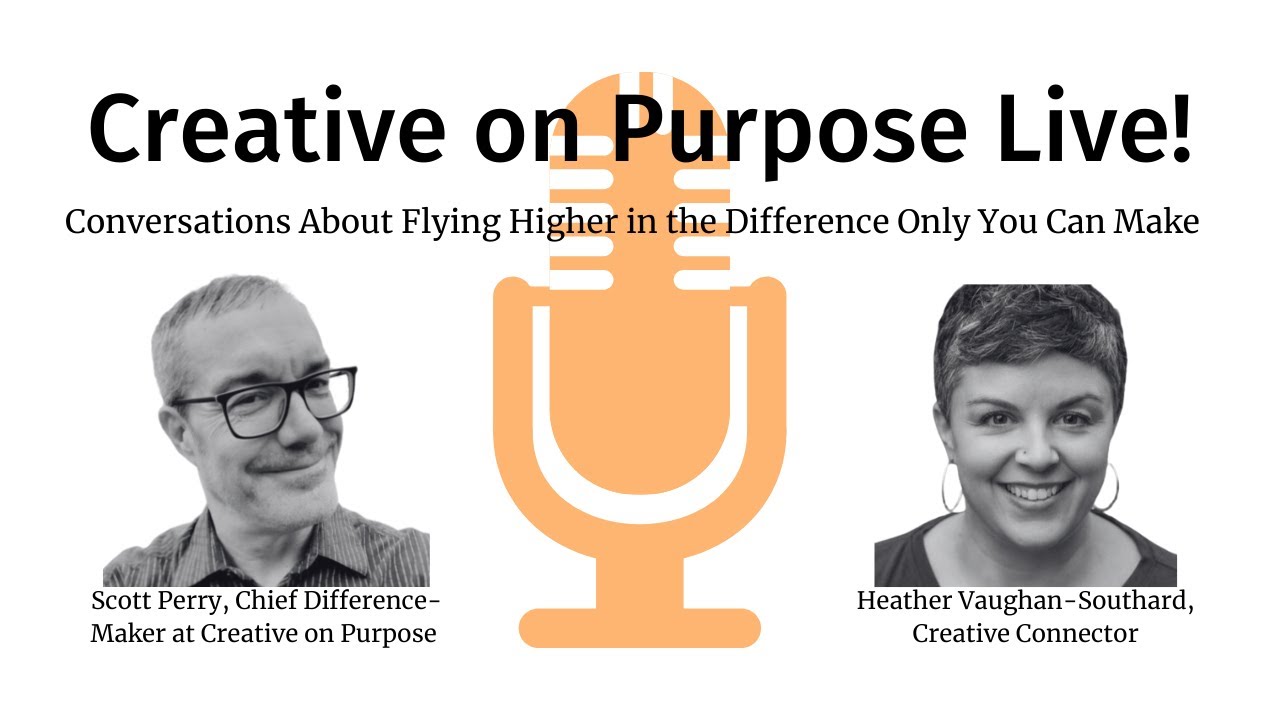
Heather Vaughan-Southard, a former dancer, explains how the body signals safety and creativity through the vagus nerve. She teaches social-emotional learning through movement in schools, and learned from a failed attempt to bring trauma-informed dance to a competitive program that she needed to honor her own rhythms instead.
Chapters
Go, go, go! And yeah, just like that, we're on LinkedIn, Facebook page, and YouTube. Welcome to Creative on Purpose Live, conversations with inspiring difference makers to help you fly higher in endeavors that matter. I'm your host, Scott Perry, author of Onward!, head coach at Akimbo Workshops, and Chief Difference Maker at Creative on Purpose. If you're ready to beat burnout and make a bigger difference by making better decisions, visit creativeonpurpose.com and grab your copy of The Burnout Solution. Let's meet today's guest, Heather Vaughn Suthard. Welcome to the broadcast. Please tell our viewers who you are, what you're up to these days, and where can people go to learn more about you and the difference you're making?
Great. I am Heather Vaughn Suthard, and I work in helping people connect to themselves, to others, and to big ideas in the world all around them. I do that by teaching social emotional skills specifically by applying polyvagal theory and teaching folks about embodiment, and in particular arts educators, therapists, and other professionals who have to work with other people, which is basically all of us. You can find me on LinkedIn and a couple other places, but that would be the best place to connect for now.
Fantastic. So Heather and I were just conversing off camera that she is between websites at the moment. We're going to put her LinkedIn profile down in the in the comments below each of the platforms. And when she has her new situation sorted, we will make sure that there's a link in the comments for her new digital home. Um, you just laid a bunch of really interesting things out in what you do, uh, and you're using big words that have many syllables, not all of which I understand. Um, the one that jumped out first is embodiment, which just Sounds like a really juicy place to dive in. And so explain a little bit more about what embodiment is and why it matters.
Mm-hmm. So embodiment is basically how we inhabit our bodies, how we can sense the cues within ourselves that serve as our internal compass. They help us read signals of safety and non-safety from other people. They help us understand our own experiences so that we can take that information and make decisions about what comes next. So in my background, I came through professional dance and was a dance educator for many, many years and still work with arts educators. So I came from that lens of, of my body really becoming the instrument of how I got to know myself. And then as I started to work with others and realize these are the common threads that we have, and these are the distinctions that we've had based on our lived lived experiences, when we take that information and we align it with where we would like to go, then we've got a strategy in place for how we can start to work to get there. So I find that when we value our own bodies and the information that we have from them, then we start to care more about the other bodies that we are in community with, and then we start to take care of each other more effectively and more compassionately, and then we, we can create a better home for all of us.
Mm. So what leaps up for me is, um, I don't recall having any issues with discomfort in, in my being in my body and in my skin when I was, um, an infant, a toddler, a young child. Um, I do recall some issues in my teenage early adult and mid-adult years. What's, uh, you know, so it sounds in some ways that you're kind of helping people return to the garden of their toddlerhood. Um, what are the forces that conspire against us that, that make us, you know, that, that cause this dissonance, um, between ourselves, however you define that, and our container, um, our bodies?
Oh gosh, there are so many. Things that sort of can create that divorce, if you will. You know, Ken Robinson always talked about the body being the vehicle that takes our mind to other meetings and other experiences. And I think to a large extent, we're conditioned away from our own physical embodied truth, right? Like you need to finish the food that's on your plate, or you need to not pay attention to the resistance that you might be having about going into the school you're hanging out with this particular person or another, they're your family member or they are this, and so you need to override those signals and move into the world and just do it because that's what we need to do. And I think a lot of the work that I do with clients is helping them return to what those signals are and to realize that they are not necessarily good or bad, they're information. And when we can treat that information as a gauge helping us understand, you know, sort of where we end and other people begin and what is the tension of that space, then we can make some stronger determinations about, is this an appropriate response that I'm having? Is this a response that is informed by some other event at some other point in time? Or, you know, do I have enough time spent in activities that make me feel really good and connected to myself so that I have more resilience when I'm facing these obstacles. And so we take a fine-tooth comb to those experiences and figure out, okay, what has it been for you? Is it— was it the home, or was it an event? And we don't get into great detail, but just a broad scope of understanding why. And then, oh, by the way, there's a lot of science behind this that helps you understand that there's nothing wrong. You just have information that you've been ignoring, and let's reintegrate that back into your system so you can be happy and healthy and vibrant.
Yeah, I love it. It's, um, one of the things that we do pretty— with some frequency here at Creative On Purpose is we do— we talk a lot about signals, the signals that, um, we send and the signals that we interpret. And it seems like in your work what you're, um, kind of helping people work through is, you know, number one, we have signals that come through the media. This is what a ideal male, female body looks like. Um, and it's easy to demonize that and say, you know, it's all their fault. And, and I'm not saying that it's not any of their fault, but, um, at the same time, you know, I think there's also just a lot of things interpersonal in our interpersonal lives. And you mentioned, you know, it can come from your family life as a young person. It can come from your peer group. It can come from, you institutionalized education and just the way that we're taught to, you know, taught what the normal way of being is. And so, but the other thing is that I assert that, you know, we all have different temperaments and tolerances. Like there are people that just never really seem to have that issue with, you know, they just seem very comfortable in their skin and like they were just born to be who they are the way they are and to walk through the world in, in that way. And then there's some of us that, you know, also experience a lot of, um, shame, suffering, self-loathing, fear, anxiety, all these things. And so it's, it almost sounds like at some level that there's a therapeutic element in what you're doing in your work to help people, uh, get from where they are to where they want to be. And the thing that is really leaping to my mind that connects your work to mine is, you know, we're helping people re-engage with their creative instinct and to apply, you know, their natural curiosity, childlike sense of wonder, childlike courage to seek the edges of their understanding and ability and grow and develop skills and thereby grow confidence. And, you know, I often start with, you know, it's actually not your fault. Like, you have, you know, we're all in this system, again, institutionalized education, institutionalized occupation that are telling, you know, that have been feeding us a steady stream of stories that actually take us outside of ourselves and don't let us do the work from the inside out that could really help. So that was just a big brain dump based on what you were just sharing. So willing to hear any reflections on any of that.
Yeah, well, you know, what you're describing in terms of the signals, I mean, that relates to, um, back to embodiment, right? So polyvagal theory, Dr. Stephen Porges talks and teaches about, um, the vagus nerve and its and its impact in us being able to shape our experiences, right? Our nervous system states really guide how we interact with the world, and our bodies are helping us understand the signal. So there's neuroception that takes place below our conscious level that is helping us like constantly assess what is safe, what is not safe, what would I like to move toward, what do I need to move away from, and how am I going to self-protect? And everything is in, is in support of that self-protection. And So when we can get to that place and we start to build more safety and connection, that's when creativity and confidence and all of these other great, wonderful things can start to emerge. And I teach that also in the work that I do, talking about social-emotional learning in and through the arts within K-12 schools, because that's the goal, right? In order to enter that zone where we can really truly learn, our bodies have to feel as though they are safe enough in order to receive that information. And so the artistic practices can help us live in that space more frequently. We call it ventral vagal, so that we can access our best selves and allow ourselves to have that sense of freedom that we really want to capitalize upon, especially when we're moving into new spaces within our professional work as adults.
Yeah, well, I'm grateful that you're doing this work with young people. I think it's profoundly important and probably helping people start to lead happier, healthier lives inside their own bodies at an earlier age. I guess, you know, so your work is really fascinating. It's definitely— I can see that it makes a profound difference in people's lives. I'm just— you shared a little bit of how you got here through the world of dance, but I wonder if you would just be willing to share a little bit more of your origin story. Like, how did you get into this, you know, fascinating realm? And, uh, and not only that, but it sounds like you've developed your own approach to doing this work. So I'd love to hear how, how that arc looks. A lot of the folks that are tuning in are people like you engaged in making the difference only they can make through an endeavor that serves others, or they aspire to do that. And so origin stories can be a really helpful way of seeing that compasses work and you can find your own way.
Yeah, finding my own way has certainly been the theme. So in my own upbringing, I started dancing really early, and that became clear that that was my lifelong passion. And it allowed me to have a sense of consistency and access to myself when I was going through times of trouble. So I lost my mom when I was very young, and you Through all of that and the tumultuous years of teenage experience, dance was the constant. So that was a place where I really could feel the most stable and the most supported in many respects. And so, I moved through a career in professional dance, received degrees in that, including an MFA, and started teaching in public schools. And I was teaching a dance program and working with students that really were outside of themselves. Having a hard time staying in the moment, staying in the classroom, staying in their learning and in relationship with other people, including their teachers. So a large portion of what I was doing was applying research that I'd done in grad school in terms of, well, what is post-traumatic stress and how do we alleviate that through movement? And then I find myself in a K-12 teaching experience working with predominantly a population that has, you know, significant trauma experience. So the winding path of life takes you in many different places, and I ended up leaving the classroom and moving into private practice working in Pilates, but also just always with this focus of how can we help people stay with themselves so that they can stay with others. And that work has just continued to flourish. I came— started working with the MIAA Project for Michigan Arts Education Instruction and Assessment Project, but also engaging with the Polyvagal Institute, and all of these things merge so that I'm able to do my own work. I still have some private clients. I'm teaching teachers how to engage with this in their classrooms. And then we're looking at policy. How do we make sure that kids have access to the arts? Because for me, social-emotional learning, that's what the arts are doing while we are creating rigorous artistic experiences for kids. So it's not that just the arts boost math skills scores, but they are really a key component and a really strong vehicle for helping people become more regulated in their nervous system states, how to access themselves in that state most consistently, which then moves the needle in terms of processing past responses and reformatting their lives. So that's how I've gotten to where I am, and I feel really fortunate to be able to do the work that I get to do in lots of different contexts. And layers and with lots of different kinds of collaborators.
Nice. It's interesting. It's really— what I love about hearing people's origin stories is I can see that, like me, it probably made no sense as you were going forward. But when you get, you know, wherever you are, you look back and say, oh yeah, there's that, that through line. There's that theme that, you know, things were unfolding just the way they were meant to. But it feels like it must have been, you know, quite, you know, on a day-to-day basis or a year-to-year basis, it probably felt a little confusing and possibly like you were really navigating a lot of uncertainty along the way.
Yeah, and a lot of uncertainty, and I think a lot of concern about the closing doors and what else What skills do I have that lend themselves to something else? And it really became an opportunity to just sit with the questions that I find most valuable for myself and then follow that thread. So it really has become a career about chasing interesting questions more so than this is where, what I do and who I do it with. Because at the core, I still feel like I'm dancing. I'm not physically performing. I'm not physically teaching dance. In the same way anymore. I still occasionally teach movement experiences for people so that they can use it as a, as a tool to, to reimagine the challenges that they're facing. It becomes a metaphor in many respects for their lived experience, and the rehearsal space becomes not just a way for them to rehearse movement, but really to rehearse life. So it's been confusing, and it's been there have been moments of panic. This is closing and there are few dance jobs in, in K-12 schools. What do I do and how do I do it? But it has also been so rewarding when I've been able to just really focus on this is the next piece that I feel like I can serve others with. And then connecting those dots has led to a lot of opportunity and fulfillment. Yeah.
I love what you said about even though you're not teaching dance, that you still— it's a powerful metaphor. I was a musician for 30 years and I haven't played a gig in over 3 years, but I still look at the world and make sense of the world and bring musical metaphors, whether it's around rhythm, harmony, dissonance, consonance. I mean, these are— there's just ways of being that are still so deeply attached to that former identity. So I mean, and I still see myself as a musician, even though I'm not actively performing. And I love that you were, you were bringing that in. That was really, it was really powerful. And you've also shared a couple of times now, something else that's really important to the audience here at Creative On Purpose, which is this idea of doing this work with and for other people, that this is like part of who we are, is, you know, we're creative beings. And we are conscious beings, but we're also social beings. And we enhance our lives most through endeavors that serve others is something that we say here quite often. I'm hearing a similar theme in your work. And so I'm wondering if, you know, that probably looks a lot like you've had mentors that have helped guide you. You have students that you're teaching and you have peers that you're working with. And I'm just wondering if you unpack a little bit more about your thinking around, you know, the people that you do your work with and for and what value that brings to the work that you're doing.
Mm-hmm. Yeah, I mean, I think something that's always guided my experience was that I've been willing and interested to learn from everyone who's around me. I remember I had a professor in college at one point say, you know, what's been interesting about watching you move through the program is that you, you engage with the younger students as well. Um, and I, it didn't occur to me that others may not do that because I just felt like, oh, well, that's another person that I'm working with. I'm, I'm interested about what makes them them and how I can learn from that experience. And certainly in the classroom, or working in a school community, there were older administrators that really guided my thinking in terms of what I was doing with students. But then when you're engaging in real content that is meaningful to real lives, you see what's working and you get that feedback really quickly. And kids will give it to you the fastest and the most directly, which has been invaluable. But I think we are all in community, right? And I have a colleague, Nafissa Simonette, who talks about the Massai warrior saying, "How are the children?" And that being a determination for how healthy and vibrant the community is functioning. And I've been thinking about that in the weeks and months since she shared it. And I just, I feel like we have the obligation to one another, to do what we can to take care of ourselves and therefore take care of each other. And when we do that, all boats rise, right? So I consistently think about not work just being what it is and how I can brand myself and make a difference in that capacity, but truly, where is it functional? How is it articulated? Is it meaningful? And how is it— how does it get expressed? So those become tenets for ways that I think about every session that I have with a client, or if I'm working with a team of professionals on community building and strategizing and problem solving. And then how does that ripple out to the, to the ultimate community experience? We want all of the children to be well, and we are all children. At the heart.
Yes, growing older is required, growing up is optional.
That's right.
I couldn't agree more. What was the— can you just— I think you said it was a Maasai proverb. Can you restate that for us?
And how are the children is the question that's asked, and then the traditional response, as I understand it, is, and the children are well.
Nice. Love that. That is really, really powerful. Thank you. I'm always eager for new quotes to add to my very large quiver of quotables. We're coming close to the end of our time together, Heather, and one of my favorite questions to ask, and you are welcome to ignore it and I'll come up with something else, but, you know, part of Being a difference maker is embracing uncertainty, navigating adversity, and knowing that much of the time you will be— you'll be experiencing far more failure than success if you're doing work that's actually worth doing. Because if you're doing work that's actually worth doing, that makes change happen, you are going to be breaking or bending the status quo. You're going to be seeking the edges of your understanding and abilities. You're going to be trying things that might not work. A all these things that you and I have talked about in the past in Seth Godin's Akimbo workshops. And so is there, um, is there a moment that maybe in the moment felt like a mistake or a failure that, uh, you now see was a learning opportunity or provided you with a really important lesson that helped you do what you do even better, um, you know, in retrospect?
Mm-hmm. I was teaching dance in a public school that in that particular community had a strong dance training environment that was really heavily competition dance. And I was offering something that was really distinct. My career had been in concert dance in Chicago, New York, Los Angeles. I had been a choreographer. My intent and approach to teaching was really, really distinctly different from what they had experienced. In the program prior to me, but also in the community outside. And started off great, but then things really, you know, got rocky because I was introducing ways of thinking and ways of being that were challenging everything that had been sort of experienced before. I was challenging the concepts that had been taught as values before. I was introducing a much more diverse and inclusive lens then in dance, as well as, you know, where does it come from and who is moving and how do we value, like, social dance compared to other kinds of dance. And it feel— it felt at the time like an absolute failure. And I thought, I've never experienced failure to this extent before. How is this possible? And looking back, it was the pivot. It was the place where that opportunity was coming to a close, but it was really pushing me to understand what is my personal value and what is the change and difference I want to make in the world. And I could really see that the students that were in front of me were just as challenged as those that had been in a different district. That had really clear adversity, but they were engaging with it differently, and in fact, they weren't acknowledging it at all. So while I was seeing similar stress responses and trauma responses in behaviors and so forth, it wasn't something that we could talk about. And that became clear to me, I need to be in an environment where I can really use movement is healing, and that I can really work with people who are interested in engaging in what it means to be human and what it means to be in relationship with other people outside of these status quo measures of what success looks like and what we think it should feel like.
Wow, that is really powerful. It's a— so, so A lot of threads to pull on there. But I just want to highlight number one. You were kind of pointing to this, I think you said, my value. And I think worthiness is such a— worthiness is the fundamental issue that we're all wrestling with. And, and I do it with myself and with others in my work, I can definitely sense that it's something that you're helping others see and express their worthiness, their value, um, and invest in that. That's the other thing is this idea that we're, um, we trust ourselves enough to invest in the difference only we can make, and we embrace this process where we're probably going to, um, fail much more than we succeed, but that's how we make forward progress in what we're doing and how we make— and it's That's how, you know, we're able to make change happen. What I was hearing in your story is, having been in academic institutions myself, you know, I've, I've witnessed this firsthand too. It's like they, they got it, they got it all figured out and they're just doing it this way. This is, this is, this is what we do. Don't rock the boat. We don't need your new ideas. We don't, you know, this, this works good and this works for, you know, the average. And it's really, yeah, I really respect that you, that you, that you, that you saw that and stepped through that. So that was a profound story. Thank you, Heather. So as we're coming up to the end of our time together, you've already dropped several pieces of wisdom. In fact, we have one person on LinkedIn that has wanted to make sure that they see that they are saying thank you for the wisdom that you shared today. And I'm just wondering if there's, you know, is there one, one tip or lesson or idea that you haven't shared yet that you think would be of value to someone like you that wants to, that trusts themselves enough to invest in themselves and to, you know, either aspires or wants to advance in the difference only they can make? Is there just one last piece of wisdom that you'd be willing to share?
I think it would be to be patient. There's seasons, you know, I've had a portfolio career and I have a family and I have really big ambitions and sometimes it can feel like it all has to happen immediately and I've come to learn that sometimes things work best when I treat them as if they come in seasons. So sometimes it's, I push this forward and other times I push that forward and it's all still contained and it's all part of the work or part of my life. But it's okay to have varying focal points at any one time.
I really, really appreciate that. Yes, patience is indeed a virtue that probably most of us could practice more often. I really appreciate that. And I want to thank everyone for tuning in. Heather and I really appreciate you lending us some of your valuable time and attention. We hope today's broadcast motivates you to lean into an endeavor that matters with greater curiosity and courage. You can learn more about Heather at her LinkedIn profile, which is down there, and we're going to put it in the comments below because it's probably hard to memorize. Um, she will have a new site up soon, and when she does, we'll make sure that you know all about it. And of course, it's always great to see you at Creative on Purpose as well. Now take the insight and inspiration from this conversation and start flying higher in the difference only you can make. Heather von Suther, thank you so much for your time and sharing your wisdom with us today.
Thank you, and thanks for doing this for others, Scott Perry. What a gift.
More from Scott



Stoics Don't Suppress Emotions, They Do This Instead #stoicism #emotionalintelligence #mindset







