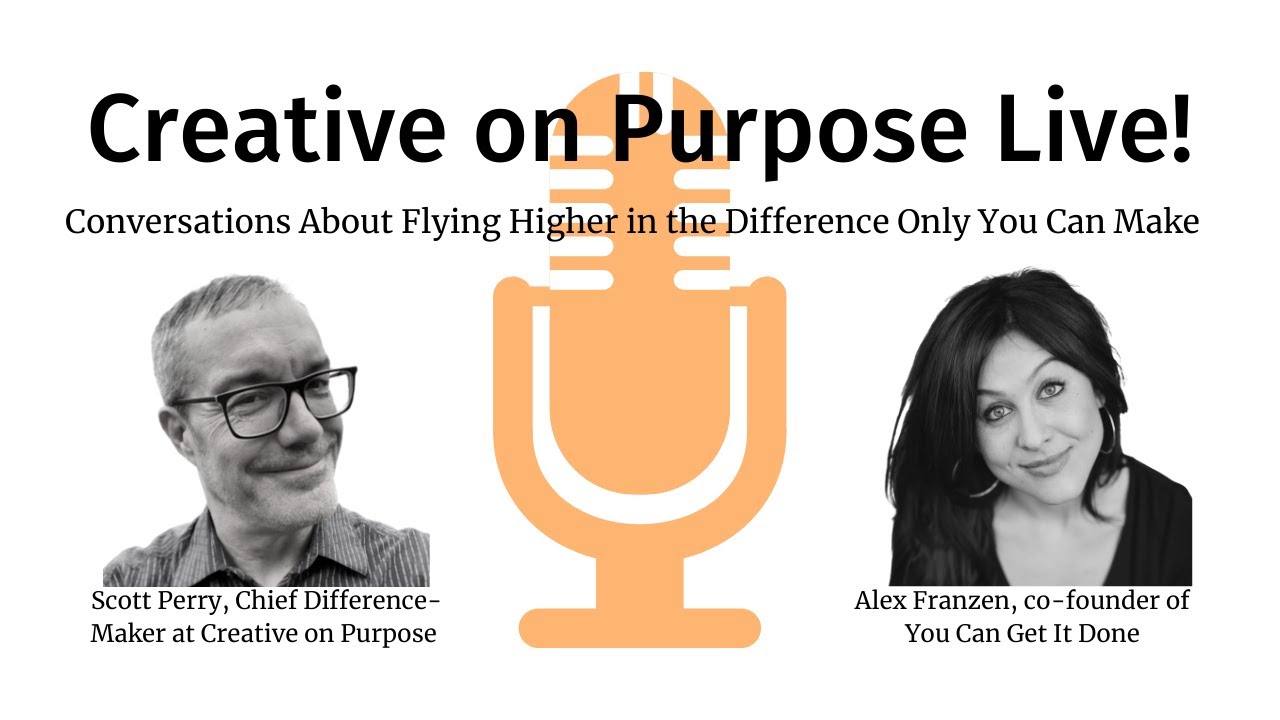
Alexandra Franzen talks about building a writing business without social media, running her "You Can Get It Done" course, and finding clients off-platform. She shares strategies to manage your time and attention, avoid burnout, and market yourself without relying on the feeds.
Chapters
Zipping across the ether, and just like that, by magic, we are live on LinkedIn, Facebook, and YouTube. Welcome to Creative on Purpose Live. These conversations are about flying higher and the difference only you can make. I'm your host, Scott Perry, author of Onward and A Compass, helping difference makers like you navigate adversity with greater equanimity at Akimbo Workshops and Creative on Purpose. You can visit creativeonpurpose.com to grab your copy of The Burnout Solution. This season, we're drawing insight and inspiration from guests making things better, doing work that matters. Let's meet today's guest, Alex Franzen. Welcome to the broadcast. Please tell our viewers who you are, what you're up to these days, and where can they go to learn more about you and the difference that you're making?
Ah, thanks for having me. Um, I am a writer. I'm an author. I'm also the co-founder of a company called Get It Done, and we offer writing, editing, marketing, publishing services to help people write books and do other cool things like that. And, uh, what am I up to these days? I'm, uh, I'm living in Hawaii. I'm moving. Half of my life is in boxes right now. I'm sitting on a rubber bouncy ball because most of my office furniture has been packed up, and I'm excited to be here with you.
It's fantastic to have you on. So just last week at this time, or maybe a little bit earlier in the afternoon, we had, uh, another member of your rogues gallery. Miss Lindsay Smith was here. And, uh, so just the interest of transparency and full disclosure, I met Alex and Lindsay through one of their programs that I highly endorse. It's How to Market Without Social Media. Uh, ironic that we would talk about that here when we're simultaneously broadcasting across 3 social media platforms. But that's, uh, one of the things that I learned from that workshop, and I'd love for you to highlight that and anything else that you have coming up, Alex. One of the things that was really interesting about that workshop is you weren't necessarily advocating to just cold turkey quit social media. It was really the way I understood it, like, let's just, let's hit a pause button if, if, if you could use a break, and let's think about how we can use and leverage social media a little bit more intentionally and with a little bit more integrity. And also remember that before there was social media, there was still marketing and all of those things still work.
Yeah, that's exactly right. So my personal story is I've been self-employed, I've been an entrepreneur for over 11 years, and I deleted, I made the personal choice to delete all of my social media accounts about 7 or 8 years ago, and it just felt like the right choice for me. I'm not saying it's the right choice for everyone, but what happened is that once I made that decision, a lot of my clients and friends and colleagues were really curious, and they started asking me, why did you do that? And how are you finding customers? And, you know, what— how, how are you doing marketing without social media. And after kind of having private conversations and email chats with people about that topic for many years, I decided, you know what, I wanna teach a course on this subject because I think there's a lot of people who are curious to figure out, do I wanna use social media as part of my marketing plan? If I use it, how can I use it in a way that feels good? And if I decide not to use it, what are my other options? What else can I do to find clients and customers and sell my artwork and my music and books? So yeah, exactly like you said, the message I'm trying to put out is it's not social media is good or social media is evil. It's just that it's optional. And if you choose not to use it, there are hundreds of other things that you can do to spread the word about the work that you're doing?
Yeah, it was really, really super powerful. The first thing was, um, for me was just taking a break from all the platforms that I was on. So, uh, you know, that just like realizing how much bandwidth and how much of my valuable, irrecoverable time and attention it was being eaten up on social media and also looking at, um, how little actual ROI I was getting in terms of traffic to my site from all these various platforms. And so one of the things that came out as a result of my engagement with the workshop was, number one, uh, I did use some kind of more old school approaches, more direct, specific, and intentional and clear communication with people I had either worked with in the past really who I— who are in my sphere of influence and connection that I wanted to work with, um, and just using snail mail and email and, you know, more direct personal, uh, person-to-person communication. The other thing is, when, when I kind of ended my fast, uh, from social media, I decided, you know, I really think that there's probably value in leveraging LinkedIn. That's a professional platform. That's where, uh, people that are in social impact investment and other social impact ventures are connecting. I'll keep that one. And I just recently, on— as I promised in your workshop, on my birthday in mid-August, I deleted Instagram, Pinterest, and Twitter. I'm keeping Facebook so I can keep my Facebook page, um, and YouTube is just YouTube. I, I don't even play there. It's just that it's a nice vehicle for broadcasting these conversations. Uh, and what's amazing is I'm getting way more traffic to my site now that I'm just really leveraging one platform. And my open rates to my emails have gone from 25% to 33% in less than a month.
Wow, that's interesting. And yeah, I mean, you're like the exemplary poster child of what I, what I hope students in that course experience, which is taking a break from social media for a short time, noticing how that feels. And a lot of people report back like, wow, I, I feel like I can hear myself think again. There's so much less noise in my brain. It feels so good to do a detox from social media. And then after that, just like you've done, with that newfound space and calm, making some intentional decisions about, okay, well, what's working? What's not? What do I want to keep? What can I eliminate? How can I focus on the things that feel good and that are actually delivering results and remove a lot of the just noise and busywork from my profession? So I love that you've been on that journey. Congratulations on deleting some profiles that felt unnecessary and also congratulations on focusing on the things that work. That's great.
Yeah, well, it's just, it's really enabled me to connect with the right, more of the right people in the right way. And, uh, and it's also, and on LinkedIn where I am present, I've also been able to really just dial in like what I want to talk about and kind of maintain the theme of the journey that I'm, uh, inviting the right people to take with me, which is how you can You know, that burnout and overwhelm are real. Um, so is equanimity and joy. And by making better decisions, we can leverage, uh, ourselves into a situation where we can experience more of the equanimity and joy and less of the burnout and frustration. Um, and, you know, your approach with the social media was a big part of helping me see the virtue of that process. Uh, You know, burnout happens when you expend resources you no longer possess— time and attention and energy. And all that time that you're spending in terms of time, energy, and attention on social media, that's time that you can't use elsewhere. So yeah, for those of that might, um, be considering checking out You Can Get It Done and, uh, you know, looking into taking the workshop when it happens again— when, when is that? And maybe Is there just one or two tips that you can share now with people that might, like things that they could explore outside of social media that might help them reach more of the right people?
Oh yeah, okay. So first of all, yes, we're going to offer the Marketing Without Social Media course again. It'll be offered in 2022. I believe it's going to start on March 1st. We might change the date, but probably March, marketing March. So in the meantime, if folks are interested, they can go to our website. We have kind of like a waitlist that you can join if you'd like to be notified once it's available again. And in the meantime, yeah, I have quite a few suggestions actually. I would say if you're someone who's feeling like, whoa, social media is just gobbling up my life. It takes up so much of my time. I'm checking Facebook first thing in the morning. I'm checking Instagram in bed at night. I'm looking at Twitter on the toilet. It's like, it's just eating up so much of my time and energy. If you're feeling that way, and if you're feeling, um, concerned, you know, that maybe social media is starting to harm you more than it's helping you, um, some things I'd recommend first and foremost, like we mentioned a moment ago, I'd say start by doing a brief social media detox. Just step away completely for even just one day. Step away for a day, for a weekend, for longer if you want, and just give yourself a chance to rinse out your brain and regulate your emotions a little bit and bring those stress levels down. Right. Because when we're in that state of stress and frenzy, when our stress levels are spiking, we actually temporarily lose 10 to 15 IQ points. So we literally get a little stupider when we're stressed out and we can't see options that might be right in front of us. And that's a fact, Google it. It's been reported in the New York Times. The more stress we feel, the more our IQ suffers temporarily. So that's the first thing. And then once you've done a bit of a social media detox or you've done something else to bring your stress levels down, then start to look at all the options because there are so many options. Um, I actually have a list on my website. It's free. It's a free resource of 21 different ways to do marketing and find clients and customers without social media. And some of the things on the list might seem obvious, like, you know, create a brochure and mail it out, or email a past client and ask if they'd like to hire you again. So some of the steps may seem obvious, but it also might be things that maybe you just haven't done in a while that you'd like to do again. And then there's other ideas on the list that are a little more quirky, a little more guerrilla marketing type things, but You know, whether it's sending a press release to the media or circling back with a former customer or partnering with another business owner who can refer clients to you and you to them, or doing a free info session to let people know about what you offer. I mean, I could go on and on and on. There are so many possibilities and so many different ways to get the word out that don't require Facebook, Instagram, et cetera. So first detox, first rinse out your brain, get into a calm state, then go take a look at that list of 21 options. And I can provide the link to you if you want to share it later. Please. Take a look. And as you're going through that list, just take a note of which options leap out at you. What are some things you'd like to try? Maybe you feel like, wow, I would love to send a personal thank you note to the last 10 people who hired me just to say thank you and reconnect and let them know that I'd love to work with them again. That's something simple, that's something small. I can begin with that, and just that simple act alone might lead to 5 new bookings or, or word-of-mouth referrals or something like that. So I think the, the main thing I want to impart is that there are so many options, and often marketing is much simpler than we think, and it's more— it's less about posting a million things on social media and more about connecting with people in a genuine way. Sometimes one-on-one, you know, an email, a text, a thank you note, these kinds of things can make such a difference. That's my spiel on what to do in the meantime.
Yeah, that's fantastic. And we'd definitely love to share the link in the comments later on after the live broadcast. One of the things that you said that I just want to highlight is that social media is a tool, and I totally agree, and I love that framing because any tool can be used for good and can also be used for ill. You can build a house with a hammer and you can smash somebody's skull with a hammer. You can get a message, you know, worthwhile message out on social media, and it can be a very seductive place to hide from doing the real work because what it provides you with is, number one, the, the reward of dopamine. And then, but the other is all that time you're spending on social media feels like real work because you're doing things. It's just that you're not doing things that are very effectively connecting you with the right people and leading you to, you know, working relationships with the people that you're, um The other thing is that I, that I really have found, uh, I still need to, to, to watch out for is there's this kind of false urgency that happens on social media that you, you end up thinking about things and doing things that are really out of alignment with your core values and beliefs, but you, they're so visibly being practiced by other people on social media. Like, it feels like it must be okay to yell, scream, spam, you know, do all the things. Um, and so one of the things, just again to highlight the, the, the tool analogy, is if you decide to stay on social media after this workshop, you will find yourself being much more authentic and human, uh, in the way that you engage. And that was a big aha for me. One of the other— so you've shared a little bit about your backstory around social media and how you got off and how you created this workshop. I'm wondering if, um, if you wouldn't mind just sharing a little bit more of your origin story. Like, what was the work that you were— were you doing other work before you became, uh, you know, completely self-employed? And how, how did those adventures kind of inform the work that you're doing now?
Yeah, absolutely. Um, well, before I became self-employed, I worked in public broadcasting. I worked for a large public radio producer in the U.S., and at the beginning it was my dream job. I've always been obsessed with radio and books and publishing and just storytelling in all forms, as I know you are too. And so when I first got that job right out of college, I felt like this is a dream come true. And in many ways it was, um, but like many people, after a couple of years working for a very large organization and having a 9-to-5 schedule and a cubicle and endless meetings that could have been an email and like all of those things, after a couple of years, um, I was really feeling burnt out and I was really feeling like I'm not sure if this is the path for me. And I remember, you know, looking at my boss and looking at his boss and sort of seeing the trajectory that I was on and asking myself, do I want my boss's job in 5 years or 10 years? And my answer was no, I don't, I don't think I do. And So that was a real— it was kind of my first, like, professional emotional crisis, you know. What, what have I done? I worked so hard to get here and I don't want to be here anymore. Um, and it was around that time that I also started feeling like I missed writing. I had always been a writer. I'd always, you know, done all kinds of creative projects in high school and college, and then it just kind of stopped when I started working full-time. And so I decided I want to do that again. I want to see if I can somehow find a way to make a living as a writer. I don't quite know what that's going to look like yet, but if I could be self-employed and keep a roof over my head, I'd be stoked. So that was kind of where I was at about 11 or 12 years ago. And I ended up taking a pretty big risk. I basically decided I'm gonna quit my job, I'm gonna give myself 1 year, and I'm gonna look at it as an experiment. I'm gonna say to myself, uh, I'm gonna try some way or another, by hook or by crook, to earn some money as a self-employed writer. And if it completely fails, if I crash and burn, if I blow through my meager savings and I— it just all falls apart after one year, I can always go get another job. I can always go do something, but I'm going to give it a year and like really try in that year to make this work and just go all in with everything I've got. So I quit my job officially. It was April 1st, 2010, uh, was my Independence Day. And then off I went. And, um, like so many self-employed people, that first year was just a lot of trial and error and trying a million things and throwing spaghetti against the wall to see what would stick and just kind of trying a lot to figure out what was going to work. Um, but little by little by little, the pieces started to fall into place. And for the last 10 years or so, I've been able to have a wonderful life working as, as a professional writer, as a copywriter, as a ghostwriter, later in book publishing, and then later really launching my own company, and it's been an amazing journey. So, but yeah, it started with a big mess and a lot of experiments.
I would say, well, I love, I love your story, uh, your origin story, and I love that you swung for the fences and it worked. Um, when I decided to leave the security of, uh, you know, a steady gig of my own to pursue a career as a musician, the promise that I made to my wife was, I'm going to do this as long as I make enough each day to do it again the next day. And if that ever— if, if that ever doesn't happen, then I'll just go back and get myself another teaching gig or get another, another straight gig. And I ended up doing well enough every day to do it again the next day for 30 years, uh, and, you know Sometimes it just takes that, you know, putting it all, going all in and doing what you can and what you have to do, you know, to live the dream. So I love your story. I also appreciate that you shared that, you know, there was a lot of trial, a lot of trial and error. I'm wondering if there is any one specific moment where maybe it,, you know, felt like a failure at the time or felt like a mistake at a time, but, uh, you know, you were either able to flip that into an opportunity or just learned a really powerful lesson that really helped you level up and, and step into a brighter possibility beyond, you know, that moment.
Oh my gosh. Yeah. I mean, one, one memory that is forever emblazoned in my mind was Maybe 6 months or so after I had quit my job. Um, at the moment that I quit, I had saved a little money, like enough to kind of eke by just in case. Um, but that quickly ran out. And about 6 months after I quit my job, there was, it was just a convergence of a lot of things all at once. I had an unexpected bill. I think it was like a car repair or something. Like a lot of things happen. I didn't have many freelance clients lined up. I had like one project that I was working on, but I wasn't going to get paid for a month or two. Like, there was just all these things happening. And I remember there was one day where I looked at my checking account balance and I had like maybe $800 to my name, and my mortgage payment was due in a couple of days. And it was more than $800. And I had a moment of just absolute terror. And my whole body was just filled with that, like, that adrenaline of panic. And I just felt like, what, what have I done? You know, how am I going to get out of here? And I remember I called my mom. And I had never done this before in my life.. But I begged her if I could borrow some money. And she said no. She said— and she, she could have given me a loan. She, you know, she was in a position where she could do that. It wouldn't have been a huge deal. But she said no. And she said to me, you can figure this out. And I— as soon as she said that, something shifted in me. And I felt like, yeah, I can. This sucks. I don't feel proud right now. But I can figure this out somehow. And after that conversation, I think I cried for a little while longer, just cried, cried, cried. But then I kind of got in, got my ass in gear, for lack of a better term. And I figured out like an immediate short-term plan and then also a slightly longer plan. And my immediate short-term plan was I'm going to get a roommate. You know, I don't want one, I need one. And so I got a roommate, I sold furniture, I, you know, I just did whatever I had to do to at least buy myself some time and bring my stress levels down to the point where I could think clearly and make some smart decisions. And then I hustled, you know, like, like so many early entrepreneurs really need to do. I think that I had been hiding a bit. I'd been hiding behind my computer screen. I'd been, you know, blogging a little bit here and there, but I had not really been assertively putting myself out into the world to email potential clients and ask for the sale. I hadn't really been doing that very much, so I pledged to do that, and I really got serious about it. And I started emailing friends and family and colleagues and former employers and everyone I knew to let them know, hey, I'm available for freelance writing projects. These are some of the things I can do. If you know someone who's looking for someone like that, please put me in touch. And I really started to assertively put myself out there in a way that I frankly hadn't done before. I think I've been kind of waiting to be discovered, um, rather than marching out and saying, hey, I am here. Um, so I did those things, and very quickly things turned around. Um, within a month or two, I was, you know, financially stable again, and things only Improved from there. And of course there were ups and downs along the way, but that was kind of like my rock bottom moment. And it was also the biggest turnaround. And it really just came down. I mean, looking back, like, I'm so grateful that my mom said, no, you can't have $1,000. Like, you need to figure this out and be a grownup and get serious about your goals if this is what you want. So thanks, Mom. Yeah, that was, that was a, that's a moment that I'll never forget. Yeah.
At Creative on Purpose, we call those real love moments.
It's not tough love. Real love moments.
Real love moments. When, when somebody tells you what you actually need to hear, or when somebody gives you the help that you really need, as opposed to the help that you may feel like you want at the moment. So I love that. Well, as our time is winding down here, Alex, we have one final question that we ask all of our guests. Which is, um, you know, this is a show dedicated to people that either aspire to or want to advance in the difference only they can make. And as someone that is making a significant dent in the universe yourself, I'm wondering if there's just one final tip, a quote, a question, a bit of inspiration or insight that you could share for anyone that seeks to, to, to build something or to advance in something where they will be able to make a dent in the universe? If you had one thing, what would that be?
That's such a great question. Um, you know, to kind of come full circle and come back to our conversation about social media earlier, um, I would say the one thing I want to say is really know where your time is going. Um, and if, for example, you feel like, wow, it sure feels like I'm spending an awful lot of time on Instagram, do the math and find out how much time it is. I remember sitting down many years ago with a little calculator and I calculated, okay, if I'm spending, you know, 20 minutes a day on Twitter and 10 minutes a day on Facebook and this and that and whatever, how much time is that per year? How much time is that per decade? How much time is that by the end of my life. And I crunched the numbers and I found that for me, with, with the way I was using social media, if I were to have continued at my current rate, by the end of my life, it would have been about 3 and a half years of my total lifespan just on Twitter. And, and for me, I mean, that number was— it was a, it was a wake-up call moment where I realized I'm not okay with that. That doesn't feel right to me. There are so many other things that I could do with that time. With 3 and a half years, I could get another college degree. I could write 3 books. I could volunteer. I could learn a foreign language. I could make an impact on humanity in a different way. So my advice is look at where your time is going, do the math, do the numbers, like confront that uncomfortable number and ask yourself, what else could I do with that time? Is there something else that I want to do with all of that time? And if there is, then you know what to do next. Um, Yeah, that's my advice.
I love it. Well, that's fantastic advice. Thank you so much, Alex. And thank you everyone for tuning in. Alex and I really appreciate the gift of your valuable time and attention. We hope that today's broadcast motivates you to lean into an endeavor that matters with a little more curiosity and courage. You can learn more about Alex Franzen and the work she's doing at You Can Get It Done at youcangetitdone.com. And of course, it's also always Great to see you at creativeonpurpose.com. Now take the insight and inspiration from this conversation and fly a little bit higher in the difference only you can make. Alex Franzen, thank you so much for the wisdom and for sharing the difference that you're making with us today.
Thank you. It was so much fun. Thanks for a great conversation and just nice to see your face like one-on-one or one-on-many, whatever we're doing right now. It was really great.
Fantastic. Thank you, Alex.
More from Scott



Stoics Don't Suppress Emotions, They Do This Instead #stoicism #emotionalintelligence #mindset







