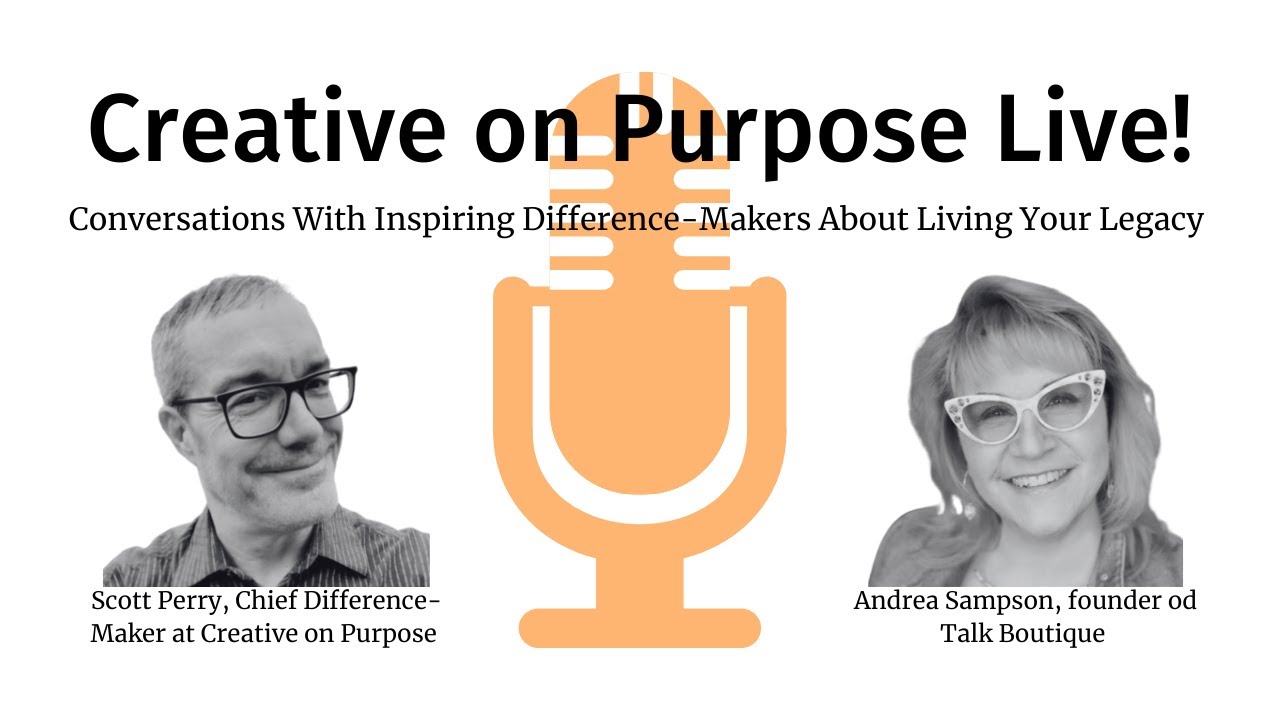
Andrea Sampson, founder of Talk Boutique, coaches experts to become storytellers. She moved from advertising into speaker coaching after volunteering with TEDxToronto, and now helps what she calls "difference makers" translate complex ideas into simple, impactful narratives. Stories are how humans make sense of the world.
Chapters
We are zipping across the ether at the speed of bytes, and it looks like we are indeed live. Welcome to Creative on Purpose Live, insightful conversations with inspiring, inspiring difference makers to inform your quest to live your legacy in endeavors that make things better. I'm your host, Scott Perry, Chief Difference Maker at Creative on Purpose. If you're ready to fly higher in the difference only you can make, visit creativeonpurpose.com and sign up for our newsletter. Get insight and inspiration delivered to your inbox 3 times every week and get a free copy of Trust Yourself, a simple 3-step decision-making guide to getting unstuck and going in the difference only you can make. Let's meet today's guest, Andrea Sampson. Welcome to the broadcast. Welcome. We are thrilled to have you with us. Please tell our viewers who you are, what you're up to these days, and where can people go to learn more about you and the difference that you're making?
Great. Thanks so much, Scott. So as you know, my name is Andrea Sampson. I am an executive speakers coach, and I'm also the founder of Talk Boutique, which is a speaker development and speaker representation agency. What we do is we work with those who want to make a difference in the world. We like to say we help to transform experts and changemakers into thought leaders by helping them to become storytellers so that they can create the impact that they want to make.
Yeah. And just by way of disclosure, I came across Andrea's work through the work of Kylie Slavik, who I'm working with in a program called Conscious Marketer, and was really, really impressed by the conversation you had with her and Richard on their Conscious Marketer podcast. And I love that your work really weaves in some of the themes that we explore detail here at Creative on Purpose. Part of that is the idea of being a difference maker, being a change agent, but also the power and importance of story. I wonder if you wouldn't mind by just sharing first a little bit of your origin story. How did you get to this point of helping other people tell their stories? I imagine that there's a pretty good story of your own in there as well.
Yeah, well, you know, that could probably take all day, but I'll try and give you the short version. I spent most of my career working in advertising. I worked as a very senior executive, you know, in what I was called a planner, which meant that I studied human behavior. I did a lot of research, understood core insights as to why people made the buying decisions that they do. And I came to a point in my career where I knew I didn't want to spend much more time in advertising. I wasn't able to really make the impact that I want to. I came to understand that I'm actually I was an idealist in a capitalist world. And so, I needed to make a change but I didn't know what I was going to do. And the reality was, while there's lots of things I could do after advertising, I had gotten to the point where I really wanted to make a difference in the world. And so, I had this great opportunity. I was volun-hired by TEDxToronto. And I was volun-hired as a speaker's coach. And I didn't even know what a speaker's coach was. But I thought my job was presenting all day, every day. And I love TED Talks, and I figured I'm a pretty smart cookie, I can probably figure this out. Well, that first year in working with TED speakers was incredible because what it did was it opened my eyes to a whole new world. You see, working in advertising, you tend to often be— see that maybe not the worst, but you're seeing sort of the, you know, the more negative side of the world because we're always looking at what's happening and how do we respond to it. And TED was all about looking at the good side of the world. What are the great things that are happening? And so I spent that first year really blown away by the quality of the people I was working with, but more importantly, the work they were doing. And I was hooked. And I spent the next 5 years working, volunteering for TEDxToronto. And I, midpoint in that, realized this was something that was a calling for me because all the work I had done in advertising, understanding core insights for individuals, had prepared me for what I was doing with TED speakers, which was identifying a core idea and building a story around it. And so I had this curiosity, and I am an intensely curious person, of I wonder if anyone would ever pay me to do this. Because up until this point, I'd been, I had been giving it away for free, as they say. And so I decided to open Talk Boutique. And well, now 6 years later, I think the writing is on the wall that apparently it's a good service to have. But, and what we did with Talk Boutique and what was really important for me was that I wanted to really work with people who were doing good work in the world. And in fact, the reason that I opened Talk Boutique, as much as yes, I needed a job because I had left advertising, But really the reason that I opened it was that I could see that all of these amazing people who were doing such good work in the world were so busy doing the work, they weren't telling anyone about it. And I wanted to help them do that. So I thought, well, if I open a speakers bureau, that would help, except that, well, they're not great speakers. And so that was where the speaker coaching came in. And so I wanted to help all of these amazing speakers shift work together to shift what I call the social narrative from one of negative dystopian futures into one of the positive outlooks that I was getting to see in the TED world. And so here I am today working with scientists, academics, technologists, artists, people who have big visions and who are doing great work in the world. We work with corporate leaders who have that same view as well. And I love what I do.
Yeah, I love that. Well, it's interesting that you said you've been at Talk to Boutique for about 6 years building that endeavor, which is about as long as I've been building the brand Creative on Purpose. So that's another thing that we share in common. And I love a couple themes that you wove in that I just want to highlight. One is, you know, you referenced that you kind of were voluntold into this position and, you know, didn't really know what it was that you, you were being asked to do, but trusting yourself that you're a smart cookie and that you could do it. And I think that trust in yourself is such a vital element of anybody that aspires to or wants to advance to the difference only they can make, is they have to trust that they can figure things out, that they have it, possess everything within them that they need to embrace the wonder and the rigor of making whatever happen needs to happen happen. The other is the importance of curiosity, like knowing what you don't know and embracing that unknowing and leaning into the edges of your understanding and ability. There are a couple things that you've referenced that I would love for you to just unpack almost as a definition of terms. You talked about making a difference yourself and that you're working with people that are making a difference. I'd love for you to just highlight, like, what are the elements that you see in the difference that you're making or the difference makers that you're working with? What distinguishes a difference maker from just your average run-of-the-mill human being?
Yeah, that's a great question. And I love that concept, how you're terming it, difference makers. You know, I think for me, what I've come to understand is that there are people out there who are doing work that is impacting us at so many different levels and we just don't know about it. And these are, in some cases, they're scientists and academics who are doing research and studying things that are actually shifting our world. And in other cases, they're people who are purpose-driven, who are working to bring together groups of people who can make changes. You know, I had the very good fortune to be part of the team that brought Singularity University to Canada in 2017 and went on to work with Singularity globally as their certifier. And so that was such an interesting experience for me because this is a network of people who are actually making a difference in the world. And like I said, for many of them, they're discovering new things about our bodies, new ways that our minds work, helping us to live longer or to solve some of the world's greatest challenges, anything from poverty to homelessness to, you know, hunger. These are grand challenges that we have. And, you know, we're— for so many of us that work in this space, we're familiar with the, you know, the UN's Sustainable Development Goals. And that's the level at which many of the people who I work with are working. Now, one person cannot solve these problems. But, but many can. And that's where the communities come in. And so my job, you know, this, and this was a sort of a big realization for myself. I, you know, here I was working with these incredible TED speakers and I'm thinking to myself, wow, what can I offer them? Look at what they're doing. And what I came to understand was that my gift is a gift of communication and what I call translation, really, because what I do is I translate the complex into the simple. And that's a gift that they need it. And it's a gift that the world needs it because without me helping them to do that translation process, others wouldn't understand their work or the importance of it. And without understanding the importance of it, it wouldn't be supported, and then that work wouldn't get done. So while I always am a little reticent to call myself a changemaker, in some small way I do help. And I, and I, you know, so that's So that's sort of my view on the, as you call, the difference makers and what they are.
Yeah, I think that I really appreciate you sharing that. What I was hearing is that to be a difference maker is, I heard 3 things: people that are purpose-driven, people that are problem solvers, and people that have a unique perspective to share about a common challenge or situation that needs to be addressed. And I love that you also pointed to that vulnerability of, you know, I think all of us are challenged to embrace our power at making a difference and to acknowledge that in our own way, every single day, in our day-to-day relationships and routines, We have a profound difference-maker power in just our conversations and the work that we do, that we really do. You know, we're— we don't always— we often are told to look for the return on the investment of our time, attention, and so forth. But really, what I think we want is forging meaning and identity through the ripples of influence and the ripples of impact that we have through the the way we approach just our day-to-day lives and our kind of work, you know, our work and our life can be very integrated when we come from this position of wanting to make positive change for the better happen within 4 people we care about. So I love all that you just shared. And then, of course, your, your real superpower as a difference maker is in storytelling, but also helping others find and share their stories. So I'd love to just get your perspective. It's something that we talk about quite a bit at Creative on Purpose because it's how I think we all make sense of the world is through narrative, through storytelling. You know, what is a story and why is it so important?
So stories, look, stories are our lives. Stories are everything that we think of. You know, I read Yuval Harari, his book Homo Deus, and in it he talks about how stories are literally how we exist in this world. Every company that we work for is nothing more than a story. And so, a story is really a collection of information put together in a way that helps us to understand a unique perspective. Now, we tell stories so naturally as humans. We are hardwired for story. In fact, we love it so much our brain lights up. And there's all kinds of brain science around storytelling. But where story really, I think, becomes effective is when we choose to use it intentionally. When we understand that we as humans have this unique ability to create contextualized understanding through stories. Because the reality is we all live the same story. It's just the, the, the details that are different. And so when you think about that, so as I tell you my story and as I give you the unique pieces of my life you are listening to my story in a way that's lighting you up in your world. And when I choose to do that with intention, and what I mean by that is when I have an idea, something I want you to understand, the reason why I'm telling that story, and I intentionally build that story, the details, the information, the sensory data, all of the indicators around that idea, What happens is you become intrigued. And not only do you become intrigued, but that idea stays with you. Now think about that. Think about any TED Talk that you've watched, and we've all watched TED Talks, right? What happens? So you listen to that TED Talk, and if you're at your computer, what happens is you watch it, you're intrigued, it's interesting. You might even kind of walk away and think about it a little bit more. But it likely stops there. The difference, and you said it just a moment ago, it's the conversation which is key. And you see, this is where storytelling is really important because when we tell stories through conversation, they're really, really impactful. You see that TED Talk that you just watched, you might meet up with me a day later and you say, you know, I just watched this great TED Talk and I think you should watch it. And I go, oh, I've already seen it. And now we start talking about it. Now what happens? You go, oh, I got— here's what I got from it. Here's— I love this story because— and then I say, oh really? I didn't take that at all. Here's what I loved about it. Now what's happening is we're connecting. First of all, we were interested in the TED Talk, but now we've got connection happening. The connection happens at a personal level, but what's also happening is that there's a level of understanding that's happening. It's a new understanding of what we watched in the TED Talk, a new understanding of who you are, and a common understanding of the idea because that's what we've done. And so, story helps us to do that. And that's why stories are so incredibly powerful when we present or we give talks because it's not so much the moment of giving the talk where the story is powerful, although it is powerful in that moment. Because we remember it. But what's more important is it's the conversation that happens afterwards in the breaks, the next day, the next time you're talking to someone where you reinforce the idea to yourself and to others because you're telling a story that you heard. And that's what we do. Stories are powerful.
Yeah. One of the things that we frequently say here at Creative On Purpose is choose your story, choose your future. And we are, Stories are how we make sense of ourselves, each other, our situation. You pointed to something really profound, which is, you know, we can be involved in or listen to the same story and have two dramatically different interpretations of that based again on our perspective and experiences, which are idiosyncratic, even though we share a common We're sharing some common themes in the stories that we're telling. I can hear your cat in the background. Just so you know, I have the same situation. As soon as I get on Zoom, both my cats come in and start nagging at me, like, "Why are you talking to that person when I'm right here?" So your cat is telling themselves a story.
That's right. That's right. And he's now joined us. So he'll be with us. This is Milo.
Milo is one of my favorite characters in literature from The Phantom Tollbooth. That's fantastic. Well, I love everything that you've shared, and thank you for that perspective on both difference-making and story. I think those two things go together so profoundly. I think also one of the things that you touched on earlier that I would just love to hear more of your experience around is, you know, I, you talked about Difference Makers are purpose-driven people. And it sounds like you have, bring a lot of purpose and passion to the work that you do. And one of the things that I have noticed is that many of the folks that come in here to share their experiences as Difference Makers really come at it from a values-based, you know, they have strong beliefs, core values, guiding principles that really help them navigate all the uncertainty and vicissitudes that come along with a journey and being a difference maker and making meaningful change for the better happen. So I'm, I'm curious, you know, what are, what are some of the core values or guiding principles or beliefs that inform and inspire your journey in the work that you're doing at Talk Boutique?
Yeah, you know, early on at TOC Boutique, we created our corporate values. And, you know, it was really important to me that we have a set of values that guide us. And those values are, I mean, I think we use them in everything we do. And the values are that we need to, the first one is to create impact. We want to create impact in the world. The second one is curiosity. You know, having a curious approach to the world. The third one is strategic risk-taking because you can't create impact if you're not willing to take risks. And then the fourth one is community. It's about connecting with people. And so when, you know, when I think about purpose-driven values, it is really about understanding first of all, who are you as a person? Because all of us come every day to whatever job we come to with the human. You know, that human comes along with us no matter where we go. And we have to understand what values we each have and how they, how they either align with or are in conflict with the values of those who we choose to interact with. And that could be the companies we work for and with. It could be the individuals that we work with every day. And so You know, for me, I know for sure when I am embodying my values, everything that comes to me comes through the lens of those values. It's when I am choosing, because we all have moments of weakness, to ignore my own values that things shift and that it doesn't get so great. And that suddenly I meet up with people who I'm not really aligned with. And you know, that's what I love about values-driven, purpose-driven lives, is that you can always go back to those values and you can go, oh look, here's where I was out of integrity with the values that I've chosen. And it shows up every time. And you know, it sometimes is a hard lesson and sometimes it's hard to admit that we're the one that created it. Because, you know, you go, really, would I do that on purpose? Well, maybe not consciously, but somewhere along the line I did. And so, you know, so maybe I was not taking the risks I should have been taking, or perhaps I came at it from that place of I know more than anyone else and not let the curiosity open the door. Or perhaps I was, you know, in an insular moment and not inviting community. Or maybe I was more focused on, on, you know, how I was going to get ahead than, than the impact that the work that I do could create. And so these are for me, those are, I mean, those are very personal, but that, that is how I live my life. And I do come back and look at those values and those purposes often. And how is my business serving my personal purpose? And my business purpose and my own personal values because I'm the founder truthfully are the same. They've kind of had to be. But you might work in a company where your values are different from your company's. But that you still need to look at your own personal values and look at are you living to them? Are you in integrity with them? And if you're not, what can you do to make sure that you are? Because That's where life is maybe a little easier or perhaps not easier, but more comfortable.
Yeah. Well, you've used two words that are really near and dear to the work that we do here at Creative on Purpose, which is intention and integrity. And that, you know, that's really for, for us, what's required if you're going to be creative on purpose is you have to have a clear intention and it should be a worthwhile intention that, and it should be made and executed with integrity for your, with your values. And, you know, working with and for people who share your values and need your talents to enhance their lives is that all of that is really, really profound. And I just want to highlight your, the values that you listed, because I think they're really important, is the value of impact, curiosity, strategic risk-taking, which I think is so powerful, and community, all things that we talk about quite a bit here as well. And that idea of strategic risk-taking, I'd love to have you just unpack that a little bit more because, you know, and the curiosity piece too, maybe because my assertion is, you know, we appear to live in a world where people are rewarded for their certainty and their overconfidence. You know, and sometimes we associate this with the idea of being an expert. And what we really more often need and should embrace is that actually the things that, you know, the certainties and overconfidence we have are in things that can never be absolutely certain, or we have no right to be overconfident in because there's so much uncertainty, there's so much ambiguity. There's so much beyond our control. And so just this idea of strategic risk-taking reminds me a little bit of what we say here about taking small steps into possibility every day. So I'd love for you to just maybe tease apart a little bit, you know, how does that unfold, strategic risk-taking? How does curiosity play into that?
Yeah, sure. So I mean, for me, the word strategic, it was so important in front of risk-taking, because I think one of the challenges with risk-takers, or the idea of risk is that it can take you down a really bad— into a bad place quickly. Not to say risk is bad. It's not. It's good. But you have to think about it. Strategic risk takers. And what— we actually have a little sort of like explanation for our values. And we talk about the fact that we embrace discomfort and that we know As we know, the outcome of courage is the opportunity to further ourselves and our business. And what was really interesting, I remember when we wrote this, we went back and forth between is the value actually courage or is it strategic risk-taking? And we settled on strategic risk-taking because while courage is important, it actually is an element of risk-taking. So risk-taking was the higher order. And then the strategy on it was to say, consider what we're doing first. So it's not— it's to say, let's look at the— let's look at what we're doing. Let's be intentional on it. And this is your, you know, the word you, you talked about. Let's be intentional. And sometimes those risks are going to take us into places that we don't want to go, and that's okay because we knew going in that it was going to be uncomfortable. We knew that there was a a possibility it wasn't going to work out. And we approached it from a place of curiosity because that actually is the key to say, well, if we take this risk and we're intentional on it and it doesn't work out, I wonder where that will take us. Because what I know for sure is that there is never a missed opportunity. There is never a failure. It is always just that opportunity to learn. And that's what curiosity is really all about, is it's looking at every situation that we find ourselves in and saying, hmm, this is really interesting. I wonder how I got here. I wonder how I'm going to get out of here. I wonder what I'm going to do while I'm here. And I wonder who I'll be because I'm here. Yeah.
I love all of that. We are approaching the end of our time together, Andrea, and I would love to end, as we always do on these broadcasts, with, you know, what is your— what would be your primary tip, a piece of advice, quote, maxim, call to action for someone watching who, like you, would like to step a little bit more boldly into the difference-only they can make? What would you share with them?
So, I would share that we all have ideas that can create impact in this world. And we often are, we often don't take the time to articulate those ideas. We think they're not important, or we think that somebody else has already done them, or we think that it's a small thing. But what I've come to know really, really clearly is that while there are so many things out there in the world that are already being done. Each one of us has our own unique, specific thing that we can offer, whatever that thing is, and to look at it differently. And that will help. That will help in a broader way. We don't always know the impact we create, and we're not meant to. It's not really important that we know. It's important that you step into the idea that you have, and that is really who you are. Now, that's a big idea. So what I want you to do is to make it smaller and just think about what is the topic that you want to impact and what is your unique how in activating that. And then the why you do it, you're doing it. What is the purpose? What is the impact that you could create if you were to do that how with that what. And I just kind of gave you a little bit of framework. We use this a lot with our speakers. It's a what, how, why framework, but it starts with the what, the topic, goes to the how, the process. That's you, that's all you. And then it ends with the why. And I thought that would be helpful for people to maybe just define the idea that they want to get out in the world and to take one or two steps towards it.
Love it. Define and deliver the difference only you can make. That's awesome. Well, thank you so much, everyone, for tuning in. Andrea and I really appreciate you lending us some of your valuable time and attention, and we hope today's broadcast motivates you to take a bolder step into possibility, living your legacy. You can learn more about Andrea and the difference she's making at talkboutique.com. And of course, it's always great to see you at creativeonpurpose.com as well. If you're listening to this podcast as a podcast, please consider leaving us a 5-star review. And now take the insight and inspiration from this conversation and fly a little higher in the difference only you can make. Andrea, thank you so much for taking the time and sharing your wisdom with us today.
Thanks so much, Scott Perry. I really enjoyed it.
More from Scott



Stoics Don't Suppress Emotions, They Do This Instead #stoicism #emotionalintelligence #mindset







