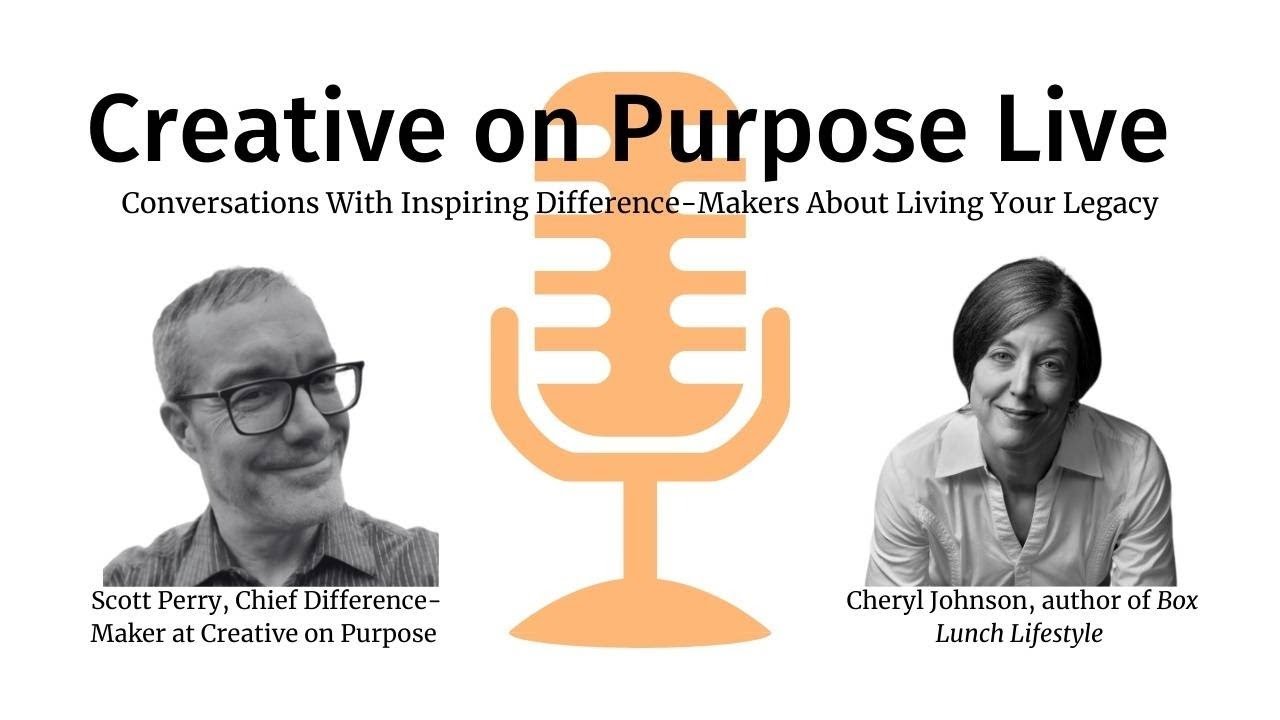
Cheryl Johnson, author of Box Lunch Lifestyle, talks about her 30-minute lunch practice: 15 minutes eating homemade food, 15 minutes for yourself. She explains how small daily practices build confidence and why your first-place dream matters more than chasing what looks good to others.
Chapters
Have fun, right?
No, we're gonna, we're going to have fun. Hey, whoa, I think we're there, Cheryl. Wait a minute. Let me double-check. Yes, we are. Welcome to Creative on Purpose Live, insightful conversations with inspiring difference makers to help you live your legacy and endeavors that matter. I'm your host, Scott Perry, Chief Difference Maker at Creative on Purpose. If you're ready to fly higher and the difference only you can make, visit creativeonpurpose.com and sign up for our newsletter. Get insight and inspiration for better living and making a bigger difference delivered to your inbox 3 times every week and join our Difference Maker Mindset Challenge. Hey, let's meet today's guest, my old friend. Well, she's not that old. Cheryl Johnson, welcome to the broadcast. Please tell our viewers who you are, what you're up to these days, and where can people go to learn more about you and the difference you're making?
Great. Hi, Scot. It's great to be here. My name is Cheryl Johnson, and as Scot said, we've known each other for a while now. Uh, I call myself a strategic doer, which means I like getting the right things done. I'm a boxer and I'm an author, and my book, Box Lunch Lifestyle: Using Your Lunch Break to Win Back the Life You Deserve, just came out. And anyone who's interested in the mindset or the method can visit boxlunchlifestyle.com to learn more.
And there it is right down below. So Cheryl, in digital years, you and I practically went to kindergarten together. And when we met in kindergarten digitally, you were just about to launch the, the website for Box Lunch Lifestyle. And I think you might have even started writing your book. Um, One of the things that I love to unpack with guests is I'm guessing that little 7-year-old Cheryl wasn't sitting in the front yard playing in the grass and thinking to herself, you know what, when I grow up, I want to be the leader of a brand called Box Lunch Lifestyle and write a bestselling book all about it. So give us a little sense of that. You don't have to start with 7 years old, but give us a sense of How did you get— how did you arrive? What's the backstory, the origin story that got you to this point?
So I think that a good place to start would be, it was probably about the time that we met actually, that I was feeling really stuck in my work. And you and I had some important conversations about that. And I had this kernel of an idea and I wasn't sure what it would lead to, but But I really thought that the problem I was trying to solve was my job. And as I, as I thought more about what that meant, I realized that I think the kind of dissatisfaction a lot of us feel, and especially now after the pandemic, but even before that, for a lot of us, this restlessness that we feel at the end of the day, thinking, Everything looks good on paper, right? Everything looks great. Why do I feel like there's something I'm missing? And I think that just like I was at that point in my life, I think we invest a lot in what I call first-place dreams. First-place dreams are the kinds of things that our culture really rewards us for, those externally motivated kinds of things. So we, um, we invest in our careers, in our marriages, in big projects like like books or inventions or whatever your creative endeavor is. These are big things, and the kind of things that we tell other people about, right? Those are first-place dreams. But then there are second-place dreams. Our second-place dreams are the kinds of things that we probably don't tell other people about. They're the quieter aspirations, like just eating a little better, or learning to play the mandolin, or just getting a breath of fresh air. They're these small things that we probably don't talk about, but if we don't invest in those things, we, um, we're sacrificing what it takes personally to be able to not just feel that personal satisfaction we're long for at the end of the day, but also the kind of energy we need to bring into our lives to accomplish our first-place dreams. I love that.
It reminds me a little bit of one of the programs that we're running at Creative On Purpose right now is called Live Your Legacy, and it's helping people kind of parse out the difference between the first half of life and the second half of life, or what David Brooks calls the first mountain and the second mountain. The first mountain is very much like your first place dreams, you know, doing all the things that society tells you to do, you know, get good, go to school, get good grades, go to a college, get good grades, get a good job, get a good spouse, get a good house, get a good car. Yeah, exactly. But in the second half of life, we are wanting to, um, listen for and heed the call of vocation. What we want to let our life speak through us and the bigger things, the bigger dreams and aspirations, the difference that we can really make, the legacy that we really want to live. And for you, that second place, um, dream is, is I, I love that it's even a little bit smaller, and that it might be just, how can I eat just a little bit healthier? How can I live just a little bit healthier? How can I be a better spouse, a better parent, what, what, what have you? Um, so I would love to, to, you know, the beauty of your, your program, your process, is that you're encouraging people to to take that small step by investing in how they spend their lunch hour, half hour differently. So, right. How did you arrive at that as the starting point for your program?
So when, um, when I was challenged to think about, uh, what, what the world might look like if like, what would I want the world to look like? How would I want it to be different if I could be responsible for one kind of change in the world? And when I thought very literally and practically about what that would look like, I would look around and see people taking a real lunch break. And what that means is that for one small part of the typical day, everyone was showing up for themselves and taking themselves just a little bit more seriously, but in a playful way, in a small way, not in an all-or-nothing kind of way. But everyone would be connecting with their food differently, thinking about what they need for themselves, having the bandwidth to connect with other people differently. It's really, you know, and to use a Scott Perry quote, it's an elegantly simple solution. Because what we want, and what I hear you saying in terms of what people are looking for in the second half of life, um, I think that it starts even before then. I think we all want to feel like we matter. And I think what really feels like what matters at the end of the day tend to be really small things. But still, when we, when we decide, okay, I know that that's what I want, then, um, if that's what I want, how do I do it? How do I eat better? We all, we all kind of know what we should be doing. We all kind of know when we're— if we're eating crap or not eating crap, right? We know. But how do we do it differently? And that's why the 30-minute workday lunch is, is such a nice framework, because all it takes is to spend 15 minutes eating food that you made for yourself, and 15 minutes to do something that's just for you. 15 minutes of better food, 15 minutes of time for you, and then give yourself a little pat on the back for doing your honest best for the day. Because you know when it's your honest best. You know when you're not making the best choices for that day. And not every day looks the same, but you know when you're showing up the way you want to show up. Yeah.
Well, I love the way that you started with, um, you, you created a vision of the world that you wanted to co-create with, with the people that you seek to serve. And I think that's something that is a very powerful thing for anyone to do. It's one of the first steps that we take when in the coaching that we do at Creative On Purpose is what's the vision of the world that you want people to live in? Um, So that's an extremely powerful takeaway. The other thing that you said that really resonated was food that you made yourself. This idea of, you know, we, we serve best others when we serve from the inside out. You have to take care of your primary asset, which is yourself, before you can take adequate or good care or the best care of anyone else that you care to. You know, make a difference with and for. And so for many of us in the working world, you know, that extra time in preparing our food is probably a significant challenge. How do you encourage people to invest in themselves in that part of the preparation for the moment in their lunch break where they're going to, you know, take care of themselves by eating something they made themselves and do some self-care?
Right. Well, and, and the, um, the beauty of lunch too is that it's small and it's simple and it's humble. I mean, this is not a meal that you're preparing to impress your in-laws. I mean, this is just for you, so it can be whatever you like, which makes it easier to pursue. There aren't any shoulds or must-eats or must-avoids. It's something that you like and anything that you can make yourself. So that might be a peanut butter sandwich. It may be, uh, you've always wanted to try eating vegan and there's some recipe that you want to try. But the, the nice thing about this is that because it is so personal, it really comes down to what your, what your goals are. Do you want to be somebody who cooks? If you do, I guarantee you can find a way to, to be that person at lunch on a lunch-size scale. If you are not someone who aspires to cook, You can, you can assemble a perfectly lovely homemade lunch with a couple of vegetables and a piece of cheese and a hard-boiled egg. No cooking required. But the idea is to say, what kind of relationship would I like to have with my food? And the 15 minutes of the homemade food partnered with that 15 minutes, you know, some of us are fast eaters. 15 minutes is a long time to eat even a simple lunch. When you, when you do it for the first time, it will feel very long, but you're giving yourself a chance to actually appreciate this kind of nice food that you made for yourself, digest it, and, um, and start to build the kind of body and brain that you need to make the choices about how you want to spend your time and be a little less reactive when things ping, ping, ping and distract us from how we'd really like to be spending our time. Then we have the kind of brain and body that helps us choose those more satisfying options.
Hmm. Well, what I'm hearing is it begins with the generosity of taking care of yourself by preparing a healthy meal for yourself and then sitting down and expressing and practicing gratitude by eating it mindfully, intentionally. And we know from modern psychology and neuroscience that gratitude and generosity are the two quickest ways to boost your mood and to increase your sense of, um, well-being. So I, I just love that you've, you've baked these practices in.
I—
so because you and I are friends and, and I was there near the beginning of, um, your adventure, um, I would love to just hear, you know, I know when you and I first met that you were, um, facing some significant challenges for getting your your venture, like you had a very clear idea of your vision and what you wanted to do, but you were having some trouble taking that initial step. And I'm just wondering if you would mind, if you don't mind sharing, um, you know, what, what was the challenge for you back then and how would you push through? A lot of the people that are here listening and will listen and replay are people just like you. They have dreams, they have aspirations, but they haven't yet taken that bold step and trusted themselves enough to invest in themselves and the difference only they can make. So How did you— what was the problem and how did you step through it?
I think, I think a big part of the problem for me was, was to think very narrowly about the, the cause of my dissatisfaction and making it really about these first-place dream kinds of things. Because like I said, when this idea came to me, everything looked great on paper. I had the job, I had the marriage, we had the house, we traveled, but it was— there's something missing. And what is that? And I think that part of that is, um, is an opportunity to express yourself and to give yourself credit and to be encouraged to do things that are a little bit playful. Because when we're kids, you have a lot of people encouraging you to take chances. And to do something just for fun. And as adults, we really don't do that. And if we're, you know, if we're waiting, as Seth Godin says, for somebody to pick us to do this, we're going to be waiting for a long time. So this is a really specific way to pick yourself and say, this is what I want for me. And part of the parallel journey for me while I was trying to wrestle with this work stuckness was that Alongside of that, I had, I had started training as a boxer. Why boxing? It didn't make any sense to me at all. I've done some fitness stuff. I've done a lot of different kinds of training things. I was looking for a new challenging, uh, like, what is the next hardest, coolest thing? And a boxing class was offered at my gym, and I was the first person who signed up, and I loved it, and I've been doing it ever since. But as I developed my skills as a boxer, it showed me the kinds of confidence that I needed in the workplace and that I needed to do things to defend my time at work and to stand up for myself and to be just a little bit tough because that's what you need to do to be a boxer. So it really started to highlight how my personal values were drifting away from my workplace values. But by pursuing this fringy, unusual sport, unusual, why do I want to do this kind of pursuit. By giving myself permission to really explore that, it gave me the confidence to say, this is who I really am. And you can only look away from that for so long. And that, that's why, again, lunch is such a nice framework, because it gives you a place to do that in a non-threatening way and take small steps in an opportunity that it's not every day for the rest of your life. It's 15 minutes on most days, and in the middle of days when the world is pulling on you to do other things, middle of the workday when everybody else is saying that this meeting is more important, this errand is more important, nothing is more important than you. And I think that when you start defending that time for yourself and investing a little bit in your body and a little bit in your spirit This is the virtuous cycle that feeds itself, and you'll start to see results because it's integral. It, it's, um, it makes progress itself towards the kind of life you want a habit.
Yeah, well, what I was— there was two things that you said that, that I'd love to just highlight. One is the, um, the validate— we spend so much of our time validating ourselves by external opinions, external, uh, how we measure up to external expectations. And what you're advocating for is getting in touch with your internal values, your internal goals, dreams, and aspirations. And I think that's so important. We do. And I love your analogy, um, you know, about childhood. I mean, hopefully you did, if you're tuning in, grow up in a home where you were given that encouragement to explore the edges of your ability and understanding. But, you know, that's how children are programmed. They want— they are— they don't have a long conversation with their inner imposter about whether or not they're worthy of walking. They just simply stand up and start trying to walk. And they do it badly before they do it well. But there's, you know, hopefully a lot of giggles and not too many bruises along the way. And I think that's something that more of us could really stand to get back in touch with. The other thing that you said is, you were talking a little bit about how our internal values, dreams, and aspirations might not align completely with the expectations that we're getting in the workplace, where you're advocating that people take that 30 minutes for themselves. And so what I'm hearing there is this pursuit of finding ways to build in some work-life integration where there are moments in your day where you are aligned both as a human, as a, in your personal life and in your work life around who you really are, what you're really good at, and where you really belong.
Right. Lunch can really be that catalyst to find the place where you can act on practical self-care measures and demand that your work meet you halfway. It's a, it's a very small battleground, but, but worth, worth defending. And I think that once people try this, and I, and I encourage people to go to the website, if you go to boxlunchlifestyle.com/giveaway, there's a tip sheet. So download this tip sheet, give it a try. If you do this for just one day, just one better lunch, what it does is it starts to show— it reveals to you some fundamental truths about yourself that you may have forgotten. And the number one truth is that you are the expert on you. We look outside for— we would love for somebody to just tell us, please, what's the right thing to eat, tell us, please, what's the right thing to do. Um, but only you know those things. And when you give yourself this little bit of space and you start showing up for yourself at lunch, you realize that you do have that capacity to listen to yourself, and you are the expert on you. And then the actions that you take as a result of that feel so much more satisfying because those are really aligned with what you want.
Yeah, well, I mean, what I love about that invitation to do— just have one more, one mindful lunch, do one lunch on purpose with and for yourself— will reveal something that once you see it, you cannot unsee it. And so now the tension is You know, do I want to revert back to the way I've been, which is eating while I'm continuing to work or whatever it is?
Right. And that's a really good point. And I would challenge people to say, so think about your last workday lunch. Think about your last workday lunch. So lunch is this little snapshot of the two most fundamental lifestyle choices we make every day, what to eat and how you're going to spend your time. This is going to happen over and over and over again. So when you look at your last workday lunch, you might say, well, my last workday lunch wasn't typical. But for most of us, it is the choice that we make on a typical day. It's, um, grabbing something on the go, or we're eating a low-fat yogurt during the meeting, or we're running errands, or we're trying to do more of our first-place dream kinds of stuff. And that's not necessarily bad, but if, if that snapshot isn't a picture of the kind of life you want, this is, this is the way to make it different. This is your opportunity to make different choices on a scale that anyone can handle, I promise. And if you get stuck, contact me, we'll figure it out.
Yeah, well, that's— I love that. The, the Difference Maker Mindset Challenge at Creative on Purpose is all about the same thing, which is bringing consciousness into the, the problem. Like, most of our lives are lived on autopilot, subconsciously or unconsciously. We're just doing today the way that we did yesterday. And what you're suggesting in, in this, you know, one, one mindful lunch, one conscious lunch, is there— people are going to bring themselves into that moment, and they're going— it's going to reveal that, you know, there is a better way. And I love the idea of that challenge. I want to, as we're coming to the end of our time together, there's 2 questions I have. The first is, people like you and I, people that are tuning in, we all seek to, you know, make a bigger difference. And when you are doing work that matters, when you're engaged in an endeavor that seeks to make things better, you're going to meet challenges, and you're going to experience experience failures or mistakes, or at least things that feel in the moment like failures and mistakes. Is there a moment in your delivery of the book that where you feel— where something that in the moment felt like a real obstacle or a real mistake or a real failure, and, and how did you either flip it into an opportunity, or how did you leverage your What did you leverage to get through that situation?
I, I was most surprised during the writing and creation of the book at, um, how dependent I was on the people around me. That I think that a lot of the kinds of projects and work that I've done in the past, um, I'm an only child, I'm used to just kind of doing it myself. I really thought that the book would be that kind of project, and it is not at all. So many people were so supportive and brought their talent to this in so many different ways that it was a, it was a real eye-opener to me that, that I could find satisfaction in that kind of collaboration without feeling like I was settling or compromising the way I had in other kinds of work environments. So I think I think that part of that challenge was realizing that it takes more time than you expect because you need other people to be able to take the time they need to bring their talent to the project. But it was— it's also incredibly rewarding to see the end result when everyone knows what they can bring and brings their best to it. And the result is just— it's, it's satisfying in a way that I did not expect. So for me, it was really a lesson in patience, that it was going to take time. It wasn't the kind of thing that I could just put my head down and work 2 more hours or have another cup of coffee and it'll get done. Books are not that kind of project. I learned that. And, um, yeah, and I think that that's, that's the kind of growth that will serve me extremely well on other projects too.
I love that.
Yes.
Uh, one of the most profound lessons I've learned as well is how important it is to connect with the right people and seek out their support, their encouragement, their feedback and insight to help you create the best work that you can create. I love that. So the final question is always, you know, again, you are an inspiring and insightful difference maker. You've already shared a lot of wisdom and a lot of really good, you know, strategy and tactics for Flying Higher and the Difference Only You Can Make. If there was just one piece of advice, one encouragement, one insight or bit of inspiration that you would leave those who are tuning in that are either aspiring to make a bigger difference or wanting to advance in the difference that they're currently making, what would you share with them?
There are two things. First, as a boxer and a writer and a strategic doer, I would say that everyone who is watching the kind of— this kind of program, the kind of people who show up and want more, you are stronger than you think. You are stronger. I encourage you to remember that, that you are stronger than you think, and the things that you think are out of your reach probably are not. And also, I would say right now, right now, mark your calendar for your next Workday lunch. Mark off that 30 minutes. It may be the hardest part of this for many of us because it's It's a concrete step towards this tiny bit rebellious statement of, "I'm going to take part— back part of my day for me." And it's 30 minutes. Nobody should be surprised to see this on your calendar. But it's— if you don't make time, then you won't have that space to see what unfolds inside it. So do that right away. You can.
Love that. I'm hearing the encouragement for people to see, step into, stay in, and share their power over their own journey. And I think that is brilliant advice. Well, we thank everyone for tuning in. Cheryl and I really appreciate you lending us your valuable time and attention. And we hope that something in today's broadcast motivates you to step into possibility, living your legacy today. You can learn more about Cheryl at boxlunchlifestyle.com. And of course, it's always great to see you at creativeonpurpose.com as well. If you're listening to this podcast as a podcast, please consider leaving a 5-star review. And now take the insight and inspiration from this conversation and fly a little bit higher in the difference only you can make. Cheryl Johnson, thank you so much for sharing your time, your wisdom with us here today.
Thank you.
More from Scott



Stoics Don't Suppress Emotions, They Do This Instead #stoicism #emotionalintelligence #mindset







