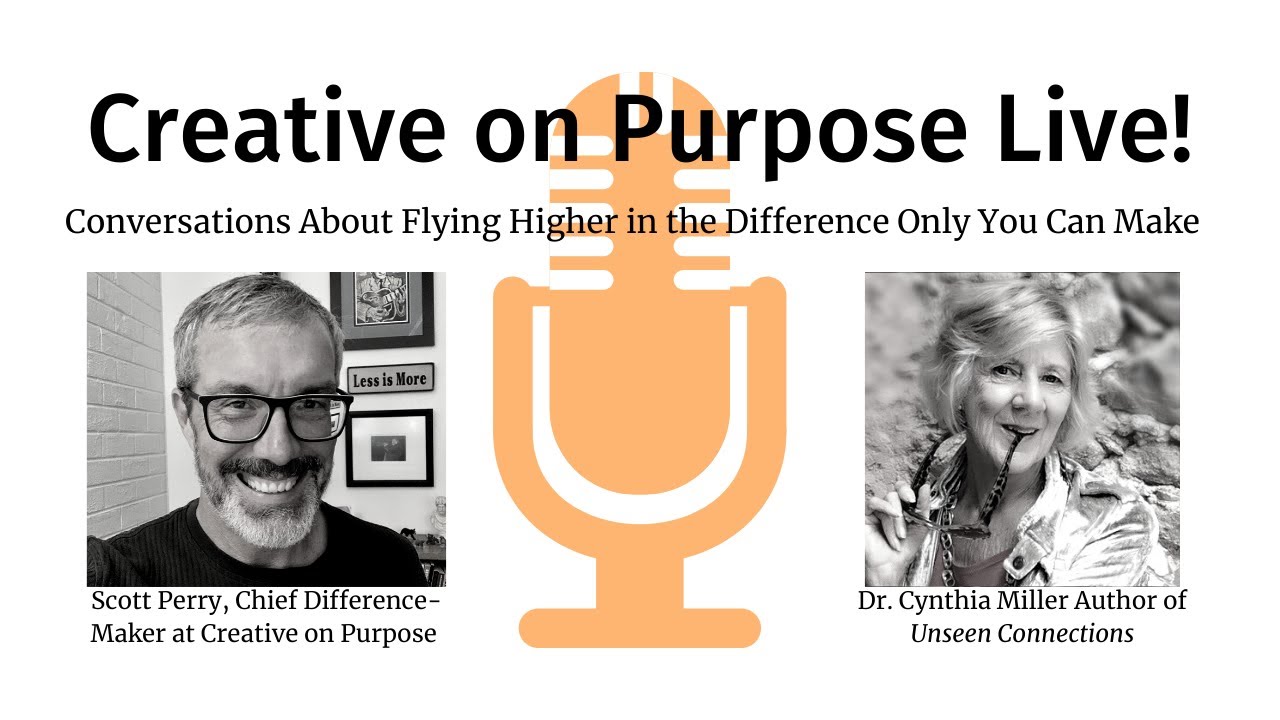
Scott Perry interviews Dr. Cynthia Miller about her memoir Unseen Connections, which documents her trauma, a near-death Kundalini experience, and her work in cellular transformation and body-based coaching. Miller discusses practices like gratitude and clearing unconscious programs, and emphasizes believing in your dreams and embracing your unique gifts.
Chapters
Across the ether. And we are live. We made it. Again, welcome to Creative on Purpose Live, everyone. Start living your legacy. Visit creativeonpurpose.com now and let's get going with the difference only you can make by joining the Difference Maker Compass email course. Identify the difference only you can make in just 3 easy steps. Remember too that this broadcast is also an iTunes podcast. Check it out and leave a 5-star review. 30 seconds of your generosity helps spread the goodness delivered. By my guests. Let's get to today's show. Welcome to Creative on Purpose Live. These conversations are about flying higher and the difference only you can make. Are you ready to live your legacy? Endeavor better. It's time to be creative on purpose. Are you ready? Let's go. I'm your host, Scott Perry, author of Onward and difference maker coach at Akimbo Workshops and Creative on Purpose. Don't die with the difference only you can make still inside. Visit creativeonpurpose.com to learn more about how to start living your legacy Today. This season, we're drawing insight and inspiration from guests who are successfully embracing uncertainty, navigating adversity, and making things better doing work that matters. Let's meet today's guest, Dr. Cynthia Miller. Welcome to the broadcast. Please tell our viewers who you are, what you're up to these days, and where can they go to connect with more, to connect with you and the great work that you're doing.
Hi, Scott Perry. Thank you so much for having me here. It's It's just a pleasure to be with you. So I'm Dr. Cynthia Miller, and what I'm up to these days, I've just completed my memoir titled Unseen Connections. It's a memoir from pain and violence into joy. So I've lived a really unusual life, and my memoir kind of describes a lot of that. And in the process of writing my memoir, I stumbled upon an amazing new way of seeing reality. So it's been quite an, quite an adventure.
And you and I— so, and, and just to be clear, you folks, you can learn more about Cynthia and her new memoir at drcynthiamiller.com. Um, Cynthia, you and I met in a, what, when we were both in the middle of writing our books, we met through an enterprise called Writing in Community. And I'd love for you to start by just sharing a little bit about how that helped you, helped motivate you and helped prepare you to get your book written and out into the world.
Well, Writing in Community was a profound experience, way more than I ever anticipated. And Scott and I were in the same group and cheered each other on and assisted each other with insights that helped both of our books. And the amazing part for me was just having— writing is a very solitary process, and just having support all along the way and have people comment really opened up my writing tremendously, and it gave me permission to expose parts of my life I never would have been able to expose if I hadn't had the support of this. So it was quite a profound experience.
Yeah, I totally agree. We, uh, Cynthia and I were in a group that was organized to just meet weekly and share our trials and tribulations and, and our challenges and celebrations week after week. And, uh, for For those of you that are interested in learning more about writing in community, that's— you can find out more at Akimbo Workshops or akimbo.com. It's part of the Akimbo Workshop series, and I believe that they're underway right now with this year's session. And Cynthia, you've alluded to the memoirs as being where you unpack the challenges and some of the pain and trauma that you had to overcome. I want you to just, in whatever way you're comfortable, at whatever way you're, you're comfortable, give us a little sense of the origin story, uh, of the book that, that you've just published. What, what, where were you? And as, again, in any way that you're comfortable sharing, uh, where are you now and where are you going next?
Um, I came from a lot of trauma. My father built the first hydrogen bomb, and my whole childhood he built bombs. And so he brought home a lot of radiation. So I lived through a lot of physical pain, and just the emotional anguish of destroying the planet and killing people was way too much for my little tender soul. So then I, I kind of escaped into the wilderness for years, and I had a near-death experience which was followed by a spontaneous Kundalini awakening, and energy came out the top of my head and completely changed my neural programs. So I can see inside bodies and see DNA. So over the years then I received a PhD in cellular transformation and the psychology of change. And so for years I've worked with clients to help them release their pain and trauma and help them live beautiful, productive, wonderful lives. So it's been quite an adventure.
Yeah, well, and learning a little bit about your story while we were in the writing group together, I mean, you have had, uh, have overcome an incredible amount. But what I love about the way that you approach doing this work and the way that you approach the work that you're doing is, you know, somehow you found a silver lining and a way to leverage all these challenges in a way that will actually that have transformed you in ways that I'm sure you couldn't anticipate and probably never would have happened had you not gone through all that. But also, now you've established this platform where you can help facilitate the same level of transformation in others. And so is your primary endeavor a form of coaching, or is it counseling or consulting? What's the, what's the primary vehicle for the way that you serve your clients?
So the primary vehicle is through individual sessions. So I take people into their bodies, they get very relaxed, and then we just journey through their body and see what's going on. Our bodies are incredibly intelligent, and the body knows how to unwind everything. So I I never have a clue where we're headed at the beginning of the session, but we go in and we release the blocks and whatever it is that's in the way. A lot of times it's just we have these thoughts about who we are that aren't really the truth. They've been programmed in from our early childhood that we're unworthy or we're unlovable or that we don't matter, and these programs influence every aspect of our lives. And once those get cleared, then it's amazing, more of the person's true essence shines. And I say we're just these incredible beings that just need a little tweaking along the way so that we can step into who we are. And create a whole new reality. So to me, it's really— we're at an amazing point in history where we do have these tools to clear what I call the bottom sludge and release all that old programs that's not related to who we are. And then we can step into this greater version of who we are and bring all that together. And as more and more of us do this, we can create this magical new world which is so needed right now.
For sure. Well, it seems like one of the underlying themes of this season is I've had been having, uh, these conversations is this, you just touched on this, this theme of becoming, like helping people become the person that they seek to become. And sometimes it's not something that we have fully clarified, articulated, or even, you know, fully have a full-fledged aspiration about where we're going. But yet, And I think about this as juxtaposed to people. One of the things I've heard very frequently is people talk about reinventing themselves. It's like, I'm going to kill the old version of me and I'm going to completely start from scratch and build a new me. And it just seems, in my experience, even though I've done a lot of different things, I feel like I have essentially been the same person all the way through. And so to maintain that integrity of It's— I'm still me. I just— I'm on this journey where I am doing different things. I am interested in different things. I am exploring different things. It's this system of becoming. And the thing— what I was hearing and what you were saying, that one of the things that is holding us back is our attachment to the inner narrative about who we've been and what's happened to us. And so I wonder if you As you're exploring these blocks and as you're helping people remove them and step into their potential and the people that they want to become or the people that they're intended to become, what's the role of, of narrative in that? Is, is it about reprogramming the stories people are telling themselves, or does the work that you do help people start to see a better and brighter way going forward?
Great questions. So, from what I understand from the research, we have 40 conscious neural impulses per second and 40 million unconscious neural impulses per second. So, what's running our lives is our unconscious, and that's also connected to the collective unconscious. So there's this whole big vast soup of the unknown that's influencing every moment of our lives. So as we start first to create boundaries, to clear, to create a boundary between me and the collective unconscious rather than taking on the whole stuff of the world. And I got really clear of this when COVID started. When it first happened, you know, I was reading the news and trying to figure out what's going on like we all were. And then I was just hit. I would be out for a couple of days. I just couldn't function. What is this? This isn't me. And I realized I was tapping into the collective unconscious. And I think that's really important right now because with the internet, we're all connected around the world in such a profound way. So it's creating boundaries within yourself so you can figure out who you are, and then going in and cleaning up your unconscious. Because these programs, a lot of them have been passed down in our DNA for generations. They have nothing to do with who we truly are, or they've been wired in when we're tiny children. The way our brain develops is during the first 6 years of your life, you have no ability to differentiate yourself from your environment and your parents and what's going on in the world. And by the time your brain's developed enough to figure every— that you're separate, then your whole nervous system has developed. And so we're running around with nervous systems of 6-year-olds, which is really apparent sometimes when you look at our political figures and go, yeah, that's what's happening. But we can consciously change all of this, but it doesn't happen automatically. We have to bring our consciousness to this process. And as we change this, then there's amazing space for who we are to shine forth.
Love that. Want to give a quick shout out to somebody that's tuning in. Daria, uh, was loving the conversation about becoming. Good to have you with us, Daria, always. Um, one of the things that I really love about your work, uh, that's tied to what you were just saying is really in alignment with one of the chapters in my book Onward, which is this idea of interconnectedness. You know, we're not all solitary actors on a journey all by ourselves through the howling wilderness of becoming who we seek to become and overcoming our past challenges, trauma, or what have you. And I was hearing that in what you were saying about this universal unconsciousness. The other— I didn't take note of the actual numbers, but you when you were talking about the conscious and unconscious, I know that from my research that about 80% of our lives, our day-to-day lives, we are on autopilot. We're making unconscious decisions, unconsciously doing the same things over and over and over again. And I'm just curious about if part of what your work is, because what I find is when I, when I want to change my attitude, my behavior, my habits, my routines, my relationships, I have to actually be really thoughtful and deliberate about shining a light on all the things that I just do without thinking about it, so that I can undo the negative and, and start to formulate healthier, you know, habits and, and relationships that promote, uh, healthier ways of being and promote my, um, healthier physical, mental, and, and spiritual well-being. And so are there ways that you, that you kind of shine a light on those things or help people to like see what they take for granted or see what they don't even see perhaps?
Yeah, one of my things I love is gratitude. It's a very, very simple concept, and yet it's profound when you really take it deeper. So I notice things, especially things I don't like, I thank them. And what you'll find is if there's like these inner gremlins and nasty things inside, if the high frequency of gratitude helps to dissolve them. So if you think of it as a frequency, The lower frequencies of fear and shame and guilt, all of those very low frequency. Gratitude and love have very high frequencies. So if you're bringing in a high frequency, what it does, it disrupts the lower frequency. And so I spiral gratitude through my body and through whatever it is, and it starts to dissolve. It's amazing if you keep going into the depth of gratitude.
Yeah. Well, the neuroscience and psychology shows that expressing gratitude is the fastest way to lift your mood and to change your attitude and your beliefs. It's a huge part of the practices that we try to cultivate in the Creative On Purpose community. This idea of just like starting your day by expressing 3 simple gratitudes gratitude. It's not, you know, not gratitude for the, the car in the parking lot or the roof, you know, the, the, the, the, the status attached to the roof over your head, but just everyday conveniences, pleasures, uh, experiences. Uh, it's, it is a really profound way of starting. I'd never heard about the frequency, but that makes complete sense that fear would be very low frequency and gratitude would be very high. And the other would be I think, at least, would be generosity. Because when you, when you are, you know, after you've taken stock internally, and, you know, taking care of your primary responsibility, which is yourself, you can then be, are in a healthier place to start to reflect out into the world, and to be generous and thoughtful and compassionate and empathetic with and for others. And generosity is also a real booster of mood. Here's Daria again. Thank what we don't like. Yeah, so that was, I love that practice because again, at Creative on Purpose, we talk about even when we are experiencing distress, misfortune, unfairness, failure, We have the capacity to practice the virtues of patience, humility, acceptance, and these are the things that build resilience. What are, what are some of the lessons or some of the work that you do around thanking, thanking the things that, that might be a challenge?
Well, it came up in a very extreme circumstance. I was in my 60s and I sold my house. I put all my money in the stock market and then I went, I put everything in storage. I was traveling to find a new place to live. I went up in the mountains for a few days on a little retreat and I came down to town and everything boat had been stolen out of storage. Almost all of my money had evaporated in the stock market, and I was in massive pain. I was— and it was like I saw no reason to live. So the day I was ready to kill myself, this energy shot up from my guts and said, choose gratitude. And I thought, what? The hell do I have to be grateful for? And so we had this little discussion, and I said, okay, I will choose gratitude, but if it doesn't work, I can kill myself later. That was the plan. But I totally committed to choosing gratitude for absolutely everything, for being homeless, for being sick, for having no money. So it was quite a profound process. So one day I— so one day I had this garage sale fork, and I said, thanks for stealing my fork, because I had this beautiful silverware that had been my grandmother's and then passed down to my mother, and I loved it. Right? And I have this crappy garage set fork and I'm screaming, "Thanks for stealing my fork!" Not a shred of gratitude. "Thanks for stealing my fork!" And so my energy starts to flow and I can feel a little relief. And then, "Thanks for stealing my fork!" And then I have this insight of Oh my God, my fork, the silverware, had been taken on the energy of my dad, from my dad, of plutonium radiation. So every time I was eating, I was shoveling radiation in my mouth with my fork. And I'm going, whoa, I'm going, thanks for stealing my fork. Thank you, thank you. I'm, you know, I'm going to get healthier. I'm not eating with this fork. And then I went, thanks for stealing my fork. And then I went, oh my, someone else is eating with this silverware that they've stolen. And then I was like, oh my God, I need to send blessings to whoever this is. So it was this huge, huge process just from thinking about my fork.
Yeah, I'm sorry, go ahead.
So it was— it's an amazing— if you go deep enough, there's this total awakening and this completely re-seeing your life, seeing something completely you never would have thought of.
Yeah, well, I mean, that's, that's the thing is if, if we sit with the tension and the discomfort of whatever anxiety or, or, uh, misfortune we are experiencing, there's always some sort of silver lining. And one of the things that I think the pandemic has taught us is, you know, as, uh, you know, there's been the suffering of, of the unnecessary and many instances loss of life and the economic turmoil. And then we've piled on the long overdue reckoning over racial justice and other social issues. All of us are having this moment where we're actually being reminded that what it takes to be more, you know, what it takes to be human, what it takes to be happy and how to become more of both is We all possess everything we need to be happy, healthy beings already at our disposal. All the stuff doesn't really matter. And I think you should make a t-shirt that says, "Thanks for stealing my fork." I don't know, that just seems like a great marketing potential. So as we're Winding down here, just, just two last, uh, questions. Um, one is, you know, we have a lot of folks who seek to level up and fly higher in The Difference Only They Can Make. And what I have found is that a lot of people like you who are succeeding, uh, in doing work that matters and making a difference in the world have surrounded yourself with, or cultivated routines and relationships that help you stay on track and help support and encourage your journey. I wonder if you would, um, have any insight to share on just, you know, are there routines that you practice every day or relationships that you have in your life that have really helped support you in doing the great work that you're doing?
You have such good questions. So one Currently, routines are when things feel off, I look inside to see what dimension it's on. Through my work, I've discovered we have 12 different dimensions. It used to be in my therapy practice, I would work with people and get great results, but it took a while, and we don't have that kind of time anymore. And what I've discovered recently is when you discover which dimension it's on, then you can just zoom in on that dimension with the gratitude and whatever tools I'm using, and it clears so much quickly— quicker. So that's something I do on a daily basis.
Oh, that's fantastic. That's a great insight. Well, as we're winding down, the very last question that I always ask every guest is you've, you've already shared a lot of insight and wisdom about flying higher and the difference only you can make. But if there were just, you know, one idea, one tip, one piece of advice that you could share that would help, that would leave our listeners, um, with something that would help them fly higher and the difference only they could make, what would that be?
Wow! To believe in their dreams. A lot of times we're kind of squished down in our— what we really want. And your inner desires and your dreams are what the world needs. And we each have weird traits. We all are unique. And so all of that is what needs to come forward. So I really encourage all of you to step into your unique weird self, because that's what your gifts are. That's what's needed in the world. And, and the world really needs each one of us, each one of you, to step into who you are, to co-create a beautiful reality for everyone.
I love that. Embrace your weirdness. Well, thank you everyone for tuning in. Cynthia and I really appreciate you lending us some of your valuable time and attention. We hope that today's broadcast helps motivate you to lean into an endeavor that matters with a little more curiosity and a little more, more courage. You can learn more about Cynthia in the URL below, drcynthiamiller.com. And of course, it's always great to see you at creativeonpurpose.com as well. Now, Take the insight and the inspiration from this conversation and keep flying higher in the difference only you can make. Dr. Cynthia Miller, thank you so much for sharing your experience and your wisdom with us today.
Oh, thank you. It's been such a joy to be here with you. Thank you.
More from Scott



Stoics Don't Suppress Emotions, They Do This Instead #stoicism #emotionalintelligence #mindset







