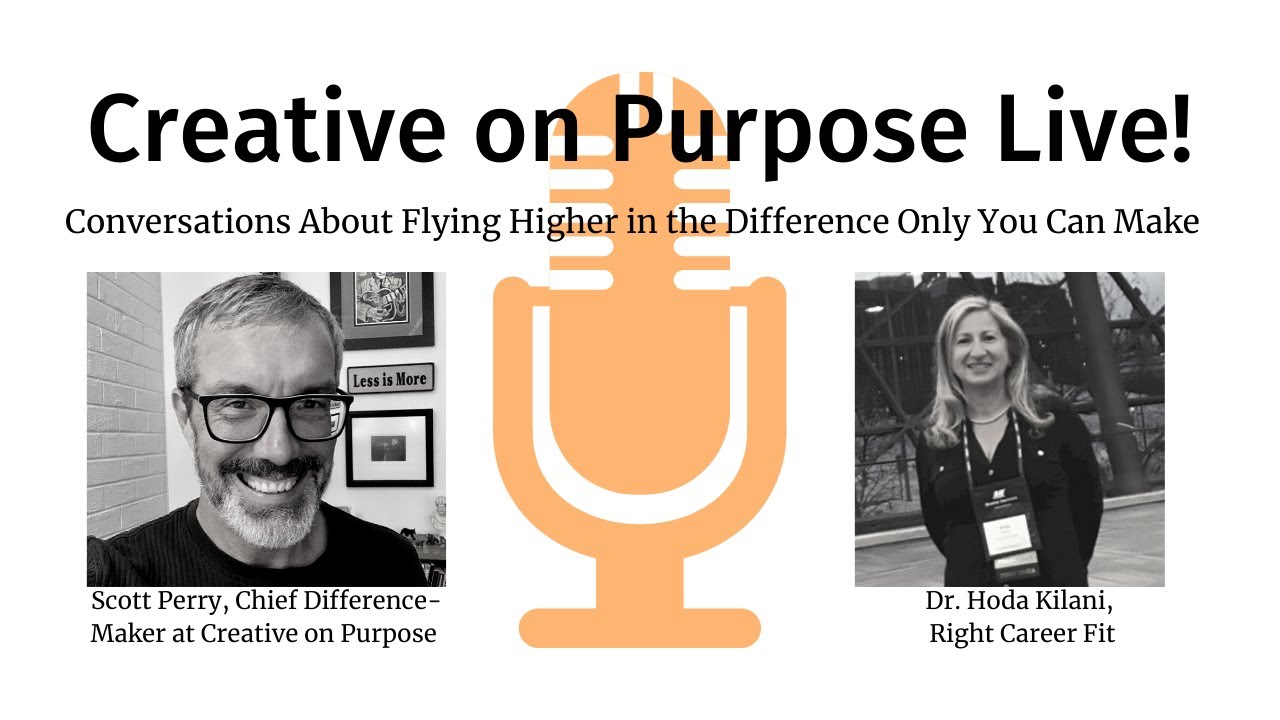
Dr. Hoda Kilani argues that "career literacy" should be taught in schools so students learn to understand their own values and skills, not just memorize facts. She returned to university at 50 and now coaches people through career transitions, emphasizing soft skills like emotional intelligence over technical knowledge alone.
Chapters
is connected. It looks like StreamYard is having a difficult time.
Technology bitch.
So it says that LinkedIn is not playing nice. This happens from time to time. We're going to try one more time, and if we don't make it to LinkedIn— we made it! All right, don't give me time to figure out how the camera All right, ladies and gentlemen, boys and girls, children of all ages, welcome to Creative on Purpose Live. Start, start living your legacy. Visit creativonpurpose.com and let's get going with the difference only you can make by joining the Difference Maker Compass. It's an email course to identify the difference only you can make in 3 easy steps. Remember that this broadcast is also an iTunes podcast. Please check it out and leave a 5-star review. 30 seconds of your generosity helps spread the goodness delivered by my guests. Speaking of, let's get to today's show. Welcome to Creative on Purpose Live. These conversations are about flying higher and the difference only you can make. Ready to live your legacy? Endeavor better. It's time to be creative on purpose. Let's go. I'm your host, Scott Perry, author of Onward! and Difference Maker Coach at Akimba Workshops and Creative on Purpose. Don't die with the difference only you can make still inside. Visit creativeonpurpose.com to learn more and start living your legacy Today, this season, we're drawing insight and inspiration from guests who are successfully embracing uncertainty, navigating adversity, and making things better doing work that matters. Let's meet today's guest, Dr. Hoda Kalani. Welcome to the broadcast. Please tell our viewers who you are, what you're up to these days, and where can they go to learn more about you and the difference you're making?
Hi, Scott. Thank you so much for having me on my, on your show. I truly appreciate this opportunity to talk about, talk with you about the work that I do. And hear your insight as well. So my name is Hoda Kalani, and I am the owner of Ride Kidney Fit, a kidney coaching company that I've had for the past 8 years. And during the pandemic, I was fortunate not to be too affected as I had started it virtually back then because I love to travel and it gave me that flexibility to do that. But working virtually is becoming more important nowadays, and I have started my own YouTube channel, and with it is the Hoda's Career Info. The purpose is to increase awareness about the value of career literacy. As a career coach working with high school students, I find that high school students don't know where to go. Typically, most of the clients who come to me anyway with their parents, struck. They don't know what they want to do next. And so the idea of Hoda's Career Literacy started to encourage parents to listen to it and my young clients and start reflecting on the career journey. Fantastic.
And, um, we have the URL to learn more about Hoda and her great work, rightcareerfit.blog. So this is, um, I love the impulse and the motivation behind your work, and I— it just immediately brings me back to my own high school years, which, um, was of course took place in caves while dinosaurs roamed the earth outside. Um, but yeah, like thinking about what your career is going to be, what, what you're going to do beyond your education, whether that's at the end of high school or at the end of college, um, is really daunting. What are some of the What are some of the common obstacles that you hear from your clients about what, what they feel is difficult or challenged by in thinking about what comes after school?
Well, one of the comments is always like, my son does not know what he wants to do next. And then they are in grade 11 or 12. They have to fill out a university application and pretend they know what they're doing. Many nowadays are opting for gap years and parents are not liking that. And I'm saying it's okay. You know what, I would, if it was me, I'd rather have my son take a gap year, try to figure out what he wants to do next before I pay for the education. And they may or may not go back to university and that is okay. And that's really the discussion we're having. And in the show that I have and in my blogs, I write a lot about It's okay not to know right away what you want to do as a young person, but what is important, and I have created a chart, is to take the time to reflect on what you want to do and really make that a lifelong commitment to reflect, even at my age, every 6 to 12 months on, am I happy what I'm doing? Do I want to move to a different field at all, or do I just want to stay because I am kind of content? And I went through my own career transitions until I hit the career development field. And now I feel every 6 months I do check and I'm happy because I am where I am.
Yeah, I really love that idea of checking in throughout the course of your life. I don't know what the numbers are now, but I remember when I went to college at the welcome speech by the college president, he told us that it was likely that we would change careers at least 7 times. I probably doubled that number just in the first few years out of college. Um, and just again, reflecting on my experience, I went to college to be a classicist. I thought I was going to study Latin and Greek, uh, and Hellenistic philosophy, and, and quickly found out that was not my thing. Dropped into a history major. Became a school teacher, became a radio, uh, show person, did a restaurant manager, so many things. And it's, um, it's just remarkable how we, we can't know what we really want to do until we start doing things. One of the things that I talk to my sons about, both of whom are beyond college, um, is how, how much of the career path is about trying things to make, to discover only that you never want to do that thing again. What's your experience with, with just kind of jumping into and trying different things?
Well, your experience definitely highlights what I try to sell to my clients is that look around you. Very, very few people. I mean, my husband is one of them, but got to a job and stuck to it for 30 years. But very few people do. And at the end of the day, he was, I think he was enjoying what he was doing. That's why he didn't move and he lucked out in that he was, you know, happy doing what he was doing. But many of us, myself included, and now your story truly highlights this, what I'm trying to tell my young clients, in that we do jump from one and it's okay. It's okay because look at you, right? You're happy right now. You're successful in what you're doing because you're really enjoying it. And it may take time for some of us, and that's okay. Like, in my 50s, I went back to university because I had jumped from job to job, and I was like, I'm still not where I want to be. And so there are a few things that I tell my clients to reflect on. Well, your beliefs, like, are you— are your beliefs, you know, in accordance with what you're doing? And if not, then you're not going to give it 100%. Reflect on your experiences. When was the happiest day of your life? What was it all about? Like for me, I found that I cry at graduations, but not at weddings. So I was like, okay, so it has to do with graduation. What is it about graduations that I like? It's the successful when I think of all the hard work that everyone put in it. And so that's experiences. That's what I talk about when I tell my clients to reflect on experiences, but also reflect on the skills that you developed. Why did you develop? So I've learned a few languages. What was about the languages learning that I like. So that's the thought process that can happen throughout the years. As you say, I have two young boys myself, they're in their 20s, and I always encourage one of them who will listen to me actually, because some don't listen to their parents, to say, are you happy where you're at, right? Is that what you want to be doing? It's not about the money, like you'll always make the money working, but if you enjoy what you're doing, I believe you'll make more money. If it's about the money for the young people who are in the lives. And it takes sometimes, like you said, 6 or 7 professions. For me, it was about 4. That's what we need to keep in mind. And that's what we need to encourage the young adults today is that it's okay to jump from one position to the other. One of the reason also that I, in my opinion, we have us, taking too long to where we're going is changing stuff in the education system where we need to incorporate career education as an important topic. And career literacy is the term I chose because I wanted to bring career education to another level. I wanna bring it to the academic level. I find that schools do not teach that. And this is my push also in my blog and in the show that I created, asking different career professionals on their opinion and their definitions of career literacy. And I'd like to bring you, Scott Perry, to my show also and hear your thoughts on career literacy, where we focus and zone in more on that. But that's— I want to see career literacy as a term, as a hashtag trending across social media to change the education system, but also to change thoughts and educate the young adults about the value of reflecting, lifelong reflecting on their careers.
Love that. So our mutual friend, Karina, is in the audience. I just wanted to let you know that she was saying hello.
Hi, Karina, and thank you. She is one of my role models in pushing for— her talk is about world of work and the now of work. I think Karina now is what you're calling it. And amazing, amazing work she does. Supporting Kitty and World.
She is doing fantastic work indeed. What, what, just reflecting on what you just said, you, you started off by talking about beliefs, and, um, I think the way that you phrased it just reminded me of, uh, the, the importance of values. Like, what, what are your core values, your guiding principles? You know, what, what are, what is your North Star? I think Speaking of things that we don't address in school, we don't do a lot around career development or, you know, thinking about career. We also don't do a lot about things like trying to look within and determine what your values and guiding principles are. And it's so important because if you end up in a career that is out of alignment with your core beliefs, you're going to experience a lot of dissonance, and that's going to cause you to suffer needlessly trying to reconcile the fact that you're, you're engaged in work that doesn't really resonate with, you know, who you are. You also talked about this idea of skill development, which is very important. And, you know, we go to school to learn some hard skills, and we go to university to learn some hard skills, and then we learn hard skills on the job. But then there are these other skills called soft skills. And I'm wondering, these are the skills of human-to-human connection, collaboration, communication, creativity, and so forth. What do you— what's the role, you think, in taking— excuse me— taking a look at those as well?
Absolutely important as well. I was actually talking to a friend of mine and she's heard someone calling them power skills and superpower skills, in that without these skills, you cannot really function. I mean, you and I, if we cannot communicate on a certain level, we cannot have a good conversation. And there's a lot of, particularly with the pandemic right now, you know, we're all, even including myself, we're all, I mean, you and I, we arranged this interview just by texting. We did not have a conversation. And so the art of conversation is losing, is going away, I think, and we need to reinvest in that. So this friend of mine, she talked about emotional intelligence as well, and she is trying to create courses calling them emotional intelligence, but within them incorporating all these skills you've asked about, right? From bullying, discussions on bullying, to discussions on communicating, just the day-to-day communicating. We're getting so comfortable in our homes that even eating at the dinner table, we're probably losing some of that etiquette. So definitely an important discussion to be had. And this is the change I would like to see in the education system. So I'm so glad you brought it. It's bringing that literacy, but also bringing these communication skills that are, that help us move through life again, make us happy, mentally happy to continue our work that we do. And can we teach all of that in school? And then, but do we get rid of math and LA and language arts? I don't know if we can do that or if we should do that. Because like you said, you're calling them hard skills. But how much do we remember? This is the debate, is how much do we remember from what we learned in school? One school in Calgary is doing something that I thought was really cool. They're calling it a passion project. And what they do is they allow the students to choose a topic they're passionate about and write about it or do some research. And for me, this is the start of that. That could potentially be the start of a career discussion in that, see, okay, what are— typical positions within that topic, or then, then go forward with what are typical roles, the details, I mean, of every role. So, um, we are moving forward a little bit, so I'm happy about that. But, uh, everyone watching, please hashtag career literacy. I really want to see it trending and I really want to increase awareness and discussions about it.
Well, the interesting— you brought up something that I wrote about some time ago on my blog, uh, about just-in-time versus just-in-case learning. And our current educational system is all about just-in-case learning. You know, we're going to teach you geography, algebra, calculus, and trigonometry just in case you decide that you need to use it later. Um, we're going to make you learn a foreign language just in case you ever go to France or Spain and— or travel back in time to, to ancient Rome. But in this day and age, when we have all the information ever created by humanity available on a device that fits in our pocket, those hard skills can be learned very easily when we need them, or we can just get the answers by Googling them or putting them into a calculator. So it feels like we really should be spending a lot more time on the human-to-human skills, on the skills of connecting, empathy, character development, values, determination, thinking about, you know, purpose and passion. And I was thrilled to hear your example about the high school that's inviting in passion projects. But, you know, part of Part of that is many people, the polling suggests that people, 80% of people asked, what is your passion, can't identify a passion. And so what if we taught people to do the work right in front of them with passion? Because that's usually how passion is found, by acting passionately, by acting purposefully. So getting on my soapbox and ranting a little bit.
No, you've really helped. You know, you've really highlighted what I was trying to say. And you brought it to another level. But I come from from the perspective of the young people who come to me and say exactly what you said. So they say, so why do I have to take this math course when I'm not interested in math? It's not something, numbers don't come naturally to me and I don't wanna do that. Like I really, if you really want my opinion, because I'm all about bringing their perspective, I don't wanna be doing this. But I know I have to, to graduate. So the debate becomes, do we take it out or do we make it optional? Why not make it optional? But then they go to university, they get tested on these things, and if they don't pass, they can't get into university. And so there's always this debate, but their grades affect also their acceptance into university. And so many are opting just to forego university, particularly now with the pandemic. It takes, I mean, a lot to change the system. Some schools are moving forward and introducing it as, you know, half of their curriculum to focus on these skills that you talked. We call them soft skills, we can call them power skills. But character building, you know, is, can be, is usually developed through after-school activities. But I think it should be part of the in-school curriculum. One way for it to be done because not everybody has the time or can participate in after-school activities.
Yeah. There's an angle I want to just explore for a moment because it's something I've been thinking very deeply about. And that's the idea— I recently read a book titled Work and it's the history of work. And one of the things that starts with is just like defining work is what all living things do by acquiring and converting energy, right? So plants take sunlight and water and nutrients from the ground and through photosynthesis develop and grow. What distinguishes the way that humans do work from all other living things is and this is not the book, but, but me talking. It's how we build identity and forge meaning in our lives, you know. So the work that you're doing is actually, you know, really important because we so closely identify who we are with what we do. And, you know, when we're talking about a career, to me, that sounds like something beyond just doing a job. So I'm, I'm a big fan of it. If you need to make money, get a job for sure. But recognize that you have like a whole bunch of other time where you can be exploring things that fill you with energy, that light you up, that help you develop purpose and passion. When you're— if to me, when I hear the word career, I think of taking the job to the next level. Now I'm actually intentionally engaged in a mission that my career is, you know, what I want to do what do I want to do with my life? And it might be something that you do on your own. It might be something that you do with another company. But just wondering what your reflections are about, like, what is career for? And how can we help young people be a little bit more intentional and deliberate about the way that they think about what they're going to do beyond the school years?
This is a very loaded question, but we'll, we'll start. And definitely an important question to ask, though. But we'll start with the, again, from the young adults' perspective, is that My dad is an accountant. And like you said, this is one thing you highlighted is I identify as an accountant, that means I'm probably going to be an accountant all my life. And so my dad's an accountant, he makes good money, he's telling me I should consider going into accounting. And then we go back, well, do you like numbers? And then is that what you want to be doing? Now, reality is we all have to be working to make money. And as you said, it's probably a good idea to start with getting a good job because you, again, from a kid's perspective, you want to get out of your parents' house sooner than later. And so yes, get a job that seems okay for you right now, but take the time, kind of like they do after-school activities, to keep on exploring. And like we talked about the values, the beliefs and trusts, but I add usually the experiences. To the mix. So you are reflecting on these after-work experiences, what made you happy, and what possible roles can get into it. The definition of career is definitely not very simple, as I'm finding as I'm interviewing many career development professionals. Each one come with their own background and define it, but it's definitely not focusing on one job. It's focusing on a journey that we go through, the journey of exploration for sure, but a journey that focuses on our values, experiences. Again, and I take you back to that lifelong reflection process that includes, of course, self-knowledge through these things.
Yeah, well, and ultimately the outcomes of our, you know, careers are largely beyond our control. I mean, we can do our best work and show up and do our best, but whether we advance in a career or whether we get the, the positions that we want or the jobs that we want oftentimes is determined by other people and, and again, forces beyond our control. But what we always, what we always possess is the ability to put forth our best effort. And if we do that, that's actually reward enough to know that you're putting forth your best effort and doing work with intention and with integrity ensures that you can have some degree of happiness and maybe even joy in your life. As we're— I'll go ahead.
Yeah, I do want to build on what you said in that, yes, we are dependent on the circumstances around us, but I do encourage my clients to look forward to do two things. Always look out for opportunities that are out there, you know, within work, even within, if you like the company you're working on, you know, you like their values, always be on the lookout for opportunities because it is your responsibility to move forward if that's what you want. And some people are content, you know, many people have reached a point where like, you know, I'm happy where I am, I just want to stay here and that's okay. But being on the lookout for opportunities that if it's— particularly if you're not content where you are, I don't say happy, but content, then that is a good way of doing it. And another way is always step out of your comfort zone, look for a way to challenge yourself, because once you step out and you feel good about it, you, you reach another level of happiness and contentment. I think one of the things that is why I created my show is because, like, sitting with you right now, I'm not comfortable in front of a camera. And a few of my young clients, they're like, okay, you're to be in front of camera. So we challenge you to do that. And so I used to do my YouTube videos, use cartoon Powtoon. I don't know if you're familiar with it, because I didn't want to put my face out there. Last year, I transitioned to sharing screen share, and then you'll see my face pop up in the, in the little square there. And finally, my clients like, no, you're not, you're telling us to get out of comfort zone, but you're not doing it. And so this year for 2021, my challenge to myself is to get out on camera. That's why I reached out to you and I'm reaching out to a lot of live shows to say, well, here I am. I'm not happy to look at the video later because I'm still not out of that comfort zone, but I am doing it, and it does give a sense of contentment. So two things: always look out for opportunities and try to find ways to, even no matter how small, to get out of that comfort zone. I think that makes you a happier person.
Yeah, I love that you wove that in because when we set a point on the horizon, a goal that we're aiming for, we can't possibly know all the opportunities and the obstacles that are going to come along. And we need to oftentimes make adjustments. And I think especially in the United States, very often we have blinders on and we just keep grinding our way towards the goal because it's the goal, and we lose track of the opportunities and the obstacles. And sometimes the obstacle is the opportunity. And so it's, I love that you wove that in. Two last questions. The first is, if you're willing to share a moment of, you know, where you made a mistake or you experienced a failure, and it doesn't have to be anything too dramatic, but, you know, very often we learn a lot about ourselves and learn a lot of important lessons from the mistakes we make and the failures we have. And I just wondered if you had one that you could share and the lesson or the takeaway that you were able to draw from it?
I was talking to someone the other day and they said mistakes are lessons learned. So I use that a lot. And so I don't see whatever happens as a mistake. But if I were to share one, it was, I don't, maybe I try not to talk about my mistakes, but I'll share with you something. When I went back to school, I was 50, I was a 50-year-old woman. 50-year-old when I went back to university because again, I felt I was in contempt, but many, I got a lot of comments in that you're too old to go back to school. Maybe you shouldn't be doing that, you're wasting your time, you're wasting your money. And so I was a little bit deflated because guess what? Going back to school 25 years later was not easy. It was very hard and I was very ready to quit. But because I was in a graduate program, so reading research papers, is a lot more intense and condensed than reading articles on— shorter articles. So I did struggle a lot. But what kept me is my goal. Like you said, we have goals, and it was an obstacle where I was like, I don't know that I can even write a thesis paper at the end. I haven't written that— like, I write short blogs for a living. And so it was that persistence, but it was also about having mentors and people who support you around. This is very important to surround yourself with a social network, because a failure will not seem like a failure. They will actually see what is good about what you tried and how this failure— again, I don't like to use failure— is good for you at the end of the day. And I cannot believe that 5 years later, I have a different mindset at my age. So definitely it's never a failure.
Yeah. Well, you're, you're highlighting something that's really important and that's being very intentional and, uh, and continually rethinking your routines and relationships because it, it really makes the things that you do every single day really inform what happens in your life. And the people that you surround yourself with, um, have a huge impact on your sense of, you know, flourishing and thriving, even if you're involved in challenging, you know, difficult work, which is usually the kind of work that, that's worth it in most cases. Well, Dr. Kalani, it's time for the last question. And you've already delivered quite a bit of insight and inspiration. But I wonder if there's just one last tip, piece of advice, something that you'd like to leave our listeners with, because we are being— people are tuning in to learn how to fly higher in their endeavor and to make a difference in the way that only they can make it. So is there any last parting piece of advice or a tip that you'd offer our viewers?
I encourage everyone to educate themselves about the world of careers or the world of work, as Karina calls it, likes to call it, if she's still listening, because it's never too late to find a job that you what will make you happy regardless of your age.
Fantastic. Really, really appreciate that. Well, thanks everyone for tuning in. Dr. Kalani and I really appreciate you lending us your valuable time and attention. And we hope today's broadcast motivates you to lean into an endeavor that matters with greater curiosity and courage. You can learn more about Hoda Kalani at— down there in the— whoops, I disappeared. There it is. RightCareerFit.blog. And of course, it's always great to see you at CreativeOnPurpose.com. Now take the insight and inspiration from this conversation and keep flying higher in the difference only you can make. Pota, thank you so much for sharing your wisdom and experience with us today.
Thank you so much, Scott Perry.
More from Scott



Stoics Don't Suppress Emotions, They Do This Instead #stoicism #emotionalintelligence #mindset







