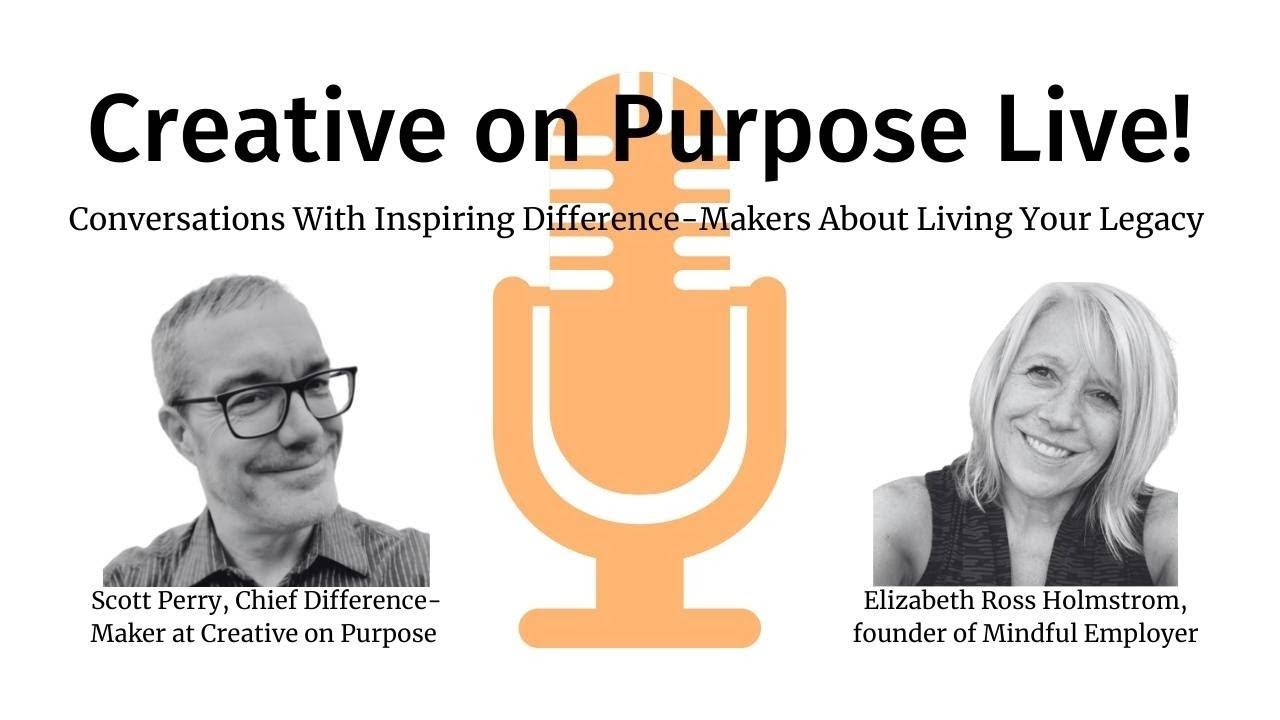
Elizabeth Ross Holmstrom, founder of Mindful Employer, talks with Scott Perry about bringing mindfulness and human-centered practices into organizations. They cover how to make DEI and mindfulness initiatives actually stick, daily routines like breathwork and centering, and regeneration in business.
Chapters
confirm that we've gotten where we're supposed to go. And according to StreamYard, we are miraculously again appearing on Facebook, LinkedIn, and YouTube. Wow. How does it happen over and over and over? I don't know. They call me Technology Man, and it's not because I'm very good with technology. Welcome to Creative on Purpose Live, conversations that inspire— with inspiring guests about living your legacy. Experience better living while making a Your biggest contribution. Actually, we're gonna try that again. Welcome to Creative on Purpose Live, conversations with inspiring guests about living your legacy. Experience better living while making your biggest contribution. I'm your host, Scott Perry, Chief Difference Maker at Creative on Purpose. If you're ready to fly higher, the difference only you can make, visit creativeonpurpose.com and sign up for our newsletter. Get insight and inspiration delivered to your inbox 3 times every week. And a free copy of Trust Yourself: A Simple 3-Step Decision-Making Process to Power Past Imposter Syndrome— say that 3 times fast— and Your Inner Perfectionist. Let's meet today's guest, Elizabeth Ross Holmstrom. Welcome to the broadcast. Please tell our viewers who you are, what you're up to these days, and where can people go to learn more about you and the difference you're making?
Thank you, Scott Perry. It's wonderful to be here. I appreciate you, and I've been loving your shows. I am, um, I'm the founder of a company called Mindful Employer. And my work is around creating conscious companies or companies that are putting human back into work and into our focus and aligning essentially work with nature. And what that means is really helping— I primarily work in the founder and startup and then growth space, helping owners and CEOs and founders to connect with their heart. As they're growing their organizations. So making sure that they're in touch with their why story and in touch with all of the— with the true experience of their employees and all the stakeholders that they work with as they're building these organizations that are impact organizations. I just love the thought of business as a force for good. So that's what I've been up to the past several years. I weave mindfulness and conscious leadership into everything that I do. And you can find me at elizabethrothsholmstrom.com is the easiest, and that'll get you to Mindful Employer. But that's what I've been doing lately. Yeah.
Well, I don't recall seeing any of those courses on the curriculum at school or grad school. I'm curious a little bit about your origin story. Like, what's the backstory? How did— how— guessing that you didn't take any of these courses in college. How did you come to do the work that you're doing?
Well, for me, it really— I took a very unique path into business. I didn't finish high school. I had to go to work very early on to just from a survival perspective and then went to school, went to college later. And you're right, like we didn't really learn this in school. What we learned— what I grew up in a family where my dad had a business that served the agricultural Valley in Central California. And so I grew up with a company that was very conscious, but they didn't call it that, right? A lot of family businesses are. And where they really cared about the next generation, and they cared about all of their customers, and they really gave back to every aspect. Like, they were always thinking about how what they were doing was impacting everything that they touched. And so when I got into business and my career, The further up the ladder I went, I was in health and wellbeing. I was head of health and wellbeing for a large Fortune 500 bank for a couple of years. And I was in that space in the national, with national companies for probably 20 years. And we kept, the further I got in, the further it felt like we were getting away from humanity. And then I discovered mindfulness, which it was introduced to me as a way of connecting with myself. I had been going through a lot of personal challenges with a lot of deaths in my family in a single year. And I started using mindfulness as a way to step out of my daily madness and into— back into me. And so I developed a program at a company that I was working with. And then I realized that I really wanted to do it full-time. And so I started offering mindfulness at companies. For just for leadership development and for a practice from a wellbeing perspective. And companies were just tacking it onto the side. Hey, we've offered this mindfulness program, we've checked that box and everything should be good now. And what I realized is that that's not going to make these practices a part of our DNA. And so I really was searching for something and discovered conscious capitalism along my journey, Raj Sisodia. Kind of a Raj Sodhi disciple. He wrote a book called "Firms of Endearment." I've taken a course with him at Babson. He's written "Conscious Capitalism." And one of my favorite books is more of his— one of his more recent books is basically "The Healing Organization." And so it really helped bring to me— it coupled what I grew up with, the family business, with how organizations can actually behave if they make this work part of their DNA. And that's what really inspired me into the work today. Wow.
That was a long story. No, that was great. That was great. I just— there's one thing that you said that immediately brought to mind a conversation I had recently with Nikki Lerner, who is doing consulting work where she is helping corporations, institutions that want to improve their posture around diversity, equity, and inclusion. And she express sort of a similar dynamic. Like, you know, companies realize they have this diversity, equity, inclusion problem, this mindfulness, presence, human skills problem. They bring in someone, OK, we've done that, check the box. Now we're going to continue. And so I love that you and she both recognize kind of the default setting in the culture, which is let's just bring in an expert, we'll do the thing, and then and then we'll move along. And so I'm just curious, what are your strategies for making, coming in as an outsider doing this work, but then giving it some stickiness and some traction so that after you leave, that these things will continue to be practiced and exercised?
I'm so glad you asked that because it's, it's key. My biggest success is when I can leave and maybe they continue to use the tools that we help them learn how to use. Um, and it's really simple stuff. This is not rocket science. The way we start is with the CEO or founder. We really help the, the leadership get back in touch with their why story. So the Simon Sinek why, right, is, is really telling my story. Why am I even in this business? Who am I serving? And getting really clear with that and then turning that same lens over to your employee population. So starting with your employees as your first stakeholder and understanding what is it like from their perspective to work with you and to work with your customers and to work with your suppliers. What's their true total human being experience like at your company through just a few questions? So my learning is that I believe that we can co-create business by having consistent conversations that are not hard, but they take practice. And they take a learning, if you will, to really ask questions with curiosity, not to solve. And so we teach just a few questions based on who your stakeholder is. We start with the employees. Then we quickly turn the work over to the employees And we say, this is your work. Like, what do we— what's one or two things that we want to work on this year to become better together? And that's it. So we— and they drive that. So they, the employees, take it on within the first year. And then they begin having similar conversations that they're having successfully within their company, then with their customers. And their suppliers, and thinking about community and thinking about the earth. So it's all around a series of listening sessions, if you will.
Yeah. Well, what's really interesting about your approach is that it aligns almost identically with Nicki's in that, you know, she discovered really soon that being brought in as the expert to work with the employees was not making any significant change happen. And that what was required, she discovered, is she had to earn enrollment and investment from the senior leadership, the CEO or what have you, and that, and then have them work with their employee and just, just as you were articulating, work, work its way down the chain. So I love that. I mean, that's a very conscious approach to making meaningful sustained change for the better happen. So I, I, I really love that. I'm also hearing like this theme of, um, essential, simple, easy to remember and execute questions, exercises. And so when I hear that in your approach, it reminds me, um, well, back up one second. That, that whole idea of coming in and working with the senior leadership reminds me of the way that we think about coaching at Creative on Purpose, which is my job is to coach myself out of a job. I'm not supposed to be here forever. I'm not supposed to be your coach forever. My job is to help you see what you don't see, help you not ever unsee it, and help you continue to lean into the tension of and the— around the uncertainty and adversity that's a part of any meaningful journey, meaningful work, but give you some tools and some first principles, guiding principles that you continue, continue on the journey without relying on someone taking you by the hand. And so part of that practice, getting back to my original question, is providing those guiding principles, those values, those guiding principles that people can keep close at hand and bring into, you know, the conversation with themselves or with other people so that they can start to change the dynamic, make the transformation happen. So I'm just wondering if there's a guiding principle, a value or two that you feel are really essential to helping make the change that you're trying to make in organizations, institutions, and corporations.
It's beautiful. I mean, and the work that you and Nikki are doing, I mean, I'm, I'm an evangelist for what you're doing because it's, it's beautiful. And to me, the guiding— I feel like for my personal being, when I am struggling with anything, when I come back to my values, right, when I come back to who I'm serving That is when I'm in alignment. And so that's what I try to help people remember, right, is that I started this business for a reason. I've got all these people gathered together to serve who we're serving for a reason. And I think that in the traditional— I call it now old paradigm, but where I, I'm hoping it's old paradigm soon. Um, the old paradigm thinking is, is really that financial win thinking, right? That, that, that I am successful— like, for, for instance, startups, right? Like, you're successful when you have an exit strategy. Well, that is so messed up. Like, why is it— why am I successful as a business owner when I have an exit strategy? Because that doesn't bring into, into your story the human beings that you're serving, right? It— every single employee that someone hires is a person, has people that they love that they're trying to support with the work that they're doing with you, right? And so to me, that is— those are the values that I try to help people get back to is why is any business in business if they are not raising the level of the human experience, right? I don't even understand how we've gotten to this place. And there's so many layers to how we've gotten to this place. And there's a way out, right? There's a way out.
Yeah. Yes.
Or a way through. Through is a better word.
Yeah. Well, the, um, I, I worked with a therapist once who reminded me of the Robert Frost line, the way out is through. And I, yeah, I, I, I recite that line to myself very, very frequently, almost on a daily basis. Um, so I, I, I love that. Um, I, one of the things that, that comes to mind is something you mentioned already, which is that it's easy when we're in the tactical weeds of running a business, of engaging with employees, customers, um, the, the supply chain, um, management.— or when someone like you or I is working with an organization as an outsider coming in to work on a specific problem, we get— it's easy to get lost in the tactical weeds. And what I've heard you say a few times now is to bring that, to bring presence and mindfulness back in, to become aware and conscious and pay attention to what's going on, and then to draw on these basic guiding principles. And it sounds like they're all around remembering that businesses, you know, we always talk about, are you B2B or B2C? But we're all actually H2H, human to human. And so I'm curious, you know, I get that a lot of the people that I work with get that. I'm wondering, um, if, if there's a learning curve with your clients to get to that, uh, or is that something that you're finding to be more, um, you know, that's a vibration that's, that's occurring more generally now through industries and, and, and corporations?
I, I think what that leads to is, for me, what immediately came to bring to my mind is a, is attraction. So for, for so long, um, when I started out my business, I like picked a few key industries to, to, um, when I was first doing the mindfulness work, I'm like, I'm gonna contact, I'm going to reach out to every attorney that I know, every accounting firm that I know, and financial institution, and places that I happen to have experienced where there's high, high stress, right? And what I learned in that is that when you're trying to convert someone, they're not ready. And so I really believe in the place where I think we're all kind of moving as a human species is this law of attraction. And so what I'm learning is that the people who seem to be attracted to the work that we're doing Um, it's definitely— I mean, I have a learning curve every single day, so there's definitely still a learning curve there. However, there is an attraction. There's something that is like, you know what, I believe that I can do what I'm doing differently. I believe that just working— like, don't get me wrong, like, if I'm going to be in a successful business, I have to have a business plan, I have to have sales and marketing strategies, I have to have— I have to do things each day to make sure that I'm successful. What I've learned and what I try to help people see through this work that— like, thank you, Raj, and all the folks that he partners with. We have 30, 40 years of data now that show that when we are human-centered, the Patagonias of the world, et cetera, when we really truly get to be regenerative, organizations that we are more successful financially. And so I find that it takes talking about the science, the data, and then also connecting with the heartstrings, you know, or just that sense that more is possible and, and a better way is possible. So it's moving from doing to being. Mm.
Yeah.
And that, that is helping, I find.
Yeah. Well, I, I, so I just wanna, uh, highlight the, the use of the word, um, regeneration because that's been a theme in some other recent conversations, specifically with Karina Balisi and, um, Kate McEwen. And, uh, so I, I'll tag them into this conversation so they find a simpatico, uh,. And the other, you know, when you mention the law of attraction, um, you know, for a lot of people that brings up the movie The Secret, the book The Secret, which is, um, is fine if you do that and that works for you. It's, it's probably not going to work to just put your, your idea for the universe. Um, I'm not— I have no empirical data that says the universe is just waiting to manifest my deepest wants. Dreams and desires. What I'm hearing in what you're— the way you're using that phrase is when you show up consistently and frequently, committedly, um, being a specific way, um, the right people, um, have an opportunity to become aware of and pay attention to and therefore start to, you start to earn their trust and their permission and their enrollment, which will eventually lead to the investment that makes meaningful change for the better happen. So I just want to clarify, make sure that, that my read on what you're saying is correct.
Yes. And I do believe that as energy beings, like every human being is an energy being, that we actually have way more energetic support than we've been taught. And I'll just give you an example. So years ago, I used to do— or for many years, I would start out my year with, um, and whenever it was, like, I would just plan one year in advance and I would do a vision board. Right? Like, what are the visions that I have, you know, for my company or from— for me personally? And I've started calling those a couple of years ago a manifestation board. And here's the key difference, is that when I first started doing vision boards, I would have a list of things that I wanted to do, wanted to achieve, and then I would go out and find pictures or words or whatever like that that made that— felt like that came together in a visual sense. And then I would make that poster or visual drawing. And what I've been doing the last few years, which is super interesting, and it sounds a little woo-woo, but it's actually worked, is that I have been energetically, like, sort of imagining myself in this space and what it feels like to be, let's say, a year ahead. And so there's a difference there than like, okay, I want to do these 7 things this year. Okay, I want to imagine what it feels like in— I'm going to look at my little— I got a poster over here in my office, um, July 16th, 2022. On July 16th, 2022, what is it going to feel like? Like, what's my business feel like? What does my home life feel like? What is— what does it feel like? What What are the things that are resonating with me that feel like I'm doing really beautifully in this space? And there's a difference there. And that's what I'm talking about is that it's a little bit of a different tangent than the day-to-day work that I do. But there's also something in there that I've been sort of starting to slowly weave in, maybe not with the woo-woo language, but just in the helping people imagine more.
Yeah, I get it.
Sorry if I took— I'm gonna wait.
No, no, no, no, no, no, no. I think— I mean, it's the— it's a distinction worth teasing apart because, uh, you—
the—
there is power in intention. There is power in putting a point on the horizon. There is power in having North Stars. There is power in, um, envisioning and imagining. And, and it— there's also power in, not just in, in doing the work, the real work, and having a plan and being strategic and aligning with the right people around values and people who need your talents and skills to enhance their lives. I mean, all, all of these things. So my, my, um, I guess the distinction I was making is that yes, you have to have this and you have to do the work that's going to help you get there. So just sitting back waiting for the universe to, um, come around to your wish list is probably not gonna— although some people say it does work. So, um, We are approaching the end of our time together. I would love to end with just 2 final questions. One is, and you've maybe just shared a little bit of this, but, you know, are there, are there any daily, are there any relationships or routines that you really lean on in your day-to-day to help you step into potential and possibility with the the difference that you're trying to bring into the world?
Yes. The very first thing that I do each day is I do breathing exercises to just kind of center, you know, because I lived probably 98% of my life like above my eyebrows in my thinking head. And I realized like, geez, there's this whole body here that has a lot of other senses to be valuable in my day. So I start out just trying to center a little bit. And I also ask the question, like, who am I here to serve today? And I find that that puts me in a space that is reminding me of what I'm doing. Right? Who am I here to serve today? And the second thing is that this is brand new this year. I have been— so I have— I'm very, um, I'm very systematic. I'm an operations, you know, sort of expert and planner. And I, um, have been— I'll put everything down on a list, but I have been recently, um, allowing myself space during the day. And I'm talking like just a minute here or two. To say, like, what is the next thing that needs to be done right now? And then doing it. Like, you let the message kind of come into you because you've got this whole list in your head. So, like, what's the next most important thing? Giving yourself some space around that and then actually doing it before you look at your email, before you do anything else, is actually get that thing done. It has been a game changer for me.. And then just trying to remind myself to do it like 3 or 4 times a day. Like, what's the next real important thing that needs to be done right here? And give yourself space for it.
Wow, that is amazing because you've just about perfectly articulated the process that's shared in Trust Yourself, which is available at Creative On Purpose, which is you ask 3 questions. What's now? Objectively, what's happening in this moment? What's next? What's the next smallest step I can take into potential and possibility? And what matters? Like, why am I here doing what I do? And who is it for? So I love that, um, that was like a perfect alignment of, uh, a very basic principle here at Creative Our Purpose. I love that. And I love the reminder, um, to breathe, which has been something I've had to remind myself a lot more of, uh, with the reemergence of COVID recently. Final question. And I mean, you've already shared a ton of wisdom and gems and some practical and pragmatic takeaways that people can apply to the difference that they seek to make in the world. But if there was just one final quote, maxim, exercise, idea that you would impart to someone who's tuning in, who aspires to or wants to advance in the difference only they can make, what is one, one final suggestion or piece of advice that you would give?
Really, like, try to give yourself some quiet space to really feel what it's like to be where you are right now. What are the things that in your day-to-day work or being, um, bring you joy, right? Like, where do you lose your sense of time? And, and then think about, or ask, you know, kind of just ask your inner wisdom, like, where, where can I do more of that? Like, how, or how can I do less of what, like, the, the shadow side of that is? Like, what, what am I doing that just actually sucks the energy out of me and isn't really adding a lot? So I feel like that's a really good place to begin, is to just go into yourself and begin to notice where you're activated in a really positive way. And then what's like— I always think of it as like energy in, energy out. What is purely taking my energy out versus what's actually, you know, maybe I'm putting energy out but there's also energy coming back in.
That is phenomenal. I love that. What I was hearing is find your focus and find your flow and maybe have a little fun at the same time.
Yeah, we all need more fun.
Amen. Well, that's awesome. Thank you so much. Thanks, everyone, for tuning in. Elizabeth and I really appreciate you lending us your valuable time and attention. And we hope today's broadcast motivates you to take a bolder step into possibility, living your legacy. You can learn more about Elizabeth Ross Holmstrom at ElizabethRossHolmstrom.com. And it's always, of course, fantastic to see you at CreativeOnPurpose.com as well. If you're listening to this as a podcast, please consider leaving it a 5-star review. Help more of the right people find us and tune in. And now take the insight and inspiration from this conversation and fly higher in the difference only you can make. Elizabeth Ross, Ross Holmstrom, thanks so much for for spending this time with us and sharing your experience and wisdom.
Thank you, Scott Perry. You are doing beautiful work, my friend. Thank you.
More from Scott



Stoics Don't Suppress Emotions, They Do This Instead #stoicism #emotionalintelligence #mindset







