Creative on Purpose Live - Evan Harrel, Center for Compassionate Leadership
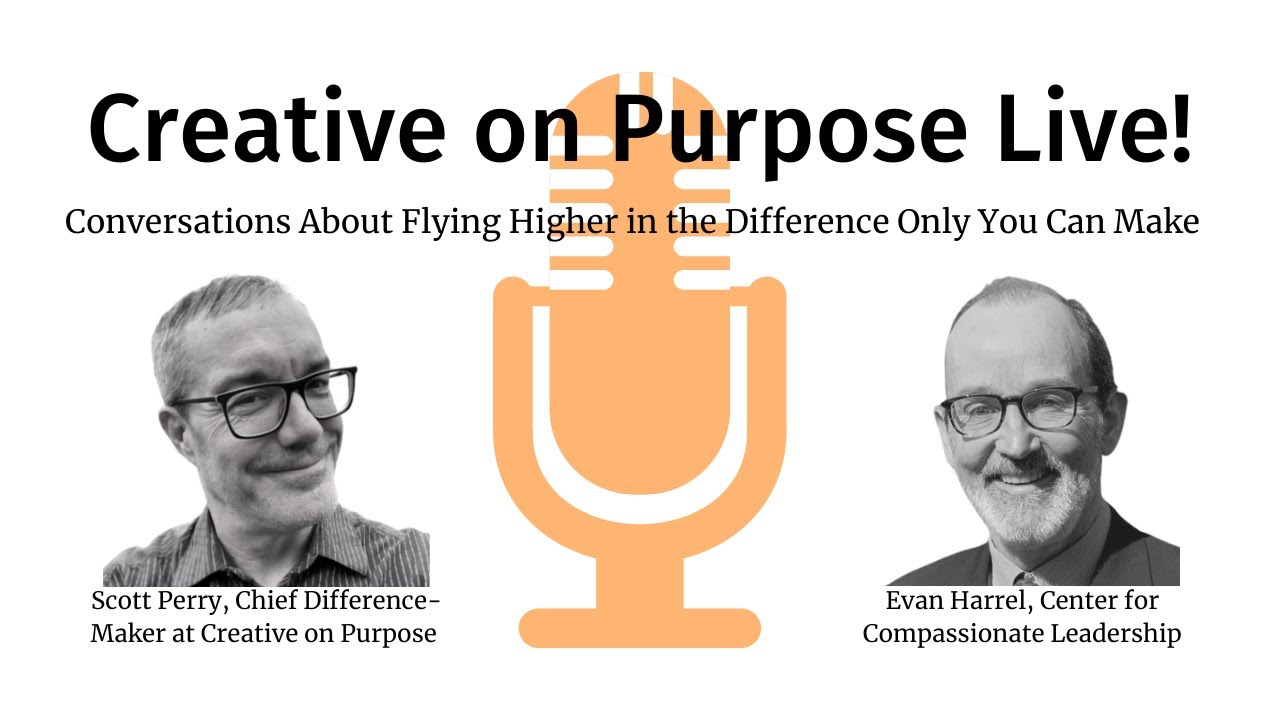
Evan Harrell, co-founder of the Center for Compassionate Leadership, breaks down compassion as a four-part process: awareness, non-judgmental connection, empathy, and action. Compassion activates reward circuitry in the brain, making it energizing rather than draining. Leadership isn't a title but a distributed skill built on vulnerability, humility, and intentional inclusion.
Chapters
position. We are zipping across the ether at the speed of bytes. And ladies and gentlemen, there we are. We are live. Welcome to Creative on Purpose Live. These are conversations about making a difference that only you can make and flying higher while you're making things better. Could not be more thrilled and delighted to have Evan Harrell from the Center for Compassionate Leadership with us. Evan, please introduce yourself to our viewers. Tell us, uh, who you are, what you're up to these days, and where can people go to learn more about you and the fantastic difference that you're making at the Center.
Thank you, Scott. It is, it's a joy to be here with you today, and I'm so appreciative of your purpose. I am the co-founder of the Center for Compassionate Leadership, and you can find me at centerforcompassionateleadership.org. We, we are an organization that believes in trying to grow compassion in the world and using leadership as the vector that brings it out into the world. We do it through trying to build community with like-minded individuals. We do it through education and training. We have 8-week training programs coming up this, this fall. We do it through research and through thought leadership. So thank you for having me here.
It is a real pleasure. So I was thrilled to connect with you, and I've been aware of the work that you're doing. But once you and I connected, I began really exploring your site and all your offerings in a little bit more detail. And what I love most is baked right into your organization's brand: Compassion and Leadership. Two subjects very near and dear to the folks that tune into this broadcast that are also members of love the Creative on Purpose community and, and read the things that we're up to. So I would love, if you're game, to just start with, you know, how does the Center for Compassionate Leadership define its terms? Let's start with compassion. What does compassion really mean?
Sure. So compassion, classically understood, is an awareness of the suffering of others combined with the intention to try to do something to relieve that suffering. We use a 4-part component of compassion that starts with awareness. So you have to, you have to understand, for starters, you have to be able to see that something is going on. It goes next to connection, and connection for us is connection in a nonjudgmental way. You have to see the suffering of another in a way that makes you want to be responsive to them. Having done that, the third part is empathy, which is resonance with the emotion of another. And finally, the— perhaps one of the most important parts of compassion is moving into action. Now, action can mean truly bringing about change, or action can be something as simple as wishing the other suffering to, to be eased when there's nothing that we can do, because many times there isn't anything that we can do other than and then hope that the other person who is suffering will be able to find a way out of their, their own challenges. So that's Compassion. And we can, we can pause there, or I can, I can jump into Leadership.
I would love to just pause there for a minute because I'm hearing so much alignment with some of the things that we've talked about. So what I heard was, the first step is awareness, then acknowledging what is going on, then the empathy to understand what is going on. And then the action, which can be as simple as, you know, my— I'm thinking of my wife and her loving kindness meditation. I mean, just to wish good upon others in the world, regardless of your, you know, the directness of her connection. And I just want to— I love the clarity because in part of my struggles to understand both empathy and compassion, uh, about 5 or 6 years ago when we— I was really exploring these ideas. There's so much out there where empathy and compassion are difficult to tease apart. They seem to often be conflated as being the same thing. And we hear people like Brené Brown talking about empathetic compassion. And I always— the framework that I, that I came to that I would love your perspective on is there's an effort to empathy, and then, but there's action to compassion. So the effort of empathy leads to the action of compassion. So I see empathy as being kind of a part of the causal chain. You know, there's pity and sympathy, empathy, compassion, and you kind of move your way through. And compassion is the ultimate expression of empathy and our human kindness.
Yeah. No, the language is very difficult, and we're talking about it in English. There are some languages where the word compassion really doesn't even translate well because compassion is not pity. It is not feeling bad for another. There's some powerful neuroscience between empathy and compassion, and what it shows is that empathy— and here we're talking about specifically empathy arising when you see someone else suffering. Empathy in its simplest definition is just when you— when I resonate with what you're feeling. So I can have an empathetic response to the joy you experience in playing a guitar. I mean, I can see it, I can— I mean, the music is literally resonating, and that's empathy. It can be a positive response. But when we're talking about suffering, we're talking about resonating with the suffering of another. And empathy arises in the pain parts of our brain. When we add action to it and it becomes compassion, it actually arises in a different part of the brain, in the reward section of the brain. And this is really important for caregivers, for nurses, for doctors, for anybody who is out there acting, acting in a caring way as part of their job, because if they stay in empathy and don't move into compassion, It is a pure— it's a recipe for burnout.
I love that you said that because that is something that really was revealed to me. I think it's the work of Paul Bloom, but he talks about how effort— empathy is very often one-on-one and very— can be very exhausting. But compassion, because it presents that energetic element and it is to, you know, to be with and to work with someone can actually be energizing. And that's the experience that we have at Creative on Purpose, where we're helping people dial in the difference only they can make, and then to develop and deliver that difference by doing the work out in the world with and for other people, people who share their values and need their talents to enhance their lives. And the natural, the most common response from people that engage in this process is that they actually feel more energized when they are doing meaningful work, even difficult, challenging work with and for other people. So I absolutely love that you brought up that point.
And I have to say, I love, I love the way you phrase that. The work that only they can do. I mean, at the core, that's, that's what Compassion is, is what is mine to do today? What is mine? And that's, that's what we need to worry about.
Well, before we get to leadership, I want to unpack that just a little bit, because now you're speaking to a part of— I believe this is very important to the work that you all do at the Center for Compassionate Leadership, and very important to my brand, obviously, because we have Creative on Purpose and this idea of purpose. And where does purpose come from? And I'm not sure that I have an absolute or clear answer there, but I do know from my experience and talking to many others that frequently in the United States, we're told to go find our purpose. Go find your passion. Like these things are out in the world and we have to be slashing our way through the brush with a machete to discover this thing that, you know, we may or may not find. And then the other, the flip side of that is often, well, it's actually you're born with a purpose and what you need to do is spend some time excavating it. So that you, you know, once you find it, then you can do something with it. And it's so difficult in my experience to do either one of those things. Um, before it—
to—
for, for me, what has happened is that understanding that really as a human being, my purpose is to be a good actor in the world, to, um, be a good citizen of the universe, of the cosmos. And, you know, we are social by nature. That's how we survived as a species. That's how we— that's the only time we thrive is when we are working with and for each other. And if you do the work right in front of you with the people that are right around you, with purpose, on purpose, for purpose, then purpose is kind of— becomes a naturally occurring thing. And you will find it within and without, and it becomes a little bit more of a virtuous cycle where you're renewing purpose by engaging the purpose and, and putting it out, taking it back in, putting it out and taking it back in. I would love to hear any reflections you have on the purpose part of the equation and how that might feed into empathy and, uh, excuse me, compassion and leadership.
Well, I mean, for starters, I, I am fully in alignment with all that you've just described. I think that's fabulous. I think we start from the point where we look at ourselves and look at ourselves as living beings and ask, what do we need to do? And at its basic core, all we have to do is breathe. All we have to do is get to the next breath. And if we can begin to recognize that we can do that, it sounds like a little bit of an overly simplistic approach, but if we can, if we can begin to think that way, then we can get to the next breath and then to the next breath. And then we, then we really can start to think about, okay, what do I need to do right now? And the paradox of all that is that when you start with just the breath, in that breath is embodied your entire scope of your life and your entire purpose. And so it begins to emerge and it begins to come out, as you say, naturally. It just, it flows out almost automatically. Whereas if we go out searching for that pot of gold over there,— or that pot of gold deep, deep inside of myself that, I mean, I know that that truth is there. I just, as you say, all I have to do is excavate it. Um, you know, it is like a pot of gold at the end of the rainbow. It's, it's a little bit of a mirage. But if on the other hand we just start with what we can achieve, we find out that it's the whole world in that one drop of water, the whole life in that one breath. So I think our purpose is to take the next breath. Our purpose is to ask, what is mine to do right now?
Well, what I'm hearing in that response, which is beautifully articulated and so important, because in that next breath or in the breath that you are taking is the present moment, which is the only moment in which we can, um, can have some influence and control over our framing of ourselves and our situation and what we decide to do next. Creative, our purpose, we ask ourselves 3 simple questions all day long. What's now? What's next? What matters? And it's meant to be a presence-building exercise and a mindfulness-building exercise because we so often are conspiring against our own best interest by clinging to old stories that really don't serve us anymore based on past experiences and mistakes and clinging too firmly to expectations and needs, wants, dreams, and desires in the future that we actually can't control. And what you're— what I'm hearing you say is that in that inspiration, in that taking in of spirit, that breath, we have a moment to— it reminds me a little bit of the Greek concept of time, chronos and kairos. There's the chronological sequence of time, but we can create a moment, a meaningful moment, whenever we decide to just take a pause and take that breath and be a little bit more present and mindful about what we're going to do.
And it doesn't have to be minimalist. I mean, think about this moment right here. You're in Virginia, I'm in New York, and here we are talking to each other completely simultaneously, able to see each other and broadcasting out over the entire world. Now, if that— just that one thought, which is just the simple reality of what we're doing right now that most of us are taking for granted. If that doesn't sort of make the top of your head blow off, and awe, which is what I think I'm experiencing as I describe this, is a very powerful tool to help us live into each moment, each breath.
Well, I love that you brought up awe. Awe and wonder are things that we should be desperately working to reacquaint ourselves with every single day. And I love what you said. I mean, we all carry a complete media broadcast system in our back pocket. You know, we can communicate, we can, we can access the wisdom of all time, and we can broadcast to any corner of the planet that we desire to communicate to. You know, so much power and, you know, also points to the necessity of doing it on purpose, with purpose, for purpose. I also like what you said about, you know, it sounds simplistic. It actually, to my understanding, it's actually what you say is it is actually just that simple, like paying attention to the moment and the breath. The problem is simple's not that easy because we have this storytelling machine in our head that's You know, oftentimes the inner critic, the, the imposter resistance, whatever you want to call it, um, you know, fueled by the lizard brain, by, by the amygdala, is cycling on stories that are trying to keep us unnecessarily humiliated and hiding, when in fact what we really need to do is to stand up and be seen, speak up and be heard, and live into our purpose with compassion. And maybe that seguays us into this. We spent 15 minutes on Compassion. Maybe we can get through Leadership just a little bit quicker, but maybe not. Tell us a little bit about how the Center thinks about leadership. What is leadership?
Well, I think the, the, I mean, I'm not going to define leadership first. I'll try to come back to defining leadership if we, if we get around to it. But the important thing for leadership for us is that leaders are everywhere. We live in a world that values hierarchy, and they think that leaders are up there. And, and, and, and so the definition of leadership matters, because for us, leaders are people who help create shared goals for a group, for a team, and motivate that group to get there. And so if you're part of a group and you happen to be a fairly, a clerical worker, say, but you happen to be in the flow of information, you are, you have very high level of power, impact how the group moves towards the goals, because you, you may be seeing things that nobody else has seen. You may be seeing combinations of things that no one else sees. So for us, leaders, the leaders are those, those people who, who help create shared goals and motivate towards it. And they, they exist everywhere. What you were just saying, I believe, gets to one of our core ideas of leaders, which is leaders need to go first. Leaders are the ones who need to drop the armor, get out there, allow themselves to be vulnerable, make the human connections, which is, as you said, we are inherently social. Leaders are the ones who have to create that. But leaders typically get to where they are because they have high levels of emotional intelligence. And as soon as they get into the position of leadership, people start telling them what they, they want to hear. And oddly enough, their, their attunement to the feelings of others they lose their ear, and all of a sudden that emotional intelligence sort of drifts away. So leaders have to be very careful to be intentional about maintaining their humility, not believing their own press releases, telling their team— now I'm talking in a hierarchical leadership situation— but telling their team, I want to know what you think. I need to hear from you. You know things I don't know. Please I need to be in on as much of this information or else I could get blindsided. And I don't want to get blindsided.
What I'm hearing in your definition or your, you know, the characteristics of leadership are two things that are very near and dear to the work that we do here at Creative on Purpose. One is that leadership is a choice. And it's a choice available to everyone, regardless of their authority, their position, their title, what have you. In some ways, what Seth Godin talks about in his book Lynchpin is the idea of a linchpin. A linchpin is someone who chooses themselves to make a change happen without concern for whether or not they get credit or if they have the authority to do so. The other is that leadership is a skill. We can, you know, we get better at being leaders by practicing the skill of leadership, which often means just that I love what you said about going first. And it just means that instead of waiting for to get permission or waiting for someone else, you decide that you're going to be the one that goes first. And then the final piece that I just want to highlight that you mentioned that I think is absolutely crucial to remember as a leader, as a leader succeeds and perhaps rises, is the vulnerability. Vulnerability is what what makes you a leader at the beginning. And it's probably, in my experience, the first thing to go when you start to get the recognition, the status, the rewards of leadership, because it feels like the stakes are much higher personally, when actually what you need to do is do everything that helped you get to where you are.
Yes. And, and, and you mentioned Brené Brown. Her research is very clear on this. Leaders are afraid that if they allow themselves to be seen as whole, i.e., vulnerable, imperfect, that people will view them as weak and it will undermine their authority. But the reality is it has the exact opposite. People instead see them as human. And it gets back to, again, to your point, which allows for the team to connect with them. We are inherently social beings. We need the connection. But we're all afraid of rejection. And so I'm afraid to say to you, I love you, because you might ignore it. But you're craving someone to tell you that just as much as I'm craving it. And so leaders are the ones who need to be out there and saying, saying these things, making themselves vulnerable. Because you know what? Leaders are the ones who are least likely to be rejected.
So, um, uh, well, I love what you just touched on. You know, at Creative on Purpose, we, we refer to each other as difference makers, and we all talk, and we talk about the difference that only each of us can make. And we also talk a lot about like, how do you create the generous tension that gets others to lead, lean into, and learn more about how you are trying about how you can enhance their prospects and prosperity by going on a journey with you. And the fundamental lever, as far as we've been able to understand it, is we used to say worthiness and belonging, but it really boils down to worthiness. Because if you do not have that worthiness, you will never, you won't feel belonging anywhere. Belonging doesn't beget worthiness. Worthiness gets healthy, whole, you know, belonging that will fuel your, your, your, your health and well-being going forward. So I, I love that. The other thing that you're touching on that I just want to pull on a little bit is the idea of, you know, how does a leader show up? And we like to talk about being a fully integrated human being. What does that mean? It just means Showing up as who you are, with what you have, where you can, when you can, with whoever happens to be around. You don't have to have all the answers. You don't have to have any certitude about what's going to happen next or what, you know, what's on the other side of that mountain. You just have to have the willingness to say, this is who I am. This is what I, you know, these are my values. These are my beliefs. This is where I'm going. Do you want to come along?
And I think that, I think that leaders understand that and they know it. It's just hard to do. It's hard to do because of our self-protection mechanism. And at the Center for Compassionate Leadership, at the start of the pandemic last April or May, we did a survey with leaders and team members. Around the question, around a number of questions, but including around the question of vulnerability. And we asked leaders, "Are you showing up in the pandemic with, with added vulnerability?" And I don't remember the numbers precisely. We also asked teams, "Is your superior showing up with added vulnerability?" Leaders felt they were showing up about twice as often, with vulnerability, about twice as often as their teams were seeing it. So it was, I want to say 56 to 28, that's not the number, so don't print it, but it's so hard to be vulnerable and we want to be vulnerable and we put something out there that we think is vulnerable and Nobody else thinks it's, it's, it's that big a deal. You just said something like, OK, yeah, you, you, you had cold coffee this morning or, you know, something routine. So vulnerability is something our research shows is clearly a difficulty for leaders. And we would, we would infer, and I can't say this with, with definition, but we would infer that because of the amount that leaders say they're trying to do it, that, that leaders value it.
Yeah, just want to quickly bring up Tina's comment here. She really resonated with what you said about leaders are the least likely to be rejected. It's great insight in that leader's responsibility and privilege to make change happen. I'd like to build on Tina's comment because she's touching on a topic that is being discussed here at Creative on Purpose and across the the world at the moment, which is this idea of privilege. And one of the problems with privilege as I see it is that for too long, people that looked a lot like you and I thought of it as a finite, scarce commodity that, you know, could only be extended to a very narrow part of the, um, you know, population. And, and therefore it was not really extended. I— it feels as though we are entering, you know, there's the possibility for an understanding that privilege is something that exists in great abundance and that our Our job now is to extend privilege and extend the privilege of choice and leadership as broadly as we can, to invite more people to take up this idea of choosing themselves, stepping into their potential, gathering others, and stepping into possibility for a better way forward. Any thoughts around Tina's question or around the idea of leadership and the privilege of leadership?
Well, the exercise of privilege by educated, white, heteronormative, heterosexual men, of which I am one, is a— has been a brutal producer of suffering. And so there is absolutely no question that compassionate leaders need to address this head-on. They need to create cultures of safety and belonging and connection for everyone. And they need to be listening carefully to the voices of everyone because for too long only a narrow bandwidth of voices have been listened to. And so compassionate leaders are very intentional about making sure that all voices are heard. And I think that this is a, this is a very important part of what we do. And it's become a much more timely topic. And as a, as a, as a as a member of many privileged classes, you know, I'm committed to trying to reverse the wrongs that have been created and in which I have been a participant.
Evan, I'm sorry, it looks like you—
and a beneficiary. Just— yeah.
Sorry, you froze up there for a minute, Evan, at the end of what you were saying.
Okay, so, um, I mean, I've been a beneficiary of the unjust systems, and it's my responsibility to repair the systems and fix the injustices that have been borne by others.
I love what you just said because I couldn't agree more. You know, privilege has been treated like an entitlement by the people that have had privilege, and our responsibility right now is to extend privilege to everyone. There is a— there is plenty of there's an abundance of opportunity and possibility for all of us, and it does not have to be treated as a scarce resource. And part of the— this— well, I don't— I hesitate to say this new idea of leadership because I think it's actually what leadership always has been, but for too long we've mistaken leadership for— or rewarded people with leadership who appear certain about things that they cannot possibly be certain about and overconfident about things that they should have no confidence in. And what we need more than ever is the humility and the grace and the generosity and the compassion to work together to make things better for everyone. So love I love what you were just saying there, and thank you for the vulnerability of leaning into that edge with me.
And I think quantum physics says we already are connected and we always have been connected. And so this fear that we actually affirm those connections with everyone, not just the people who are similar to us, is in reality does not have to be threatening. It actually should be deeply enriching to all of us.
Absolutely, absolutely. One of the chapters in my most recent book is, uh, talks about that idea, which goes back to ancient philosophy and is vetted by quantum mechanics. We are all one. We're all part of— we're all made up of the same stuff, from the stuff that began at the very beginning. So, um, this idea of, uh, trying to divide up ourselves, um, cross ridiculous lines is just, uh, absolutely ludicrous and something we need to get over.
I—
and I am rambling a little bit because unfortunately we are coming to the end of our half hour together. Um, Evan, obviously I could have spoken to you probably all afternoon long, but before I let you go, there is one question that I always like to end with, um, and that is around the idea— you've already shared an immense amount of insight and wisdom with us about how we can become better leaders by becoming more compassionate, more thoughtful, more vulnerable. If there's any last piece of advice or a tip that you have not yet shared that would help listeners and people watching in replay step a little bit more boldly, with a little bit more curiosity, a little bit more courage into the difference only they could make, what would that be?
I would, I would say that, and it ties into something you already said, this is innate to all of us. We see in children younger than 2 years of age acts of compassion towards other children or towards adults. We've had this capacity from the very beginning. It can be trained, it can be developed, and in fact, early epigenetic studies suggest that we can even affect ourselves, not just on the neurological level through compassion practices, but on the genetic level through compassion practices to become more compassionate. This is what the world needs today. It is not an exaggeration to say we face an existential threat. And compassion, I believe, is the answer. And I would encourage anyone who has even the slightest hint of wanting to pursue it to go for it.
Really, really appreciate that, Evan. And what a fantastic place to end our discussion. Thanks, everyone, for tuning in. Evan and I really appreciate you lending us some of your valuable time and attention. We hope that today's broadcast motivates you to lean into an endeavor that matters with a little bit more curiosity and courage. And you can learn more about Evan and the difference that they're making at the Center for Compassionate Leadership at centerforcompassionateleadership.org. And of course, it's always great to see you as well at creativeonpurpose.com. Now, take the insight and inspiration from this conversation and fly a little bit higher in the difference only you can make. Evan Harrell, thank you so much for your time and for the wisdom that you shared with us today.
Thank you, Scott Perry. It's been wonderful.
Pleasure.
More from Scott



Stoics Don't Suppress Emotions, They Do This Instead #stoicism #emotionalintelligence #mindset







