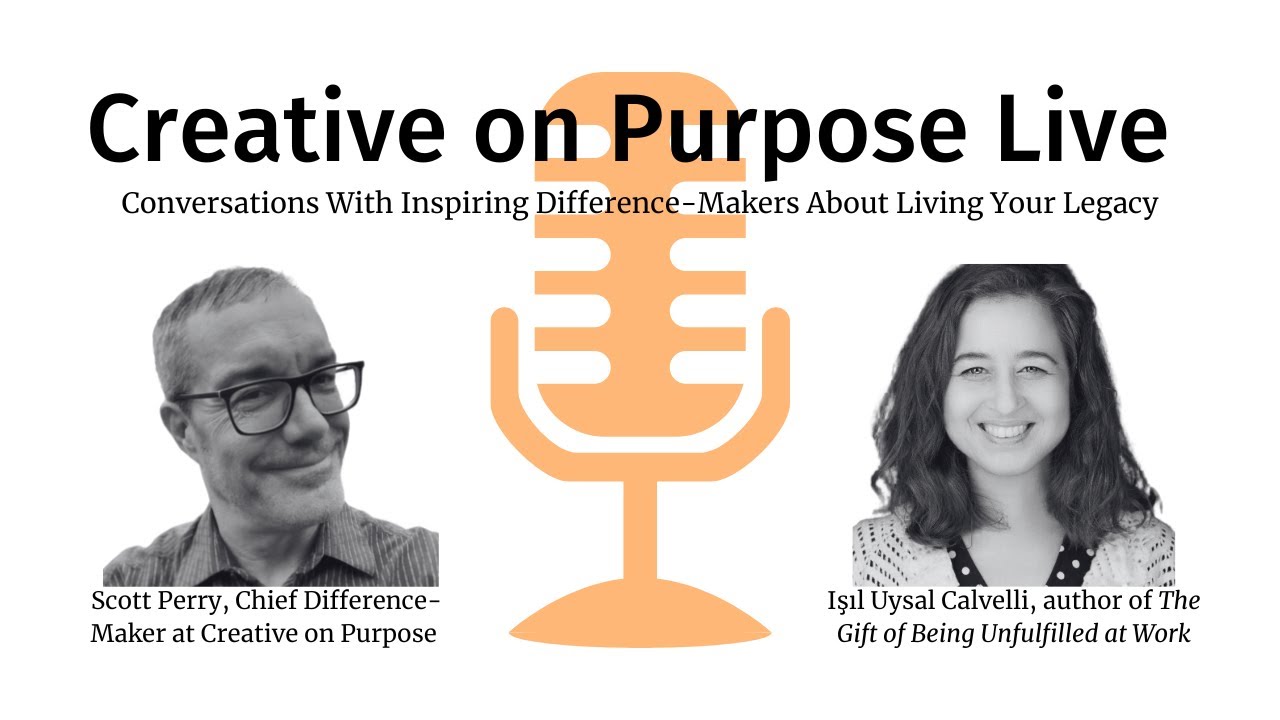
Işıl Uysal Calvelli, a former corporate auditor turned coach, argues that feeling unfulfilled at work signals what's missing and points toward more meaningful careers. She defines fulfillment as curiosity, meaning, and alignment with your values. Her mantra: fall forward and embody the abundance you seek.
Chapters
as soon as we confirm that we have landed. And yes, indeed, ladies and gentlemen, the eagle has landed. Let's go! Welcome to Creative on Purpose Live, insightful conversations with inspiring difference makers to help you live your legacy. I'm your host, Scott Perry, Chief Difference Maker at Creative on Purpose. If you're stuck at a work-life crossroad, visit creativeonpurpose.com and sign up for the free Power of Purpose email minicourse and start crafting a life of meaning and impact today. Let's meet today's guest, Işıl Uysal Calvelli. Welcome to the broadcast. Please tell our viewers who you are, how badly I mispronounced your name, what you're up to these days, and how they can— where they can go to learn more about you and the difference you're making.
Thank you very much, Scott. I love it. I think you said it perfectly. My strange name, Işıl Uysal Calvelli, is a combination of a Turkish first name, Işıl, which means shiny, and it's a Turkish surname with an Italian surname as I'm married to an Italian. So that's where the strangeness comes from, but you said it perfectly. I'm currently located in Munich, Germany. I have been living here for the past 10 years, and I am a professional coach, and I am someone that is super interested in the topic of work. So that's my area of coaching, but also my area of thinking and writing. And I know, as you have just introduced yourself, that's also your area, purpose and work. So I'm really, really curious to talk more about this with you today, especially what are you interested in? You ask, I'm interested in work, and I have written a book called The Gift of Being Unfulfilled at Work. So I would like to talk about a couple of ideas. I'm curious also about your opinions on this. I would like to kind of expand the views and co-create with you together. So if anyone wants to know more about me, about my work and about the book, they can visit my website, issyluisal.com, the strange first name and surname, .com, which you are also seeing on screen right now.
Fantastic. Well, one of the things that we love to do at the beginning of the conversation is get a little sense of how you came to be where you are right now and be doing the work and making the difference that you're making now. My guess is that little 9-year-old Ishil did not wake up and say, "You know what I want to be when I grow up? I want to be a coach. And I want to help people navigate more equanimity and joy in the world of work." So I'm just curious, like, what's the backstory? What's the— looking back, I'm sure there's a clear path. I'm sure it wasn't clear at the beginning. But how did you arrive to be doing this kind of work? Now.
Yeah, it's wonderful that you touched immediately on the child, Ushio. That's also what I'm reflecting on in the book. I wanted to be a dancer when I was a child, and that was super clear for me. I was made to be a dancer. I enjoyed dancing. People loved watching me. So that's what's supposed to be. But then something funny happened. Um, my father told me in a regular conversation, I guess I was 5 or 6, he told me, "Well, you are a bit chubby, my dear. So if you wanted to be a dancer, then we would need someone like the world champion of weightlifting to be your partner, and that wouldn't be possible. So probably you're not going to be a dancer." He was joking, and he didn't know I was going to take it seriously. Now reflecting back together, he said, "I don't know if I— I didn't know I ruined your dreams." But back then I decided, okay, that's not going to happen. So let me just continue my life. And it was quite a struggle, uh, which we can go deeper later to find what it is that I can do as work. And my journey was here and there trying things out, understanding what it is that I like, but there was always this common thread. I wanted to do something meaningful, something that is creating value for people and something that is creative. And these combinations were partially met, mostly not met in my career journey in corporate environment. I have started my career as an auditor, which is completely not creative. And it was difficult to feel direct connection to people. So that was the first learning journey for me. Then my corporate life continued with international banks, but I found myself a little corner of creativity. It was Online banking back then was new. It was just starting. I'm not that young. And we, I wanted to be part of offering services that would be useful to people that are creative. And that journey continued for some time. And that journey, the specialty, brought me to Germany as well. I wanted to live abroad. But after some time, that became too technical for me. It was too much project management, too much working on specifications of how online banking screens should look like. And more and more, I felt less connected to the creativity and to the direct impact I can make in the world and the connection with people. And that led me into a soul-searching journey and a discovering journey. And I got a lot of help. I got a lot of collaboration. And through this journey, I received a lot of gifts. That's why I named also the book that way, The Gift of Being Unfulfilled at Work. And I recognized that through my experience of unfulfillment, what did this unfulfillment tell me about what I was missing and what was important to me and how could I create work fields or create services that would be fulfilling what I was missing, and also at the same time give space to more creativity and has a generative output rather than just fixed ways of being. And through this journey of self-reflection, collaborating with other people, understanding, soul-searching, I found the connections to coaching. Actually, that was there for me in the beginning when I started working In my first bank job, I had a job interview where I told the ladies who interviewed me from HR that I would like to, after some years, I would like to work in HR because I know that I want to work with people and support people. But to me, it feels like without being in the field yourself, you wouldn't know how it feels to be in the field. So I feel I couldn't support people the best if I didn't work first in the field, then I could do HR. It felt as if judgmental now talking with you that I felt I judged these HR ladies who were interviewing that they are just from the back seats talking about HR without being in the field, but I knew it back then. And also when the first time I got coaching, there was this lamp that said to me, well, is this a job? You ask questions, you support people find their own answers, you facilitate their transformation, you hold the space for them while they discover something that is important to them and take little steps that is requiring courage and sometimes need a little gentle push towards what is unknown but wants to be discovered. That time I was inspired by it, but through life's journey, through being busy, I forgot completely. So it required me to have this moment of unfulfillment of saying, well, this is not what I want to do anymore. I cannot imagine myself doing this work for the rest of my career. I need to do something. Then I remembered, actually, I needed to ask these questions to remember what I knew back then. So that's kind of how I came to be what I'm doing right now. I am right now.
Well, there's two things in sharing that story, and we appreciate the vulnerability of the share. And, you know, that work is how we, you know, your book is about The Gift of Unfulfillment, because work is one of the things that we do to seek fulfillment, to find fulfillment in our lives. The other is how our journey into the world of work is driven so often by you know, first our parents, then our peers, then our teachers, and then society at large. And we— your story is not at all uncommon to all the other stories I hear where a parent who thinks they are protecting a child or helping prevent a child from making a mistake dissuades them from pursuing the life that they aspire to or that they dream of and take a safer path into, you know, a kind of occupation that most people understand and expect. And what I love about your story is it reflects something that doesn't always happen, I think, which is sometimes some of us wake up to the fact that we are not living our life's calling, that our life is— that we are out of alignment with our true selves, that we have not yet aligned what we do to make a living with who we really are, what we're really good at, and where we really belong. So I love all of that. And I'm curious, because fulfillment is language that we use here at Creative On Purpose as well, you know, how do you— what can you define for us or describe for us or give us at least some ideas about what a fulfilled life, fulfilling work, what are the elements of that that you might share?
That's a fantastic question. I talk a lot about unfulfillment. What does it mean to be unfulfilled and how it feels to be unfulfilled? I think fulfillment for me is there is no limit to fulfillment. That's why I value unfulfillment a lot, because it always invites this growth and discovery and being curious. What I experience, or when I reverse back what I'm unfulfilled about into to define what this unfulfilled looks like, it feels to me that what I do has a meaning for me. I value what I do. I am genuinely curious about what I do. I want to learn more about the work that I do or the topics that I'm interested in. Like, I am working in something I'm interested in, so I would continue to research, test things out, try things out, even though maybe I wasn't paid for it. I am really, really curious about this. I'm feeling a pull towards this. It lets me go continue and kind of embrace life rather than wanting to get back, hide. Again, I'm talking the negative language. Let's stay with the what is fulfillment. So curiosity, interest, meaning. And I think when I talk about interest, meaning, I see two ways of doing it or finding meaning on it. Some people, I guess, like the act act of work. So whatever the work is, if you are a writer, you enjoy writing. You might write for like a personal development blog, or you might maybe still enjoy writing for a medical company. There is the act of love of what you are doing. And then the other point is act of love towards the impacted thing or concept or the subject of the work. So there is a certain love element involved in this unfulfillment. Either you love the doing of it or you love the subject where your work is leaning towards or creating impact on. There is the interest and curiosity, definitely. And for me, probably for a lot of people, The values, uh, values are met. So my, one of my important values is connection. I would like to feel connected to people. I would like to have people around me. I would like to talk with people, design together. Another thing for me is creativity. Another thing for me is inspiration. So there are certain ways I want to feel and be, which I call values. That are fulfilled also through the work I do. I think this is how I can define my values are met, meaning being another value, and there is a love and interest and curiosity of what I'm doing. How, how would you define it?
Well, I love what everything that you shared, and I think, um, I would agree with all of it. And one of the things that I have found, um, is something that you're pointing to, which is finding work that fulfills us, that fuels us, that provides us with a sense of meaning, and, um, that makes us feel like we, we are living our legacy and having an impact. Goebbel often is found, um, with all those things that we experience as a child, as we are engaging with the world, a sense of curiosity, a sense of wonder, sense of awe, sense of connection, a sense of joy. You know, all the being— you didn't mention this specifically, but I think you spoke all around it, which is, you know, when you are doing the work that you are meant to do now, you will experience, you know, what some people call a flow state, a sense of being immersed, you know, where time that is— it doesn't feel like it's, uh, you know, something that's, um, finite or passing. And, and you said something at the very beginning that I think is also really at the heart of it, and this is, um, speaking to the great lie of why I think we're struggling so much, uh, you know, as a global society, but certainly here in America. This idea you pointed to of abundance, like there is an abundance of potential within us. We are not born to do any one thing. We can do many things and our, you know, the possibilities are endless. The opportunities are endless. We treat all these things as scarce commodities. And therefore, if you happen to have had the privilege to be born where you have a lot of access to opportunity and privilege, you want to hold on to it because you think it's a finite resource. And in fact, it's not. If we treat, if we treat it as the renewable resource that it actually is, we actually help create more abundance, more opportunity, more privilege, and that could be extended to more people. And more of us can start to find fulfillment, forge meaning, build identity, uh, doing work that matters with and for people that we care about.
Oh, that's beautiful. I think I said generative in the beginning somewhere. I think that was the idea that by doing, that's why I chose coaching. I feel that's generative and to do self-employed right now, it also gives opportunity to do multiple projects at the same time. And I love it how you said it. The abundance aspect is really, really important. I think we are trained, or as you said, maybe the culture I'm coming from, the family I'm coming from, or my own self-beliefs. It's a constant practice of remembering the possibilities and the abundance. And I think the reminder for me has been the downs is always an invitation for ups, or the lack reminds the abundance. So sometimes in life, I think we need the reminders to keep on practicing what is calling us or what is important to us. And when you were talking about the career choices, how it was impacted by actually the society and our families. That's so true, and we are usually not aware of it. And at the same time, there is another aspect, I think, that— a couple of aspects here. First thing, we don't know ourselves. I think we know just a little bit of who we are because we have an inner experience and what people tell us, or what we take from how people react to us or respond to us, and then we make meaning out of it. And if we are lucky, people tell us. That's one of the gifts, I think, of being a philanthropist or being at work because you work with people and these people become your mirrors. So I find the journey of going through different work or trying out different things actually give us the possibility to understand who we really are. And we start with a little knowledge, what I knew I wanted to to be creative, but I didn't know in which ways I could be creative. Or I knew I was a dancer and dancing comes naturally to me because of the creativity aspect of it. And there is a spontaneity, but I couldn't do these things when I was a child. And then when I made a career choice, the career choices that I made were based on what I knew, the options that I thought were possible to me, but only into stepping one of these options. Then I can only recognize, okay, so these aspects are good, but I had no idea about these aspects and I hate them. So now that I know about this, that also becomes a mirror to me. Okay, me hating them, what does it tell about who I am? So I am a person who is good, good, good at this and not good or doesn't like this and this and that. All right, so right now I can take a new turn or I can craft my current job in a way that is fulfilling for me as well. We don't have to always talk about that you have to leave everything and go. As you said, it's abundance. We have possibilities. We can also craft the work that we have in a way that is enriching us and enriching the world. But this aspect of getting to know ourselves, I think, is really, really important that the work gives us as a gift or trying things out or having unfulfilling experiences. We get to understand what it is that we like and who we are. And then seeing different options, there is an agility. Life itself is agile. There are ups and downs, births and deaths, new trends are happening. And then career choices seem to be traditionally, and it used to be, you choose something and then you continue until your retirement. I think the agility we can invite also to our work choices, and this agility is facilitated through these unfulfillment cycles as well, I think. And then through these cycles, we are able to make new choices and then expand also our possibilities. Then we are becoming more richer beings that have learned from all the aspects that we are working on, and also having the mirror of other people around us, knowing more about who we are, I think every next choice will be a better one than the previous because the self-knowledge has increased. So overall, I think it's always a generative process to look into the world of work as an invitation to self-discovery and life discovery. I would say it's so connected for me, work and life.
Yeah, I really appreciate that. Appreciate that. You referenced kind of how much of our lives are lived out in and often defined by the external experience, and that, you know, it can cut us off from our internal experience. And by the same token, if we, if we're always living inside of our internal experience in our head, that can be equally dangerous. And so I, I think it's so important You mentioned connection as being a really important value. And I think when we are connecting, you know, there's connection with others, obviously, but there's also connection with the richness of our internal experience and the things that we want to see more of in the world, like empathy and compassion, you know, the effort of empathy, understanding other people's experience that leads to the action of enhancing their experience. You know, we think about that as also being externally focused, but if you can't practice empathy and compassion upon yourself, how can you possibly practice it fully with others? So we, I like to think of it as working from the inside out. You, you take care of your primary asset, which is yourself, your, your valuable time, attention, and wellbeing. And then you can reach out to more of the right people. Uh, you know, people who share your values need your talents to enhance their lives. And when you're working with those people, you will get energy back that will continue to fill your tank, and you can, and you can, uh, share the excess. And so that feels like a— and I love that you see the gift in unfulfillment, because I think you're absolutely right, because it wakes up when we are experiencing anxiety, fear, distress, challenge, dissonance, whatever it is, it wakes up our consciousness and says, hey, we need to pay attention, to spend some time with, and put some effort into this thing that's happening right now because things are not right at the moment. So I think it's a powerful, you know, that idea that you're sharing in the book is super powerful. And It's a gift because it's woken us up to something that's important and worth paying attention to. We're, we're approaching the end of our conversation together. I, I would love to ask you two final questions. The first is, you know, this work that you do and this work that, that we do at Creative Purpose and the work that is being done by people that are tuning in is rewarding for sure. It's rewarding in large part because it is challenging. For sure. And if you're going to engage in meaningful work, fulfilling work with and for other people, there will be challenges, there will be misfortune, there will be mistakes, and there will be failures or things that appear to be failures in the moment. Is there any one experience where what appeared to be, at least in the moment, a failure or a mistake, a misstep, a misfortune, that provided you with a really important aha lesson or takeaway that enabled you to refine your approach or get clear on your next steps? If you have an example like that to share, I'd love to hear it.
When you started asking this question, something popped up. It's not exactly the answer that you wanted to take from me, Um, because it came, I want to share it. Um, when I left my job, last job, and I decided to find the meaningful work for me, and after I found coaching, I looked for a possibility to sustain my living for the time that I'm going to— I was going to develop my coaching business. And I got support from the unemployment agency here in Germany. It was possible for me to, during building phase, to get some more unemployment benefits still. So it gave me a certain cushion. But what I didn't realize, or I didn't pay attention, is that to be able to get this financing, I needed to do a lot of operational work that actually took me out of investing in the business development. It took me away from connecting with people, testing things out, trying things out. I started from a very mental space of planning things, calculating things, and what I recognize is that that's Coaching is a people's business, but I think everything is a people's business. There's, I think, nothing that is not a people's business. So I have learned to have conversations. So this taught me not to miss the conversations, learning through interactions with people, building prototypes, running it through, getting the feedback, and then moving with it. So I feel I have lost quite some time and energy because I was thinking from the way, okay, let's first cover that aspect. And once we are safe, then we can start doing something. But that was the realization of what I could create and what was possible. So it's one lesson for me to always include interactions, always include the prototypes, First, start doing it, start talking about it, start testing things out. So this one big lesson that I can share with you, I don't know if that was what you were looking for, but that came in.
Fantastic. In fact, Vina just weighed in to say thank you for that during that insight. Well, and this might tie into the final question, what you just shared. You know, I always ask my guests at the end, if, if there were just one insight, mantra, exercise, idea that listeners, viewers could take with them, viewers who, like you and I, want to make a bigger difference by doing work that's meaningful and fulfilling to them, what would you— what, what advice, what final parting wisdom would you give someone that is ready to fly higher in the difference only they can make?
In this moment, without planning, two things emerge for me. One is fall forward. Fall forward. Make the movement. And if there is a fall, you are forward. And if there is not, you are high and flying. So in either way, forward movement is your guidance rather than hiding behind. So that's the first thing. And the other thing is, I'm taking from you, the conversation, is that remember the possibility and the abundance, or rather, let's say, practice or be the possibility and abundance you want to experience.
I love that. I, and I especially love the the call that when in doubt, do something, step forward. I think that's really powerful advice. We learn much more from doing things than we do from reading and watching things. Well, thanks everyone for tuning in. Ixchel and I really appreciate you lending us some of your valuable time and attention. We hope today's broadcast motivates you to take a bolder step into possibility, living your legacy. You can learn more about Ixchel and the great work that she's doing here at ishulyusal.com. I know I just mispronounced that. I'm sorry. And of course, it's always great to see you at Creative on Purpose as well. If you are listening to this as a podcast, please consider leaving a 5-star review. It really helps more of the right people connect with the messages our guests are delivering. And now take the insight and inspiration from this conversation and fly higher in the difference only you can make. Ishul, thank you so much for your time and wisdom that you shared with us here today.
Thank you. It's my pleasure.
More from Scott



Stoics Don't Suppress Emotions, They Do This Instead #stoicism #emotionalintelligence #mindset







