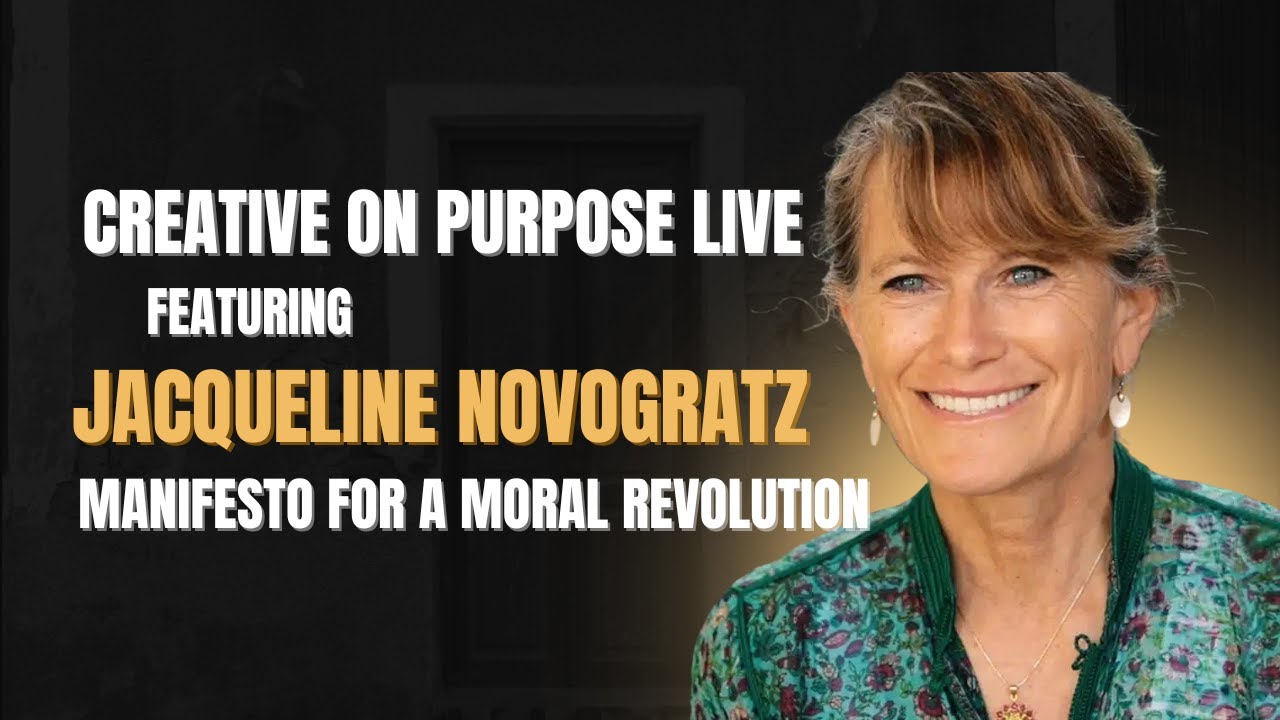
Jacqueline Novogratz, founder of Acumen, explains how dignity, not income, is the true opposite of poverty. She describes building a nonprofit that deploys patient capital to entrepreneurs in low-income markets, and shares three pieces of advice for changemakers: be genuinely interested in others, start acting and let the work teach you, and move quickly.
Chapters
Just fine. There are some people on LinkedIn that are eager to see us both. So let's do this. Let's see if I can. All right. So I need to confirm that we're live. It's Jacqueline. It says that we're live. Check your pulse. I, I feel alive. I hope you do. Welcome everybody to another episode of Creative on Purpose Live. There is a very good reason why Jacqueline and I are a little delayed. She'll explain in just a minute, but we're We want to welcome you to the broadcast. To learn more about Creative on Purpose, visit creativeonpurpose.com and get going with the difference only you can make. Remember that this broadcast is also an iTunes podcast. Please check it out there and leave a 5-star review. 30 seconds of your generosity really helps spread the goodness delivered by my guests. Speaking of, let's get to today's show. Welcome to Creative on Purpose Live. These conversations are about flying higher and the difference only you can make. Endeavor better. It's time to be creative on purpose. Are you ready? Let's go! I'm your host, Scott Perry, author of Onward! and Difference Maker Coach at Creative on Purpose and Akimbo Workshops. Visit creativeonpurpose.com to start doing better work by making better decisions. This season, we're drawing insight and inspiration from guests who are successfully embracing uncertainty, navigating adversity, and making things better, doing work that matters. Let's meet today's guest, Jacqueline Novogratz. So grateful that you're with us. Welcome to the broadcast. Please tell our viewers who you are, what you're up to these days, and where can people go to learn more?
Wow. Thank you, Scott. And huge apologies for being late, which we will talk about. I am Jacqueline Novogratz. I am the founder and CEO of Acumen. Our mission is to change the way the world tackles poverty. We invest in entrepreneurs that are solving problems of healthcare, agriculture, education, energy, and have an academy as well so that we can take the insights, package them, build leaders, spread ideas, because we think that we need a moral revolution that moves the world away from one that puts profit at the center of all of our systems to one that puts our shared humanity and the sustainability of the earth there. How's that?
That's fantastic. And it's really important and impactful work. And the fact that you're able to get on this broadcast after you just experienced a little bit of a disaster at home is evidence of your commitment to making a difference and doing great work. I would love, if you wouldn't mind, as someone who has listened to Seth Godin, our mutual friend, speak about you and the great work that you're doing, it's— I've only come to investigate Acumen recently, and I was really, really transformed by The Moral Revolution and also the course that went along with that. So I'm wondering if you would give us just a glimpse of the origin story as to, you know, in terms of Acumen, The Moral Manifesto for Moral Revolution, and who this person Jacqueline Novogratz is becoming?
Oh goodness. Yeah, so the origination story really is back to when I was a young, very young person who wanted to change the world somehow. And yet, as so many of us do, ended up being an accidental banker. This is the early 1980s, primarily in Latin America where I I learned that I really loved the tools of finance. I didn't love that low-income people in places like Brazil and Colombia, particularly in the 1980s, had no access whatsoever to the banks. That sent me on a journey to Rwanda where I helped found the first microfinance in the nation with a small group of Rwandan women. And if working with markets showed me the power of markets and also their limitations in that they too often exclude or exploit the poor. Working in international development showed me the need for a different kind of approach to change because too often the top-down approaches created dependency. And that over the course of my life, Scott Perry, I came to understand that the opposite of poverty isn't Well, the opposite of poverty is income, is dignity. And by dignity, I mean the ability to solve your own problems, to make your own decisions, to be able to chart a path for the lives that you live and ways that you want to contribute. And that was really the beginning of Acumen. How could we take the best of market tools but not be controlled by them, use them in service of solving the biggest problems that we have. And at the center of that, and this is where I have such respect for you and what you're doing, is entrepreneurs. Um, those individuals that find joy in the world impossible because they are going to solve the problems. Um, but they need a different kind of capital. They need what we do, long-term patient capital that can withstand the ups and downs, particularly when they're trying to solve problems in markets where people earn $2, $3 a day, where there's no trust, where there's high levels of bureaucracy and, and, and corruption, where, where there are very, very few skills. And so, um, so to think that just traditional investing will work is such a false conceit. Um, and so we really developed a whole suite of capital instruments as well as tools, including the way we do the work. And that is where the Manifesto for the Moral Revolution came in. I had written a first book called The Blue Sweater about the journey. But over time, after having invested $150 million of nonprofit or philanthropic-backed capital into companies that serve 300 million people, as well as building, you know, for-profit vehicles, started to see that those entrepreneurs that didn't just build companies but changed systems were differentiated by character. Not only the ability to listen and have empathy, what we call moral imagination, but the grit and the resilience to fight all the fights that are actually needed in, in, in going up against the status quo. And while I thought I would write a book on impact investing, because that's what I and Acumen are so known for helping to pioneer, I realized that the book that needed to be written was one for the generation of changemakers that realize that this is a time where we have to reimagine all of our systems. We know our current ones don't work, but to reimagine it in a true sense when everything is broken means there is no roadmap. And the best that we can offer each other is a moral compass, one that, as I said, reframes what success is, what this world needs, which is not more money, power, fame, but rather systems that put our dignity at the center, our shared humanity, the sustainability of the earth. And thus came the book, 12 Practices, because I don't think it's about principles only, it's about living into the practices. And I was really struck when you said you're becoming as a probably very deliberate word.
Yeah, well, I've been catching up on your work and the arc of your journey through listening to your interview with Krista Tippett and many other podcasts, but also reading your book and investigating Acumen. I participated in the workshop that's attached to—
Thank you so much.
Oh, it was phenomenal. In fact, Melissa, who connected us, said that one of the reasons that she connected us was because she saw my manifesto on my website. And I said, well, it just so happens I wrote that in your course. So, you know, you, you've already had a deep impact, um, in a very short period of time that I've been doing your work. But when I was watching all these interviews and reading your book, and, you know, because in the Manifesto for Moral Revolution you share a lot of your journey, as you did in The Blue Sweater, I was thinking about my own journey. And I, I, I had up to that point been talking about, like, reinventing myself. I've reinvented myself all these times. As I was engaging with your story, I could see that you and, and reflecting my myself as well. I'm, I've been on this journey of becoming the fullest version, the best version of myself, fulfilling my potential and promise as a human being who wants to make a difference in the world. And it didn't feel to me like you were, I love the term accidental banker. I think that should be your, your Link, um, but, you know, started off here, saw that you needed to go over here, and then wanted to also do this. And it's, it's the through line is very, very clear when you look back. It probably didn't look that way, um, in the moment or, you know, back then. And so I just, I love this idea that we're all trying to become the best version of ourselves that we can. The I also wanted to just address what you were saying about principles and practices as opposed to step-by-step programs. You mentioned Compass, as opposed to, you know, many of us invested in the status quo or invested in the comfort of the status quo, knowing where we stand and what's expected, want roadmaps. Please just tell me what to do and how to do it. Many of us are very nervous about being issued a Compass and saying, here, find your own way. But you've done that really powerfully in Acumen and also in the Manifesto for a Moral Revolution. I'm just curious, because it's a metaphor I use frequently, the compass metaphor, how did you arrive at thinking about things that way as opposed to the traditional status quo way of give me a map and I'll go where you tell me?
Hmm, I'd actually be interested in hearing how you arrived at it also, Scott Perry, so I hope you're going to answer that. As well.
You first.
I'm happy to go first. I think I've always thought about the moral compass in a way, and maybe that is what pioneers do, is that my entire career, if I— and I never thought of myself as having a career, but my entire life since Chase has been about creating things that didn't exist before.. And so I always felt that I was somehow out in the wilderness. And then, you know, you think about what Gandhi talked about when he talked about education. He spoke of it in terms of unlockment, and that the idea of true education is to find the wisdom that exists within a person by providing the questions that that person then can go and find for herself. And so I think for those of us who are seekers, who are on a quest, there is this recognition that we're always looking for guideposts, but those guideposts won't look like any traditional markers, almost definitionally. And so what we have to build in ourselves is a way of recognizing patterns, if you will, seeing the stars and finding those those guideposts that are both within ourselves and externally driven so that we can start to move toward that North Star. And I almost think it's the definition of both an entrepreneur and certainly of a changemaker. And it goes to the idea of moral imagination that you have to be clear-headed and grounded in the misery often of what is and have that pragmatism, and you have to have that idealism and that vision that is guided by a North Star, because that might be all you have, the audacity to see the world as it might be, as it can be. And then to get from here to there requires a compass that you are constantly calibrating and recalibrating, and it just gets stronger and stronger directionally. As you then start to build maps for others. Does that resonate?
That's really, really powerful. You've mentioned character, which is also a fundamental discipline in the work that I do at Creative on Purpose. And I think the work that Seth does with Akimbo, this idea that our pursuit of becoming the best version of ourself and pursuing our potential and our promise and trying to experience more flourishing and equanimity as we engage with meaningful work, that comes in part by being clear on who we are and what we're good at and where we belong. Like, can we associate ourselves with people who share our values, need our talents to enhance their lives, and do that in pursuit of better making, enhancing the prospects for others while we develop our own potential? And I, and so Moral Compass, which is the word word you use, is very something that I definitely have been thinking deeply about ever since I was in the 7th grade and first introduced to the Meditations of Marcus Aurelius, which is, you know, Stoic philosophy all about virtue and character is really all that matters. It's all that you own, and your duty as a human being is to develop that potential and promise in pursuit of making things better with and for the people you find yourself with. And that's the reward. The reward is not in the results and the outcomes. You should have aims and aspirations, but it's, again, speaking to what you were saying earlier, it's about the process. It's about doing that work with intention and integrity, about doing that, about the quality of your efforts, because that's all that's really yours is the quality of your efforts. So why not do your best to make the biggest, best difference that you can?
I love that.
And let go of the attachment to all the trappings of success that at least we're cultured into here in the United States, you know, status and money and things.
Well, and what we forget is that anything that can be conferred on you— money, power, fame— can be taken away from you. And so what you're also saying is cultivate those parts of yourself that, that can only be yours and And I would include knowledge there and I would include service and I would include relationship into those places. And so I think that what you're saying is just really powerful. It's about intrinsic, intrinsically moving. And so that compass gets, as I said, just more and more honed as you do the work and show up for it.
Well, it's, yeah, working from the inside out. Your why is very important. You should be doing work with purpose, on purpose, for a purpose, with and for others. But you'll find that more likely, I think, if you start with who. And the first who to start with is you. Who are you?
That's right.
What are your values? What are your beliefs? What are your skills? Where can you put yourself to do the most good? So really, really, really appreciate that and the power of that. I'm, I'm interested. So as I was reading the Moral Manifesto for Moral Revolution, as I was engaging more in your own conversations with others about your work, I was struck by the number of challenges that you have come up against and really in many ways, I mean, invited into your work by putting yourself in situations where challenges very clearly. Going to happen. And we're all human beings, and despite our best intentions and motivations, we will make mistakes. And those can be obstacles or opportunities, depending on what we do next. So is there a— and I'm sure there's plenty to choose from— but what would you like to share, if you're willing? Is there a challenge or mistake that you've made that you feel really had an impact on helping you level up in the change that you seek to make in the world?
Yeah, Scott, as you said, I've made hundreds of mistakes. In a way, it might be most helpful to talk about categories of mistakes since I've made some pretty big ones. I think the most painful category where I think I'm finally leveling up is in with people. Because, and really the whole, this whole conversation is about leadership and people. The corporate way of saying hire slow, fire fast has great truth to it despite how crass that is, that may sound. But to really take time to select for character as well as for competence. And I've actually made mistakes on both. I've been so blown away by someone's character that I haven't really done the work to understand if they have the skills to be fully capable of doing the work that's needed. Sometimes that's okay if you're hiring someone that's younger and you're helping them move. Sometimes you need to have those skills off the shelf, if you will, for the mission. And equally, where I think sometimes the risk of over-empathy, where someone may not be the right person in the right job, um, with the right skill set at that particular time, um, rather than helping them to go to where they will succeed, um, I would leave them and try to make things better at the cost to the mission, but more than that, the cost to other team members and the cost to the person themselves. And I think I've gotten so much clearer and frankly more effective and compassionate by being much faster at having the hard conversations about an entrepreneur, a teammate, an advisor who might be in the wrong place at the wrong time. And see it as part of my job to help those people fly as high as they can, to use some, you know, your language and get them to where they need to be. That took me longer than I would like to admit to learn. The second category, which is complex, it's all complex, is getting too excited by technologies and and big ideas without really understanding the character of the entrepreneur we are backing. I've said a little bit about character. What I didn't say was their self-awareness, their own humility. Are they surrounding themselves with a team that has the capabilities that they lack? Do they not just have vision but really deep operational proclivities, if not all the things that they need at that point? Are they listeners and do they hear feedback? And now we do the reverse edacumen. We want to understand who that entrepreneur is, understand that they will immerse and be able to really have a deep understanding of the communities they intend to serve, et cetera, et cetera. We also do the due diligence that you would see in most other private equity firms, but the whole beginning is invest in character. And so that's been transformative for Acumen, where some of our very first investments were very cool. They just didn't do very much for very many people. Yeah.
Well, again, it speaks to this idea of starting with the who and starting with the people. Starting with the who.
Yeah.
I really, really appreciate that. And I love— the way that you broke down character versus competence. And sometimes we can get over, over enamored with the competence or over enamored with the character. And what we really need often is, is a healthy balance of both. The other thing that leaps to mind is just this idea, and we talk a lot about this in Akimba Workshops and at Creative on Purpose, is your routines and relationships are something that you constantly need to be revisiting and revising. Um, you know, not to, like, to your point, it's not the crass, like, oh, I'm going to ditch all my loser friends that aren't serving me anymore to find friends that can promote my progress. But, you know, who are the people, the best people now that I can surround myself with to make the change that's necessary now for the people that I find myself with now? And to remind yourself that most relationships are not marriages. You're not committing for life. You're not required to continue on with the same people all throughout the arc of your journey, because your journey will change, your challenges will change.
Yeah. Although I see it slightly differently in that, um, and, and I was just mentoring a young entrepreneur this morning about this, um, and I was actually telling him about, um, my professor at business school, Jeffrey Pfeffer, who had a course called Power and Politics. And I really resisted a lot of what Professor Pfeffer would teach us about how to be flexible and all these ways that people amass power. And I was like, that is not the world that I want to live in. And he'd be like, well, that is the world. And then 20 years later, he wrote a book, which is spectacular, by the same name. And he asked me to blurb it. And I laughed because I said, "You know, we fought nonstop." And he said, "Yeah, but I still think you might like it." And the last chapter is how some people who amass great power and effectiveness in the world lose it, often because of hubris. But he said, "There's also something that differentiates," and I think Scott Perry Scott, this goes back to character, in that the ones who continue to renew and stay successful are also the ones who go back and are truest to themselves. And some of the ways that you find those indications are, are they still friends with their best friends from growing up? Are they still committed whether they're with or without, to their first wife and hopefully their only wife, etc., etc. And I would laugh with him and say, you know, one of us learned a lot in these last 20 years. But I say at Acumen, you know, we're like the Hotel California. Once you work with us, we never let you go. And that is not inconsistent It may not be the time for you here inside, but if we're both carrying this ethos, my assumption is we will be doing this work inside and outside. And we need more organizations in the world that have no walls. And that the dream I have and the vision I have is that we build this reinforcing network of individuals that become nodes in and of themselves. Either they go and they become entrepreneurs, they work in other orgs, they stay within us. And those that are surrounding, like Seth Godin, who is someone who keeps renewing himself and changing, then there's even more of a consistency within. So I think I see it with fluidity, what's on the inside and what's on the outside, but it's all of a piece. And the commitment is not only to the work but to the people doing the work.
Yeah, well, and what I'm hearing is the commitment to maintain relationships and recognize that we're all on a journey, sometimes on a similar journey, and sometimes on the same journey. And even though people will have stronger and weaker ties as we all go along, you can be committed to the idea of treating everyone with dignity, respect, empathy, compassion, the empathy—
And keep investing, keep investing in relationship because this is such a transactional moment. Are you useful for me? And you may not be useful for me, whatever that means today, but I certainly may need you in 20 years. And now I'm old enough to know How many people in my life who I worked with in 1983, believe it or not, have come back over the last, you know, 5, 6 years and said, you know, Jacqueline, I've been following your work. We haven't talked in 35 years, but I'd love to find a way to get connected. And so when your mother— when our mothers tell us don't burn bridges, I think it's actually deeper than that. It's, um, yes, respect, dignity, and, um, and don't ever forget that we don't know who we're talking to, and that every— like you said so beautifully— we're all on a journey.
Yeah, so, so, so true. And I mean, really, we're all at a level wanting to increase and promote prospects for ourselves, but also with people that we care about. So ultimately, we're all in this together. And that's what I love about your work is that it extends across the globe. And that you are trying to— you recognize something that I think is rare in the times that we live in, and you reference transactionalism. There's actually, there's actually plenty, there's actually an abundance of opportunity And it's not necessary for us to continue to treat everything as a finite resource and we better get as much as we can, that if we actually have access, provide access to everyone, to the richness available, it just be— everything becomes a renewable resource that more and more is cultivated. Um, and there's plenty, plenty for all.
It's so right, Scott. And, and, and so much what I, uh, of I sometimes think it sounds countercultural, but I think it's what we're yearning for because it connects to that. But when we think in terms of what's good for me is good for you, and I can only win if you lose, then consistent with that is check your privilege. And what we end up doing, I think, whether it's intentionally or unintentionally, is that those with privilege often do check themselves out rather than saying, hold on, privilege is often given to us, and therefore we have a responsibility to use that privilege, to extend that privilege. And I think that's also really at the heart of this idea of moral revolution, certainly of Achimov's work. When you look at the academy and the master course you took on Path of Moral Leadership, that What I get so excited by are to see incredible leaders from far-flung communities, rural Pakistan that have so much to teach us, that where we can provide platform so that we don't have to tell their stories, they can tell their own stories. But it's those kinds of things don't happen if, as you said, we're thinking either in terms of scarcity or in terms of opting out of the world. Aristotle used to say that the most dangerous society is the one we're in, right? Where you have the people are too wealthy and they're too poor. And so the poor feel that they are not part of the system and the rich think that they are above the system. We all have to be in this system because It is our system, and, um, and it's our opportunity.
Yeah, so this has come up for me twice in this conversation already. There's a quote from Marcus Aurelius' Meditations that goes something along the lines of, what is not good for the hive is not good for the bee. And the corollary is also true— what is good for the hive is also good for the bee. It's this idea that, um, you know, it's either good for everyone or it's really good for no one. That there's— and I just, I love that impulse to, you know, this is a time where people that look like me in particular are being asked to check our privilege and being asked to see things from other perspectives and point of view. And privilege is a tool like any other. You can use it as a force for good or a force for evil. So far, it seems that the evil is winning out, but we have, through your work, in large part, and the work of Seth and many others, this opportunity where we can leverage privilege to extend privilege to more and more and more, and to make the prospects and prosperity for everyone just a little more abundant.
And that goes back to where you started, that it is also, then also behooves those with privilege to put themselves in the other's shoes, to be the bridge and ask questions, to give others voice, to hold out rather than always come at things with certainty as we extend. And I just so appreciate what you're doing in that respect. Yeah.
Well, the effort of empathy is really important. Learning how to see, hear, and understand somebody else's situation and experience is crucial, but it makes— you spoke to this before about the necessity of putting ideas into action. The effort of empathy, when it leads to the action of compassion, actually trying to do something to enhance the prospects of somebody else, that's a really important step as well. We are coming to the end of our 30 minutes together. Apologies to those of you that hopped on right at the top of the hour. Jaclynn had a very good reason for why she was a little delayed here. It's actually quite generous and selfless for you to be here despite what's going on downstairs right now. So could not be more grateful for your time. I, if it's OK, Jaclynn, there's one question that I like to end every conversation with, which is this broadcast and the work that I do at Creative on Purpose is all about helping others fly higher and the difference only they can make. We have a lot of folks here like you that would like to do more and do better for others through the work that they're doing. If there was just one tip or one piece of advice that you could share, and you've shared many already, um, what's a last tip or insight or bit of inspiration that you would share for somebody that seeks to either advance or aspires to begin making a bigger difference and in the way only they can make it.
Thanks, thanks, Scott Perry. And yes, we actually had a fire in my house today, which is why I keep doing this, because all the windows are open and the firemen are still downstairs. So apologies again. I'm going to very quickly say 3. The one is be interested rather than interesting. Too often we focus on, you know, who am I here rather than who are you.
Mm-hmm.
Two, and it follows, is just start and let the work teach you. That, you know, purpose doesn't find people who are waiting on the sidelines trying to figure out their purpose. When you see something that interests you, follow the thread of your curiosity, take one Take a step, and that step will lead you to the next step that you need to take. And the third, which is not for people who are just starting out, but more for people like me. I was recently with one of the great social entrepreneurs of the world, just a couple of years before he died, Fazal Abed, who founded this extraordinary organization called BRAC in Bangladesh. And I said, Sir Abed, 'If you had to do one thing differently, what would it be?' And he said, 'I would have gone faster, earlier. Everyone wants to slow you down. Don't let them do it.' And I think about that all the time. I love that.
I totally agree. When in doubt, do something. You will learn something, and who knows what will happen. Well, thanks everyone for tuning in. Jacqueline, I really appreciate you lending us some of your valuable time and attention. We hope that today's broadcast motivates you to lean into an endeavor that matters with a little more curiosity and courage. And you can learn more about Jacqueline and her work at Acumen at acumen.org. And of course, it's always great to hear from you at Creative on Purpose as well. Now, take the insight and the inspiration that you gleaned from this conversation and keep flying higher in the difference only you can make. Jacqueline Novogratz, thank you so much for spending this time with us today and sharing so much wisdom.
Such an honor, and I learned a lot from you, so thank you so much.
Pleasure was all mine. Thank you.
More from Scott



Stoics Don't Suppress Emotions, They Do This Instead #stoicism #emotionalintelligence #mindset







