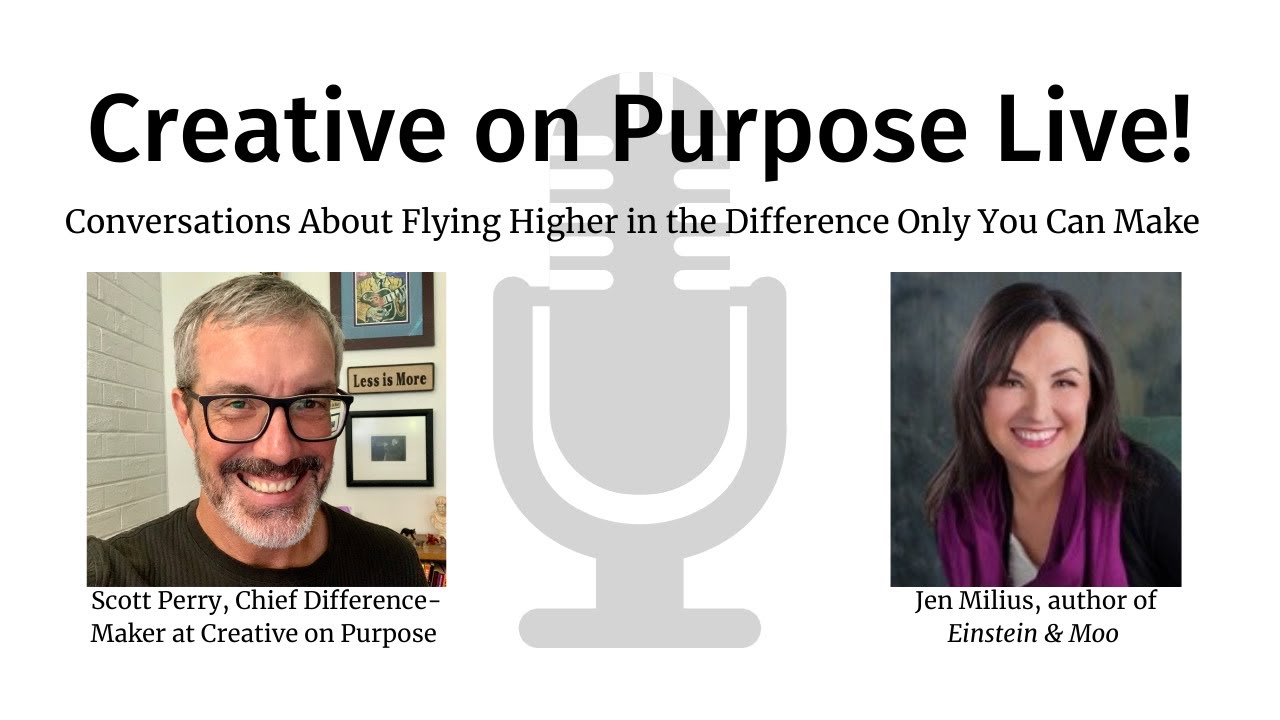
In this live interview, host Scott Perry welcomes author, coach, developmental editor, and podcaster Jen Milius. Jen explains her role as a developmental editor, describing how she helps writers see the big‑picture structure of their manuscripts, identify plot holes, character arcs, and pacing, and serve as an early‑stage partner before line editing. She discusses the core challenge writers face—fear of the unknown, imposter syndrome, and anxiety about worthiness and belonging—and how coaching and developmental editing can help them move past these blocks. Jen introduces her podcast, The Tough Fish Show, recounting the humorous origin of its name from beta‑reading jokes and its mission to inspire and equip aspiring authors with marketing, business, and creative tips. She then shares the concept behind her children’s series, The Wild Adventures of Einstein and Moo, based on her two tuxedo cats, highlighting the playful, rhyming style and the themes of authenticity and curiosity. Jen also announces an upcoming nonfiction leadership book, You Know It’s a Verb, Right?, co‑authored with Dr. Wayne Applewhite. The conversation turns to the routines and relationships that sustain her creative work, including participation in the Preneur Business Club, supportive collaborators like her accountant, and the importance of surrounding oneself with people who uplift and challenge. Finally, Jen offers a closing piece of advice: embrace your unique gifts, share your story, and trust that the world benefits from your singular contribution. The interview weaves together practical advice for writers, insights into creative entrepreneurship, and encouragement to pursue meaningful work.
Chapters
We are zipping across space and time. StreamYard is telling me that we are live. Check your pulse, Jen. I'm feeling pretty good and pretty alive right now. Absolutely. And want to thank those of you that are starting to assemble on the Creative on Purpose Facebook page, LinkedIn profile, and YouTube channel. Just want to thank you for being here. Remember that this broadcast, which is of course live, is also repurposed as an iTunes podcast. So please check it out and leave a 5-star review. 30 seconds of your generosity really helps spread the goodness delivered by my guests. So with that, let's get to today's show. Welcome to Creative on Purpose Live. These conversations are about flying higher and the difference only you can make. Endeavor better. It's time to be creative on purpose. Are you ready? Let's go. I'm your host, Scott Perry, author of Onward and Difference Maker Coach at Creative on Purpose and Akimba Workshops. You can visit creativeonpurpose.com to start doing better work by making better decisions. This season, we're drawing insight and inspiration from guests who are successfully embracing uncertainty, navigating adversity, and making things better, doing work that matters. Let's meet today's guest. Jenn Millius, so great to have you on the show. Please tell our viewers who you are, where in the world you are, and where can, what you're up to, and where can people go to learn more?
Well, thank you, Scott, so much for having me on the show. I am so excited to be here with you. My name is Jen Milius, and I am an author, I'm a coach, I'm a developmental editor, and you can find me locally in Virginia. The web is jennifermilius.com, and what that really means is that I love to write, I love to tell stories, I love to help people. I build people up with one book at a time. So whether you're a reader or a writer. Books are powerful, words are powerful, and I like helping with that.
Fantastic. So tell us, um, let's dive a little bit more deeply into, um, your work as a writer. I know that you have a book out with a— or a series of books out, uh, that have a very intriguing title. I'd love to, to learn a little bit more about that, but also what are the things that you do to help other authors find their voice and tell better stories?
Well, one facet is, uh, so developmental editing is when that person is helping the editor, the writer, tease out the story. So sometimes they're reading and they're, they're basically offering a critique. So in some ways they are taking the bird's eye view, they're taking a very big picture view and looking to see, okay, are there plot holes that we need to fill? Is the— are there character development things that we need to work on? Is the story— maybe it thinks it should start on page 1, but really the story starts on page 5 and you need to adjust pieces. So they are a partner with that writer, especially if it's in fiction, in that way to help tell the story so that as the reader is going on their journey, that it's the— the pacing's right. You feel the build appropriately. Appropriately. You feel the, the characters make sense or they don't, and if they don't, they don't need to be there type of thing. And when it's nonfiction, you're still taking your reader on a journey. You're just— it's a different type of journey, and a lot of times they might be that hero with you as they're going through it. So a developmental editor helps you to get that story out of your head and onto paper. Um, when you think of an editor, a lot of times you might think about literally checking syntax and grammar and punctuation. And yes, I can do those things, but this big picture view is just— it's so much more fun to me because it unleashes a little bit more of that creativity going on. And when you get to see that writer's joy come through because you see the aha, and they go, oh my gosh, that's what I was— that's what I was trying to communicate, or it really is coming across clearer, or oh, thanks for telling me now before I try to get that any further going. You know, it helps because you really believe in that writer. So it's a nice pairing that way, if that makes sense.
Absolutely. Well, it's— what's really fascinating about what you just shared to me is that we're all writers, uh, you know, whether you're typing words on a page or writing them, uh, on a piece of paper, you know, human beings are narrative creatures. We make sense of the world, ourselves, each other, our situation through narrative, through storytelling. And it sounds— I also maintain that we're all coaches and what you do sounds a lot to me like coaching, helping somebody identify where they are, where they want to be, what's getting in their way, usually themselves, and how to navigate around, through, over, or past, you know, whatever resistance, whatever block. Happens to, to be in their way, uh, in the moment. And I love just the, the kind of editing that you do. You know, we hear a lot about line editing and copy editing and all these other kinds of editing, but developmental editing— is that what you—
yeah, it's basically like heavy lifting, and it's one of the first set of eyes you would put on a manuscript. So it's not necessary— not every book might necessarily need it, but if the author feels like they've been struggling a little bit, or maybe they, they know that they need some extra eyes and they want it earlier on, then it is a good time for, for doing that. I mean, sometimes you might think of a beta reader doing some of those pieces, and a beta reader is someone who is reading the book for the author before it goes out and giving feedback. And you might get some feedback like that, but this type of editor can come into play a lot earlier. So they are helping you to build a better product up front. They're also someone who is going to be a little bit more critical So you want to work with someone who you genuinely feel is going to really have your back and that you feel like you can be vulnerable with. Because this is— when you're writing something like a book, any type of story, whether it's fiction or nonfiction, there's the piece of you going out there and you want to feel safe. Just like in a coaching space, you want to feel safe with the person that you're working with so that you can have that outcome that you want, that transformation that you want. And a lot of times a writer is creating a transformation for that that reader, even if it's just for this time being, go visit this world, this fantasy world that I've created in these chapters. And then when you come out, you feel like, okay, I just got to have a mental release and an escape, and now I can get back to my day job or what have you. So it's really however that transformation is that you're creating.
Well, I totally agree with that. I mean, create any creative endeavor, and most endeavors are creative, and again, human beings, creative beings, in addition to being storytelling beings. Um, creativity is about making change happen, uh, and, and writers do that profoundly, uh, through storytelling. The other thing that you touched on earlier that I also really like, and I just want to highlight, is you and I had a conversation on your podcast, which I would love for you to, to mention here in a second, but, um, you know, as a nonfiction, primarily a nonfiction writer, um, I always think of the hero's journey as being like the template for my nonfiction books because my books, I call them help others books because they're not really self-help books, but since there's not a help others section in the library, you have to put it somewhere.
Yeah, I love that.
But I'm trying to help a reader see themselves as the hero and to take them on this journey as a guide. As a fellow traveler and not to rely on me, but to essentially coach myself out of a job through storytelling to help them become the hero of their own journey and the agent of their own destiny and the change that I'm seeking to make, you know, which varies depending on the book. So tell us a little bit about your podcast as well.
Well, thank you. Uh, the podcast is called The Tough Fish Show, and, uh, it's really about helping other aspiring writers and authors to get their story out, because the people who are being interviewed on this podcast are those who have written a book, and they courageously got the idea out of their head and onto paper, and not just onto paper, but then turned it into a book, and they have shared it. And it's intended to create motivation, inspiration, get tips. Some of them have been marketing tips, some have been business tips, some have been just the— here's some ways to kind of overcome different pieces. And it's different genres, different businesses, but the commonality is that each person took the time, had the idea and the inspiration to go and tell their story, or tell a story, or write a book. And whatever that book is, they did it and they want to get it shared, and it's another way to do that.
Yeah, it's a fantastic show, and I recommend that anybody viewing or listening to this broadcast check out Tough Fish. I gotta ask, where did you come up with Tough Fish as, as the name of your podcast? There's got to be a story there.
There's a story, uh, so kind of going back to that beta reader idea. I had been beta reading for a dear friend of mine, and whenever she would ask me to beta read, I would joke and say, you know what, I— beta reader, that just sounds— I don't feel like that sounds like a fun name. I am your fish. A beta is a fish too. I like fish much better. I would like to be a fish. So I, I need to be fed. I'm hungry. Send me over a chapter. Send me over the next several chapters. And it became a joke between us. But then as I would continue to beta for her and for others and still using that term. My friend came back and said, you are one tough fish. You really, you give me this feedback in a way that really helps me to be a better writer. You help me to see other ways, but you help me to be a better writer. And it really touched me because my whole intention was for her to shine, for her book to, to bring joy. But in this case, sometimes it's a little bit of suspense in there, but there's still a thrill in there. And but to give the reader something that they enjoyed, whatever that type of enjoyment they were looking for. And it just was an honor to be a part of that with her. And it, so it kind of stuck and it makes me smile and it makes me laugh. So it has to stay.
So, yeah. Well, I mean, and, and again, you know, storytelling and, um, just from, you know, marketing is, is one of the, is a form of storytelling. You can name your thing what it is. You know, the plumber's podcast. Okay. I know what that is. And I don't really care. Or you can name your thing something that makes people go, oh, that's interesting. What's that all about? So Tough Fish obviously is a great, I think it's a really great juicy name because it makes me, well, Tough Fish podcast? Fish listen to podcasts? What makes a fish tough? I want to, you know, tell me more about that. So I just, I think that's brilliant. I think, and it's again, a great show, Tough Fish with Jim Milius. Check it out on iTunes and wherever you tune in to hear your podcast. So going back to your work as a developmental editor, you've touched on this a little bit. And I have a specific challenge I'd like to ask you about. But what, what do you see as if you had to name just like the number one challenge that most of your clients are trying to overcome? What is that number one challenge that a writer has that, that you're helping them solve?
A lot of times I think it's just the fear of the unknown. I think that it's a fear of, is this enough? And am I enough? Am I the right person to tell this story? I can't tell you how many times I've been at book signings for my own books and having people come up to me and tell me about their story, and then they would say, the business side scares me, or I'm the— no one really understands what I'm working on and I kind of feel like I'm just by myself out there, or I'm writing this story and I'm not sure that I'm going to really be able to talk about it. But the underpinnings on all of that is fear. And to me, we're all here for a purpose. I think each one of us are here because we, we're, we're a little different, as we should be, because if we were all the same, it'd be kind of boring. And to me, we're infinitely and wonderfully made. So there's— each one of us has something very special to contribute. So if you have that story to tell, it is for you to tell, because no one has your perspective, your vision, your thoughts, your personality, your skill set the way you do. You're going to share a message one way, and you're going to connect with other people, and you have no idea the ripple effect you're going to have. You have no idea where your one story might touch someone else and you might not ever see it, but you've made a positive impact. You've, you've made, you've created purpose and you have been a difference maker because of that. And I just, that's the thing that I see a lot of is a form of imposter syndrome, whether or not it's, is my writing good enough or can I get the idea out of my head and stop self-editing as I write versus just Write and know it's going to be a crappy first draft, and that's okay, and just move on and come back to it and allow yourself the process of refining versus thinking it has to be perfect the first time. Or you have this and being scared of what's the next step— look at it as enjoying the next step, that you were courageous enough to get this started. See it through. You did this. Keep going. Yeah.
You touched on two themes that I think just, I think that this is essentially the problem that we all solve, whether you're coaching, coaching someone as a developmental editor, in my case, coaching somebody, helping them discover, develop, and deliver some sort of meaningful work. We are addressing anxiety. Sometimes we call it fear. Sometimes we call it Uh, imposter syndrome. Sometimes we call it the resistance. Sometimes we call it the lizard brain. You can, you know, the fight or flight instinct. You can, you can call it whatever you want. It's just anxiety. And, um, the, and the thing, the two things that I think are driving most of our decisions and most of our actions and most of our behaviors most of the time are, you touched on these, worthiness. Am I worthy? Is what I have to say valuable? Do I really, you know, should I stand up to be seen, speak up to be heard? And then belonging, like, and they're so closely connected. And it's just, it's fascinating to me how, again, you're dealing with storytelling. We are narrative creatures. We can tell other people stories that help them get out of their head and get out of their own way and to step boldly into their potential. And most of the time, we can't do that for ourselves. We need somebody else to help us change our minds by changing the story that we're telling ourselves. One of the things I say in Onward is choose your story, choose your future. And the thing is, the choice is yours. You actually, it's simple. It's just not easy. This is why we need each other. This is why people, writers need you and people that are doing meaningful work need people like me and, and on and on and on. So I just really, really love, um, all that, that you shared and just that hopped out as me, cuz it's come up so much at the time in the past several weeks, especially in my work. Um, Another thing that I would love for you to touch on. So I guess before I ask my next question, I— we mentioned your podcast, but you still haven't mentioned your, your books. Um, The Adventures of—
it's Einstein and Moo. Uh, the Einstein and Moo children's book series is based upon our two tuxedo kitties, their brother and sister, who will be 12 this year. And the inspiration came because When we adopted them, they were 3 and a half, 3 and a half months old. And they're just like little twins on the outside. They look very similar, but they're very different little personalities. Einstein would be— he is all interested in being in your face. He's very social. If you came over with a backpack or a purse, he'd stick his nose in it, steal a pencil, walk off, offer you a headbutt because, hey, we're good. Mushu is more of my snuggle bug. She wants to be in your lap. She's a little bit more cautious. She thinks before she does a lot more, where Einstein just goes and then realizes maybe that wasn't a good thing. And they both bring joy. They both are amazing just as they are. They don't try to be something that they're not. And I think we could see a little bit more of that. I kind of think a lot of us are just oversized 6-year-olds. I think we all really are. And whether or not you're 6 or whether or not you're 60, you're still— there's the piece of you that wants to be seen. You want to be heard. You want to know you're adding value. And that you matter. And when I see these kitties, that's exactly what I see. They own who they are. They don't try to be who they're not. And these stories reflect their love of curiosity and playing. So they rhyme like Dr. Seuss. So they have the iambic pentameter to it. And there are 6 books in the series plus an activity book because I like to color. And so it came up because my illustrator would send over sketches that were amazing and I'd start coloring them after approving them. And why not create an activity book because you like to color? And, uh, the other book that's coming out next month is nonfiction and a leadership business book. It's personal development, leadership, business, and it's called You Know It's a Verb, Right? And it's, uh, I was asked by my dear friend, uh, Dr. Wayne Applewhite to co-author this with him. And what an honor it was to be able to do that. He's an amazing human. It was such a fun experience, and I can't wait for that to come out.
Yeah, I saw, um, we follow each other on Instagram, and I saw really recently that you, that your, your nonfiction book is coming out. I'm super excited about that, and I love, I love your children's book series. We have two cats that are brothers, Miles and Pip, and yes, they are very, very different, uh, and at the same time. And you say we're all essentially 6-year-olds. My wife and I have decided that everybody's a 4-year-old, um, and that's in part because it was our favorite age, um, when our boys were that age. Um, and my boys are still very much 4-year-olds. I should— they don't watch the prod— they don't watch the broadcast, uh, and they know I say that all the time anyways. Um, so with your work I would love, just because I think it's a really instructive and inspiring and insightful for other people that are either doing meaningful work already or aspire to make a difference through some sort of endeavor that seeks to serve others. You know, that kind of thing is fraught. There's going, it's meaningful because it's challenging. It's meaningful because you have to embrace and seek uncertainty and push through your anxieties and into your potential. And so mistakes will be made. That's just a fact. If you're willing to share, it doesn't have to be the biggest mistake or most embarrassing mistake you've ever made, but a mistake that you made along the way in your journey and either how you overcame it, how you flipped it into an opportunity, or just what lesson you were able to derive from it that made you a better, bigger, stronger, creative, uh, you know, continuing your journey.
Actually, I'd like to share two stories then with you. Uh, the first one was when I first draft, uh, wrote, uh, Einstein in the Leaf. I actually wrote that in the middle of a meeting at my corporate job, so a little bored. And so it started writing that, and then I Mishu needed a book, so I wrote one for her. And I didn't see it as a book until something was suggested to me, like, hey, maybe these could be that. Well, there was a publisher down the street, literally down the street from me, and I printed my two little sheets and I took them down and showed it to him. And he put his glasses on and, you know, adjusted them and looked at the paper. And he goes, you have wonderful iambic pentameter. I said, thank you. And he goes, you need to have illustrations. I said, thank you. And he said— I said, I was kind of hoping that that might be a conversation we could have. And he said, oh no, you're going to want to have them, you know, done. You get your family friend to do it. It's a little expensive, what have you. And I thought, soft no, good to know, thank you. And so I just was glad for that. It's first experience because for one, I mean, it, it showed me he wasn't the right one. It showed me I would rather have the door close often and quickly. And, and so I can keep moving because I believe that the closed door is just moving you to the yes. So when I look at the closed door as thank you, let's keep going. Thank you for helping me to see where I need to keep going. I just saw it as more helping me with alignment, if you will. So it could have been frustrating, but it, it wasn't. It was one of those so that when my co-author, uh, Dr. Wayne Applewhite and I were pitching for our current book, we kept seeing different rejections, different reasons. You know, it wasn't fitting somebody's model, or maybe they thought it wasn't going to fit in another way. No bit, no biggie. So For a while it started to get to me and then just, I decided, you know what, it's back to the closed doors. This is okay. It's moving us where we need to go. And so in my mind, I would kind of allow the song by Queen, Another One Bites the Dust, kind of like play in the background. So then I would send, when I would see the rejection before Wayne, I would send it to him going, dun dun dun, another one bites the dust. And then I probably was like, she's singing this now every time she's texting me. But I'm like, pretty much because it became a way to, help figure out, you know, this is how I can get my head around it. And I know that the story was put in our hearts for the right reason, and it was a joy to write, it was a joy to do. So I had to trust that the right timing was going to be there, the timing and the opportunity and all of it would come together. So that first experience helped me to have faith when it was getting frustrating for the current book. But it panned out just like it was supposed to. Yeah.
Well, what's, what's really interesting and instructive about that story to me is how often, you know, we've talked about fear and anxiety and impossi— it's, it's a wayfinder. I mean, if you're, if you're experiencing anxiety, you're doing something that's worth doing. If you're, if you're, if going in a certain direction makes you nervous, that probably means that you're headed somewhere that you're intended or should be going. And if you're failing, it's proof that you're trying, and that's the only way that you're going to get better. I mean, you know, if we— the way that you were talking about writers being, you know, often perfectionists, they want it to come— they want complete perfect prose to just spill out onto the page, and that can never happen. It's just like, how could you— you know, how did you become a walker? Did you like study and think about it and have some conversations about it and then stood up and took the first perfect step followed by the next? No, you wobble and you fall and you giggle and you, you know, you walk, do a lot of bad walking, and until you eventually do some some okay walking, and then you get to eventually do some good walking. Pretty soon you're doing it without even thinking about it. I think that's right, true of any, any, um, skill that we've developed, whether it's making a sandwich or writing, writing a novel. Uh, it's— you're gonna do it badly before you do it well.
Yay!
Means, means, means that you're doing something that's actually worth doing. I love, love, love that story. Um, Was that two stories wrapped in one or did you have another one?
That's kind of two wrapped in one because the one kind of helped to create the second story of, oh no, are you kidding me that we're doing this? We keep getting all of these rejections because it did get to me. It really did get to me at one point and I was like, I can't let this because I got to keep getting up and keep going. So, well, shift all the doors and keep it going.
Yeah. The other thing that's really instructive about your story is routines and relationships really helped fuel you through the challenges. And, you know, you have to be— I think maybe you can speak to this, like, what, how, what are the routines and relationships that you cultivate to enhance your experience and to continue to, to, to level up in, in your endeavors? Um, because a lot of time I find people surround themselves, they're surrounding themselves with the wrong people and you can't do the right work with the wrong people and you can't do better work with people that are not worthy of the great work that you're doing. So what are the routines, relationships that you have cultivated that help power you through challenges but also keep leveling up in craft?
Well, for one, where we met inside a Preneur Business Club hosted by Tamsen Horton, that has definitely been a blessing in so many ways because it has been a way to not just learn a tool or better utilize a tool, um, Kajabi shout out there, but it's also that masterminding feeling of working together, helping each other to build each other up, to say, hey, is this the right path or is this going to help you to get here? And then calling each other out if it seems like, hey, are you holding yourself back a little bit here? Are you just, you know, are you potentially doing something that's going to, uh, hold yourself back just simply because you're scared versus that it truly needs a little bit more work? Like we've talked about the B+ versus saying, um, you know, instead of being a recovering valedictorian, it's okay to have a B- and it's a solid B- and know that you're going to keep refining and keep improving, and that's okay. So though that membership in and of itself, the relationships with Inside have just been invaluable, just absolutely invaluable. And to have had some amazing team members. So I think of my accountant as an amazing team member. I love her to pieces. She is a wonderful guide. I look at people and their relationships like that, like not just from a business standpoint, but from a personal one. So I think it's important to cultivate the relationships that are also bringing you up, where you're doing that with them and they with you. And you feel it, you can feel it on the inside when it's the right type of relationships, and to trust that. And when it's time, it's okay if a season ends, and to be thankful for what was, and then to be gracious and, and to be graceful in that transitioning season. And that's okay too when that happens.
Wow. All right, well, that was just like a whole, whole bunch of wisdom all dropped at once. But yeah, so quick shout out to Tamsen and the Preneur Business Club, because like you, I get a lot of value from those exchanges on the calls that I join. And everybody's doing something really different. And but yet the perspective that we are able to share with each other is always, uh, very, very fresh and very, very unexpected and delightful because it's coming from someone with a perspective that's completely outside of the domain that you're working in. So it's a really, um, wonderful organization. And I love what you were saying about relationships, your, your relationships with customers, your relationships with coworkers or collaborators. These are not marriages, you know, you're not, you're not swearing a blood oath to stay together forever. Um, and it's important to, um, continue to reevaluate and to, um, refresh relationships and do that with kindness and empathy and grace. And, you know, people should be onboarding into your life knowing where the entrances and the exits are. And people should be able to come and go without hurt feelings and without feeling like, um, you know, they're— they were violated in any way, shape, or form. Um, and, you know, we're all— we're all on a journey, and sometimes we get to walk together, and other times we're going to walk with others, and that's okay. Well, as we're coming up to the end of our time together, I would, um I'd just love for you to share your response to the question that I always ask my guests at the end, which is, what is one tip or piece of advice that you'd leave listeners with to help them fly higher and the difference that they seek to make in the world?
To remember that there is only one you. There is only one you with your gifts, your talents, your personality, and your skill set, but there is only one you, which means you have to share that book or that course or that business. You are the person who was entrusted with that gift, and you are fully able to share it, and you should, because the world will be a much brighter place because you have followed that and you followed your heart.
Yeah, wonderful. What a great way to wrap this up. Thanks everyone for tuning in. Jenn and I really appreciate you lending us some of your valuable time and attention. We hope that today's broadcast motivates you to lean into an endeavor that matters with greater curiosity and courage. You can learn more about Jenn Millius and her fantastic work at JennMillius.com. Be sure to check out Tough Fish Podcast and The Wild Adventures of Einstein and Moo, available on Amazon. It's always also, of course, great to see you at creativeonpurpose.com. And now we want to encourage you to go out, make the difference only you can make, keep flying higher in endeavors that matter. Jenn Milios, thank you so much for all of the time and insight that you shared with us here today.
Thank you so, so much for having me. This has been a blast, Scott. I appreciate it.
Always a pleasure. Take care.
More from Scott



Stoics Don't Suppress Emotions, They Do This Instead #stoicism #emotionalintelligence #mindset







