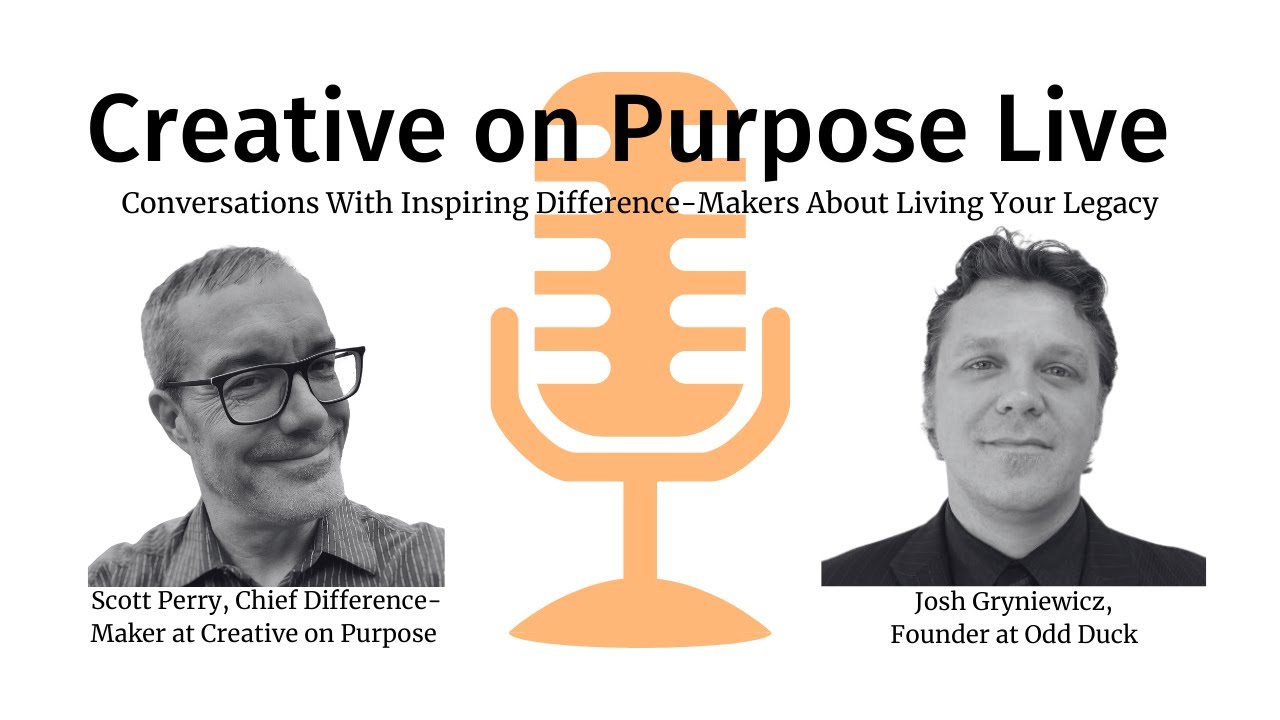
Josh Gryniewicz founded Odd Duck to use storytelling for social change in health and mental wellness. His "braided" method weaves personal narrative, argument, and research into TED-ready stories. He launched the consultancy during COVID after a seven-year journey exploring purpose through meditation, philosophy, and incremental growth beyond his comfort zone.
Chapters
At the speed of bytes, it's showtime. It looks like we have landed everywhere we are supposed to be. Welcome to Creative on Purpose Live, insightful conversations with inspiring difference makers to help you live your legacy. I'm your host, Scott Perry, Chief Difference Maker at Creative on Purpose. If you're stuck at a work-life crossroads, visit creativeonpurpose.com and sign up for the free Power of Purpose email minicourse and start crafting a life of meaning and impact today. Let's meet our guest, Josh Grenowitz. Welcome to the broadcast. Please tell our viewers who you are, what you're up to these days, and where can people go to learn more about you and the difference you're making.
Awesome. Thank you so much, Scott Perry. I appreciate it. And I'm a super fan, so this is a big treat. Um, my name is Josh Grenowitz. I am the founder and chief narrative strategist for Odd Duck. We are a storytelling for social change communication consultancy. Focused primarily in the population health and mental wellness space. Really how we approach this is kind of through 3 lenses, 3 service deliveries. The first is narrative framework, so that's your strategic storytelling. If you picture, Scott Perry, if you picture a Venn diagram with kind of concept branding, you know, your messaging framework, traditional messaging framework around like campaigns, and change management. The overlap of that Venn diagram right in the center is narrative, and we believe that's the sort of connective tissue that pulls all of those things together. Oftentimes, and I learned this the hard way, folks work on, you know, really getting a beautiful brand and pushing that out there in the world, or getting all of their messaging in a row and putting that out in the world, and they forget about the people that are most important— their brand ambassadors and the people who are the, the most prominent stakeholders in their work. So that's, that's where that third component comes in. The second piece that we do is focused on just content development all through a narrative lens. We've done interactive comic books for adolescent depression. We have done videos that kind of introduce early childhood learning for, for parents, for, for low-income parents who are stretched very thin. We have, we have done all sorts of interactive platforms. And then the third piece is training and technical assistance, which right now is primarily focused around helping community health providers navigate misinformation, disinformation around the pandemic. So that in a nutshell is me right now, presently, what we're focused on. 50% of our clients are in the population health space. And really doing something oriented around the pandemic and handling or managing the pandemic or some of the fallout from the pandemic. And again, our role in that is helping create a narrative framework, a narrative strategy to, you know, really disrupt and counter some of the misinformation, disinformation that is just, you know, being kind of accepted and understood as truth. Truth or as reality. The other 50% is really focused on helping business leaders and, you know, executive directors, thought leaders to shape and share their stories, often of disruptive technology in various spaces. And so that's, that's what I'm up to now. And you can find out the, you know, if you look, the oddduck.io is our website, and you can find out all about what we're doing and what we're up to, or Follow me on LinkedIn.
Beautiful. Yeah. And it's a, it's a really beautifully designed website. So encouraging folks to take a, take a gander.
No pun intended.
At oddduck.io. I want to dive in a little bit on some of the, you know, the work that you're doing and the purposefulness of it. But I'm also, you know, it's interesting that you mentioned that narrative is a central tenet, central pillar of what you do. And I'm always really interested in people's own origin stories, their narrative about how they got to what— be doing what they're doing right now. I'm guessing little 9-year-old Josh did not wake up one morning and say, "You know what I want to do when I grow up? I want to work in population health and help people tell better stories about what they're doing." So just give us a sense of you know, the arc of what got you to where, what you're doing right now, and if there's any common thread to the things that happened along the way. Always love to hear about that.
Awesome. Yeah, so 9-year-old Josh probably wanted to be either Buckaroo Banzai or secretly still wanted to be a ninja. So yeah, you're right on that. Although I probably also harbored the desire to be a writer. So I'm not too far from where 9-year-old, he wouldn't be shaking his head. I have a personal origin story and a professional origin story. That kind of coalesce in Odd Duck. So I'd like to share both if you're interested and you think it would be of value to your audience. The personal origin story is really— so my mom is an artist and a do-gooder in the world. So environmental issues. She was an early childhood education teacher for years. Dad is an artist, a poet. And a storyteller, and he's also an amateur folklorist. And so kind of the two coalesced. And, you know, that's sort of where those passions were first cultivated. When, you know, I started kind of picking a career, I chose psychology. I was less interested in sort of documenting those stories and the folklore and more interested in understanding the purposes that they served us. I know this is right up your alley, Scott Perry, but, you know, a lot of what drew me to psych was Jung in the first place and sort of understanding that the Jungian archetypes and everything. So that's, that's the direction that I went. But I, you know, I needed a job and, you know, Jungian analyst wasn't being posted on Monster.com at the time. So I went into social work, kind of burnt out on social work a bit after about 6 and a half years of working with runaway and homeless youth. And I said, okay, I need to do something that's in the social service that uses my skill set, but kind of combines it. My professional origin story starts when I was working for a pretty controversial public safety or public health approach to public safety. And basically the short version of the story is that I was the director of communications there. I was promoted to the director of communications position, and a large part of my role was to help kind of roll out this initiative nationally. We had probably a little over 2 dozen sites in Chicago. We had a fledgling pilot in Baltimore, and we wanted to expand coast to coast. And so at that time, we had a 4-year, or 4-university, 3-year independent evaluation that was conducted of the project showing effectiveness in communities up to 67%. We thought, I thought in my naïveté, that once that evaluation hit, that all of this endorsement, all of that goodwill would lead to folks pounding on the door, rolling out the red carpet, wanting us to go everywhere, be everywhere all at once. And the evaluation came out, it was released to the public and nothing, crickets. Simultaneous to that, Scott, was a documentary film that was being made about 3 of the community health workers that were doing this work. It really didn't focus on the science, it focused on their personal stories. It showed sort of their home lives and what they were doing out in the street and how they were navigating this work. And it was all individually story-driven, really immersed in their lives. It was released at Sundance, had 200-some art house release, and then aired on Frontline on PBS. And everything that we thought was going to happen with the evaluation happened with the documentary. Every city was pounding on our door. Everybody rolled out the red carpet. They wanted to completely evaluate adopt whole cloth the model. And we went from roughly 28 sites in 2 cities to having approximately, you know, 25 cities with 50-some sites to now having over 100 sites globally around the world. So it's a pretty remarkable progression in basically 10 years. It was a game changer for the organization. It was also a game changer for me. I sort of saw this and said, okay, there's something to this. Everything that I know about health communications can definitely be infused and informed by story. I went back to grad school, focused on creative writing, and basically Odd Duck is the culmination of my passion for social change and my passion for storytelling.
Love that. It's, uh, amazing that the, the power of story. So my friend Natalia Alvarez and I have done a couple storytelling kind of origin story type workshops.
Yeah.
I've participated, uh, I've worked with Kylie Slavik, who's also, um, been a guest on the show, uh, who has a real interesting approach to, to origin story. And I mean, for me, story is how we have all— narrative is how we've always made sense of ourselves, our situation, each other. And so no surprise that the story approach really connected and lifted get that endeavor off the ground. Do you have a particular template or formula or just approach to the way that you craft stories for clients or in your work that you'd care to share?
Yeah, so I would kind of divide that into two. So we do have what we refer to as the disruptive storytelling process, and it's really kind of like a 6-session accelerated sort of, you know, we'll nail the concept branding, we'll nail the storytelling, we help take the kind of the founder story and blend it with, you know, the mission, your mission, your massive transformatively purpose, you know, purpose in the world and kind of blend all of that together. So that disruptive storytelling piece really sort of tries to figure out, define who your core audience or audiences are, What are the main barriers to them adopting your work or your service or your product? And then how do you navigate around those barriers? So that's the disruptive storytelling approach, the model that we use. The other side of that is a lot of time folks who are solopreneurs or, you know, thought leaders in different spaces. Sorry about the lawn maintenance. They actually plan it for whenever I'm doing podcasts. They're like, oh, now's the time. Okay, get it, boys. So the, the, what we do is kind of work one-on-one with thought leaders, um, helping shape and share their stories. Uh, and I, I, uh, have adopted what I refer to as the braided approach. So the braided approach is sort of, if you picture 3 threads, the first thread is, um, you know, their personal story, and we're mining their personal story for you know, similar to, um, uh, the work that you were just talking about, their origins, how they first became passionate about this work, um, what drew them to this work in the first place, uh, and, and sort of go deep on that. The second thread is your typical, like, how we learned how to do, uh, essays in grade school, right? So it's, you got your thesis statement, you got your first supporting paragraph, your second supporting paragraph, and your third supporting paragraph, and that's all reinforcing their personal work. And then that Third thread is context. So what, what, what, what is the research that backs this up? What are— we're not just the research, but the quirkiness of the scientists who are doing that research. Are there historical anecdotes that you can pull in? Are there other factors that you can pull in? And then we literally braid those together so that you have something that's page-to-stage TED-ready, right? And so that's the other piece of my work that I do with that kind of coaching.
Space. Really fascinating. I love the idea of weaving the disruptive, the theme of disruption into the, into that work. So you've touched on, on purpose a couple times. And obviously, as, as someone whose brand has purpose in, in the, in the name, I'm just always curious, how do you, how do you define purpose? And how does it, how does it weave into the work that you're doing?
Yeah, yeah. So I define purpose as sort of that, you know, the same way that organizations have, you know, their, their mission, vision, and values and sort of build everything that they do, ideally everything that they do around those central tenets. I think we can do the same thing with our lives and cultivate the same thing with our lives. And I think we live better lives for it. So we are definitely kindred spirits Scott Perry, definitely kindred spirits. But how I define purpose and how I define my personal purpose is to shape and share stories for massive social impact. That's how I define my own purpose. And it's actually interesting. I spent probably a little over a year kind of exploring and defining my purpose for myself, going on a journey. I know you have a process for it, and I wish I knew you existed at the time that I was going through this. But that's, for me, that's kind of what led me on that path. And I feel like I have historically been and traditionally was somewhat of a pessimist just in my orientation. Once I actually solidified and defined my purpose, and I'm truncating 7 years of growth here into a couple minutes,. But I felt like having that reorientation around purpose actually gave me a new optimistic lens to move forward and grow from. And, you know, I haven't looked back since.
Yeah, well, I love what you shared, because although, yes, we do have a process to help people dial in the difference only they can make, also known as their purpose, passion, There's lots of different words that we can use for that. That process evolved from my own experience and trying to figure out what my purpose was. But, you know, part of it was also where, you know, where do you find this thing? You know, what I, what I have found is that there's, there's two narratives around purpose that we're fed to by society, by the culture. The first is purpose is out there. You need to go find it. And once you find it, you need to monetize it. Okay, so go west, young man, find your purpose. And then there's the, oh, your purpose is, you know, inside you, and you need to excavate it, you find your purpose within, and then you can bring it forth and bring it into the world. And, you know, the polling shows that 80% of people that are asked to define their purpose can't do it. Which means that, you know, although we talk about the importance of purpose all the time, that conversation invites 80% of the people listening to, you know, shame and suffering because they haven't yet found it. So I'm just curious about your— in your journey, your 7-year journey to kind of dial your purpose in and start living into it, you know, what are the insights? What are the takeaways? What were the aha moments about where purpose can be found and how people can start living with, for, and on purpose?
Yeah, yeah. No, that's a great question. So the first, I don't know if you, are you familiar at all with the work of Victor Stryker?
Who?
Victor Stryker, Dr. Victor Stryker. I don't think so. So it's Stryker, but it's spelled stretcher. He's a public health leader. And what he did, Scott, is he looked at kind of existential crisis as through a public health lens, so as sort of an epidemic, right? And so this, this lack of meaning in the world in, in an epidemic kind of lens. And so I had encountered him around the same time that I was sort of floundering and trying to find, you know, my own kind of definition, my own purpose. So, so that was, that was helpful, just kind of characterizing. And then that led me back, you know, kind of retreading some of the sacred ground of, you know, kind of the ambling adolescent, you know, the existential works, you know, Camus and Sartre and Nietzsche and so on. So those were all factors in it. Stephen Kotler, who's a kind of flow expert and flow researcher, his work was really helpful as well. He wrote a Rise of Superman and Art of Impossible. And, you know, some of his, his stuff focuses on kind of figuring out what, what your passions are and the intersections of those passions. So I did a lot of that work as well. And it was really just sort of kind of doing that internal, you know, exploration, meditating, practicing qigong regularly.. And, you know, really just trying to push myself to sort of find, find some definition that felt right and that made me feel right in my skin, that helped sort of solidify this purpose. Yeah, so I hope that answers your question.
It really does, because it's, it's funny to me how most thoughtful people do, you know, had this journey of struggling, spending some time out there in the desert, in the wilderness, trying to figure this thing out, this purpose thing out. And the common thread seems to me to be that purpose is less of a destination, whether it's external or internal, and more of a process. And what, you know, through your through your practice of qigong and meditation and, you know, learning from mentors, uh, virtual and real. You know, it's— you can't— you, you, you arrive at your purpose not by searching for it outside or within, but by purposefully stepping into every engagement, every opportunity, every relationship with, for, and on on purpose. And, you know, so purpose is, is more a story around emergence than arrival. And I think that's, you know, I think that's a powerful message for anybody that's tuning in. Because again, most of us, if we have found purpose, there is a, a saga to go along with it. And if we haven't, it can be a real invitation to feel less than. And that's something I would encourage people to try to talk themselves through, because we, we have all gone through it. And even for someone like you or I, and I'm curious about your, your experience, having arrived at some, some semblance of identifying a purpose and trying to live into that purpose, I don't really get the sense that I have arrived anywhere, that this still feels like there's, there's a point on the horizon, purpose-wise, that I'm stepping into without a clear idea of exactly what that would be.
Yeah, I feel, I feel like that's the, like, that's the thing about purpose too, is you're constantly living it, right? Like you're constantly adding to it, you're constantly deepening your engagement with it. So it's not like a one-off, like, oh, it's discovered, I'm just going to put this in my back pocket and, you know, head out. Like, it's, it's never like that. It's like once it's, it's found, it's like it has to be nurtured, it has to be cultivated. You have to kind of like breathe life into it almost. But it's reciprocal, right? So it breathes life back into you as well, especially when, say, there's a global pandemic and a lot of social unrest. And a lot of tumult, that you can still sort of have that North Star to help advance you.
Well, that's an excellent point, because one of the things that also comes up over and over again, and you could look at historical figures like Lewis and Clark, who, you know, there's depression involved and a sense of aimlessness and, and, you know, contemplation of suicide, and then this an incredibly challenging mission is bestowed upon them, and nobody could have been more purposeful in their pursuit of finding the Northwest Passage. And so, um, you know, just this idea that, um, you know, the challenge is probably an indication that you're, you're on a path worth continuing to pursue. And, and, you know, Viktor Frankl's Man's Search for Meaning Well, that's—
yeah, exactly. That's, that's totally on point. And, and I'll say too, like, so, so I formally launched my agency right in the thick of the pandemic. Like, we started— so we, we sort of started, um, in 2018. My wife and I both lost our jobs at the same time, so it was like, whoa, okay. Um, and so that became like a test run, uh, and, you know, honestly, Scott, I never missed a paycheck. So I, you know, as soon as, you know, my sort of the severance was paid out, I already had gigs lined up and was already kind of, you know, hitting my stride. I found another job shortly after that, and I went into that job saying, this is what I want to do, but I'm doing this as my side hustle, and I really want to launch in 2020. Haha. Which wasn't, you know, wasn't You know, like, I didn't have the foresight to be like, huh, maybe that's a bad time to launch. But you know what, I did, and I launched exactly on schedule, um, and the timing ended up being perfect in a lot of ways because, you know, again, going back to purpose and sort of that, that weird sort of the serendipitous nature that presents itself, which I think you and I could probably geek out on for a whole nother half hour, um, that serendipitous nature that sort of reveals itself when you're kind of living your purpose, right? And so it was just sort of like I launched and, you know, I had clients at the ready, you know, and so, you know, I, I haven't looked back since.
Well, the takeaway for me, or the insight in that share is that I have a riff that I do on being a possibilitist. And it's whatever you're facing, there is always an opportunity, despite the face value of, you know, being a serious setback or misfortune or being an obstacle or a challenge. There's always an opportunity. And it's the only way to realize the opportunity or find the possibility is to step into it because you're always going to be putting yourself into the next situation. And, you know, so many people, you know, find them in the, in the, in the, when faced with challenge, uncertainty, adversity, and all that, want to sit and wait to see what happens, which is, you know, not that you shouldn't be thoughtful and deliberate and purposeful in the way that you're approaching things, but You know, as Robert Frost said, the way out is through. And so the only way to get through is to actually do something. And so I love that you also kind of— the second-to-last question is always around, you know, around a misfortune or a mistake. And it sounds like you and your wife losing your job at roughly the same— your steady gig at roughly the same time is a great testimony to your ability to navigate through that sort of challenge. So the last question is always around just You know, this is a show where people are coming for insight and inspiration to help them discover, develop, and deliver on their promise, their, their purpose, whatever it might be, and to build some sort of endeavor that will fuel them with a sense of fulfillment, sense of flourishing, sense of identity and meaning. So for the people that are tuning in, there's just one final if there's a quote or a resource or an idea that you could share that would help someone take their next step into the possibility and their potential and the difference only they can make, what would you share with them?
Yeah, I, well, I honestly, you, you, there was a lot of gems packed into what you just shared. And I don't, I would say just, you know, exactly what you said, like pushing out of your comfort zone is the best way to grow. And, you know, there's, there's things, there's circumstances, of course, that push us out of our comfort zone. But there's also, you know, opportunities that are sort of just, just in front of us, or just slightly out of reach. And we can, we can rationalize and talk ourselves out of not taking that step, not moving forward, not pursuing them, or, or, you know, telling ourselves that the timing is just not right. But the thing is, You know, the timing is never gonna be perfect to do the things that you wanna do. Sometimes you have to launch a business during a global pandemic. Sometimes, you know, sometimes you don't have a choice but to line up clients, you know? And so I would say like, there should be, I think the secret to growth is sort of constantly pushing yourself forward and pushing yourself just slightly outside of your comfort zone. At incremental stages to sort of move forward. Yeah, I love that.
Growth, growth requires challenge. The plant does not— the seed does not grow by not pushing through the resistance of the soil above it. So I love that. Well, thank you so much, Josh, and thank you everyone for tuning in. And we appreciate you lending us your valuable time and attention. We hope today's broadcast motivates you to take a bolder step into possibility, living your legacy. You can learn more about Josh and the difference he's making right there at oddduck.io. And of course, it's always fantastic to see you at creativeonpurpose.com as well. Now, take the insight and inspiration from this conversation to fly a little bit higher and the difference only you can make. Josh, thanks so much for your time and wisdom that you shared with us here today.
Awesome. Thank you, Scott Perry. Appreciate you.
More from Scott



Stoics Don't Suppress Emotions, They Do This Instead #stoicism #emotionalintelligence #mindset







