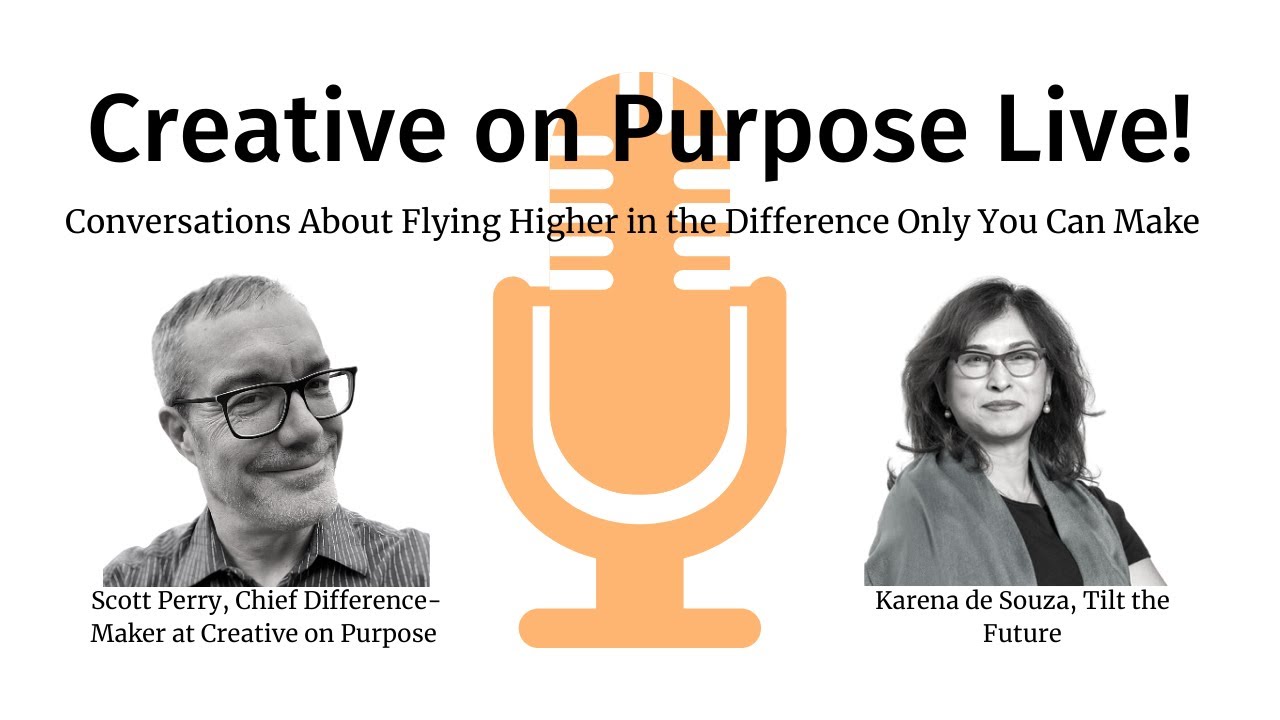
Karina de Souza, founder of Tilt the Future, argues that courageous parenting means equipping kids to make their own choices rather than deciding for them. As automation replaces routine work, she says the future demands soft skills like resilience and creativity. She built her book and business through mastermind groups and community learning, staying grounded by values and agency.
Chapters
end up where we're supposed to be. It looks like— oh my goodness, Karina, how do you feel? Because I feel like we're live. That could be. Ladies and gentlemen, welcome to Creative on Purpose Live. These conversations are about flying higher and the difference only you can make. I'm your host, Scott Perry, author of Onward! and Difference Maker Coach at Akimbo Workshops and Creative on Purpose. Visit creativeonpurpose.com to start living your legacy today. This season, we're drawing insight and inspiration from guests successfully embracing uncertainty and navigating adversity as and making things better, doing work that matters. Let's meet today's guest, Karina de Souza. Welcome to the broadcast. Again, please tell our viewers who you are, where, what you're up to these days, and where can they go to learn more about you and the difference you're making?
Oh, thank you. Well, thank you very much for having me on your show today, Scott Perry. I love being on here. I'm Karina de Souza. I have a company called Tilt the Future, and I focus on the future of work, primarily focused on the youngest generation, what we call Generation Z right now, Z. And you'll find me at tiltthefuture.com. I am available to give presentations, workshops, keynotes, and most recently I wrote a book. Somehow accidentally, I guess because my work dovetails with that age group, the teenage group, I've published a book called Contours of Courageous Parenting. And it's directed, and it's not a parenting coach book, more about helping us as parents make great choices for ourselves, be at peace with the choices we make, and also encouraging us as parents to speak forward to our young, um, the young adults in our home and to model what goes through when we make a decision. So one of the, uh, key points that I make in the book is that, you know, it's not— we're past the stage of making a decision for our children. It's more about have we given them the tools to make the decisions for themselves. And of course, the pandemic is where that gelled for me in that moment. But it does dovetail beautifully with the work that I do consistently, which is the future of work.
Awesome. In full disclosure, Corinna and I are, in digital years, very old friends. We practically went to kindergarten together. And we each wrote a book in writing and community. So I just want to give a shout out to Kristin Hatcher and her endeavor through Akimbo called Writing and Community. And I published, wrote and published Onward while we were in the first session of Writing and Community. You just published yours pretty recently. I'd love for you to hold it up one more time because—
Oh, sure. I'm happy to do that.
I think it's, it's, it's actually your cover is just gorgeous. I love, I love the COVID really eye-catching. And I love the message of your book because what I'm hearing in what you just described is that you are— it's not about parents telling young people what to do, it's about coach— or helping parents help their children realize their agency over their choices, over their lives, over their decisions, and so forth. Is that a fair read?
Uh, yes, yes. And, uh, the reason I find it really, um, important to have us as parents step into that role, um, there are a couple of issues that I have. Um, most of us parent as we were parented, and many of us are parented by parents telling us what to do. Um, we're stepping into a space and time out of the industrial era into the intelligence era where we're neither here nor there, and therefore the way we were parented does not necessarily serve the children of today or the grandchildren of tomorrow. So we have to make that disconnect between the way we were parented. And so this is that encouragement to us as parents to say say, you know, value the tools that you received as you were being parented. Distill from it what is still valuable, but also be willing to let go of the things that may not serve your child. But in that process is a lot of learning for yourself and for your child. Um, so like I said, the pandemic is an issue which gelled it for me. It was, you know, here you were as a parent, you know, if your children were at university, you're not stepping over them, you're not standing by their side guiding them, you like, actually, I mean, I was, I was at the point where I wanted someone to get in a car, drive over and pick my kids up and bring them home because that's where I knew they would be safe. But you can't do that, right? They're adults. And so you have to be willing to, you have to be courageous. That's where the phrase courageous parenting came to me. You have to be courageous as a parent to say, all right, have I allowed, have I given my kids enough tools that I can hope and trust that they will make a good decision for themselves? And that they also have the tools to distill when that decision is no longer serving them. Are they willing to let it go and then take on the next decision, take the next move? So there's, there's a whole, you know, complexity in there, a whole like little mechanics that happens. But it is a process, and it's something, you know, it's another thing that as I was doing my research for the book, we make decisions before we have language, before we have walking, right? So, when you're smiling, you're like, "Okay, I want the peaches, mommy." You know, it's like you don't have language to express but you've made a decision. You've made, you know what you want. And so, decisions have been with us forever. And if we take that whole concept of how the brain works and how it creates its highways, well, if you take the driving process of, you know, check your mirrors, check your side mirrors, put your seatbelt on, all that becomes automatic over time. Well, decision-making is something if we've grown up with before we have language that has been with us. It's innate almost by this stage. So having to pull yourself back and distill that down is actually a very thought-provoking process. So I found it really interesting when I was coming through with the book.
So yeah, really interesting. Well, one of the things that you, you said just a moment ago really resonates, and because I've been thinking about this deeply as a head coach in Akimbo Workshops, but also just in the work that I do at Creative on Purpose is I grew up in an age where you just did what you were told. And it really didn't matter who was telling you. Like, I remember being in the grocery store, touching the fruit and some little old lady swatting me with her umbrella and saying, "Stop touching the fruit!" And I was like, "Oh, yes, ma'am!" Because that's just what you did. And when I, one of my very first jobs was as a school teacher. I was teaching at a small private school in New England, and I was teaching in the way that I was brought up, which is like teaching through authority. And what I realized very, very quickly is that doesn't work because people don't respond to authority as, uh, as a motivator for actually engaging with learning. And it's been a long process for me to kind of unlearn all those, all the things that I was habituated to just because it was the way that I was brought up. But I love the, the way that you sort of talked about encouraging young people to learn things by doing things and also having parents. You equated, uh, or at least what I wrote down was courage and trust. And I think that's, those are really important things. You have to, you have to trust yourself that you've done the best you can, and that it's— and you have to trust your child at university or wherever that they are capable of navigating their own way, making their own decisions, learning from their own mistakes, and kind of charting their own path and finding their own way.
Right. And when you think about the journey we've been on as adults and where, you know, what our parents were doing when they left, they sent us off to university or, you know, past high school. Um, look at how much our lives have changed and how much we've embraced and how we've gone about learning and incorporating things into our adult life. We don't know what's in the future for these kids. So having the courage to say, okay, I've given you enough, I've given you the willingness to learn, I've given you the ability to read signals, I've given you— like, you know, that's what we have to have the courage. And then we have to be willing to, to know that just as I make different choices from my mother, I have to be willing that my child will read a different landscape and respond differently. That to me, I mean, I see the same equation when I speak with my mother. It's like she still holds a lot of courage as she's parenting me as old as I am because I'm sure I'm not doing things the way she wants me to do them. And that takes a lot of courage as an individual, you know, I think.
Yeah, well, it's the idea of holding multiple, multiple truths, multiple realities, right? And, uh, I think about that a lot. My boys are both grown. One of them is married and living close by, but, you know, living his life now. And the other is back home because the pandemic interrupted his schooling. And, um, it's again, just unlearning the authoritative parenting model and accepting that, um, I know that for us with both of our sons, uh, they were— we homeschooled and we just had a great relationship with our boys for almost their entire childhood until like 17, 18, when of course it's time for them to figure out their way. And, you know, there was sitting in that tension and, and sometimes with that friction and just saying, All we, like, we've done everything we can do. We're just going to love them and we're going to wait until they find their way through whatever it is that they need to find their way through. So, um, I love that. And I love the idea of encouraging like that open openness to their experience, but also other experience, other people's experience, which is what I was kind of hearing. In what you said. What's, what do you think is, what's the biggest challenge in your, you know, it sounds like you're working in kind of both worlds with young people and with parents, if I'm hearing that correctly. Are the challenges that you find, you know, kind of coming up over and over again similar, different as you work with those two groups?
So let me start off with the parents because that's what I am, um, and that's where my work had its seeds, I guess, had its, its germination. Um, I think as parents, especially as parents of our age with our children, we want the best for them. And I think where this all started for me was, do I have enough? Do I have enough knowledge? Do I have enough tools to have access to the right information to be able to offer my children the right advice? And that's when I started. Um, I have a my background strategy. So I happened to be in that world at the same time, and that's what led me into understanding how the future of work was going to be dramatically different from, you know, the way I was— the future that I had facing me at the age of 20. So that was very important, and I think that's the conversation I have with most parents is we want what is best for our child, and It is difficult. The challenge I have with parents is, once again, they parent as they were parented. Even though logically many of them are reading the same material, they understand the mechanics, they see technology moving, they see the economy changing, everything. I'm not just talking about technology, I'm also talking about the green economy, right? You know, the way the world is responding and requiring us to pay attention to climate. So all these things are coming together all at once, and as a parent, you don't quite know where to send your child. And so there's that component of it, which is obviously a challenge. And that's where I step in there, is to say, I get you, I know you because I am you, um, and these are some of the things that have helped me, possibly they will help you. And then on the young adult side, a ton of confusion to start off with because they have, you know, you As we have talked often, it's the compass versus the map. Right now, what I used to call the gap, the in-between the industrial era and the not yet the fully intelligence era, is the gap. It's the time when we don't know which way is up. We don't know. There has been no map drawn as yet. So there are a couple of options here. One is you have no map, you have a compass. So that's one thing I lean on very heavily, which comes quite significantly from your work. The other is, what can you lean into? What, what can you use from this space? Is the knowledge that nothing is yet created, therefore you have opportunity. So those two actually help drive me in my conversations between parents and young people, because I think if you have opportunity, you're not looking at at despair. You're saying, okay, if it's not built yet, what can I create in that space? That to me is positive. That's a way forward. It's a way of taking this and spinning it around. So there's a class I've done with MIT called Shaping the Future of Work and/or Shaping the Work of the Future. And one of the things that I noticed, which I kind of was subliminally aware of, was that the transition between the agricultural era and the industrial era was actually about 200 years. So that's about 3 generations. So if you extrapolate that, you know, maybe 1 to 3 generations is roughly the transition we're going to go through, what we're going through right now, depending on our age, is affecting us, our children, and potentially our grandchildren, depending on where we are in the age gap. And this is a space we have to live in. This is a reality we have to live in. And that's why we're feeling so unsettled. But we have to figure out tools to serve us in this space that might not necessarily be true, you know, 100 years from now. But we have to figure out how to manage this space. And that's what's important. So talking, just bringing that awareness to people of any age, like I actually say, my adults are 16 to 60, because all of us are dealing with the future of work in some form or another. Um, I think just bringing that awareness is, is very, um, positive and enlightening to a lot of people because they realize that this sense of unease that they're dealing with is not something that is, is individual to them. It is actually something that they are responding to, which is bigger.
Yeah, I, I work with both, um people my age or, you know, people who are younger parents and young people. And one of the sources of dissonance that I find is that, um, is, is people my age and, and younger parents having difficulty recognizing that we're in a different moment now, the one that you just articulated, and that You know, the way our education system is structured and employed in most places, there are definitely innovators and people doing things in a new way. But, you know, we're, we're, we educate around compliance and doing things the way that we've always done them. I love what you, you know, you, you referenced our, both of our fondness for compasses over maps because maps can only show you where other people have gone, which is great. But Compasses help you chart your own path, and Compasses encourage— to circle back to the agency— they, they encourage you to employ your agency. And Compasses remind us that there are no guaranteed outcomes and that decisions are not actually tied to outcomes. Decisions are just decisions. And every decision puts you in a new place to plot your next Compass point and to step into a new path.
Next step.
The next step. So I love, I love all of that because I think, you know, what we're learning is, or, you know, when I, when I work with people that where there's, you know, a parent and a young person where there's some dissonance is the young person is actually oftentimes the wiser person in the conversation because they realize that they're being sold a false bill of goods. Like the way that they're being educated is not going to help them in the world that's waiting for them. And to your point about, you know, I remember when we were working together, um, in a coaching relationship, you were really struggling with like, do I want to do this future work thing or do I want to do this environmental thing? Because the environmental thing is going to have to be solved or there's not going to be a future of any kind. Um, and yeah, just again, we, you and I had to unlearn the authoritative approach to parenting and, uh, now we have to unlearn our reliance on institutional systems, educational and occupational, that just don't work anymore. Because we have to, we have to set young people up to do the human work, because pretty soon everything that can be done by a robot or an algorithm will be. Which means that we have to employ connection, collaboration, communication, creativity, compassion, and all those things that are really going to where the real work is going to be done in the future. That's my estimation anyways.
Right. And that— so one of the— I talked about the skills that we need in this space, and you touched on them beautifully. Because the analogy I use is that right now, I think it's something we lean into that say, oh, then we'd love to go back to the way things were normally. Right? But when you think about it, what was normal in the '80s? What was normal in the '90s? It was just as choppy. Maybe now is a little more so than it was then, but there was a lot going on. I mean, we still had recessions, we had, you know, booms and busts. So this is not unusual, right? It just feels more unusual right now because we can look back at it nostalgically. So a couple of points I wanted to raise. So one of the things is I would like people to realize that change itself is very constant. You know, I came to this when I was watching my father in his last weeks a couple of years ago and speaking with the doctors. And you realize then that change has to happen for us to live. The heart beating is a change. Like, that is what they're watching for on that graph, right? They're watching it on the monitor. That is a change. If that change disappears, you're dead. So change is something we absolutely have to learn to live with. And so this idea that we're struggling for consistency is, is, I think you'll have to search for where you're looking for that consistency in life, but you have to embrace change. So that's one thing that I'd like to park on one side and leave you with. Um, that being said, right now if we're in choppy waters, they're choppier than normal. So what gives you stability when you're in choppy waters? And I'd say a deeper anchor than you normally have. So whereas you have still waters and you have like a decent level anchor, If you're in very stormy waters, you want a deep anchor. You want to be able to edge for that thing that keeps you stable. To me, that deep anchor are what we used to call the soft skills. It is the stuff that we've inherited from our parents, who inherited from their grandparents, who inherited from, you know, a couple of generations before that. It did not need education. It just needed us to lean on ourselves, lean on our community, learn to communicate, trust ourselves to have good critical thinking skills, And like I said, none of that— like, when you think back to the number of people in our history who had the advantage of going to university to be able to learn how to think, they got us to where we are, to where we have this privilege sitting and being able to sit in those universities without having had that themselves. So that is what I lean on when I say that you have that deep anchor, you have to go be able to go back to that, because what is happening here will keep changing, but you have this if you have this anchor to write with you, that will actually maintain your stability. And I think that's something that I offer parents as the tool they can pass along to their kids. It's the resilience, right, that, that, that we're all asking for right now. And then something else you mentioned, which was the education system. So there's a really good professor here, Ilona Doherty, from Waterloo University, and I was attending a conference One thing she referenced in her presentation was there was no such phrase as teenagers before the industrial era. So before the industrial era, education was what your family did. Educational was generational, right? So you, as you helped your parent, if they were like, say, um, I don't know, stonemason, you started off by carrying something. You next went to helping them, you know, with the water. Then you started figuring out, you know, the plumbing lines and everything else. You learned by doing, right? And when you aged out, you returned to the home and helped in some other way. And when we came into the industrial era, suddenly it first started off that the kids were actually in the factories, but once the child labour laws started coming around, I think was the late 1800s, that's when they suddenly had kids running around the streets while both parents were working in the factories. And that's when teenage as a concept started entering our vocabulary. And to be able to support that, they started then putting them in schools because now they can create the structure to be able to support the manufacturing plants. So it's interesting how this came about. And, you know, we don't think that far back. We don't think, okay, did everybody go to university in the 1600s? No, you know, but it came about and it's become the structure we're living in. So it's really very particular to the era we've just come out of. So it's not necessarily necessary, that this is the structure that will survive into the next, um, 100, 200 years. So I think that's all was also a huge aha for me as I was, as I was learning. So yeah, I don't know if that helps.
Yeah, no, it's— and I mean, Seth, you know, our mutual friend and mentor Seth Godin talks a lot about the industrialized economy and, and how the normal school and schooling in general really served as a way of preparing people for the mindlessness of industrial work. And yeah, so we, I think this all points towards, we have to have a new way of encouraging young people to build and employ those soft skills, the real skills, the human skills, whatever you want to call them, the skills of solving interesting problems, of working together, of employing, you know, reason and being willing to experiment, failed. You mentioned resilience earlier, and I think, and I love what you were saying about kind of the deep anchor, because for me, what, what I was coming up for me was something that we talk a lot about at Creative Our Purpose, which is, you know, don't start with why, start with who. And the who you need to start with is you. What are your core values? What are your guiding principles? And then you can look at what are your hard skills and your soft skills, and then how can you align yourself with people who share your values? Who need your talents and skills to enhance their lives. And if you can dial those things in, then you are in a place where you can create work that will sustain you. Um, it doesn't— not saying it has to be your full-time occupation or your vocation. It's something you can do on the side. But I think we're, we're seeing more and more and more that we're going to have to, um, well, to speak directly to your brand. I mean, we, we're going to have to tilt the future and rethink what the world of work really looks like, because it's changing very, very— I don't, I don't think it's going to be a 200-year, 3-generation thing. I think it's already kind of here. And we're going to be catching, doing a lot of catching up. And which is why it's, I think, so important that people like you and Hoda, who was here last, last week, you know, you're all in deeply invested in helping young people find their way in this kind of new way of being that's new, not just to them, but to you and I. I'm just— a couple questions, um, as we're approaching the, the end of our conversation here. Um, the first is just, you know, you, um, you've been kind of an independent professional for as long as I've known you, doing, working on your thing, Tilt the Future. And I'm just wondering, uh, as a practical takeaway for, for viewers. What are some of the routines and relationships that help— have helped sustain you? Because you have been working on your thing at least as long as I've been working on my thing, which seems like a long time. Um, and it's hard when you're doing it all by yourself. It can be lonely. It's— and it's fraught work. What are the routines, relationships that have sustained you through this journey into getting the book published?
Um, well, The book is a little like— the book is separate because I consider the book an accident. But it actually does play into your question, which is one of the things that sustains me is learning. And I think it does also— it is indicative of the fact that we're moving into an era where we're going to be constant learners. K through gray is now the concept. It's like you should always be out there learning new things. And Shane Parrish, Farnam Street, which we both share a passion for, was hosting this decision-making class. And that's how I took time to sit back and, you know, separate following his framework, which he graciously allowed me to use in the book. I followed the framework and started distilling down the decision process. So, what is one of the things that sustains me is learning and learning in community. So, the writing of the book, the decision-making class, all the other classes I'm involved with. I seem to be a constant learner.. But I find that I learn better in community. So those are the practices that keep me going. And then the feedback, just having people ask questions, that is hugely useful in saying, because sometimes you can sit there thinking, am I speaking into a vacuum or am I the only one thinking this way? And until COVID struck, I had this feeling that I was the only one who understood what the future of work was going to look like. And then Suddenly, you know, everybody else gets it. So, which is fantastic. Fantastic, fantastic, not. But I really enjoy being in that place where I can start helping people. My sister has this phrase for me. She goes, sometimes you feel a little bit like a prophetess, you know, like the person in the old gospel. Because I'd say to her, I'm like, no one's listening. She goes, yeah, yeah, that's the role. It's like you go out in front and you figure out what's going to happen. You just have this vision of what's going to happen, but you can't get out. It takes work to get people to understand what you're seeing because it is just so off the charts at the time you start seeing it, which for me was actually 2015. So it was a while ago.
Well, and so just when you were actually in the very first group coaching program at Creative On Purpose, I can't remember what it was called, but it's evolved into the Do the Work intensive. One of the people that was in your group way back when actually was in the January cohort again this past, just this past January. And just, you are a person that shows up from time to time in our Difference Maker Community events. I'm just wondering if you would be willing to share any reflections on how either Difference Maker coaching or the community Creative On Purpose has helped support or encourage your endeavor?
Well, for me, it's like, once again, it's about the community, right? It's about finding other like-minds. It's finding people, like, it's finding language as well. So some of the— I don't know if I can mention names, but some of the people who are in my group really helped me distill down the questions that other people should be asking me. Because in my head it's a fully baked concept. And they forced me to come up with who is my audience? What is it that I'm trying to deliver? Why am I trying to deliver this? Why do I feel like it has to be this way? So just having that other— that actually a great way of describing it. If you're a single person, if you're a single entrepreneur and you need a board of directors. So this was kind of a board of directors concept, right? Where they were there quizzing me and helping me develop something that was better.
Yeah, I just remember your cohort being a really, really strong— you guys held together throughout the 3 months.
And beyond. And beyond.
Yeah, exactly.
We stayed as a mastermind.
And Tanya, Randy.
Yes.
Was there anybody else?
No, just the 3 of us. And you. And you. Usually important.
Yeah, me and my pointy stick. Yeah, well, I just want to thank you for, I mean, you, you were, you, Randy and Tanya, were the brave ones that, that took a chance on the very first group coaching program. And group coaching has been the thing that I have loved the most about all the Difference Maker coaching that, that's been going on, because each cohort has, like yours, helped sustain and support each other. It's been really rewarding just to witness that, never mind facilitate it. Well, as we're wrapping up here, I just wonder if If there is one last tip, piece of advice, something that you'd like to leave listeners, you know, who are here because they either aspire or wish to advance in The Difference Only They Can Make, what's a tip or piece of advice that you would leave them with that will help them fly higher in The Difference Only They Can Make?
I think stepping into the things that, that keep you absorbed. I mean, the only reason I wrote a book was because I actually have a passion to share what I've already learned. And what I learned was was the decision-making stuff and my future work, and I dovetailed them, and somehow I wrote a book. I think you have opportunities, but you have to step into the things that bother you enough to write about them, or that you're passionate about enough to bother to, to invest that energy. But the world is out there looking for something that only you can give them.
Love that. What a great way to end. Well, thanks everyone for tuning in. Karina and I really appreciate you lending us some of your time and attention. We hope that today's broadcast motivates you to lean into an endeavor that matters with greater curiosity and courage. You can learn more about Karina de Souza, her book, and her fantastic work at tiltthefuture.com. And of course, it's always great to see you at creativeonpurpose.com as well. Now take the insight and inspiration from this conversation and fly higher in the difference only you can make. Karina de Souza, thanks so much for your time and sharing all your wisdom today.
My pleasure, and thank you very much for having me.
More from Scott



Stoics Don't Suppress Emotions, They Do This Instead #stoicism #emotionalintelligence #mindset







