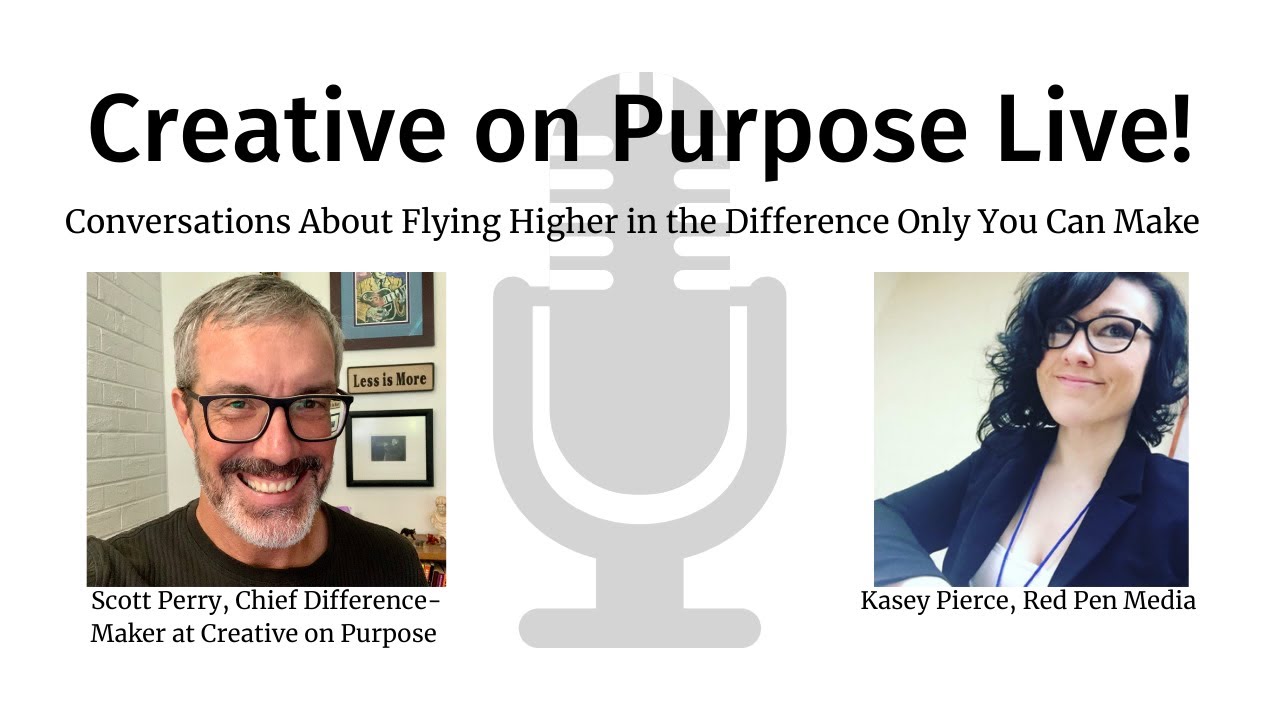
Kasey Pierce, editor of the upcoming graphic novel Verissimus about Marcus Aurelius, discusses how Stoic philosophy shaped her work and her path in comics. She explains how she brought Donald Robertson's manuscript to life with illustrator Zenonofraga, and why Stoicism matters beyond its reputation for rigid detachment.
Chapters
Please fasten your seat belts and put your tray in the upright position. And just waiting to confirm that we are live. It looks like, it looks like we might be. We are indeed live.
Here we go.
So I told you I've never lost, never lost a guest yet. So welcome everyone to Creative on Purpose Live. Please, to learn more about Creative on Purpose, visit creativeonpurpose.com and get going with the difference only you can make. Remember that this is also an iTunes podcast. Check it out. Leave a 5-star review. 30 seconds of your generosity helps spread the goodness delivered by my guests. So let's get to today's show. Welcome to Creative on Purpose Live. These conversations are about flying higher and the difference only you can make. Endeavor better. It's time to be creative on purpose. Are you ready? Let's go. I'm your host, Scott Perry, author of Onward and Difference Maker Coach at Akimbo Workshops and Creative on Purpose. Don't die with the difference only you can make still inside you. Visit creativeonpurpose.com to learn how to start living your legacy today. This season, we're drawing insight and inspiration from the guests who are successfully embracing uncertainty, navigating adversity, and making things better doing work that matters. Let's meet today's guest, Casey Pierce. Welcome to the broadcast. Please tell our viewers who you are, what you're up to these days, and where they can go to connect learn more about you and your work.
My name is Casey Pierce. I am a writer and editor. I am the creator of the Nora series for Sourcepoint Press, which is a sci-fi comic, and, uh, I've been doing that for about 6 years. I am also the main editor at Red Pen Media, which is a company that I've recently taken over. So I do freelance editing, creative advising. Um, I— before COVID I gave a panel across the United States and even overseas, a talk about direct sales and marketing in comics called Good Luck with That. And very well received, and I can't wait to get back to it. But I should probably be doing a panel like that online soon. So if you follow me on social media, watch that space. So, but yeah, now I am the editor of a very big graphic novel coming out. For all you Stoics, you've all heard of it, Verissimus, which is written by Donald Robertson, of course, the author of How to Think Like a Roman Emperor. It is a sweeping bio-epic of Marcus Aurelius, and it's a gorgeous, gorgeous book, and I can't wait to talk about it more.
I'm really excited to talk about it too. So Donald Robertson is the person who connected us, and grateful for that, and grateful for Donald's work. So his book, uh, I think it's called The Art of Living, um, that he wrote for the Teach Yourself or something like that series, was, was one of the books.
It was The Art of Happiness.
Thank you. The Art of Happiness is a fantastic resource for anyone that wants to get started learning more about, um, the practical application of Stoic philosophy. And my introduction to Stoicism actually came in the 7th grade through reading Marcus Aurelius' Meditations. It was given to me by, by my Latin teacher when I was in junior high school, and I read it for a lot of years before I even knew that it had anything to do with this thing called Stoicism. So excited to dive in there, but I just want to start by talking about Red Pen Media. I love that branding, in part because my wife and I homeschooled our two sons all the way through high school, and one of their favorite things to say was Oh no, pa, not the red pen of death. Because whenever it was time to correct their work, I brought up my red pen. And so it was called—
yep, that's when you know it's getting real. Yeah.
So is— and you said this is a company that you've— a brand that you've taken over, or—
yes, yes. So a fellow creator and writer, um, uh, David Hayes, he's also one of my mentors, he recently became the dean of a college and he said, this, this job has just taken over and I can't keep up with my clients anymore, and I believe in you. You're the only person I trust with this. So I was very honored by that, and I took the reins on it, and we've been very, very successful. I also subcontract people from time to time, so I get to give my other fellow creators work as well, which is always a joy. I love doing that. That.
Well, I love that. And I just, to pull that thread just a little bit before we jump into the graphic novel, um, a lot of people that are difference makers, that are creative difference makers, um, get hung up on this idea that, you know, they have, they are competing with so many other people in their domain, whether it's being an editor or a publisher or an illustrator or what have you. And Honestly, I love when I meet other people who see themselves as being one of just many choices, and you do your best to set yourself apart based on your unique perception, set of skills, you know, what it is about the way that you do your work that makes you the right, the right choice for some people. And then for other people, there are other choices, and we can all, you collaborate and share the abundance of people that are looking for—
Yes, yes, because absolutely, I mean, editors are not a one-size-fits-all. And I will be very honest with my clients if I feel like this is not something that's in my wheelhouse. But I do have an arsenal of people that you can choose from. And also playing off of what you just said, Alan Watts, had said that if you notice, the more people that genuinely love or spread love receive more. They are the most abundant. And this is not anything to do with woo-woo or spirituality. That is a fact. That's a fact. It's inarguable.
Well, it turns out, according to the Stoics, that we are inherently social creatures and we are born to serve and help each other, or at least those that we find ourselves surrounded by, and that our endeavors are to be done with and for and in service of others. Well, let's, with that clunky segue into the world of Stoicism, tell us a little bit about the graphic novel that you're helping Donald edit, "Virisimus," and how to, you know, what about the project itself and just about how you came to become the lead editor in this project.
Oh, "Virisimus." So, It's— I— this is going to be a story. Okay. So I had just read How to Think Like a Roman Emperor, and I absolutely love this book. And I remembered just from the opening chapter, because at the time I was seeking wisdom, right? So I'm a big fan of Enlightenment self-help books, and I just finished Eckhart Tolle's A New Earth. And I'm an Audible nut, and I was jogging at the time. This is back in July. And I kept seeing How to Think Like a Roman Emperor pop up on my suggestions. I'm like, well, that sounds pretty badass. Like, I want to think like a Roman emperor. So, um, what wound up happening was the opening chapter provided me with something that I knew I was seeking wisdom, but I didn't know I was seeking this, and this is what I needed. So my mother has Alzheimer's, and it— the book opens with graceful acceptance of impermanence, Marcus Aurelius on his deathbed and how he views and embraces the idea of impermanence and how embracing it is actually a very freeing thing. It's not a bleak thing at all. And I remember after that first chapter, I had just cried and I was like, this, this is exactly what I needed. So then as I'm going through the book, I'm like, well, I've always thought this way. Only I called it being a mercenary. It just made decisions easier, seeing everything in the grand scheme. So fast forward, I'm like, I have to send this author an email and tell him how much I loved this book and how much it resonated with me. And I looked him up on social media and I'm like, oh, what are you doing in my waters? You got a comic book coming out. So I said, listen, after I gushed about the book, I was like, I don't know where you are in production, but I would love to at least offer free proofreading services. And he said, well, I can see you're a horror author, and there is an element of this book that it needs a little bit more horror to it. And so he had sent me some pages, and I gave my friendly critiques on how this could have more of an impact in a horror sense. And then he just brought me on board. He liked the critiques and, you know, it was kind of like a sample. And from there, I know Tim— forgive me, his last name escapes me— Tim is actually the main editor from St. Martin's Press. But I came in for more art direction, now a little bit of project management. Like I said, anything Donald needs for this project, I'm on it because I'm very passionate about it. So Verissimus, the Stoic philosophy of Marcus Aurelius, is a very— it lends itself very much cinematically. It reads cinematically. There's gorgeous landscape shots of Rome, Roman landscape, from the artist Zenonofraga. See, I didn't butcher your name this time. And it is, again, like I said, a sweeping epic a biopic, but it also— what I love about it is it shows you how much Marcus was a true student, true student of philosophy, even in death. And I think seeing now, that's what makes a true philosopher, um, someone who is always a disciple and willing to learn more from his experiences.
Yeah, um, it's— you and I were joking before we got on that I've been listening to Donald, um, you know, just, uh, bang on about this, this graphic novel for at least 2, maybe, maybe even 2 and a half or 3 years. Um, and it sounds like it's, it's coming, um, to fruition and going to be published sometime in, in 2021. Um, In this, so what was, what was the big challenge? What was the, the thing that you were able to identify and to help or establish as, you know, if we can get through this piece, then we can, we can make some serious progress here? Because you had mentioned that, um, it was kind of a, there was a, a bottleneck created because everything was being done by one person.
Yes, Zay is a one-man show on this. And I had told Donald, like, I sort of wish I was here in the beginning, um, because I've been in the industry for 5, 6 years, and there are tradespeople that we hire to create an assembly line to get a thing done. Now, a graphic novel this long, over 200 pages, having it be about a 2-year span, that's not that bad. Uh, normally maybe it's a 1 year or 1.5 years, but, um, when I saw that he was doing everything from the coloring, inking, lettering, I'm like Wow, that is a lot for one person. But I think we are, I mean, Zé is very, very good, diligent, resilient, and he's a stoic as well. So that really, really helps in terms of communication and the way we all see things. So he gets it done, man, and he just gets it done beautifully, beautifully. Like I said, it does read like a film. And now we have sort of this production schedule going. I think it's more about just being on a schedule, shooting for this, and we'll go back to the edits later. We just need to get a thing done. And in comics, we always say a good page is a done page. Get it done and we'll worry about everything else later. That's how all comic production is.
Yeah, I love that because it reminds me that, you know, Stoicism is actually a philosophy that really encourages action. Epictetus famously says, learning that does not lead to action is useless. And Marcus Aurelius is a living example of someone who did not spend a lot of time navel-gazing or hiding from, uh, being decisive and being a person of action. He actually, uh, you know, all thoughtfully and deliberately was committed to doing the best he could in the situation as it was with whatever he could bring to bear. So I love, I love that. In, I'm just wondering if, so you, you're helping with team building and scheduling and helping really get this thing kind of pointed in the right direction and having the team all kind of heading in the right direction, which also speaks a little bit to some of the things that Stoic philosophy teaches, which is that we're born to work with and for each other. You're also, I've noticed, involved in another element of Donald's work that I'm really excited about, which is broadening this, the modern Stoicism tent, to include more people that look like you. And because there's plenty of people that look like me already associated with this quote-unquote movement, so it is, it is not as frequent that the guests who are coming to this broadcast to talk about Stoicism, um, are of the female persuasion. So just curious about if, you know, what you see around, around all that, about trying to make the, the philosophy a little bit more appealing to everyone and how it can inform and inspire, uh, professional women in their journey.
Absolutely. I was just having this conversation, um, with a fellow Stoic. We were talking about doing a sort of a prose novel. Um, I can't get in too much of that yet, but I was talking about how this would be a wonderful project for me to work on because philosophy on surface level, people see sort of a rigidity to it and that it's, you know, men in togas. And, um, but you have to understand that, you know, certain social roles at the time, even, I mean, Verissimus highlights that Faustina plays a huge role in Marcus's life. So there's no female oppression then in this sense, you know, and even now. Stoicism is not gender-specific. Philosophy is not gender-specific. And it— and even the modern application has made it very relatable, and so is this whole resurgence. And it's a beautiful thing. People are no longer intimidated. People no longer have to feel like you have to be perfect at a philosophy or an approach to life or not at all. No, like, we all fall short. You know, this is, this is life. This is how we learn, and we are forever students. So you can take Stoicism and you can say, well, I'm not just a Stoic because we also have philosophy and even religions that overlap in beliefs too. So like Stoicism, you know, or I should say that Stoicism, there's a little bit of Buddhism and also Taoism as well. Sort of this art of allowing and seeing everything in, you know, from above, I guess. And no decisions are 9 times out of 10 life or death. And Anyway, I'm rambling, but, uh, we were just having this conversation, and I think that more females in modern Stoicism does reduce the rigidity, um, or the surface level, or the sort of mask that it wears in, uh, popular media.
Yeah, I really appreciate that. It is very frequent when, when people ask me what, what's this Stoicism thing, and I describe the kind of first principles to say, they often say, oh, it reminds me of Buddhism or Taoism. And I just, one of the things I'm notorious for is my daily cemetery run, which is when I listen to my audiobooks.
I remember that. I had heard you talk on the Scotland Stoics about that.
Oh, that's right. That's right. So I just finished David Sloan Wilson's This View of Life, where he talks about the Axial Age, when basically humanity across the globe in isolation. Not— these were not ideas that were being shared from the Far East to, um, you know, the Mediterranean, into Europe. They were all kind of coming to the same understanding because at that point in our evolution, we were starting to gather into these, you know, larger groupings of city-states or what have you. And so we needed to figure out how do we do this together? How do we start to get along? How do we become a little bit more collaborative and a little less competitive? And so all these ideas are kind of flourishing, you know, around the same time. So there's a lot that they rhyme. Buddhism does rhyme with Stoicism, does rhyme with, um, does rhyme with Taoism. And of course, um, the Christians took a lot of the best of a lot of philosophical disciplines of that time, Stoicism in particular, to, uh, create, you know, to create some of their principles and practices. Um, so I'm— I really appreciate that work too, because I, I am really excited to see Stoic philosophy, which is so pragmatic, so practical. It doesn't really require a whole lot of interpretation or instruction to become a practicing Stoic. It's basically a philosophy of how you can thrive in any situation or circumstance for instance, the one that we find ourselves in right now when there's a global pandemic, lots of social unrest around racial justice and inequity in other areas. What I, I'm just wondering if there's— so in your work, I imagine there you are frequently challenged and find yourself experiencing difficulty, maybe even misfortune., and maybe making mistakes from time to time. I'm wondering if there's a, a, a failure or a mistake, a bottle of, of some sort that you could, you'd be willing to share and how you, whether it was with Stoic philosophy or not, how you were able to overcome it and, and what you learned and how you grew and developed from that experience.
Well, first of all, problems are just temporary situations. So we can sort of dismantle or take power away from the idea of a problem. I think— I won't say this was a problem, but maybe this is the only thing that comes to mind— was once early on in my career, and again, this segues from our discussion about not being gender-specific, there was someone who had asked me, a podcaster, What does it feel like to be a woman in a male-dominated genre? And I went dumb. I had no words. I had no answer. I was not prepared for that question because I do— nobody has ever asked me. I didn't see it that way because, okay, in this arena, I am not a woman. I'm not a man. I'm a writer. So that is why you will never see me. I mean, I'm all about supporting my fellow woman. Professionally, all about it, but I will never use that as a marketing ploy. You know, the hashtag support female writers, buy this book. I'm not gonna guilt you into something like that. No, that's very, that's, that's, that's classless, I think. But also when it comes to considering, okay, so everything has two handles, right? So, and that's what Epictetus says, and your desire for peace, loving, love, and understanding must exceed your desire to feel superior or to be right in a situation. Well, we take Comic-Cons, which is the cesspool for the socially inept. Let's just face it. But there are some patrons who are young gentlemen that not— let's say I'm selling my book, and I will never say that I'm the writer up front because I push the company catalog. I am very Source Point Press all the way, and I hand the book over to them. I say, oh, you like dark science fiction? Yeah, I love dark sci-fi. You like anything like Blade Runner? Sure. And they're flipping through it and they read it, and I get them engaged in the story first, and then they want to purchase the book. And I say, would you like me to sign it for you? And they stop for a moment and just say, "You're the writer?" Yeah, I'm the writer. So whereas there are some of my peers in this industry that sort of rail against the idea that a young man couldn't believe that a woman could have written this stuff. Well, wait a minute, let's question the intent. Let's question where they come from. We don't know. Maybe they are just truly— they maybe they just weren't taught well or, you know, raised by, you know, an old boy, or you know what I'm saying. And this person, they are not out to be sexist. They learned something today. This was an opportunity to educate someone, and I'm so glad that I had this opportunity, so glad I had this interaction, and so glad that I made a connection with another reader. So every problem is an opportunity. And that wasn't even a problem. Maybe that was just a— it's just an off scenario that I have occurred time and time again, and that I'm pretty agnostic about, you know, but, but yeah, that's, that's the one thing that comes to mind, I think.
No, that's a, that's a phenomenal example. And there's lots of juiciness to draw out of it. But my latest book, is a repurposing of the 3 Stoic disciplines: perception, action, and wisdom. Or, I'm sorry, perception, action, and will. And what you're talking about is the first discipline. It's like you can choose how you see a situation and how you frame it, and you can frame it in a way that causes you to have strong emotional attachments and reactions and just, you know, attachments to outcomes that are going to make you complicit in your own suffering, or you can look at it objectively from above and find the opportunities and silver linings. Uh, and, you know, in the example you just gave, you, you, you created a learning op— an opportunity for you to, to enhance your character and will and to help a human being by starting by just giving them the benefit of the doubt.
Yeah, yeah, intention is everything. And you know, I learned that— that's actually a quote from— that's— I learned that from massage school. So I, you know, in my, uh, my other life, I do massage therapy. And the proprietor of our school, Irene Gothier, who's very famous, who's from Sweden, she says that intention is everything, everything in your life, from, from massage to the way you walk, everything, everything is purpose.
Yeah, and intention and impact are not always the exact same thing. I mean, that's the other teachings of Stoicism, is kind of assuming good intent. Like, there are very, very, very few psychopaths and sociopaths walking around intentionally trying to do harm. Everybody that is doing things that you perceive as harmful are actually doing what they think they need to do. And it's, and it's by keeping the dialogue open and being a little bit more objective and a little bit more generous and thoughtful and deliberate about how you engage, that we can all make the best of a situation and elevate each other's situation and, and perception.
Yes, absolutely, because mankind wants to do good. They do. They want to do the right thing. And, uh, Eckhart Tolle talks about isolating the ego, what— recognizing what is an ego response and what is truly you, what is your true self. And when you have a knee-jerk reaction to something It's important, and it takes a lot of power and practice to step outside yourself and say, now wait a minute, I don't have to feel this way or that way about a thing. I can simply just let it sit and say, well, that's interesting. I'm going to sit with that for a second. Now I'm going to look at the intent. Does this person that said this— and this happens more often than not in text where something gets lost in translation. You're like, okay, is this person generally a loving person? Yes, if their intent was to what I think, you know, offend me, maybe they're just lost right now. Yeah, so I'm going to act with patience or I'm going to act with silence, either way. But I am not going to hand over my power of my mind and how I feel to this person who could potentially mean me harm, but I really don't think they are. I think we're just having a misunderstanding here.
Yeah, reminds me of my favorite Viktor Frankl quote that he— that there is no evidence that he actually ever said, which is, between stimulus and response there is a pause. Within that pause lies our choice, and within that choice lies our power. You don't have to do anything sometimes. Sometimes it will just sort itself out, or, or a better way will reveal itself. We have— before I ask you the final question of our, of our half hour together, my friend Mariana is in the audience, and She had a question for you.
Do you find there is a misconception that Stoicism has an edge of rigidity? Absolutely. And in every philosophy, really, because when you say the word philosophy, you know, with a capital P, people like, oh, pinkies up, you know, if we reframe that in a modern way, we say approach to life. So yes, absolutely. And that's why some people are, you know, people say, oh, that's way over my head, philosophy. No, it isn't. No, it isn't. You have a framework to your outlook too, that could fall under this category, that category. It doesn't matter what name is on it. What matters is how it adds to the quality of your life. So yes, absolutely.
Yeah, I love that. This is what I love most about Stoicism is it doesn't require interpretation. It doesn't require an academic degree. And Stoics don't spend a lot of time arguing about how many angels can dance on the head of a pin, or whether a tree makes a sound if it falls in the forest and nobody's around to hear it. It's actually just, if you are eager to live a better life, the good life, then that is possible. Here's 3 simple ways that we can teach you to start to thrive a bit more and stress a bit less despite whatever's going on. So thank you for your question, Mariana. So, um, Casey, I love to just end every broadcast with this question. We have folks like Mariana that are in the audience and people that will be watching in replay that are difference makers. They are creatives who are seeking to make things better with and for the people that they find themselves with through work that matters. If there was just one tip or piece of advice that you could leave with viewers that would help them fly a little higher in an endeavor that makes a difference, what would that be?
Remember that you are so free you can choose bondage. Never hand over your power to somebody else. Wow.
Okay, that was a mic drop moment. So we're just going to sign off now. Thanks everyone for tuning in. Casey and I really appreciate you lending us some of your valuable time and attention. We hope today's broadcast motivates you to lean in, uh, into an endeavor that matters with a little more curiosity and courage. You can learn more about Kasey Pierce and her great work. It's right there below. She's got a Facebook profile listed while she's getting her website together. Of course, it is always fantastic to also see you at creativeonpurpose.com. And just thank you for the insight and inspiration for, for, uh, in this conversation, Kasey Pierce. Delightful to have you with us.
Oh, thank you so much for this wonderful opportunity. It's been a joy. Thank you. Thank you.
Pleasure is all ours. Thanks so much.
More from Scott



Stoics Don't Suppress Emotions, They Do This Instead #stoicism #emotionalintelligence #mindset







