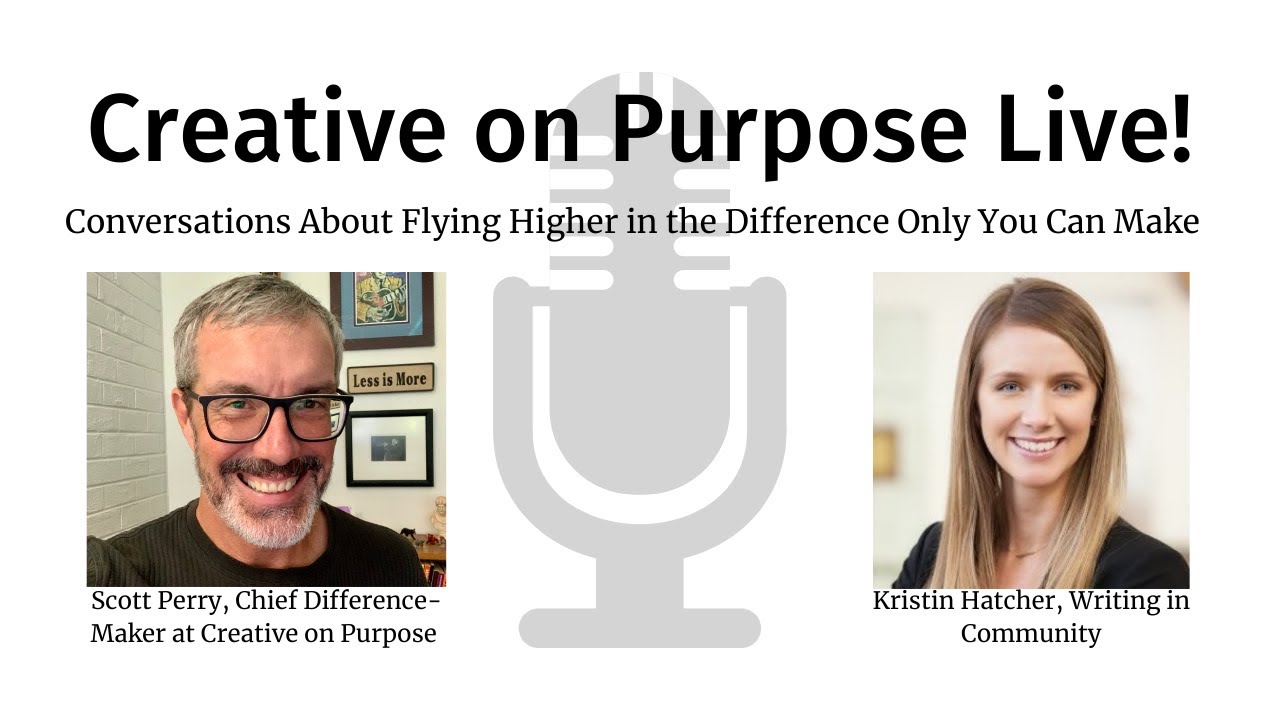
Kristin Hatcher, a public-health professional and writer, describes her Writing in Community program, a six-month group for writers to overcome isolation and silence their inner critic. She uses 10-minute writing bursts, a low-stakes notebook, and treats writing as daily habit. Community and understanding your purpose matter more than ego.
Chapters
Fasten your seatbelt, we are zipping across the ether. StreamYard says we are live. Pulse check. I feel alive. How about you, Kristen? How you doing?
I'm feeling alive. Hey, Scott Perry.
Welcome everybody. You're tuning in to Creative on Purpose Live. To learn more about Creative on Purpose, visit creativeonpurpose.com and get going with the difference only you can make. Ready to start living your legacy? Visit creativeonpurpose.com/challenge and join us Kristin and I in the Creative Difference Maker Challenge. Remember that this broadcast is also an iTunes podcast. Check it out and leave a 5-star review. 30 seconds of your generosity helps spread the goodness delivered by my guests. Let's get to today's show. Welcome to Creative on Purpose Live. These conversations are about flying higher and the difference only you can make. Endeavor better. It's time to be creative on purpose. Are you ready? Let's go! I'm your host, Scott Perry, author of Onward! and Difference Maker Coach at Akimbo Workshops and Creative on Purpose. Don't die with the difference only you can make still inside. Visit creativeonpurpose.com to start learning how to live your legacy today. This season, we're drawing insight and inspiration from guests who are successfully embracing uncertainty, navigating adversity, and making things better, doing work that matters. Let's meet today's guest. Kristin Hatcher, welcome to the broadcast. Please tell our viewers who you are, which I know could take the whole half hour, what you're up to these days, and where people can go to learn more about you and the great work that you're doing.
Ah, thanks, Scott. It's a pleasure to be with you. Always fun to chat and excited to be part of what you're doing with Creative on Purpose. So thanks for having me. So I'm Kristin Hatcher by day. My background is public health, so I help nonprofit organizations set strategies and design programs and articulate the value that they're creating in the world. And by night, and sometimes also by day, I have created a community of practice called Writing in Community, and that's alongside Seth Godin, and it is a place for people who write or who want to write, and specifically for people who want to write and publish a book.
So that's how I'm spending my time these days., and you can go to kristin-hatcher.com to learn more about what Kristin is up to. You and I are, in digital years, we're old friends. We were co-coaches in the Creatives Workshop, the very first session. And, uh, then you ditched us to start this other thing called Writing in Community, which I was lucky enough to participate in. It's where Onward was composed and, uh, what helped facilitate its publication. Tell us a little bit more about Writing in Community because that's coming up soon.
It is. So we'll relaunch Writing in Community again in March. And it was my great pleasure to have you, Scott Perry, there and writing Onward as part of that community because Onward is a book that needs to be in the world. And I am better for having had the chance to read it. So if you haven't, go please read Onward. So Writing in Community is sort of exactly what it sounds like. It's a space for people to come and to write. And the reason that I thought it was important to create it is that my own experience with writing was oftentimes more not writing than actually writing. And it wasn't until I found a group of people and wrote with them and to them and alongside them and had people that were receiving my words and whose words I was receiving, really until I found community that I began to write consistently. And I think sometimes we think about writing as this mostly torturous, occasionally revelatory, solitary endeavor, but it doesn't have to be that way. And I think as we find other people who are trying to head in the same direction, regardless of exactly what they're writing, we learn a lot about ourselves and what's possible and what writing can look like. So that's sort of what writing in community is, finding the others and setting out in the same direction together and watching what happens as a result.
Yeah, so what I'm hearing is writing in community is a way, is a place where you can go to get out of your own way and do the thing that you really want to do but are often complicit in preventing yourself from doing, which is doing the work. Doing the writing. Um, I'd like to back up for just a second and hear your thoughts on why are we always so interested and invested and complicit in getting in our own way and preventing ourselves from stepping into potential and possibility in whatever endeavor that we're engaged in?
Well, I don't know about for you, but for me, there's this little voice that, uh, pops up most times that I pick up the pen that says varying things like, 'Wow, that is complete garbage that you've just written,' or 'That actually might be the worst sentence that's ever been composed in the human language,' or 'Who cares?' I was just writing this essay last week on eyebrows, of all things. And let me tell you, when you get to page 5 about eyebrows, that voice is going to be like, 'Who cares? You're writing about eyebrows.' And I think, like, we have to find an answer to the question of who cares? And we need to get to a place where, you know, we're saying we care about our work. But it's just, it's fraught. And I think until we get honest about the track that's playing in our head, and until we realize that that same track is playing in almost everybody else's head, or a version of it, it's hard to find forward momentum. And I think it's easy with writing and a lot of creative pursuits to feel like I am deeply flawed because I am having these thoughts. And it's until we realize that like, no, this is part of what being human looks like. And I think within community, we can actually come to laugh about it. So, you know, you and I have done some writing at the same time in different places together. We'll do 20 minutes of writing and then take a break, and somebody inevitably is like, whoo, like, that was brutal, you know, or I can't even think of the word for this. And everybody can just laugh about it because It's a shared experience. This is just part of what it is to be, to be human and trying to create something that doesn't exist.
Well, I just want to say that before the pandemic and the stay at home, uh, I noticed at the mall that there was an eyebrow joint where you could go and get your eyebrow, eyebrows sculpted into perfection. There was a line going out the door. So I'm thinking that maybe the eyebrow novel could be the next big thing, Kristen. I'm going to encourage you.
Scott, if you're interested in co-authoring that with me, just let me know.
Have you seen these? Okay. No.
The natural brow is in. That's what the subject of the essay was about, Scott. Yeah.
Yeah. Well, that's awesome. Um, one of the things that, so you, you mentioned the voice in our head. And we, in the Akimbo universe, we know this to be the lizard brain, the imposter, resistance, and all sorts of other things. One of the things that competes with that, and you kind of alluded to this, is we also have this we voice of aspiration, this idea that we have one voice telling us we're worthless and we need to shut up. And we have another voice that says,, but I might, this might work. I might have something to say here. And so I love, uh, I loved all the conversations in Writing in Community where people were expressing both sides of that equation. And it's, I think, really a defining quality of being a human being is we can hold these two opposing ideas of I am nothing and I want to be something in our head at the same time. And one of the things too that I learned through working with you in Writing in Community is even though I knew that human beings are narrative creatures, that narrative is really, really super powerful, and it becomes even more powerful when you take it out of your head and put it onto the page. And then the big thing for me was speaking that, uh, speaking that truth out loud. So For those of you that have a copy of Onward, the audiobook, that came about because Kristen healed my childhood trauma of hearing the sound of my own voice reading my own words. She laid her hands on me and I was cured suddenly and miraculously. So thank you for that. Well, what else is going on for Kristen Hatcher? What is Kristen Hatcher writing these— I mean, aside from the eyebrow novel, what else is great?
Absolutely thrilling pieces about eyebrows. Um, so I am working I'm working on a couple of different things. I'm writing about writing, which is a little bit meta, but I'm so fascinated by how we come to actually pick up the pen and face ourselves. And so I'm spending a lot of time thinking about that and writing about that. And in my other life as a public health professional, a lot of my work and background has been around two things. One, behavior change. So how do we help people make the decisions in, in terms of their own health that they want to make and that are good for them? And then around accompaniment. So in some ways, it's sort of two parallel tracks that are really meaningful to me, both in terms of health and writing. But I think, you know, how do, how do we do the things that we want to do is a really interesting question to explore. So I'm thinking about that a lot right now in terms of what I'm writing.
Awesome. What's the origin story for Kristen Hatcher, the writer? When did your journey and adventures in writing begin?
Yeah, so it was mostly, like I said, not writing through my 20s. Um, so I would write a little bit of, you know, secretive personal essay on the side, but then my day job would write some academic-related pieces and publish in some journals that I think only my mother read to help her fall asleep at night. And, you know, I'd write some fundraising pieces and really I'd write just enough at work to keep me from coming to terms with the fact that I wasn't actually writing the things that I wanted to write. So I found, again, this group of altMBA alumni, altMBA being a program that Scott and I have been associated with for a couple of years. And really it wasn't until I committed to writing weekly with this crew called JAWA, which was under the leadership at the time I was part of it of this wonderful Tamara Kemper. And I think what it took for me to learn how to write was to have another, to have a group of people that taught me how to be with myself, like taught me how to be with the inner critic. And I think that's the power of community, right? It's that we can be so cruel and so self-censoring and just stop ourselves. But when we're with others, the opportunity is they actually teach teach us how to be with ourselves. So that's sort of my journey. And then from there, last year did a 100-day project with writing, which is what you can find at this website, and then plowed right into this Writing in Community project. So yeah, writing now is more of a gift most days, even when it feels painful. And I think a lot, you know, another thing that Writing in Community is about is lowering the stakes. So I think sometimes what's hard about writing a book is either that the experience we want to write about, or the character we want to bring into the world, or the idea we have is so big and it's really hard to put words around it. So we're like, oh gosh, I could never do that. Um, it's, it's how do we just like lower the stakes? Like, okay, that's going to be a challenge, but like, what if you just write for 10 minutes today and 10 minutes tomorrow? So My daily writing is in a composition notebook like you had in elementary school that costs less than a dollar. I write with a pencil, um, and it's just about like lower the stakes, like put some words in the world, come back to it again tomorrow, and then see what, see what happens.
Um, yeah, love that. Our mutual friend Luis Karch, who is also, uh, one of the coaches in Akimbo and coached with us in the first, um, Creators Workshop often talks, reminds the, the students inside the workshops, we always overestimate what we can get done in a year and we always underestimate what we can get done, uh, or I'm sorry, we always overestimate what we can get done in a day and underestimate what we can get done in a year. And I don't remember how many days, uh, the writing and community, um, gathered, but, uh, it was, it had to be over 100 days.
184.
Yeah. Okay. So almost twice that. Yeah. And so it's incredible what happens when you look at, um, at a, even just a month's worth of, you know, just sitting down and promising yourself that you're going to write for a minute. Because if you sit down and write for a minute, the likelihood that you'll write for additional minutes is very high. And so many books were published. I remember the, uh, the celebration at the end that you had with Seth Godin and he put all the books that had been published in the background. Behind him. And it was just really phenomenal to see, um, that you had created this container, uh, you know, with your— with Seth and with the, the coaches and so forth, that, um, it was a, was a catalyst for bringing all this great work out into the world. What I'd be curious— so writing in community is a way that we can navigate our way through the imposter and through the resistance. But we're not always able to write in community. Um, what are some of the other strategies that you've found useful for when you're— when, when it's just you and the paper, your pencil, and, and the composition book? What, what are some of the strategies you use to make sure that you push through the resistance and get words on paper?
Yes, love this question. So I think it's actually, um, One of the techniques is related to the word you just used, which is container. So I think part of what is amazing and excruciating about writing is that every time you sit down at the computer, there's a near limitless combination of keystrokes that you could combine into sentences. And I think when we're thinking about things that are limitless, like the night sky is really cool, but also it breaks our brains a little bit. Like, what do you do with limitless? And so I think the question is like, how do you create a container around the experience of writing? So Writing in Community is a 6-month container. What's possible in 184 days? But when you don't have that, like the container can be 10 minutes. You set a timer for 10 minutes and you can just, if you're completely stalled and don't know what to write, you can literally just write, I don't know what to write. I don't know what to write. I don't know what to write. Probably after you've done that for about 90 seconds, something else is gonna pop out onto the page. So I think one of the things for me is just put a container around it, 10 minutes. And it's back to Martha Beck's idea of the turtle step. She says, the only great thing she's accomplished has been 10 minutes at a time. Like take whatever you think the smallest amount of time you could spend writing is and divide it by 4 and just start there. Simple, small, day by day, I think is the only way I found to do it.
Yeah. One of the, one of the bigger ideas that I drew from my Alt MBA experience back in 2016 was from the book A Beautiful Constraint. And we live in this time of abundance. And for those of us that have the privilege of being able to access all that abundance, it can be completely overwhelming because Nobody's telling us what to do, or there's no map for where we're supposed to go, but we can all build for ourselves a compass. And I don't know about you, Kristen, but I find that the resistance, the imposter fear, anxiety, et cetera, that's my compass. When I'm starting to feel anxious about the direction I'm going, I'm usually It's usually an indication that I'm heading in a direction that's worth exploring, um, because the, the juicy, interesting stuff, uh, is always at the edges of our understanding and our abilities. And, and we get stronger by pushing back against that resistance.
Absolutely. And I think the, the whole experience of writing is being unsure. You know, even if you have an outline, you don't know where it's gonna end up. It could take a different direction. It could be received really well. You could feel really good about it at the end. You could feel really not good about it. Like the thing is, is unsure. So how do we become friends with that? How do we live with that, go along with the journey? Because I don't know about you, but I prefer when things are a little bit more certain. But the reality is that table stakes of doing creative work, of doing things that haven't been done before, is being unsure. And, and that's okay, but it's real.
Well, one of the things that I think is baked into your Writing in Community and a lot of the other Akimbo workshops and the Alta MBA for that matter, and the work that many of the people that are engaged in those endeavors do out in the world themselves is at some point you come to realize that it's nothing but uncertainty because there are no guaranteed outcomes. Seth's, one of Seth's many famous lines is reassurance is futile and there are no guaranteed outcomes. There are no maps that go to clearly defined destinations. Everything is uncertain. And so you're left to decide, well, what's it all for then? And it turns out that what it's for is you get that— you get to try, you get to do, you get to have your practice. And the quality, the intention and integrity of your effort is actually reward enough. If you happen to get published, great. If you happen to get accolades, great. If you happen to get sales, great. But you're not entitled to that. You're entitled to the work. And that was a really profound lesson, I think, that was underscored in your community.
Absolutely. And I have this vivid memory of talking to a mentor. I was working on this project and there was just no clear pathway forward. And I really cared about it. I really wanted it to work. And so I asked him for advice and what do I do? He was like, I don't know, like, make a decision and You know, and I, oh, it's hard. Oh my, trying to make it work. And he looked at me and he used the League of Their Own line. You know, it's the hard that makes it good. And he said to me, do you know if this was easy, you would have quit like ages ago. You like the hard, you like the challenge. And I think it's how we're describing that and how we're talking about it and how we're making meaning from it. It's also an important part. And there is some, to some extent, that the hard is what makes it good. It's part of the invitation.
Yeah, for sure. If it's not challenging, it's probably not worth it. I would love for you to go as deep or pass on this question if you like, but I am sure that in your journey there have been a few times when you have made a mistake or two, a misstep, where misfortune has come to visit. I'm wondering if you'll, you're willing to share one of those moments where perhaps it was a misstep or mistake, but you were able to find a silver lining, flip the situation into an opportunity, or just learn something that was really important to you for continuing the journey beyond the moment.
Anything? Yeah. Well, let me think really hard about a misstep. Mistake, um, because there's so many to choose from. Um, you know, one that I've been reflecting on recently is actually the first time that I met Seth. And, um, I was sharing a bit about the work I was doing at the time, and then I was sharing a bit more and a bit more, and finally he just looked at me and said you know, what is it that you actually want to be on the hook for? And I didn't actually have a very good answer to that at all. I was mostly like looking down at my feet and shuffling them around and trying to look for the nearest exit. And after that, there were some things that, that changed in, in life and made me recognize what a significant question that was and how significant it is to find an answer to that question. So I think a mistake is really having a period of time where I didn't have a great answer to that, that question. Um, also it looks as if Scott may have just dropped off.
Oh no, I'm still here.
I'm just— okay, it looked like you went off the screen. I was like, oh dear.
Here was a neighborhood beautification project. I just thought, you know, we'll get rid of the old There you go. Have I mentioned that I'm technology man, Kristin?
Why I doubted you. I mean, my goodness.
Well, I, I love what you were saying about navigating mistakes and misfortune because they are inevitable. Work that matters is always fraught. And embracing that. And one of the things that I've been One of the things I unpacked in Onward was this idea, like, when did you forget about what it felt like to be a fearless creator? You know, when you were a child, you did not have conversations in your head about, oh, I don't know if I should try to walk it, it looks really scary and I might not do it right and people might laugh at me. I mean, you just, like, people are doing this walking thing, it looks kind of fun, I'd like to be mobile, I'm going to get up, oh, I just fell down. And then you just, you do that over and over and there's usually— I mean, maybe there's some bumps and bruises along the way, but there's also a lot of giggling and a lot of joy. And then there's the thrill of the first step followed by the second step. And if we can re-embrace that childlike sense of wonder and playfulness as we are doing the fraught and difficult work of trying to make a difference through writing or whatever it is, it just— it's it can be easier. Yes, it's challenging. Yes, it's sometimes difficult, but it can also be fun even.
Yes.
As it's fraught.
Yes. And you know, a word that we don't use very frequently in creative work is ease. And I'm really interested in how do we find ease? So how can it be hard to open the notebook and how can we find ease as we do it? Um, I don't know. I don't know the answer to that, but sometimes I think just stopping and saying like, where could I find ease as I attempt to do this thing that really matters to me is a relevant question to ask.
Yeah, we were talking about this, uh, in a Q&A with Seth in the Creatives Workshop the other day, and what leapt to my mind were two lines from, um, the Xander's Art of Possibility, which is number one, rule number six, quick taking yourself so damn seriously. And then the other is it's all made up.
Yeah, you—
I mean, you are the actually the agent of your destiny and the steward of your experience. You can, you could decide to be miserable, uh, you can decide to be angry and frustrated or, and jealous and miserable, or you could decide to have, have some fun and play around with this, um, amazing opportunity that you've been given to, you know, possess the means to make something out of nothing, to put narrative from your head down on the page and share it. And it might actually transform somebody else's experience. It's all in the framing, all in the framing.
And maybe just one person. I think for me, the Creatives Workshop, the big transformative thing I took away from that is the thing you're creating isn't— probably isn't just for you. It may not be— it's certainly not for everybody. It may not be for the masses, but like, what if the thing that you secretly, deep down, only have admitted to yourself that you want to do could change one person? Does that make it worth the fear of being seen and of putting the thing in the world? And I think There's a lot of power there.
Well, you just hit on something really profound and really important, which is one of the things I would tell my guitar students when they're getting ready to do their first recital is, you know, every musician early on is worried about how do they look, you know, how, how am I being judged by the people who are listening to what I'm doing? And I would remind them that it's actually— you've got it completely turned around. It's not about you. The song is for the audience, so serve the song so that you can serve the audience, and the rest will take care of itself. And we forget about that. I forget about it still all the time. Oh wait, it's actually not about me, it's about the gift that I am trying to create. If I'm going to present something to somebody else in an effort to change them, why don't I just do my best, and then learn something from how it's received and then iterate it and do it again.
Yeah.
Love that. So we're, we're nearing the end of our time together. I always like to, to end, uh, with one question, but I wanna sneak in one underneath that, which is, are there routines in rela— relationships that you're currently cultivating as you're in this transition to do, you know, doing your own thing? That are helping fuel your forward progress?
It's a great question. So I'm trying to write every day. I'm reading most days, trying to read every day. And I think, so I'm working with a coach. There are relationships that I'm being intentional about, but I think, so when Scott Perry, I would love your opinion on this actually, perspective. Is I've started wondering, 25 years from now, when we look back at this moment in time, what will we say to ourselves? And to me, there's this balance between, you know, your mistake is thinking that you have a lot of time and, you know, really trying to have, like, really trying to live into that, and also being like, the world is really upside down right now. There is, people are experiencing, I mean, think about all the people without heat in Texas today. You think about the ways that our society is coming undone and people are working to remake it. It just, it's a really unique moment in time and a really difficult moment in time for a lot of people. So back to that concept of ease, like the sort of sister concept of like, how do we be gentle with ourselves right now? And how do we balance the fact that there are things that are too important to leave up to how we feel on a given day? And the world is really upside down right now. Like, loved ones are sick and homeschooling for parents. You know, there's all these things going on. So for me, it's finding those couple of things that really, really matter and doing those well and trying to find space to be gentle with myself. And with the people around me, which my partner may tell you that there's still some work to do on that front.
Probably true for all of us. Uh, I really, yeah. So one perspective that leaps to mind is actually the world is always upside down somewhere. It just happens to be upside down the same way for everyone at the same time in, in at least one domain with the pandemic.
Yep.
Um, And a lot of the things that are coming up now in terms of the, you know, in this, in the States, the divisiveness amongst, um, the, the political right and left and the long overdue reckoning over social justice, that's always been there. It's just we have very, very poignant reminders right now. And this is this is the real work of the human being, is enhancing our own lives through endeavors that, that serve and elevate the lives of others as well. This is the way it's always been. We are inherently social creatures, we are inherently creative creatures, and on a good day, we are inherently rational creatures. And if we can employ all those things to the difficult problems that we face at any moment in any day, and do that together, we can make progress. And that's all you get. I, you know, I think it circles back to the effort thing. All you get is the quality of your effort. And when you are gone, whether it's 25 or 50 years from now, you know, you will be remembered not for what you left behind in terms of money and monuments. You'll be remembered for what you did and how you showed up in the world and the difference you tried to make. Every single day. And with that, I really appreciate the difference that you are making every day. And before I let you off the, the call, I would love for you to share your number one tip or piece of advice, or a tip or piece of advice for the folks that are tuning in, because they are all the difference makers and they seek to fly higher and the difference only they can make. What would you say to them as one parting piece of advice or a suggestion?
So I have this working theory that all great things are accomplished in exactly the same way. You have to decide and then keep deciding. And so that's the reason I enjoy doing some longer triathlons, because it's the act of practicing deciding and reducing it down sometimes to like this step and one more step and one more step. And I think whether you want to do an Ironman or be a great partner or build a business or write a record or a book or whatever it is. I think, how do you commit to that process of deciding? And then you have to keep deciding and keep deciding. And I think as we are faithful to that process, great things can happen.
I love that. Decide and decide again. It's all you get to do. Love it. Well, Thanks everyone for tuning in. Kristin and I really appreciate you lending us some of your valuable time and attention. We hope today's broadcast motivates you to lean into an endeavor that matters with greater curiosity and courage. You can learn more about my friend Kristin at kristin-hatcher.com. And of course, it's always great to see you at creativeonpurpose.com as well. Now take the insight and inspiration from this conversation and keep flying higher in the difference only you can make. Kristin Hatcher, thank you so much for your time.
Thank you, Scott Perry.
More from Scott



Stoics Don't Suppress Emotions, They Do This Instead #stoicism #emotionalintelligence #mindset







