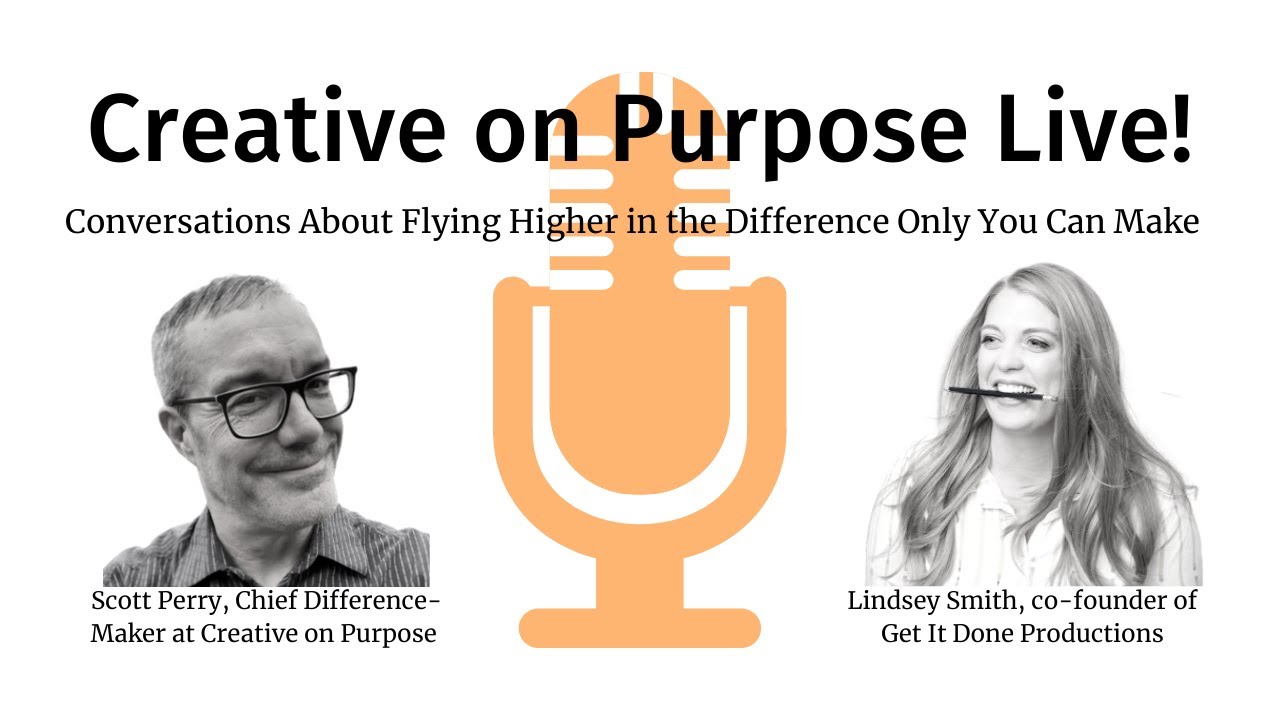
Lindsey Smith, co-founder of Get It Done, talks about building a business around marketing and book writing without burning out. She defines burnout as waves of anxiety that surface when people skip rest, and argues social media is optional. She left a profitable book-course partnership because it conflicted with her values.
Chapters
Ether at the speed of bytes. And there we go. We're live. Can you believe it? It happened again. Welcome to Creative On Purpose Live. These conversations are about flying higher and the difference only you can make. I'm your host, Scott Perry, author of Onward and A Compass Helping Difference Makers Live Their Legacy at Akimbo Workshops and as Chief Difference Maker at Creative On Purpose. You can visit creativeonpurpose.com to learn more. This season, we're drawing insight and inspiration from guests successfully embracing uncertainty, navigating adversity, and making things better, doing work that matters. Let's meet today's guest, Lindsay Smith. Welcome to the broadcast. Please tell our viewers who you are, what you're up to these days, and where can they go to learn more about you and the difference you're making?
Yeah, well, thanks so much for having me. I'm Lindsay Smith. I run a company with my friend and partner, Alexander Franzen. It is called Get It Done, and that's exactly what we do there. We teach marketing, book writing, and production and communication, and we help take people from idea to done. But I will say, without burning you out, which is part of our philosophy too. Wonderful.
And, and so as folks can see, you can get it done. Is the URL. Full disclosure, I participated in Marketing Without Social Media through You Can Get It Done with Lindsay and Alex. It was a fabulous workshop. Lindsay, I forgot to mention this before we got on. I have deleted my Pinterest, Twitter, and Instagram account. I'm only on LinkedIn, Facebook pages, and YouTube. In part thanks to the workshop that I went through with you back in February, I think is when that was.
Oh my goodness, that is so amazing. I'm so proud of you. And I just want to say and give you a shout out because you just brought so much great energy to the course and to the vibe. And we just really appreciated that. And you're someone that we always think of when we think of just great people doing great things, bringing great energy to everything that you do.
Well, everything that you shared was really insightful and inspiring. And one of the things I want to share just about that workshop again, uh, because it was so impactful on me, is obviously I didn't get off social media entirely, but it made me become much more intentional. Since I've limited myself primarily to LinkedIn, my opt-in rate on my website has increased by by like a factor of 10. My open rate on my emails, on my weekly email broadcast, has gone from 25% to 33%. Crazy. So just, uh, so I'll ask you about when that workshop is being offered again so our viewers can, um, tune in to that. I would love, um, ever since I've met you through that workshop, I've been really curious to learn more about your origin story. I remember you sharing a little bit of that in the workshop, but How did you get to where you are with this new company and helping people like me develop a healthier and happier relationship with social media and promotion in general?
Yeah. So, I mean, how far should we go back, Scott Perry?
As far back as you can remember, or as far back as you dare go. How about that?
Okay. So I do want to say, because I feel like this is kind of fun, fun part of this is I always tell people that I'm kind of who I was, like, when I was 7. That's kind of when I peaked. Like, that was like who— like, when I, when I think back to 7-year-old Lindsay, I'm like, oh, she's the exact same person that she was then, you know. And, and it's been kind of fun to, to look back and see who you were as a kid, to, and see how that kind of influenced what, you know, specifically what I do now. And when I was a kid, I, when I was 7, I, my next door neighbor who watched me after school was my like everything. Like she, you know, she was like my second mom. We did everything together. She took me everywhere. She watched me after school. She was actually diagnosed with breast cancer. And as a 7-year-old, I couldn't wrap my head around what that meant. You know, and all I knew was that probably wasn't good and I wanted to do something about it. And so at 7 years old, I decided to host a carnival at my house and I got all my snacks, like any little snacks that I could get, made a little concession stand. I, in my backyard, I did like, I put my little kiddie pool out and did like a fish, you know, put like little fake fish in there and you could pick the fish as like one of the things. I got all of my personal stuffed animals that I was willing to part with as prizes. And I made, I handmade all of the marketing materials, you know, like the posters and things like that. And I passed them out to my neighbors, went like door to door, passed them out. I'm having this carnival, it's down the street, it's to raise money for Diane as she goes through treatment. And I had like little pound puppy races. Like it was a whole experience that you could get. And so I held this carnival and I ended up raising, I think, like $75. And as a 7-year-old raising $75, like, you know, charging a dollar, like 25 cents and 50 cents and a dollar for things, I was just so proud. And to go to my neighbor and to show her what I did and to say like, this is for you. And I think back at that often because That shows me so many things about my own journey, which is I love helping people. You know, I'm inspired by people's stories and what they're going through. And also I enjoy marketing, clearly, like making flyers and, you know, getting creative with the games. And so for me, it's always been there, right? Like this kind of essence of who I've been has always been there. And that just continued on. By 4th grade, I had my first, um, uh, I was in an anthology. My poetry was featured in an anthology, so I became a published author in 4th grade. And this kind of just continued on throughout my life. And the big start from it, which is how I ended up in this career and this company with Alex Franzen, is through my own personal journey of first creating my own brand, writing and publishing a book. Um, before all of this, I was a health coach, so I did a lot on food and mood and anxiety and like stress reduction. And when I wrote my first book and published it, I just became obsessed. I became obsessed with the process, the creativity, the marketing of it. And so that naturally evolved into people asking me, hey, how did you do that? How did you write a book? How did you market it? And I just realized I love talking about that stuff. As much as I love talking about like food and mood and stress reduction and those things, I found such a huge passion for the marketing aspect of it, which kind of makes sense thinking back to 7-year-old me that was making posters and putting them around town and, you know, getting people to come to my event. And so that led to me teaching my first book course, actually teaching people how to write and publish books in 2015. And I did that with the nutrition school that I went to. And then I stepped away from that in 2017. And I had my big book, my last book come out with a big publisher. So I spent about a year marketing that. And I just felt again, really, again, people were coming to me wanting to know this. I wasn't doing the book course anymore. And that's when Alex and I got together and did the tiny book. We started it as a workshop, developed it into a course, and then we were like, hey, we've both been doing marketing without social media. We've both been, you know, teaching these concepts for, you know, the better part of 10 years. Why don't we come together and create this? So that's the long-winded, uh, story of how it came to be, but I think it's I think it's pretty fun because I hope that inspires listeners to think about their own origin story of like when you were a kid and the things that lit you up and how is that infused into your work today.
I love that story. So does my friend Cheryl Johnson tuning in from up in Minnesota and Taylor Harrington also tuning in, loved your story. And what I, As you were telling that story, it was reminding me of the lemonade stand I started when I was like 7 years old. And I—
why did we peak at 7?
Well, and, and I— but my, my big gimmick was I was out there selling lemonade at 6 AM because the garbage trucks went through then, and I would sometimes sell out before 7 AM because the garbage dudes would all buy everything. And then as a little bit, uh, as a young teenager putting on puppet shows and scripting shows and putting together entire programs for the neighborhood, I mean, and the fact that I became a performing musician and a teacher, I mean, it all just kind of makes sense, um, when you look back. So I love that idea, and I, I think I think there's a lot of virtue in like, what are the earliest memories you have of being really happy and engaged doing something that mattered, at least to you? One of the other things that you mentioned right at the top of our discussion is how in the Get It Done workshops, you are trying to help people navigate these challenging endeavors like writing a book or marketing without social media, without burning themselves out. I wonder if you would just be willing to share, like, how do you think— how do you define or characterize burnout? And what are the symptoms as you see it?
Yeah, well, I think— I mean, I think it could be different for a lot of people. It could come in waves of anxiety or depression or sadness. It could— some people don't realize they are burned out until they have a break, and then your body kind of releases all of what you have been carrying, you know. So I think it could be different for everyone, but I think one of the things that we try to infuse into the work that we do and what we share with, with other people is you can get stuff done, you can be productive, uh, but like we always say, it's important to also get nothing done. Um, so it's like, get it done and get nothing done. Because when you allow yourself kind of that rest, that reset, that recharge, uh, and whatever that looks like for you, it doesn't have to necessarily be, you know, a 7-day, you know, silent retreat. It could be, that could be your thing, but it could also be, you know, getting off Instagram for a day, taking back 2 hours of doom scrolling that you probably were doing, or, you know, like little subtle ways that the stress and the the energy of the world, our life, all these things can kind of compile. And so I think it's really important that we are conscious of, instead of go, go, go, do, do, do, that we also stop, reflect, take time, because we find that that energizes you, that, you know, takes you to the next level. It helps you get the next creative idea. If you're always trying to produce and go, you don't allow for those moments of true creativity or even tapping into what you really want to be doing. And we see this all the time with, with authors. You know, so many people come to us and they're like, here's the book I should write. It makes sense. It's my, this is my business. This is what I want to do. And they've, they haven't done it because it's not actually what feels good for them. And what if you just kind of shifted that and say, well, what, what feels fun for you? To create. It may not be the thing right now, maybe this comes later, but what feels really good? And oftentimes we find when people tap into that, it gives them the creative energy to keep going and do other things, and they realize kind of that balance. So, so yeah, I hope that answers the question. That's, that's what I would—
that's what I know. That's fantastic. It's, it's something that I've been writing about and thinking about a lot lately. And, you know, because it comes up so often, you see on social media, the channels I'm on, how overwhelm and burnout just get mentioned over and over and over again. And what I have come to, just to the thinking I've come to, is we all have a finite amount of energy, time, and attention. And for people like you and I and the people watching this broadcast, we're difference makers. We're people that are naturally grateful to have, you know, a generous nature and ideas and, you know, things that to share that will help make people's lives better. But at a certain point, if you're always outward-facing and sharing and putting energy, time, and attention out into the world and toward others, you'll empty the tank. And when you are giving something that you no longer possess, that's when burnout is going to happen. And so it has to be a virtuous cycle cycle. You have to fill— you know, I love what you were saying, like the simple act of, at the beginning of, um, the Marketing Without Social Media workshop, of taking a 2-week break from social media freed up far more time than I imagined I was spending. And that was time I could use to take a nap or read a book or take a walk with my wife. Um, really, really powerful. I just want a couple quick shares here. Cheryl was finding my story about the music stand and trying to sell to the trash collectors hilarious, as was Taylor, who shared a similar entrepreneurial spirit. Cheryl also had a question. What kind of questions should I ask myself when deciding how and when to use social media to share an idea? Any thoughts on— and what's your relationship currently with social media, Lindsay?
Yeah, so this is a really great question and I, I love this question. So, uh, my partner Alex and I, we, you know, our philosophy is social media is optional, it's not mandatory. And one of the things that's so great about— that I, I love about her and I is that she's not on social media at all and I am. And so I think when you look at social media and posting, one of the things that I kind of always check in with is like, does this feel good to post, or do I feel I need to post it or have to post it, or if I don't, something's gonna happen? Or, you know, because I think what happens is we hear all this noise. We hear, oh, you need to— now the algorithm's changed, you need to be posting 3 times a day. Oh wait, now you can no longer do that, you need to actually be only putting in your stories, you know, once a day because if not they'll get pushed to the side. Like, it's always changing, right? And so you hear all this stuff and it's exhausting. It's like, what do I even do? And for me and the relationship with social media is I actually don't post a ton. Uh, I just post when it feels really good and authentic to do so, when I feel like you know, it lights me up. It's something I'm interested in sharing. And I find that people— that energy, when you feel that, other people feel that too. If you're saying, oh, I need to post this because, you know, I got this event coming up or whatever, and it doesn't feel great to you, it's not gonna have— it's probably not even gonna have the same engagement because you're putting that into it as well. So that's kind of my philosophy with posting or sharing something where it's I have to get to a place where I feel really good with it. And I feel like it's something maybe, and when I say value, it doesn't have to be like a life change. Like sometimes I get excited to post like a funny thing, you know, like, like this is funny, this is humorous. This is like truly like a behind the scenes look at my life right now, or like this weird thing that happened just because I find it like I did one of those, how it started, how it's going, like things like a while back, because I just thought it was funny. Like I wasn't looking at it as, oh, this is going to, you know, people are going to sign up for this program or whatever. But in doing that, like I'm feeling good about it. I'm putting that energy out. And then people responded to that. And then you create connection with people, which is really what it's about, is creating connection. So that's my long-winded answer, but just really tapping into that, that energy and feeling really good about what you are posting.
Yeah, I think it's really important to remember that social media is a tool, and any tool can be used for a good purpose or a bad purpose. You can use a hammer to build a house or smash someone's skull, and it's kind of up to the user. But the, the, the, the slightly different edge with social media is we actually become the tool because we're what's for sale. Our attention and our time and our content is what is being sold to advertisers. And just flipping that frame made me start to be a lot more intentional about which platforms I got off, which platforms I stayed on and continue to engage in. And I just think it's just what I was hearing in your responses, like zooming out and being a little intentional, like what is this for? And You know, if it's just for fun, fantastic. And if it's for, you know, for the purpose of brand advertising or reaching your ideal customers, do it with, for, and on purpose. Yeah.
Oh, another thing I was just thinking is, and I don't know if you did this, Scott Perry, but one of the things that was really helpful for even me is if you— I call it like you know those detective boards with like the little strings, you know, where you take a step back and you say, if you are a business owner, entrepreneur, creative, you take a step back and you say, you know, how did I get my first 10 clients? How did I get my first booking? How did I, you know, you start to, you know, you take a look back, you put your little strings out and you start to see, oh, Actually, 60 to 70% of my business is referral-based. So what if you took the 2 hours that you're spending on social media and just reached out to your clients and said, hey, if you know anyone, send them my way. Or, you know, like write a really nice, a nice letter to your, to your clients already and ask for referrals. Or maybe you find that it was pitching. Like if you're a speaker, you got many of your talks by pitching. So maybe you say, okay, instead of spending 2 hours a day on social media, I'm going to spend that 2 hours writing a new pitch letter and pitching it to 1 to 3 people this week. I think people, social media kind of became so engrossed in our society that we just kind of were like, okay, we're going to go all in on it and we're going to do everything and I have to be on it and I have to be doing this. But if you actually look for you and your business of where things come from, I think you would be surprised. I think you would see all these other ways. And then, then my, my suggestion would be start there, you know, like take that shift a little bit and see how that impacts your business.
Real quick shout out to my brother Tommaso from Alta MBA 6. Great to have you with us. I love what you were just saying and the reminder of one of the most powerful things that happened for me during the workshop was the reminder really to myself, because it's something I actually will teach my clients is who are the specific people already in your circle of influence and your spheres of connection that you can send a direct, personal, and relevant communication to. About the action you want them to take. So I reached out to old inactive clients and gave them an update about what, what I'm up to, what my new offerings are, and several of them signed up for, for new coaching packages. I reached, I reached out to some people who had participated in a particular program and asked if they would be willing to recommend the program to any of their friends or contacts. And I got several sign up that way. And so again, this idea of intention and integrity, like having a clear, honest communication with people that you already know, as opposed to the seductive hiding that happens when you blast things out on social media to strangers whose awareness, attention, trust, and permission you've not yet earned.
Mm-hmm.
Doesn't make sense.
And because at the end of the day, people relate through connection. Like they want to feel connected to you. Like they understand you, that they'll vibe with you, that they, you know, which is why, you know, if you're creating that on social media and over time you can develop that, like people can start to see, you know, what you're posting and feel, you know, akin to you. But if you think about like even the last 5 products you bought, it's probably because of a review online. You you looked at all the reviews and went through them and were, you know, seeing which one was best, or you probably got a referral. Like someone said, hey, I love this product. Like, it's amazing. You should try it out. And that's probably, or you asked someone, hey, I'm in the market for this thing. Do you have any recommendations? And that's still the best way because we're human beings and we do want that connection.
Yeah, really, really powerful. As we're winding down our time here, I'd like to squeeze in two more questions. The first is, you know, one of the things that I know from my own experience and from having hundreds of these conversations with other people really making a difference in the world is that if you are leaning into the edges of your understanding and abilities and doing work that matters with and for people you care about, you will make mistakes or you will fail or it will feel like a mistake or a failure at the time. Sometimes those things, those are opportunities or provide really meaningful lessons. I'm just wondering if there's a moment like that that you'd be willing to share, Lindsay, where, you know, what appeared to be a mistake or a failure turned up and you were able to find a silver lining, flip it into an opportunity, or if it just provided a really important lesson that helped you do what you did next a little bit more resiliently and maybe a little bit more thoughtfully.
Yeah, absolutely. I think one, one big thing in my life was creating the book course, uh, for the school that I went to for nutrition. Um, it was, it was a time in my life where people were asking me how to write and publish books, and I didn't necessarily have the platform for that, right? Like, I, I was teaching food and mood stuff, and then, but I really wanted to hone in on that. And so the school that I went to was great because I could partner with them, connect with them, and, you know, they had the audience essentially. Uh, the, the thing with that is at the end of the day, um, while, you know, I could protect my intellectual property, at the end of the day it wasn't mine. And, and so, I mean, the intellectual property was, but like, if they decided to stop selling it, like, that doesn't help me any because it's not my audience, it's not my thing. And, and also there were some— I don't want to, I don't want to say like super integrity issues, but definitely things that, you know, I care about. Like, for example, in all of our courses, Scott Perry, as you know, we give unlimited email support. You can email us anytime. You can email us, take a look at our pitch letter. Hey, take a look at my book outline. And it is a lot of— it is time-consuming. It is extra staff that we need to help with things. It can sometimes maybe even feel a little overwhelming. But for us, doing that means a lot. It builds a personal connection. We don't want people taking our courses and just not engaging with us in any way. Like, we want— we truly want to create finishers. We want to create, you know, people doing good work in this world. And so, um, with the, the other one, it— they wanted to pare it down. Everything became like, okay, how can we streamline this and just make it all audio, all automated, and still charge like a ton of money for it? And I think for me that just never sat right. And I ended up walking away from that, uh, in 2017, which was a very hard decision. I grieved it for almost a year. Like, it was a very, very hard decision to walk away from something that I created and that I loved and that I taught thousands of people through. Um, but I knew that in order to stay in my own integrity and to eventually create something that I feel gives, gives a lot and is generous and, you know, is in par with that, that I would have to do it, you know, the way that I envisioned. And so, and I'm so glad. And I mean, and then partnering with Alex, you know, we were able to bring the things that we believe, just generosity and really, you know, even just giving snail mail, like we sent snail mail boxes, like the things that we do are so intentional. And sure, they cost more money to do, like, it all costs more. But at the end of the day, like, I'd rather have that and stay true to the integrity of what I'm creating, then try to pare things down to make the most amount of money possible.
Yeah, so well said. Really appreciate all of that. And one of the things that I loved about the workshop that I took was how well aligned it was with the the work that I do in that, you know, I don't, I don't want people to just consume a bunch of content. I want to help them make a change that they— that's worth making happen. And you can only do that when you're kind of on the hook and meeting with people and looking them, you know, in the eye and, and walking with the— accompanying them, you know, for a period of time. So I really appreciated that element of what you all provided. And the little goodie box was really delightful. So well done on, on that. Final question. Everyone that's tuning into this broadcast, whether it's live now or in replay later, is either aspiring to or advancing in the difference that only they can make and wanting to do that with a little less stress and a little bit more sense of joy and flourishing. You've already provided a lot of insight and tips about this, but if there's just one thing that you could impart or share, whether it's a favorite quote or just an idea or exercise that would help the people that are watching fly a little bit higher in the difference only they could make, what would that be?
I think it would be to follow the joy. You know, I think a lot of times I, I said this a little bit, but I think a lot of times we think I need to do what makes sense, right? Like, oh, all these people are doing courses, I need to create a course, but that doesn't maybe feel joyful to me for whatever reason. And even if it seems a little off the wall, like I can just think of so many examples of people that we worked with when they follow that joy or that hunch or that inkling, even if it doesn't seem like quote unquote the business thing to do. I, I just— the results have always been amazing when you just listen to that intuitive guide, that intuition, that nudge that's like, okay, this isn't the businessy thing that I thought, but it's really what I'm feeling right now. I think again, it comes back to the energy. It's because if you're tapped into it, if you're into it, people are going to recognize that. And what I find is it's usually greater than you ever even imagined. So that would be my advice, is to really listen to that, follow that joy, and don't necessarily be afraid of it. Let it, you know, guide you and see what happens. I mean, the thing is, you can always try, you know, if it doesn't work, okay, you can move on, but at least you listened to that nudge. And now you know, you know, now you know.
Yeah, I love that. Follow the joy is great advice. And we'll, we'll just end on that note. So I want to thank everyone for tuning in. Lindsay and I really appreciate you lending us some of your valuable time and attention. We hope that today's conversation motivates you to lean into endeavor that matters with a little more curiosity and courage. You can learn more about Lindsay and the difference that she's making at youcangetitdone.com. And of course, it's always great to see you at creativeonpurpose.com where you can download the free guide to the free antidote to burnout and overwhelm. And now we invite you to take this insight and inspiration from this conversation and fly higher in the difference only you can make. Lindsay Smith, thank you so much for your time and for all the wisdom that you shared with us today. Yay!
Thank you so much for having me. It's been a joy.
My pleasure.
More from Scott



Stoics Don't Suppress Emotions, They Do This Instead #stoicism #emotionalintelligence #mindset







