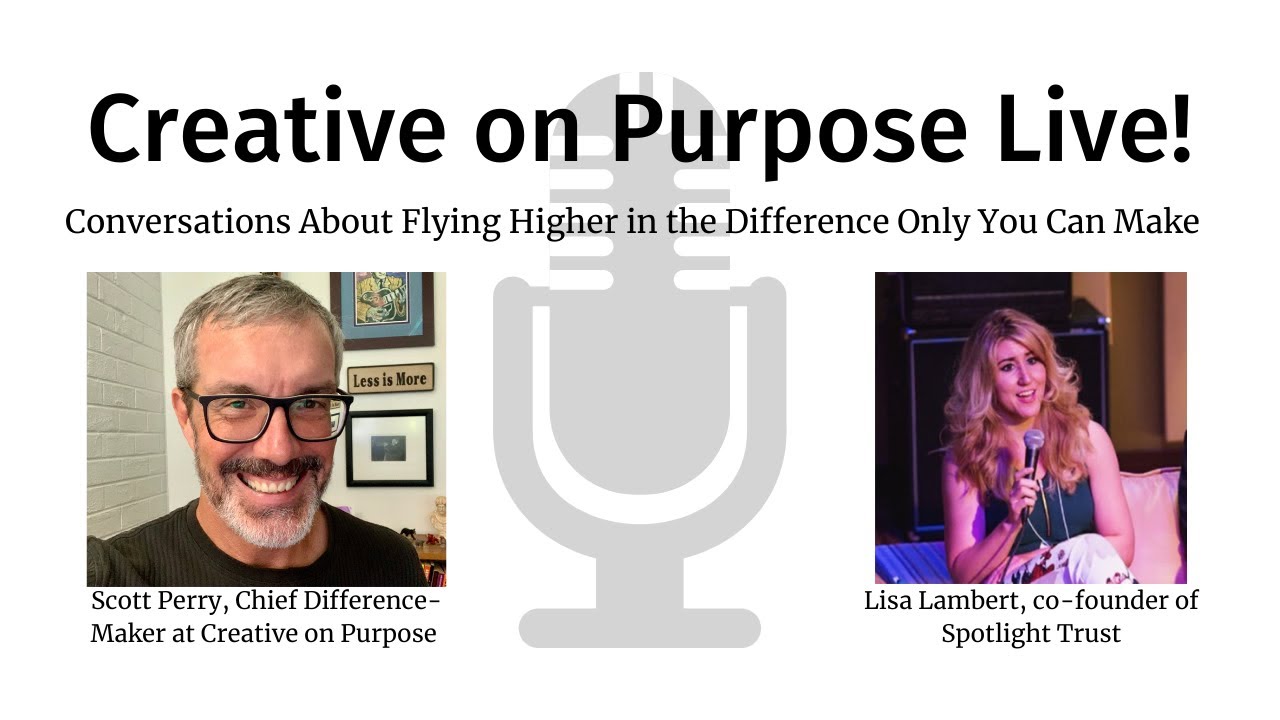
Lisa Lambert, who runs Spotlight Trust and Rule Number 6, talks about integrating work and life instead of balancing them, and why trust is both noun and verb: confidence plus vulnerability plus risk. She treats trust like a plant that needs constant care, especially in remote work, and says the first move for any change-maker is to earn trust first.
Chapters
Across the ether at the speed of bytes. StreamYard says that we're live and I just checked my pulse and it's there. So I think we're probably live. So welcome everyone to Creative on Purpose Live. To learn more about Creative on Purpose, please visit creativeonpurpose.com and get going with the difference only you can make. Please remember that this broadcast is also an iTunes podcast. Check it out and leave a 5-star review. 30 seconds of your generosity really helps spread the goodness. Delivered by my guests. Speaking of guests, let's get on with today's show. Welcome to Creative on Purpose Live. These conversations are about flying higher and the difference only you can make. Endeavor better. It's time to be creative on purpose. Are you ready? Let's go. I'm your host, Scott Perry, author of Onward and Difference Maker Coach at Creative on Purpose. Go to visit creativeonpurpose.com to start doing better work by By making better decisions. This season, we are drawing insight and inspiration from guests who are successfully embracing uncertainty, navigating adversity, and making things better, doing work that matters. Let's meet today's guest, Lisa Lambert. Welcome to the broadcast. Please tell our viewers who you are, what you're up to these days, and where can people go to learn more about you and your work?
Thanks so much for having me here, Scott. I'm glad we didn't disappear as we got this show on the road here.
I haven't lost a guest yet.
This is good. Let's keep this track record going. I think it's a solid one to continue going forward. My name is Lisa. I'm in North Vancouver, Canada, but with the interwebs, I get to plug in almost anywhere, which is pretty magical. And these days, who I am is probably a facilitator, and in the words, or in the sense of facilitating to make easy, easier, or to render less difficult. And I do that in a number of different ways. One of the main ways I do that is over at Spotlight Trust in collaboration with Rick Kitagawa, who I believe you're chatting with next week, which I will be eager to tune into. And we help leaders and organizations build what we think is the most valuable asset today, and that's trust. So we bring a practical approach in working with them and helping them really kind of facilitate their journey going forward. And my background is also in science, technology, and innovation. And I just can't shake that world. It is so much fun. So I, over in my own private practice at Rule No. 6, RuleNumber6.ca. I work with science, technology innovation teams, which their work is really a team sport. But we are seldom really kind of learn how to collaborate or be cohesive or get clarity or communicate together. So I really work with those science technology teams who are working on transforming the world and helping them in that process. And again, facilitating that and making that a little bit easier or less difficult for them.
Yeah, and Probably should also mention that you and I connected initially through the coaching work that you and I both do for Akimbo Workshops and the altMBA, which of course is now an independent B Corp, but often associated with Seth Godin. And so you're busy. You got lots of things going on.
It's, it's a lot of fun. And I get to work with some magical people like you over in Akimbo and in other spaces. So it's, it really is an energizing Everything I get to do really energizes me more than takes energy from me.
I love that insight right there. So let's just dive in at that point because yes, you and I are doing a lot of different things. It, it would seem, um, you have Spotlight Trust and Rule Number 6 and your work in the Kimbo Workshops and Alts MBA. How do you, how do you incorporate, how do you get to the point where you feel like you're an integrated full, complete human being when you are seemingly in so many different places throughout the course of your day?
That's a really great question. I want to hear how you do this too, too, Scott. I think there's different projects that I do, but I look at really what lights me up in the work that I've done. And I've, I think over time, I've been able to figure that out a little bit more. But realizing that when I'm lit up, I'm a lot better at lighting other people up. As well. So that to me is kind of a guiding light, so to say, without taking the light metaphor too far. And but that's helped me kind of figure that out. And again, there's a lot of relationships between the different things that I do. And if you want to give it kind of different roles, I do, whether it's as a consultant or a coach or a teacher or facilitator running workshops, a lot of that stuff is kind of a similar flavor. And then I get to come in and just show up as me. And who I am and bring my experience to it. But I get to collaborate with other people who bring that themselves, and we enrich one another in that sort of work. I'm flipping that question on you because I want to hear.
Well, I want to just reflect back on yours for a second. Because I love this idea. Because I pay attention to, to the very same thing. It's like, if I feel myself consistently, persistently over time feeling exhausted, I'm doing something wrong, or I'm doing the wrong thing. And what I find is in all the various places that I show up in my day, uh, I just keep getting more and more energized and excited. So it feels like I'm doing, um, you know, doing the right thing whenever, whatever I happen to find myself doing. You and I had a discussion on your podcast with Rick, um, where, you know, I talked about something I wrote about in Onward, which is this idea of just being integrated. Like, yeah, when I was approaching every place I show up as a different bucket that I had to make sure didn't get filled too much or too little, it was really exhausting because I couldn't possibly, you know, fulfill my role as husband and father and coach for Akimbo and coach at Creative on Purpose and have all those things equal all the time. So I decided that instead of paying attention to where I was showing up. I would just pay attention to who I was showing up as, which is the best Scott Perry I can be right now, and do work with and for the right people. And that will help me become a better version of me while I'm helping them get from where they are to where they want to be.
I love that view of it. And I also, I love that perspective, that word integrated as well, because I think it challenges a word that we hear a lot and people strive for, and I don't I don't know if it's necessarily helpful or realistic, and that's the one balance. We're always kind of seeking this work-life balance. And I don't want to be on a teeter-totter forever. They're fun for a moment, but it's also binary to look at that teeter-totter view of it. And someone shared with me a few years ago, and it was something that really stuck when I was kind of struggling with that integration piece. And they said, what if you looked at it like a symphony and you strive for harmony instead? So everyone's working off the same, performs the same piece of music to begin with, but there's a time where the trumpet section needs to be a little bit louder. And here's where the strings are gonna shine. And here's, you know what, clarinets, go for it. This is your space. And that visual for me helped me understand a little bit more and get more clarity around integration, what I was striving for, and helped me kind of ground myself in how I wanted to show up and have that integrity in who I am and who I am when I'm interacting and working with others, which is the biggest part of my work too.
Yeah. Well, and the word integrity, very much a part of that integrated, uh, you know, so just knowing who you are and who you, who, who you're, who you're here for and what, what you're here to do. Um, super, super helpful. You, one of the things that we also talked about on your broadcast that I'd love to just unpack a little bit more from your perspective is Your endeavor with Rick is called Spotlight Trust. And I love the branding and I love the, I think the promise is right there in the branding, but, you know, trust is a many-splendored thing and it's something that, you know, it's a term we all use all the time and, but what does it really mean? So what is trust? What is trust? What does it mean to you and how does it apply to the work that you and Rick are doing?
Yeah, that's a really great question. I think a really important one for us to ask. I just want to say too, that conversation that we had, and I hope people will go check it out because you just had so many insights that I keep learning and reflecting on whenever I listen to it. But I think trust, and that's what we really focus on, Rick and I, trust is at the core of everything that we do. We all have experience with trust, but we don't often think about it. And it's interesting when you start to think about trust and what it actually is. So trust, in our lens, how Rick and I look at it, trust is a noun and a verb. And I think a lot of times we think maybe more about the noun than the verb. And how do we go about building, earning, strengthening, and sometimes even restoring trust? And we kind of look at trust as maybe having different properties, different ways of looking at it. So, you know, why is trust kind of tricky? Sometimes. And I think trust involves a placement of confidence combined with a willingness to be vulnerable and engage in something that we don't necessarily know. So there's that piece of unknown or uncertainty in it as well. And trust also involves taking a risk and then choosing to dance with that unknown or that uncertainty with a hope or a belief that you're going to be better for it. But that positive outcome isn't guaranteed. And that's why it's trust and not a sure thing.
Love that. Referencing the work that you and I do together at Akimbo, Seth, one of his favorite things to say is trust the process. And one of the things that, that I've learned is you can't trust the process until you trust yourself. And trust is a skill. That you earn by doing it before you can actually do it. Like, you have to, you have to act as though you trust yourself before you actually start trusting yourself. You have to act like you trust the process before you actually have that. But I love the, the, the image that you used of, um, confidence and resilience. But it's because, again, you You earn confidence by doing things that require you to practice, you know, resilience. And resilience requires the vulnerability that, you know, things might not work the way that you intend them to.
You— Can I just jump in for a second on it? Because what you're saying, I think, is an insight that's often missed, and it's really subtle, but it's super profound and really propelling in a lot of ways too, that I think a lot of times we think of trust as something outside of us, or we're waiting for trust to come and be in place. But oftentimes the fastest way to earn trust, whether it's with ourselves or with others, is to take action and to extend it first. So to step into that possibility, to step in that vulnerability, um, and missing that, that piece, especially with ourselves, but also with other folks, um, you can sit down and wait around forever and miss out on all that opportunity that's there.
Yeah. Well, and it reminds me of You know, we, I have conversations quite frequently. My brand is Creative On Purpose. So people are often like, well, where, where do I find my purpose? And it's like, well, actually, I just, like you were saying, trust is not a destination. It doesn't reside somewhere and you have to go discover it and find it. Purpose is not a destination. I know lots of people that think that purpose is going to be in important work, like being a doctor or a first responder or a lawyer or what have you. And then they they invest all that sunk cost in being able to do that work, only to find that it doesn't light them up, it doesn't fuel them, it doesn't energize them. Purpose and passion are things that you find by acting purposefully and passion— passionately about whatever it is that you're doing. You can be purposeful and passionate about cutting the lawn or doing the dishes or taking out the trash, and you will cultivate purposefulness and passion that you can then treat as a renewable resource that you just keep putting in. And I see that in what you're just saying about trust. When you act trustworthy, then you create a renewable resource as opposed to the finite resource. You know, if you, if you think of trust, purpose, or passion is this thing that you have to find and then exploit.
Yeah.
At some point you will deplete it and there will be none left. And that's a really dangerous approach because if you rely on passion to get you through things that are hard, you'll run out of passion before you get through hard things.
I think I love how you're phrasing this and how you're saying this. Because I think ultimately, when I look at this and look at that relationship between trust and passion, they're coupled together— or sorry, trust and purpose, they're coupled together. That having that purpose, having that clarity, having that focus, you know what your North Star is. But without that trust to go hand in hand with, with your purpose, you're going to fall short of your aim.
Yeah. Or perhaps end up somewhere different than what you were aiming for. But if you do it with the integrity that we were talking about earlier, you'll end up somewhere great, especially if you're surrounding yourself with the right people. What's the biggest challenge for you and for your clients in, in the work that you're doing at Spotlight Trust? What's, what's the hard part that you're, you're really helping people with?
I, there's a few bits of it. Maybe I'll kind of go to kind of the height of the I'll go upstream a little bit first with this one, is that I think it's really hard for any of us to admit we have trust issues. It's a scary thing to do, or to even talk to someone, someone kind of poking around saying like, hey, you know, might there be trust issues here? And I think, I mean, that's one way to lens it as well. But I think you can never have too much trust in a lot of ways. And there's a lot of times where we overestimate our trustworthiness as well. And going back to that bit of a resource and to make it a generative thing, it's something we have to continuously build. You can't just go and flip a switch when you need trust, like a light switch and say trust engaged, it's not going to be there when you need it most. How we look at trust, Rick and I, is looking at trust as a plant. And sometimes it's a little seedling that you've got to nurture and cultivate, and sometimes it's a perennial, and that needs to be tended to and watered and cared for as well. So part of what we're doing is actually just kind of framing that conversation about why trust and why it matters that way. But I think, I mean, 2020, the year we're coming out of, has been a really interesting place where I think that spotlight has really been on trust. And not just because we've been working in that space, but I think looking where a lot of people have had to very, very quickly shift to collaborating at a distance, and where things have been changing so quickly. A lot of times trust gives you that leverage for difference-making that can happen. But I also think there's a shift going on in the workplace. And we've been working with a lot of teams and leaders around this, that work isn't transactional. Work is relational. And relationships are all about trust. Trust is the glue, the lubricant, and the accelerant for us collaborating together, us working together, us having a sense of community, a sense of belonging, a sense of cohesiveness, and a sense of alignment. So we've been working with with teams and organizations, bringing them into what the future is and this trust-centered approach to how they can go about their connection, their collaboration, their culture and their work.
Yeah.
Yeah.
It's, there's been so many opportunities in the moment that we've been experiencing for, you know, since March of 2020. And I'm hopeful that all these powerful lessons that many of us have learned will extend and continue when things go back to normal, whatever normal ends up looking like. But you mentioned belonging, for instance, and it's like one of the, you know, in, in the time of social distancing and dis— and sheltering in place and disconnection, we, we like suddenly we're reminded, oh, we really need connection. And that connection and communication and collaboration, you know, fulfills this basic human need for belonging. And we spend about half of our waking life at work. Why would we not bake that into the place, uh, you know, where we're spending most of our time? It's, it's really Powerful. I really appreciate that perspective. You and I do hard things, and we do work that requires us to embrace uncertainty because there are no certain outcomes and there's, there's no absolutes. And, and when you're trying to level up in your endeavor, you have to reach for the edges of your understanding and ability. Turns out, in my experience, and I'm interested in yours, mistakes happen along the way. And so I'm wondering if there's a moment, a mistake, or, you know, what seemed at least to be a mistake at the moment, a failure, however you want to frame it. But what's a moment of making a mistake or experiencing a failure that was really impactful for helping you grow and develop while still being willing to lean into hard things and challenges and do the difficult work of making change happen?
I've had a lot of good mistakes along the way. I'm I'm trying to think of a— I mean, there's a lot of them to share. I think one that's maybe coming to mind was, so before leaping out on my own with my own work at Rule No. 6 and later syncing up with Rick on Spotlights Trust, I worked in the corporate world for a while in leadership positions, mostly in science, technology, innovation space, and working on special projects or endeavors that were really about, about change, about transformation, which is a tough, tough thing to do in organizational cultures. And something I'm grateful I get to help out with now. But it was a space too where I was young at the time as well. I was one of the youngest people in a leadership position. I think the youngest person on the leadership team at the organization. And I was one of the very few women. In that space. And I was one of the only ones who wasn't a professional engineer, or a PhD, or someone with a whole bunch of credentials after my name. And coming into this place, and I was kind of used to joke around that I was the misfit in that place as well, with what my mandate was with my team, was looking across the organization and our community, instead of looking into verticals, verticals, kind of like, here's what our silo is doing. So I was always coming at things with a bit of a different perspective. And I think early on in that, I let some of the frustration— or I think I know I let some of the frustration get to me and some of the pressure in that too. We were moving so quickly, what we were doing. And I had this view that to show up as the leader, I had to have armor on. I had to be strong and mighty. So I had this big shield, um, up to try and help me go through. And I carried that armor and that shield for a really long time. Where I was too tired to kind of keep carrying it. And I was really grateful to have a friend, a mentor, colleague, a coach of mine say, what would it look like if you put the armor down? How might things be different if you let people see you as a human coming to this and let people see you as a human trying to be the voice of the other humans that are doing this kind of work and that you're seeking to serve. Um, and that was really, really, really scary to think about because I'd been— I was white-knuckled clutching onto my shield and my armor. Um, but you know, my legs were shaking, I was so tired at this point and exhausted. And it took a lot for me to just put that down and be willing to act as if for even a moment. Um, and I remember the relief when I did. It was really scary at the same time, but the sense of relief that came into me and the sense of, oh my goodness, why did I not do this so much sooner? Um, because I think there was a view that I thought I was serving people better by, you know, having the front line and the guard up. Um, and realizing I was way more agile, I was way more nimble, and I actually had the space where I could connect with people, um, when I didn't have this armor as a barrier. Between us.
Yeah, it's interesting. We, we often think, um, that confidence comes from knowing the answers, as opposed to, um, confidence being our ability to, to not know, you know, our capacity to, to not know the answers and do things anyways. Um, really, really powerful. And so one of the things that I was hearing in response is, you know, you had a habit, a way of thinking that you needed to change. And in order to stay on track and continue to grow and develop in our craft, you know, you, you with Spotlight Trust and Rule Number 6, me with Creative on Purpose, you know, I think it's important to always be kind of taking a look at what are my current routines and relationships and where do I need to make some adjustments? Where do I need to make new connections? What connections do I need to, you know, distance myself or stop? And what are the new habits that I need to focus on that will help me get to the next level? So as Marshall Goldsmith says, what got you here won't get you there. And I'm fond of Saying that in more extended form, what got you where you are won't get you where you want to go. So I'm just curious about what are the routines and relationships that you lean on now to keep you on track and leveling up and the work that you're doing at Spotlight Trust and Rule Number 6?
I think it's such an important area to look at. I'm grateful for this question. It's a good one. I think the first thing is mindset. That comes into it. So I— and I want to bring it back to our conversation on purpose a little bit— is, um, I think a lot of times we fall in love with our routines or our habits because they're comfortable and we're used to them. I have my routines, I enjoy them. Um, but from the— what got us here isn't going to get us there. It's not our routines that are going to necessarily bring us forward, or falling in love with those. I think what we need to fall in love with again is our purpose and our aim. And The world is changing all the time. We're changing all the time too. But just having that said, that, you know, our commitment isn't to our strategy or our tactics or our habits, our routines. It's to our purpose. So as we're looking forward, what do I need to do to succeed in my purpose? And maybe it's bringing some things forward with us through that portal, um, but maybe it's letting go of some things too, or trying other things out. So just having that reminder and that mindset for me in a lot of ways makes it easier for me to let go of some, some habits. But also, I hate this expression, and I— if someone has a suggestion for another one, I would really appreciate it— um, not throw the baby out with the bathwater on what we're doing too. Because I think sometimes we get, you know, everything needs to change, and we get so, um, enchanted, enamored with kind of like this decluttering view that not everything necessarily has to go. And looking at where our strengths are, where the beauty is, where those lessons are, and bringing those forward with us as well. And I think other, like, with mindset, I think reflection is really important. I love this quote from John Dewey, and Rick, if he's listening, is going to laugh at this, but we don't learn from our experiences, we learn from reflecting on our experiences. Yeah. So that's something I have a practice where every day I do a little bit of reflection and then kind of do a little bit more on a weekly basis. It doesn't take too long at all. And then a monthly and a quarterly basis. To kind of assess and see where things are going. And sometimes my goals may shift within that too, and that's okay, but it's making that shift happen with intention.
Yeah, well, and you said earlier in the conversation the— about the importance of action. Like, change happens because we do things, not because we think about things. And we also have to bake in that time for reflection, for thinking about— like, you can't One of the things that, um, is written into the closing chapters of Onward is this idea of stillness in motion. Like, the, the, the real magic is when you can be in motion and still cultivate that sense of stillness where you can zoom out and pull away from your situation and see it like from above, so that you are— while you're in the act, in action mode, you're actually also in reflection mode. And what you said is essential to that as well. It's like you have to know who you are and where you're going. What's, you know, what is your purpose? What is your intention? What is your aim? I really love that. Well, we're coming close to the end of our, of our half hour together, Lisa. I had this question that I always leave for the very end, and I'm really curious to hear your response to it. That people that are tuning into this broadcast are, by definition, difference makers, or people that are either aspiring to or advancing in the change that only they can make. And so for you, who have been a change agent for some time, I would love for you to share just one tip or piece of advice for people that want to be more like you in terms of moving forward with the change that you seek to make, what would that piece of advice or that tip be?
I'll— this is a work in progress for me, and it's always— this is a journey, it's not a destination for everyone. So I'm going to quote our good friend, our mentor, our teacher Seth Godin. This is where he said, earn trust, earn trust, earn trust. Then you can worry about the rest.
Yeah, love it. As soon as you trust yourself, you will know how to live. Um, fantastic, Lisa. Thank you so much. That's a great place for us to start to put a bow on this thing. So want to thank everybody for tuning in. Lisa and I really appreciate the gift of your time and attention, and we hope that today's broadcast inspires you to and motivates you to lean into the, an endeavor and make the change that only you're able to make, and to do it with a little bit more curiosity. Authenticity and Courage. You can learn more about Lisa and the fantastic work she's doing by going to spotlighttrust.com or rulenumber6.com. Is that—
.ca and all spelled out.
Very good. And then, of course, it's always great to see you at Creative on Purpose as well. So we hope now that you'll take this, some of the insight and inspiration from this conversation and start flying higher and the difference only you can make. Lisa Lambert, thanks so much for the gift of your time and attention and all the wisdom you shared with us today.
Thanks, Scott. It's always a treat to get to chat with you.
More from Scott



Stoics Don't Suppress Emotions, They Do This Instead #stoicism #emotionalintelligence #mindset







