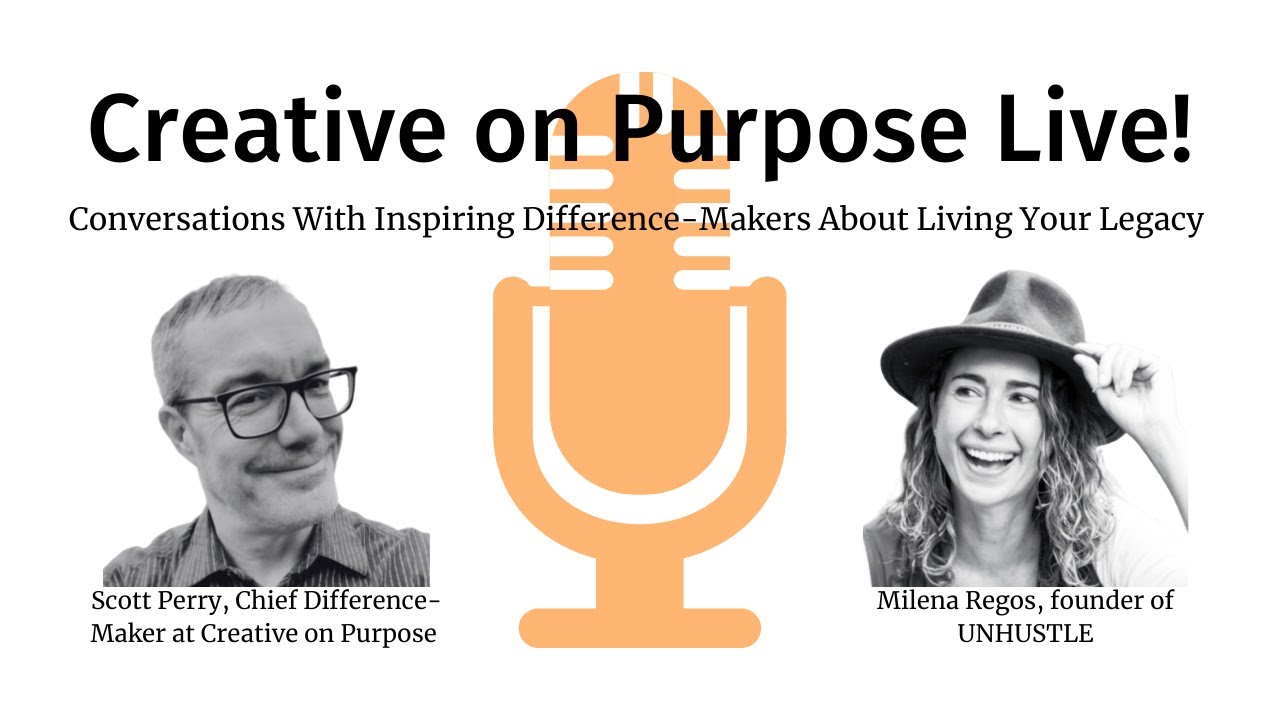
Milena Regos left a 17-year marketing career after burning out, then founded Unhustle to challenge hustle culture. She uses Richard Leider's research and the ikigai framework to help people find purpose through flow and well-being instead of grinding. Her advice: solitude, nature, movement, and meditation to align work with what only you can do.
Chapters
Fasten your seatbelts, we are zipping across the ether at the speed of bytes, and just like that, here we are. Welcome to Creative on Purpose Live, insightful conversations with inspiring difference makers to inform your quest to live your legacy and endeavors that matter. I'm your host, Scott Perry, Chief Difference Maker at Creative on Purpose. If you're ready to fly higher in the difference only you can make, visit creativeonpurpose.com and sign up for our newsletter. Get insight and inspiration delivered to your inbox 3 times every week and a free copy of Trust Yourself, a simple 3-step decision-making guide to get unstuck and going. Let's meet today's guest, Milena Regos. Welcome to the broadcast. Please, excuse me, please tell our viewers who you are, what you're up to these days, and where can people go to learn more about you and the difference that you're making.
Thank you for having me, Scott. I am Milena Regos, an ex-marketer who decided to step into my purpose and start Unhustle, basically trying to disrupt the way we work, live, and play and inspire people to create sustainable live-work-play design and replace hustle culture with human culture. And you can find more about me at unhustle.com.
Love it. I am always really interested in people's origin story, but I know that you probably have not been doing this all of your life. You mentioned that you were a marketer. I can't remember if you said reformed or recovering, but whatever it was, I would love to know a little bit about your journey. How did you go from your role as a marketer and into developing your own brand and stepping into leadership through UnHustled?
Yeah. How much time do you have?
We have 24 minutes.
24 minutes left. Well, I, Originally from Bulgaria, came to the US to pursue the American dream and, uh, did an international marketing MBA in San Diego. Went down the marketing career path for about 17 years. First worked for a media company during the— when online marketing was really kicking off. Um, so that I did that for about 5 years, started their internet division back before dot-com. Really. Then I transitioned over to being a marketing director for Incline Village, for the whole community of Incline Village. I did that for 10 years. I got paid to ski and do marketing, which was on my bucket list of jobs to do. And then I started my own marketing agency, which was doing great. Social media was taking off. I built a little team. We had phenomenal clients. We worked with some celebrities, and I ended up working all the time. Which we know— I know now because of all the research I've been doing— is not the right approach. So whether I was burned out or not, I can't tell you. But, um, eventually I decided to take a little break. I hadn't taken a vacation in 3 years. Went down to Baja for a 10-day trip, which turned out to be a digital detox by design, not by default, and realized that there's more to life than working. And, um, eventually after a lot of homework and exercises and practices, I really wanted to drill down into what is my purpose, or what does life really want out of me instead of what do I want out of life. And so that led me to Unhustle, because I think hustle is the absolute wrong advice to be given to entrepreneurs and leaders. And the way we're working isn't working. Now we know it with the pandemic. Back then we didn't. So in 2018, I started on Hustle.
That is really, really, really interesting. Love the, the, the globetrotting nature of your journey as well. That's exciting. So that, that's on my bucket list is to live the digital nomad life that I finally set myself up to be able to live, but we're in pandemic and I can't go anywhere.
I'm actually moving to Baja at the end of the month. So I'm actually really stepping into my purpose because that was the original idea 9 years ago. When no one, very few people are working remotely, right? And it's not just about working remotely, Scott, as you know, living your purpose is being really in alignment with what you believe in. And I'm finally stepping into that completely. Not that Tahoe is that bad.
But yeah, no, Tahoe sounds pretty nice too. I, you know, as someone who is Chief Difference Maker at a brand that has purpose baked into it, Creative on Purpose. I'm always eager to hear how other entrepreneurs and freelancers and difference makers frame what purpose is. And the, the interesting conversation for me is always around where, you know, what is purpose? And where does purpose come from? And I wonder if you have any reflections on either or both of those things.
You know, I'm going to tell you a story. I did a— I had a great person to interview on this topic. And I don't know if you know Richard Leider.
I don't think so.
He's been studying purpose for 40 years, started back with Viktor Frankl and decided that he was going to make purpose his mission in life and help other people find purpose in life. So he's been doing it for 40 years. And I had a fascinating conversation with him because I was really tiptoeing around, is this really my purpose? Right? And basically he used to go to these safaris in Africa and would go out with the tribesmen and sit down under a big tree and have these conversations. And the elder of the tribe would ask him, Richard, do you know the two most important days in your life? And, um, he would say, of course, you know, the day you are born and the day you die. And the elder would say, well, the day you're born is true. In their tribe, they would hold off on naming their people until they know what their purpose is. So imagine, you know, your name being Love. Or joy or compassion or un-hustle or creative on purpose, right? And then he said, but the second next, next important day in your life is really the day you find out why you were born, right? Now, purpose, I look at as being fundamental to your well-being. Anyone can step into purpose. And it doesn't have to be that big of a thing. You know, my husband's purpose right now is to make sure, you know, we have a roof over our head while I'm building a business, right? So I think people, when people think about purpose, they think of like this big, big mission in life. But I think it could be something a lot smaller. And I'd love to hear your thoughts about it.
Well, I love, I love that framing, because it does align with the way that I think about it. You know, I, I have been, uh, investigating and exploring what purposes and what my purpose is really since I was very young. I mean, I remember having conversations at 9 years old that were about, you know, what, what am I here to do? And one of the things, one of the, the epiphanies I had was, you know, I was wrestling with Simon Sinek's work, and I think it's brilliant, and I think he has, you know, done much to bring the purpose conversation into the popular culture. But I really, really disagree with some of the, the, um, the assumptions that he's landed on around your purpose is defined by the time you're 21 years old, and that's your purpose forever. And you only, you know, and I just never really resonated with that idea. As you were saying, you know, your husband has a purpose now that will probably, is probably very different than it was before he met you and will be different again when you are, you know, a thriving enterprise. So I think that, you know, for me, it's about, well, is the way I look at it is this. In the United States, at least, the purpose conversation It happens one of two ways. The first is your purpose is inside you, find your purpose, and when you find your purpose, you need to live your purpose. And then the other conversation is your purpose is out there, you need to go find your purpose, and when you find your purpose, go live it. And that's all well and good, except that 80% of the people that are polled about purpose cannot identify a purpose. So what you've just done is shamed 80% of the population. You know, into feeling like they are deficient because they have, despite their searching within or without, they've not been able to find it. And so for me, purpose is a naturally occurring resource that comes from doing the work right in front of you purposefully, engaging in the conversation that you're in right now purposefully, with intention, with integrity. And when you do that, you are creating what I think of as a renewable resource, something that is defined and refined as you continue to lean into whatever it is that you're doing with purpose, with passion, and with all the things that we should be doing.
That's beautiful, Scott Perry. So I've been leaning more into the ikigai concept of purpose. I just wrote an article about it. I'm looking at the little drawing that I made. I'd love to drop that in LinkedIn, but I'm trying not to get distracted. But it's basically there for questions. It's like, what do you love to do? Right? What are you good at doing? What does the world need? And what can you get paid for? And the middle of that, the intersections of all these 4 questions can be your purpose, which is a very simpler way of identifying your purpose.
Yeah, I have a Venn diagram that I came up with on my own, which I which I created before I learned about ikigai, um, that I'm often accused of stealing from, um, from ikigai.
Interesting. Yeah.
Um, mine only has 3 parts. Who are you? What are you good at? And where do you belong? Who are you is what are your values and guiding principles? What are you good at? Are your soft skills, your human skills, your hard skills, the things you learned on the job and at school? And what are your talents, your innate inherent skills. And then where you belong is with people who share your values and need your talents to enhance their lives. And if you think of those as 3 overlaying circles, in the center of that is where you can begin to find what I call the difference only you can make, which you could also call purpose, which you could also call passion, which you could also call vocation or many other things. And I love that idea. And I get the ikigai as well.
Yeah, yeah, that's beautiful. I guess my question to you, since you study so much about purpose, right, is why aren't our kids in school taught, trained, educated more on finding their purpose? Instead, you know, they ask them like, what do you want to do?
I wish we asked our kids what they want to do. I I mean, you're flipping this interview around now.
I feel like I'm the one— I'm sorry, I'll shut up.
I'm always happy to weigh in, you know. Uh, you know, I don't think that it's a conspiracy, but I do think that the educational occupational industrial complex leverages the darker side of human nature. Human beings love the status quo. We love to know where we stand and what's expected. And human beings love to explore, are inherently curious and creative creatures who love to explore the edges of their understanding and ability. School and occupation really leans into the, our, our desire to, to know where we stand and what's expected. And so what they actually do is we don't have the conversation of like you said, we don't have a conversation about purpose with our young people. We say, here's what you need to learn. Here's the boxes to check. And if you do that well, then we'll reward you with sending you to another institution where you can check some boxes. And if you do that well, we'll put you in a cubicle somewhere where you can check the boxes again. And that's, and that's what your purpose is. Live, live a life of checking boxes and collecting rewards.
And I think that is Yeah, factory workers. Yep.
And instead, what we should be doing is saying, is really just what you were talking about with the, the, is it Richard Leiter?
Leiter, yeah.
Leiter. You know, what the tribe said, like, hey, let's put you in a situation where you can, you know, explore and, and find, build and, and define your identity. And then when you do, we'll give you a name and encourage and support you to live into that purpose. I think that would be a beautiful way to reimagine education.
Let's do it.
All right, let's go. This interview is over. Melaina and I are getting to work. I want to lean into a little bit about something else that you said that really resonates with me. And well, I love your brand. I think one of the things that, you know, I, I've, I've, you know, watched the videos and I've read the book and, you know, Gary Vee, and I get it, you know, hustle and grind and grit and all this kind of, all this kind of talk. And as someone who has been accused of being productive and hardworking. Um, I really appreciate the value of doing things, doing the essential things effortlessly and living, um, living an integrated life where you have meaningful work and you have meaningful recreation, pleasure, Periods of rest and rejuvenation. The, the, you know, I'm just curious about, you know, with Unhustle, is it a response to any particular paradigm or philosophy, or is it just something that you arrived at through your own experience of, of being a little bit too overproductive, um, and a little bit too hustle and grind yourself? Um, and what, what are the virtues of the Unhustle lifestyle?
It was born out of personal experience. Yeah, but, um, I, I'm a firm believer in hard work. I just think there is a tendency to overwork, which leads to negative results and impact on your health, well-being, and business results, right? And I saw it personally. And, um, whether it's an anti-Gary Vee thing, which people, some people tell me it is. Um, going back to your Simon Sinek story, I mean, I was trying to come up with the idea and how do I frame this in my head and actually ended up watching his video and I was like, unhustle is what we need to do. We need to go that direction. I didn't know the research and stats and the data that I know now back then, but when I started really digging into it, There's so many studies in science and experiments and 4-day work weeks and all these, uh, companies and people realizing that if we work with— if we increase our focus, increase our flow, get better with our priorities— I look at flow as, as the opposite of hustle. Um, but in order to be in flow, you have to feel good. You have to, you know, in order to perform better, you can't be sleep deprived and you can't be stressed out. Um, a lot of what I did was with the Human Potential Coaching Institute, which got me into a mindfulness-based stress reduction program. So I'm implementing science of wellbeing into the principles of Unhustle, science of flow, science of mindfulness, packaging it all together. Some of the outcomes of living an unhustled life is that you can create sustainable live, work, and play where you can get your most impactful work done and make the difference in the world you want to make, still have a life, and fix your playtime, which I realize is also broken. Our leisure time is broken, which is why we end up working extra hours and playing less, because our flow time in work is actually higher than in playtime. So as adults, if we spend more time playing will increase our flow at work too, which I find extremely interesting.
Yeah. Though you've, you've used this word a couple times now, I just want to shine a light on it and highlight it because I think it's so important. You've used the word sustainable, and that is so important. Hustle and grind is not sustainable. You cannot do that forever. At some point, you, you can only give and give and give so much before you just finally give out. And whether you call that burnout or anything else, really doesn't matter. You, you have a finite amount of energy, um, that you can expend, finite amount of time and attention that you can spend on anything. You also said something that reminded me, um, you know, when you're talking about flow, to me that sounds like a renewing process when, when, when you are doing, um, what is essential and doing it as effortlessly as possible. You are building in that sustainability and creating a renewing resource where you're simultaneously filling your tank while you're putting your effort into your work. And that's the final thing that I heard in what you were just saying is, and this is something that we really lean into at Creative Our Purposes, the results and the outcomes are really not yours. I mean, you may or may not get them, but you can't absolutely control whether or not— no amount of grind or hustle is going to guarantee you any kind of results. There are forces beyond your control. And at the same time, what's always at your disposal is the integrity and the intention, the quality of your effort. And that can be the reward. And for those that have experienced, you know, being in flow, We all would love to experience that all day, every day, because it is its own reward.
And what I'll say is, look at how many people are hustling but not being successful, right? So clearly hustle alone won't get you to success. There's a lot more components involved. And then look at somebody really successful, like let's say Richard Branson, who starts his day with, you know, kite surfing or a tennis session, spends plenty of time with his family and runs plenty of businesses. Yeah, right. So most successful people don't hustle. They're just a lot better at picking the— choosing the priorities, to your point, what's essential, and then figuring out how to use their energy instead of their time better.
Yeah, I really love that, and it's a, it's a really great point. You know what it You, I think you used the phrase, you know, leading a good life or leading the good life or however it was that you phrased it. And I think that I'm just curious about this before we get to our final question. You know, one of the things that I'm sure your research has borne out is that we get the most fulfillment and forge the most meaning and find the most purpose in work that is done within, for other people, when we are doing work that is in service, enhancing the lives of others, enhancing our own lives through work that elevates others. What, what, if any, piece of that do you feel like is part of the UnHustle?
Yeah, you're extremely on point with that. I mean, when I was doing social media marketing, you know, I worked in health and wellness, industry, still very great products and marketings and services to put out there into the world. But I get a lot more fulfillment at the moment from people saying this concept really resonates with us. We know instinctively is the right way to go about it, fitting your work into your life instead of your life into your work, right? And so I get a lot more fulfillment and gratitude on a day-to-day basis, getting all these messages from people saying This is incredible how you redefine your success, how you incorporate more well-being into your workday, how you prevent burnout. I mean, all these things. I just spoke, I was a mentor for Techstars yesterday and mentored like 12 startup founders, and 2 of them were completely burned out. And you can't build a business when you're burned out. You know that your creativity is is done, and you're better off getting a 9-to-5 job. So what I'm currently doing is a lot more impactful, and that really resonates with me and puts a smile on my face. So I do believe— I'm very happy that I was able to find my purpose.
Yeah, yeah, I love that. So, Milena, what we do for the last question of the interview is, and you've already shared plenty of insight and inspiration for how someone can kind of begin to step into their potential and the difference only they can make. But if there was just one final tip, quote, exercise, piece of advice that you had for someone that, like you, would like to, um, do work, uh, live in more alignment with their purpose and, and do work that is more purposeful, what would you tell them?
Connect more with your heart and your soul and your body intelligence, as opposed to spending all this time in just in your head. You know, and we do that by taking time to be alone, spending time in nature, moving, journaling, meditating, you know, whatever it is. Just take— we're overwhelmed with information, and you can't come up with good ideas when you're constantly bombarded with information that half of it's not even relevant. So just take some time to breathe and just listen to what your heart wants to do.
Love it, love it, love it, love it. All right, folks, thanks very much for tuning in. Milena and I really appreciate you lending us some of your valuable time and attention. We hope today's broadcast motivates you to take a bolder step into your potential and possibility, living your legacy. You can learn more about Milena and the difference that she's making right over here at unhustle.com. And of course, it's always great to see you at creativeonpurpose.com as well. If you're listening to this as a podcast, please consider leaving us a 5-star review. And now take the insight and inspiration from this conversation and fly higher in the difference only you can make. Milena Riegos, thank you so much for sharing your wisdom and insight with us today.
Thank you so much for having me today, Scott Perry.
More from Scott



Stoics Don't Suppress Emotions, They Do This Instead #stoicism #emotionalintelligence #mindset







